Feeds:
Posts
Comments

Archive for the ‘poetry’ Category

 . 
[with 3 poems by Michael Gaspeny]
 . 
Dr. Petway is Retiring, 1962
 . 
My husband’s such a ball of pep,
if I shot him, he’d pluck out the bullet, eat it,
slap Old Spice on the hole in his chin,
leave for work whistling.
 . 
My boys will follow their fishing rods
to the rock-and-roll backseats of panting cars
and into sleepwalking marriage.
Fritz the dachshund lies in his basket licking
his parts. Hear his slurping all over the house.
If only I’d had one daughter.
 . 
How do you tell love from guilt?
How real is your love when you can’t trust yourself?
Lie around so much, I should be upholstered.
My life’s a song: “Smoke, Smoke, Smoke That Cigarette.”
 . 
What do you do when you can’t buy a dream?
If I drift in my nighty through Fantasy Park,
Cary Grant hides in the bushes.
When I close my eyes, the curtains rise,
but the film splits. I wait in the dark, clutching
my ticket. What good is it?
 . 
Dr. Petway listens. He doesn’t tell me
to count my blessings, polish the silverware.
He says my pain is justified, arising from the good inside.
He says my chance to heal will come.
He has to pass me on. Dr. Petway will soon be gone.
 . 
Michael Gaspeny
from The Tyranny of Questions, Unicorn Press, Greensboro NC, © 2020
 . 
❦ ❦ ❦
 . 
I see you watching me. In fact, there’s never a moment I don’t notice you. Paying attention is not a pastime – it’s staying alive.
 . 
Not that I can imagine what you’re thinking, standing there at your discrete distance. I couldn’t even try, you and I are so unlike. I know what I’m thinking, though. I’m just here making sure. Yeah, making sure.
 . 
But what do you say let’s try it, just this once, both of us try to imagine. You hear my chatter, follow my swift flitting. Do I seem frantic to you, pressured? Maybe you imagine me exhausting myself with motion and anxiety. It’s not really in my vocabulary, but don’t you recognize projection when you see it?
 . 
This is who I am. This is why I am. Defending my territory. Building and growing. And now these three youngsters. If yours were crying out to you like mine do, wouldn’t you be back and forth every three minutes making sure they have everything they need? And after dusk, when they finally nod off, maybe you’d lean back and say to no one in particular, “I am exhausted,” but I’m thinking you’d be saying that with a little grin on your face and more than a little joy in your heart.
 . 
If you said it in any other way, you wouldn’t make much of a wren.
 . 
 . 
❦ ❦ ❦
 . 
Taking After Mom
 . 
Each day Tommy whips a rubber baseball against the house
from a homemade mound. He’s throwing his heart out.
Whump. . . Whump. . . Whump – ball against brick for hours.
High school senior, no team wants him. If he could hang
that wind-up on a hook in the garage, I’d pitch it in the trash.
“Mom, where’s my motion?” he’d ask.
“Haven’t seen it, son.”
 . 
In English class, the book he chose to analyze was
The House of the Dead. It must have sounded familiar.
I read it behind his back. I couldn’t put it down.
I got hooked on Dostoevsky novels
from Crime and Punishment, to The Devils.
In Tommy’s book, I underlined the passage
where the author says useful work ennobles
a prisoner, but if you give that convict two glasses,
one full of water, the other empty, and force him
to pour back and forth all day, he’ll lose his mind.
I wish Dostoevsky could counsel my son
about pitching to no one.
 . 
Michael Gaspeny
from The Tyranny of Questions, Unicorn Press, Greensboro NC, © 2020
 . 
❦ ❦ ❦
 . 
Addie Zampesi recounts her life. Confesses and raves. Gripes and pines. Hides then finds the truth inside herself, misses then discovers what’s truly inside her husband and sons. Forty years she tells it, 1933 to 1973, opens it all to us in lines on the page, even grants us a brief glance back as her family casts her ashes into the bay. Oh my goodness, Addie, how we have come to know you!
 . 
Oh my goodness, Addie, how Michael has spoken your voice! What do you do when you can’t buy a dream? The Tyranny of Questions – such an apt title. Every poem asks, “What does it all mean? What am I to make of this? Why am I here?” And is there an answer to be had? None, not a one, except in discovering forty years and forty pages of how to ask the question.
 . 
Outside the book I ask, “How has he done it?” How has Michael Gaspeny discovered, or created, Addie’s voice and kept it sure and true through all these poems? It reassured me a little to have him tell me it took him over five years to write these, and it reassured me more to learn that Addie shadows the quietly desperate life of his mother. I told him that if I had found out he created this persona de novo, as pure imagination, I was going to burn all my old drafts and scribblings and bow at his feet, my demigod.
 . 
But I defy anyone to ask this: How can a man be permitted to write in the voice of a woman? It is the writer’s ultimate gift, to step outside themselves. It is the ultimate gift to the reader, to open us to experiences outside ourselves. Thank you, Michael Gaspeny.
 . 
Maybe I won’t thank him, though, for one thing. As I corresponded with Michael about discovering and acquiring voices that transcend our own, I joked about writing in the voice of the asparagus I had just cut for brunch. Michael assured me he had no doubt I would be able to do so. Now I can’t pick up the shears without hearing a small green voice saying, “Oh shit, not again!”
 . 
 . 
Purchase The Tyranny of Questions and learn more about Unicorn Press HERE
 . 
Michael Gaspeny has also authored the chapbooks Vocation and Re-Write Men. He has won the Randall Jarrell Poetry Prize and the O. Henry Festival Short Story Competition. He taught journalism and English for almost forty years at High Point University and Bennett College
 . 
 . 
❦ ❦ ❦
 . 
I Had to Do Something
 . 
With Tommy off to college near Richmond,
Ben wheedled his father into sending him
to private school in Charlottesville
(we’ll see what comes of that experiment).
My smoke veiled the rooms. Always a Camel in hand,
another winking wherever I left my drink.
 . 
Dear Reader, come one, come all. Meet the model
for the mystery woman etched in the pyramid
on the Camel pack. Roy grumbled, “You’ll burn us out!”
I bit back:”I’ll stop when you take that foul Pall Mall
out of your mouth.” He went cold turkey, begged
me to quit, left cancer pamphlets under my whiskey.
 . 
My breath grew halt. I drank and dozed
on the sofa curled around silver-muzzled Fritz,
cherishing his whimpers. After years of crotch-licking
and finger-nipping, he was baby sweet,
with breath Queen Elizabeth would crawl for.
 . 
At Brentaldo’s, I tore in a First Family of Virginia harpy
hissing because a Negro customer tried on a scarf.
That Scarlet O’Hara fright stabbed me with her eyes,
said, “At least they’re not in the changing rooms yet.
You must be a carpetbagger fortunate to kiss
the earth in God’s country of Virginia.”
I shoved her. She swung her purse.
The manager wedged between us.
 . 
On easter, I saw her at First Colony, where self-esteem
was thicker than perfume. I thought, “If Jesus came,
they’d offer Him Communion. What have I belonged to?”
Dr. Schwepson gave me new tranqs nd the Serenity Prayer.
I raved, “I will no longer accept the things I cannot change.
This prayer is Sleepy Time tea justifying lying down
when you ought to stand up, even if I haven’t done it yet!”
 . 
Michael Gaspeny
from The Tyranny of Questions, Unicorn Press, Greensboro NC, © 2020
 . 
 . 
❦ ❦ ❦
 . 
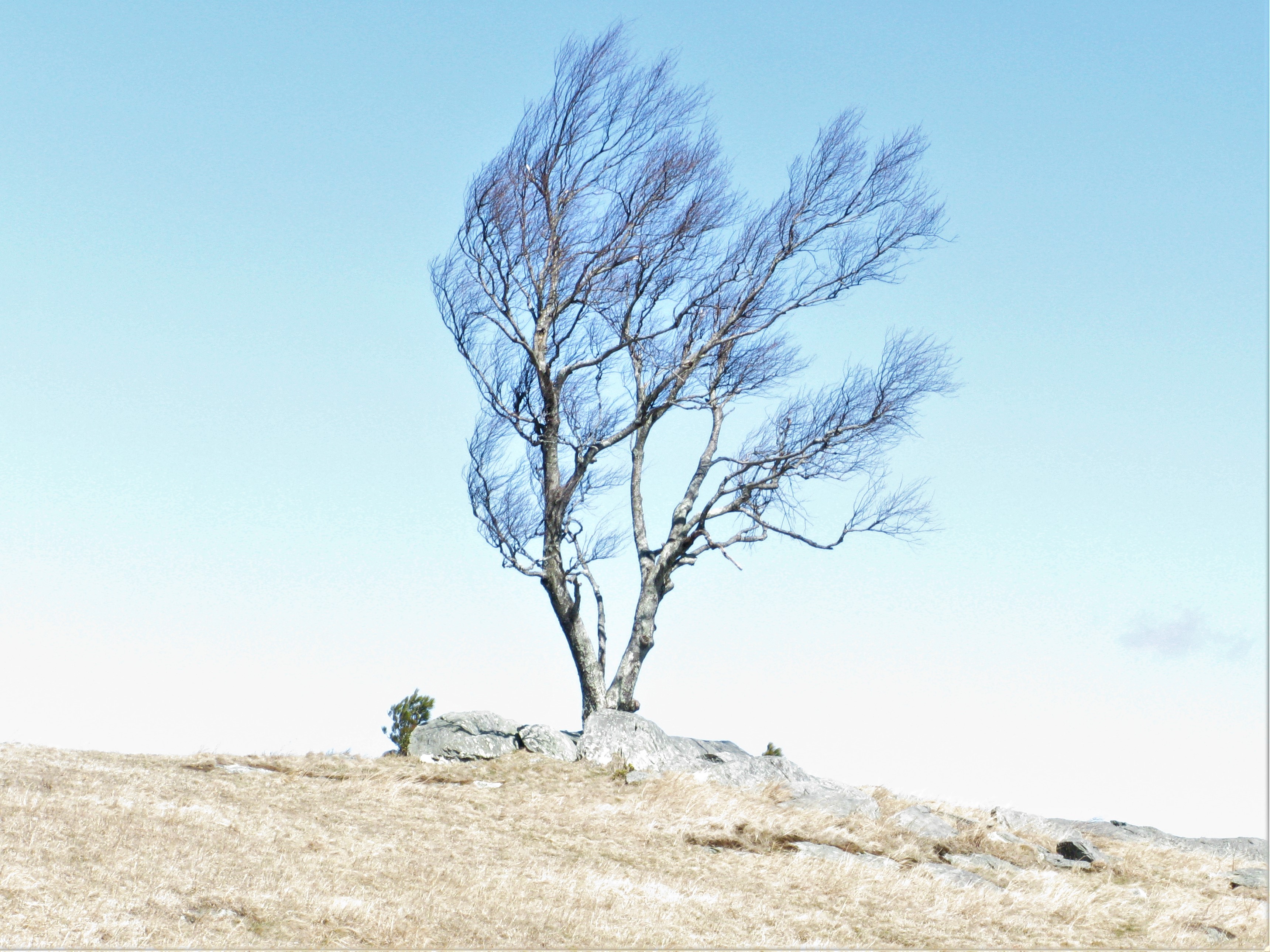
Doughton Park Tree 2020-06-11a
 . 

Read Full Post »

 . 
[with 4 poems by Lou Lipsitz]
 . 
Blackberry Authority
 . 
When I first came out to the country
+++ I knew nothing. I watched
as people planted, harvested, picked
+++ the berries, explained
the weather, tended the ducks and horses.
 . 
When I first came out to the country
+++ my mind emptied and I
liked it that way. My mind was like a sky
+++ without clouds, a summer sky
with several birds flapping across a field
+++ on the eastern horizon.
 . 
I like the slowness of things, the empty
+++ town, the lake stillness,
the man I met who seemed contented, who
+++ sat and talked in the dusk
about why he had chosen this long ago.
 . 
I did better dreaming then, the colors
+++ were clear. I found something
important in myself: capacity for renewal.
+++ And at night, the sky so intense.
Clear incredible stars! Almost another earth.
 . 
But now I see there are judgements here.
+++ This way of planting or that.
The arguments about fertilizers and organics:
+++ problems of time, figuring how
to allocate what we have. So many matters
+++ to fasten on and dissect.
 . 
That’s the way it is with revelations.
+++ If you live it out, your start
thinking, examining. The mind cries out
+++ for materials to play with.
Right now, in fact, I’m excited about
+++ several new vines and waiting
for the blackberry authorities to arrive.
 . 
Lou Lipsitz
from Seeking the Hook: New and Selected Poems, Signal Books, Chapel Hill NC; © 1997
 . 
❦ ❦ ❦
 . 
This green chasm, engulfing trees and vines – this is four lane 421 west of Winston-Salem, not the Appalachian Trail. Last summer was all orange barrels, lane closures, men in trucks extending long booms with wicked whirling steel teeth. Dragon-necked cretaceous devourers, no gentle arborist in sight, slashing open the Yadkin Valley bar sinister for twenty miles.
 . 
Then winter, splintered, broken and bare. Grey horizontal walls sixty feet high along the roadway. Conquered, blasted, subdued.
 . 
Until spring. Sunlight, warming earth, the gathering retaliation of cambium and rising sap. This May impenetrable green fills every chink, lines the cowering freeway, and reaches into the light. Untouched leafy crowns look down on us as we speed past. The canopy crowds the sky. Every shade of jade, kelly, forest fills our periphery through the windshield . If our machines and our hubris withdrew for a year or two, would Kingdom Plantae march in and obliterate all traces of our presence?
 . 
I feel the King’s green pressure leaning in.
 . 
 . 
❦ ❦ ❦
 . 
Evening
 . 
The poet’s test
is to write a poem
called “evening”
beginning in the small street
near the bay
where they are selling clams.
 . 
There must be a woman
he is pursuing
in his own distracted way
– someone he has sought
for years
and can almost catch.
 . 
There must be a fire
somewhere
in the darkening sun for example
or in a room
where logs are flaming
and the poet
must hold back and wait
until he knows
exactly what not to say.
 . 
Then, when he opens his lips,
the moon will
come out of his mouth.
 . 
Lou Lipsitz
from Seeking the Hook: New and Selected Poems, Signal Books, Chapel Hill NC; © 1997
 . 
❦ ❦ ❦
 . 
In the book store, across the room, before the poetry reading begins, I glimpse a man I haven’t seen in twenty years. It was at another poetry meeting. We spoke for just a few minutes and I bought his book. I know exactly where that book is today, in one of the piles on my desk, waiting for me to open it and let it speak to me again. When I get home I will.
 . 
A poem may capture a moment or span a lifetime. It may tell a story or simply evoke a gut response. Perhaps the poem is historical, explicitly tethered to a date and place. Or perhaps, as Lou Lipsitz writes in Evening, the poet / must hold back and wait / until he knows / exactly what not to say.
 . 
Read Walt Whitman, writing 150 years ago – the distance in time and space is no real impediment to you lying with him in a field of grass. The lines weave into you and wrap you into their reality, becoming your reality, remaining theirs. But now read poems written 30 years ago by a man pictured in his 40’s on the book jacket whom you’ve just seen in the flesh in his 70’s. Reality is more complicated. The longing and conflict in those lines, do they still reside in that person who wrote them? Is it even fair to ask? Does it matter at all in the moment of reading, in the reflection afterwards?
 . 
Lou Lipsitz’s Seeking the Hook is deeply personal, painful and contemplative, self-accusatory and redeeming. Reading the poems then and reading the poems now jars me to ask how I myself have changed in those twenty or thirty years. I share those accusations; I seek the same redemption. The reality I discover in these poems touches me in new ways, perhaps more confusing but perhaps also more familiar. Personal. I want to tell Lou this, but when the reading has concluded I turn and he is gone.
 . 
 . 
❦ ❦ ❦
 . 
Song of the Divorced Father
 . 
“. . . I realized that it’s inevitable; wounds are part
of what parent give their children.”
++++++++++++++ Michael Meade
 . 
There was a woman poet from Chile who
wrote “sleep close to me” to her small son.
Reading that, I think of you, children, no
so long and substantial, no beyond
my picking up and carrying to bed, now
beyond the reach almost of my arms and my soul.
 . 
I remember the night silence and my father-ear
listening for your breathing; the cries and
choking sound that pulled me from sleep.
I remember the early mornings of sentimental
thoughts as I watched your faces utterly
asleep, and then strange dreams you told
of wolves and weddings and curious caves
full of treasure.
 . 
Now I want you to sleep near me, to be
in the house with me, so we can sing together
sometimes, so I can relearn your new voices.
So we can carry the wounds together,
pulling them from the sea, an old boat
we used to fish in –
+++ turn it upsidedown and let the flaking
+++ paint dry in the sun – then when night comes
+++ we can howl and weep – you can hammer me
+++ with you small fists of long ago and we can
+++ hack the boat apart and burn it;
+++ it will burn all night, the stars wheeling above us
+++ as we lie there, separate, exhausted.
 . 
Then in the morning, the boat will be intact,
awaiting us, the blue paint fresh. I will say:
“let’s get some fish in the marshes.” And you
will steer, knowing the way all over again.
 . 
Lou Lipsitz
from Seeking the Hook: New and Selected Poems, Signal Books, Chapel Hill NC; © 1997
 . 
❦ ❦ ❦
 . 
A Task
 . 
+++ — reply to Auden & the intellectuals
 . 
Potatoes. I will hunt potatoes
in the fashion of my grandmother
who fed us all.
 . 
Potatoes. Like the tough hearts of young men.
The core of dark joy in sexual love.
The world that trembles and changes.
 . 
In the fashion of my grandmother
I will abandon all exotic things
 . 
and hunt a language
of odd, true shapes the were nurtured in the old earth
 . 
Lou Lipsitz
from Seeking the Hook: New and Selected Poems, Signal Books, Chapel Hill NC; © 1997
 . 
❦ ❦ ❦
 . 
Biography and other works by Lou Lipsitz HERE
 . 
Selected poems by Lou Lipsitz in THE SUN
 . 
❦ ❦ ❦
 . 
 . 

Read Full Post »

 . 
[with 3 poems by Rick Campbell]
 . 
The Light We Call Winter
 . 
If you see me walking down
the shell road under myrtle
 . 
and Spanish moss, don’t worry.
The road’s a circle and it brings me
 . 
back to my yellow mailbox.
You might give me the name
 . 
of the bird that sat all morning
on the thin branch.
 . 
Give me the last lost months gone
in a haze, sloughed off like an old dog
 . 
shakes himself dry.
Walk with me.
 . 
I won’t say
I don’t need you.
 . 
Rick Campbell
from Fish Streets Before Dawn, Press 53, Winston-Salem NC; © 2024
 . 
❦ ❦ ❦
 . 
When the first Human woke up on their first morning on Mother Earth, they discovered all the other persons watching them. The Plant persons, the Animal persons, the Lichen and Fungus persons, all of them had already been living together on Mother Earth for a very long time and they knew how to get along. Now here was this new member of the family, this Human. No doubt everyone was asking themselves whether this new person would also learn how to get along.
 . 
The Human opened their eyes and the first thing they said was, “How did I get here?” A question Humans would spend a very, very long time trying to answer. Then the Human stood up, looked all around, and asked, “What am I doing here?!”
 . 
At this point the Creator of Mother Earth and Every Living Thing smiled. Yep, those are the right questions. Two of the big ones. And don’t forget the third, maybe even bigger and maybe even more important. The Human noticed all the persons watching – Plant, Animal, Fungus, all of them – and asked, “Who are you?” The Creator smiled even wider. Yep!
 . 
 . 
A nod to Robin Wall Kimmerer and Braiding Sweetgrass for inspiring this little parable. And a nod to Rick Campbell for poking at all the questions until they wake up and try to swim to the surface. The answers you’re going to get in this life depend on the questions you ask.
 . 
Be sure to ask, really, the questions no one knows the answers to. I almost wrote “the questions no one knows how to ask,” but how is something you certainly do know. The more you pay attention, the more you wonder, the more you know how to ask those questions. Not ask like Rodin’s Thinker with your chin on your fist in placid contemplation. More like lying awake at 4 a.m. in a sweat and doubting but asking anyway whether there’s any reasonable hope for you, you Human.
 . 
What am I doing here? I haven’t needed an answer as long as I’ve been always doing, doing. In fact I don’t even know there’s a question until I stop. (Maybe Rodin’s silent seated ponderer is an apt image after all.) In that momentary pause, in that engulfing silence, the questions suddenly loom huge and overwhelming. Why am I? What is my purpose? And cold, dark nothing threatens to bring its answer.
 . 
But then I look around. Who are all these others? All these persons, Human and not, sharing this circle with me? Can we get along? May I know them? It’s never too late to ask. Never too late to try.
 , 
 . 
❦ ❦ ❦
 . 
Practicing Silence
 . 
Outside of NYC, it’s
almost impossible
to be mistaken
 . 
for a mime. Here,
at the edge of the country
I’m just a guy who moves
 . 
silently down crushed shell
roads, through pine forests
in deep sand, past the harbor’s
 . 
broken docks. Ok, yes,
I could talk more, but to whom,
the clerk at the Dollar General?
 . 
What would I find worth saying
more than thanks? Buzzards whirl
over my head like synchronized swimmers.
 . 
Rick Campbell
from Fish Streets Before Dawn, Press 53, Winston-Salem NC; © 2024
 . 
❦ ❦ ❦
 . 
Frank X. Gaspar writes this in the introduction to Fish Streets Before Dawn: In the poem Throwing Starfish Back into the Sea [Rick] wonders how much “good he has done” with his uncertain act of kindness. It is an apt poem, and taken in the context of this collection and its outcries, we see that Rick Campbell’s wanderings and questing are testimony to the core of his art: surviving, yes, but surviving as the step that allows us to pursue any small good we can bring along with us.
 . 
Rick Campbell lives in Alligator Point, Florida, and teaches in the University of Nevada-Reno’s MFA program. He has published seven earlier poetry collections, plus a collection of essays, Sometimes the Light. His most recent poetry collection, Fish Street Before Dawn, from Press 53 in Winston-Salem, North Carolina, is available HERE
 . 
 , 
❦ ❦ ❦
 . 
Xenoglossy
 . 
I once wrote of my mill town
that you can want all your life here.
I was in love with words and
the directions they might lead:
into the temple of furnace fire
and out again? Along
a ridge with hawks drafting
thermals? Blues as it’s bent
at the crossroads? Freight trains
clacking downriver under the cloaked moon?
Just empty space?
 . 
At night I speak in the tongues
of angels and fools: babble
imperfect definitions of desiderate, lack,
+++++++++++++++++++ ought.
 . 
Yesterday, blades of grass parted
as the pygmy rattler sidled away
from my boot. I wanted to call
the hawk in the pine tree
down to snatch it up, but
I had no tongue for hawk.
 . 
What did I know? I am older.
It wasn’t just home that wanted,
not just the valley that lacked.
 . 
Rick Campbell
from Fish Streets Before Dawn, Press 53, Winston-Salem NC; © 2024
 . 
❦ ❦ ❦
 . 
 . 
❦ ❦ ❦
 . 
2020-03-07 Doughton Park Tree

Read Full Post »

« Newer Posts - Older Posts »