Feeds:
Posts
Comments

Archive for the ‘Ecopoetry’ Category

[New Year’s Eve, poems by Mary Oliver and Jane Mead]

“Are spirits’ lives so short?” asked Scrooge.
“My life upon this globe is very brief,” replied the Ghost. “It ends to-night.”

The worm Ouroboros eats its tail, every day renewed, ever renewing. Cycles unending. The Neuse River snakes to New Bern, clouds lift inland, each little feeder stream is filled. Rain, ice, lichen eat the stone, phosphate creeps its migration through generations: rock to soil, leaf to masticator, herbivore to predator and all decomposing back to soil. I breathe out what the tree breathes in and breathes out for me to breathe. And the cycle we mark today: the dying Year gives birth to the New.

So many cycles. One enormous round. Every thing connected, interconnected, and we sense ourselves as spokes of the wheel or sometimes the never-ceasing motion of its rim that grinds along the path that is our life. As daylight diminishes it grows harder to hold onto our imagining of that wheel, its endless turning, that path it pursues still stretching on beyond the horizon. Harder to hold onto hope that the path’s end is indeterminate and out of sight.

Yes, it grows harder in these years of death’s overwhelming harvest to push aside imagining our own death. Too many deaths, COVID and otherwise, to pay attention; too many deaths to ignore a single one. In a few minutes I’ll set this page aside when my son arrives. He’ll leave Amelia here while the rest of the family attends their next-door neighbor’s funeral. A sudden death – our friend M was not old or ill. A shock to the fragile wall we build around our own mortality. Linda and I find ourselves tallying all the deaths that have touched us this month. The man who fixes our cars. A friend’s best friend. Names and faces more than we ever expect, doesn’t it seem? Death hunches at our shoulder, sometimes intrusive, sometimes silently lingering, sometimes perched like a moth that’s invisible until it flies into our face.

Tonight at midnight we will celebrate the Newborn Year but perhaps with even more enthusiasm we’ll celebrate a moment’s permission to ignore its haggard, dissipated forebear. The Old Year dies in winter darkness; death, the ultimate consuming dark. But notice – twelve days enfold the span of solstice to new year’s morning. The Ghost of Christmas Present senescent and dying yet retains some presence within us. Twelve days already lengthening, light seeping in even before the old year succumbs. Perhaps endings and beginnings are false markings along the ever-flowing course. Perhaps encircled by death it is possible, vital even, to engage with life. Perhaps death itself is not darkness but enfolding light.

.     .     .     .     .     .     .
.     .     .     .     .     .     .

White Owl Flies Into and Out of the Field

Coming down out of the freezing sky
with its depths of light,
like an angel, or a Buddha with wings,
it was beautiful, and accurate,
striking the snow and whatever was there
with a force that left the imprint
of the tips of its wings — five feet apart —
and the grabbing thrust of its feet,
and the indentation of what had been running
through the white valleys of the snow —
and then it rose, gracefully,
and flew back to the frozen marshes
to lurk there, like a little lighthouse,
in the blue shadows —
so I thought:
maybe death isn’t darkness, after all,
but so much light wrapping itself around us —

as soft as feathers —
that we are instantly weary of looking, and looking,
and shut our eyes, not without amazement,
and let ourselves be carried,
as through the translucence of mica,
to the river that is without the least dapple or shadow,
that is nothing but light — scalding, aortal light —
in which we are washed and washed
out of our bones.

Mary Oliver  — 1935-2019
this poem first appeared in The New Yorker, January 2, 1989


.     .     .     .     .     .     .

I Wonder if I Will Miss the Moss

I wonder if I will miss the moss
after I fly off as much as I miss it now
just thinking about leaving.

There were stones of many colors.
There were sticks holding both
lichen and moss.
There were red gates with old
hand-forged hardware.
There were fields of dry grass
smelling of first rain
then of new mud. There was mud,
and there was the walking,
all the beautiful walking,
and it alone filled me –
the smells, the scratchy grass heads.
All the sleeping under bushes,
once waking to vultures above, peering down
with their bent heads they way they do,
caricatures of interest and curiosity.
Once too a lizard.
Once too a kangaroo rat.
Once too a rat.
They did not say I belonged to them,
but I did.

Whenever the experiment on and of
my life begins to draw to a close
I’ll go back to the place that held me
and be held. It’s O.K. I think
I did what I could. I think
I sang some, I think I held my hand out.

Jane Mead — 1958-2019
this poem first appeared in The New Yorker, September 20, 2021

.     .     .     .     .     .     .

Mary Oliver was a guide to the intersection between human life and the natural world; her voice affirms the expression of person in nature in person and affirms that no voice can fully express that oneness. Jane Mead, who for years was Poet-in-Residence at Wake Forest University in Winston-Salem, NC, expected poetry to move people to preserve the earth; at the end of her life she was a guide to the landscape and ecology of dying.

.     .     .     .     .     .     .
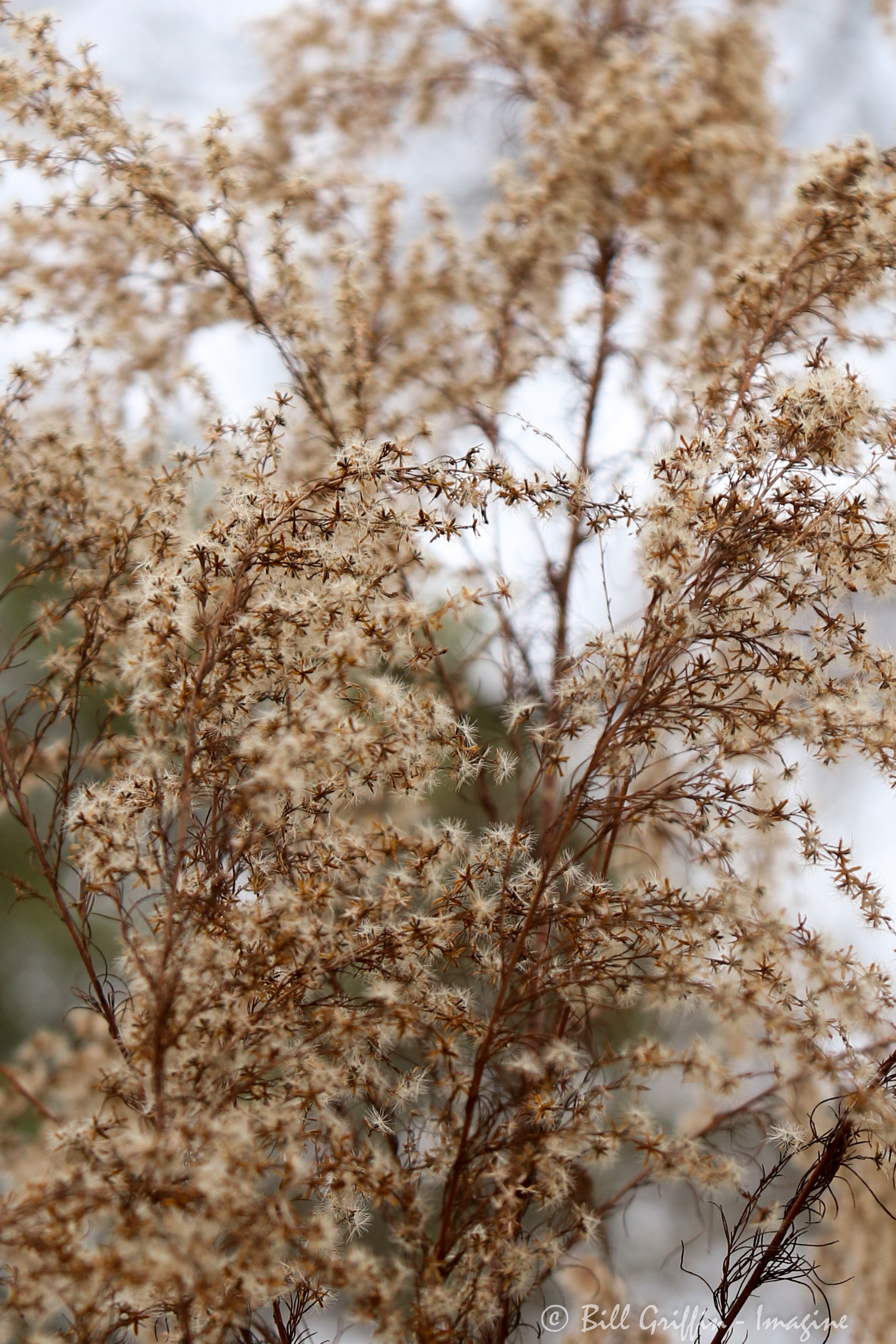
 

Doughton Park Tree 2021-10-23

Read Full Post »

I thought I saw a Merlin. Facing into the stiff onshore breeze, harrying above the dunes: fierce raptor profile, fleet spitfire, wings cocked at the wrist – falcon.

I wanted to think it was a Merlin I saw, last week at Bogue Banks for Thanksgiving, as it veered away from me, slipped sideways and rolled, master of current and draft. I still wanted it to be a Merlin when it arced back overhead, whirled into a perfect stall, snatched a perch at the tip of the spar where the surf warning flag flies.

It drank some water trapped in a crease of the wood. Tawny waistcoat, single-barred tail, face tattoos – this hunter was not a Merlin. Just its much more common little cousin.

Why did my heart skip when I first spotted it? Why did I want so much for it to be a Merlin? I haven’t seen one in years; I’ve only ever seen a very few. The last time I saw a Merlin, Linda and I were alone together on a rare vacation, January in Nags Head, doing what we love: hiking the dunes and maritime forest and half-freezing ourselves in the salt rime. Driving to Hatteras next day we spotted a Merlin perched above the salt marsh, watchful in regal disdain. Merlin – rare visitor from the mysterious north. Merlin, power and magic. Merlin mythic. Merlin romantic.

Is it just its name that makes it so? Falco columbarius per Linnaeus, Esmerejón in Spain and Mexico, Dværgfalk in Denmark and Norway, 55 names listed in Cornell Ornithology. Learning its name accompanies learning its field marks, habitat, range. But what do I really know about Merlin? How to read shifting wind while stalking the wood rat a hundred yards below? Folded wings, little rocket, full velocity strike , blood and hair? What name, Dream Hunter, do you give yourself?

We see the Merlin’s little cousins all the time here in the NC foothills, especially in winter perched on wires above the mouse-gleaned fields. I saw one driving home from the beach. Actually, four. And last week my brain knew what I was seeing above the strand even before my eye would admit it, even before it swooped in for me to take closer look . . .

. . . and turned upon the current of air. Watchful for movement in the sand, ultraviolet signature of mouse urine, it raised its wings, their sharp fast flutter, fixed, motionless on high. Only one little falcon can do that. And I know its name.

.     .     .     .     .     .     .

The Windhover
Gerard Manley Hopkins – 1844-1889

I caught this morning morning’s minion, king-
++ dom of daylight’s dauphin, dapple-dawn-drawn Falcon, in his riding
++ Of the rolling level underneath him steady air, and striding
High there, how he rung upon the rein of a wimpling wing
In his ecstasy! then off, off forth on swing,
++ As a skate’s heel sweeps smooth on a bow-bend: the hurl and gliding
++ Rebuffed the big wind. My heart in hiding
Stirred for a bird,—the achieve of; the mastery of the thing!

Brute beauty and valour and act, oh, air, pride, plume, here
++ Buckle! AND the fire that breaks from thee then, a billion
Times told lovelier, more dangerous, O my chevalier!

++ No wonder of it: shéer plód makes plough down sillion
Shine, and blue-bleak embers, ah my dear,
++ Fall, gall themselves, and gash gold-vermillion.

[This poem is in the public domain.]

.     .     .     .     .     .     .

.     .     .     .     .     .     .


Windhover is a British name for the European Kestrel, Falco tinnunculus, a dead ringer for its close relative the American Kestrel, Falco sparverius. They are the smallest of the falcons and one of the very few birds that can hover motionless in still air, in this case watching for its usual prey, the field mouse.

The Windhover has long been one of my favorite poems. Oh my, where does this magical and mysterious language come from?! What hidden realm is revealed in these lines? Read it aloud to hear Hopkins’s incantatory music. How does he do it?

One of my most striking memories is the Saturday morning Tony Abbott recited The Windhover at Weymouth Center for the Arts and Humanities to call to order a meeting of the North Carolina Poetry Society. As he approached its last line Tony slowed , each word deliberate, and upon gash gold-vermilion there was one unified sharp intake of breath among the entire congregation before we erupted in applause.

Gerard Manley Hopkins was a Jesuit priest; he dedicated The Windhover To Christ our Lord. The poem, like the fierce undaunted Kestrel, breaks open the blue-bleak embers of our dull, unreflective spirits to reveal the fire, the power, and the glorious mystery of creation which surrounds us.

[more Gerard Manley Hopkins at The Poetry Foundation]


.     .     .     .     .     .     .

.     .     .     .     .     .     .

2019-02-09 Doughton Park Tree

Read Full Post »

All Wild Animals

[with a poem by Brigit Pegeen Kelly]

Prepare for a long poem today. To discover some destinations takes a bit of traveling. Have I missed my turn? Have I totally misunderstood the directions? Then suddenly it becomes familiar, a place I’ve never imagined but somehow always knew I would reach.

First left after the Carter Falls Trailhead, Bob told me, then watch for the vineyard. I’ve already driven a mile farther up Pleasant Ridge than I expected. Sudden blind left, swerve onto Preacher Field Road, but there’s no vineyard in sight. Well, think, Bill – you’re meeting up on the west bank of Elkin Creek so you’ll have to cross water somewhere. The country road becomes all elbows and knees and wanders down into the little valley. Here’s a bridge. Now we’re meandering back uphill.

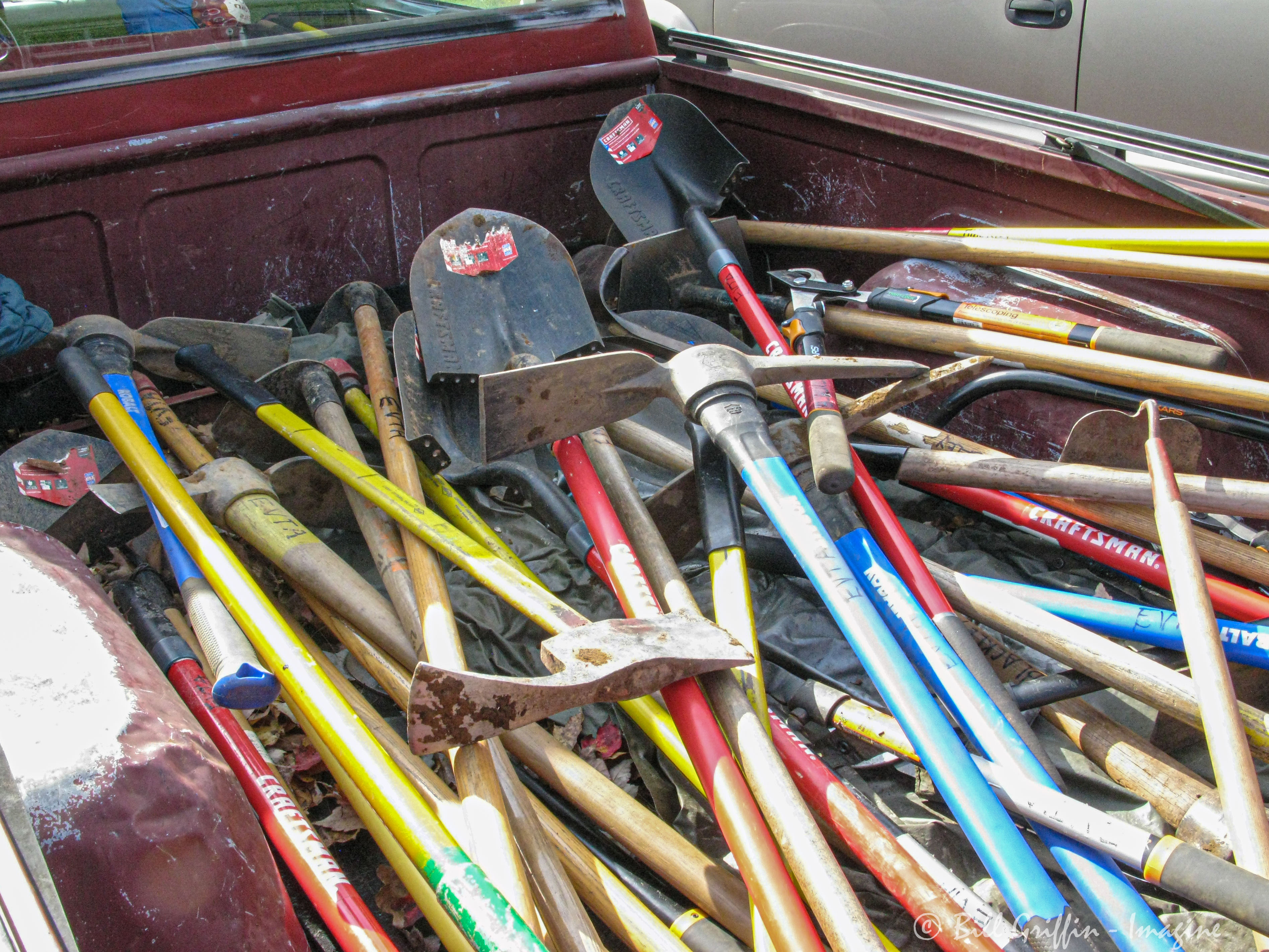
And here’s the vineyard, gravel farm drive, crunch down past the barn on right through the pumpkin field to where the trail crew is parked. They’re standing beside the old grave plots talking tools while one man kneels to trace the dates on a headstone: 1751-1848, William Harris, who served three years as General Washington’s body guard then settled here to farm.

We can hear the upper falls from here; glint and sparkle tease us through the oak and sourwood . For the next three hours we’ll follow Bob’s little pink flags with our mattocks, shovels, loppers, Pulaski. Almost too steep to stand and swing in some places. Bench an 18-inch wide footpath, almost every strike flashing sparks on stone (did you say granite or dammit?). Give it just the right camber, slope & runoff. We inch through morning with the murmured encouragement of Big Elkin Creek at our backs and the first draft of a new trail emerges.

So far the trail doesn’t come from anywhere or go anywhere. Today it just enjoys its windings between chestnut oak and beech, through greenbrier and grapevine, and is more than happy to take us with it.

.     .     .     .     .     .     .

.     .     .     .     .     .     .

All Wild Animals Were Once Called Deer
Brigit Pegeen Kelly (1951-2016)

Some truck was gunning the night before up Pippin Hill’s steep grade
And the doe was thrown wide. This happened five years ago now,
Or six. She must have come out of the woods by Simpson’s red trailer—

The one that looks like a faded train car—and the driver
Did not see her. His brakes no good. Or perhaps she hit the truck.
That happens, too. A figure swims up from nowhere, a flying figure

That seems to be made of nothing more than moonlight, or vapor,
Until it slams its face, solid as stone, against the glass.
And maybe when this happens the driver gets out. Maybe not.

Strange about the kills we get without intending them.
Because we are pointed in the direction of something.
Because we are distracted at just the right moment, or the wrong.

We were waiting for the school bus. It was early, but not yet light.
We watched the darkness draining off like the last residue
Of water from a tub. And we didn’t speak, because that was our way.

High up a plane droned, drone of the cold, and behind us the flag
In front of the Bank of Hope’s branch trailer snapped and popped in the wind.
It sounded like a boy whipping a wet towel against a thigh

Or like the stiff beating of a swan’s wings as it takes off
From the lake, a flat drumming sound, the sound of something
Being pounded until it softens, and then—as the wind lowered

And the flag ran out wide—there was a second sound, the sound of running fire.
And there was the scraping, too, the sad knife-against-skin scraping
Of the acres of field corn strung out in straggling rows

Around the branch trailer that had been, the winter before, our town’s claim to fame
When, in the space of two weeks, it was successfully robbed twice.
The same man did it both times, in the same manner.

He had a black hood and a gun, and he was so polite
That the embarrassed teller couldn’t hide her smile when he showed up again.
They didn’t think it could happen twice. But sometimes it does.

Strange about that. Lightning strikes and strikes again.
My piano teacher watched her husband, who had been struck as a boy,
Fall for good, years later, when he was hit again.

He was walking across a cut corn field toward her, stepping over
The dead stalks, holding the bag of nails he’d picked up at the hardware store
Out like a bouquet. It was drizzling so he had his umbrella up.

There was no thunder, nothing to be afraid of.
And then a single bolt from nowhere, and for a moment the man
Was doing a little dance in a movie, a jig, three steps or four,

Before he dropped like a cloth, or a felled bird.
This happened twenty years ago now, but my teacher keeps
Telling me the story. She hums while she plays. And we were humming

That morning by the bus stop. A song about boys and war.
And the thing about the doe was this. She looked alive.
As anything will in the half light. As lawn statues will.

I was going to say as even children playing a game of statues will,
But of course they are alive. Though sometimes
A person pretending to be a statue seems farther gone in death

Than a statue does. Or to put it another way,
Death seems to be the living thing, the thing
The thing that looks out through the eyes. Strange about that . . .

We stared at the doe for a long time and I thought about the way
A hunter slits a deer’s belly. I’ve watched this many times.
And the motion is a deft one. It is the same motion the swan uses

When he knifes the children down by his pond on Wasigan Road.
They put out a hand. And quick as lit grease, the swan’s
Boneless neck snakes around in a sideways circle, driving

The bill hard toward the softest spot . . . All those songs
We sing about swans, but they are mean. And up close, often ugly.
That old Wasigan bird is a smelly, moth-eaten thing.

His wings stained yellow as if he chewed tobacco,
His upper bill broken from his foul-tempered strikes.
And he is awkward, too, out of the water. Broken-billed and gaited.

When he grapples down the steep slope, wheezing and spitting,
He looks like some old man recovering from hip surgery,
Slowly slapping down one cursed flat foot, then the next.

But the thing about the swan is this. The swan is made for the water.
You can’t judge him out of it. He’s made for the chapter
In the rushes. He’s like one of those small planes my brother flies.

Ridiculous things. Something a boy dreams up late at night
While he stares at the stars. Something a child draws.
I’ve watched my brother take off a thousand times, and it’s always

The same. The engine spits and dies, spits and catches—
A spurting match—and the machine shakes and shakes as if it were
Stuck together with glue and wound up with a rubber band.

It shimmies the whole way down the strip, past the pond
Past the wind bagging the goose-necked wind sock, past the banks
Of bright red and blue planes. And as it climbs slowly

Into the air, wobbling from side to side, cautious as a rock climber,
Putting one hand forward then the next, not even looking
At the high spot above the tree line that is the question,

It seems that nothing will keep it up, not a wish, not a dare,
Not the proffered flowers of our held breath. It seems
As if the plane is a prey the hunter has lined up in his sights,

His finger pressing against the cold metal, the taste of blood
On his tongue . . . but then, at the dizzying height
Of our dismay, just before the sky goes black,

The climber’s frail hand reaches up and grasps the highest rock,
Hauling, with a last shudder, the body over,
The gun lowers, and perfectly poised now, high above

The dark pines, the plane is home free. It owns it all, all.
My brother looks down and counts his possessions,
Strip and grass, the child’s cemetery the black tombstones

Of the cedars make on the grassy hill, the wind-scrubbed
Face of the pond, the swan’s white stone . . .
In thirty years, roughly, we will all be dead . . . That is one thing . . .

And you can’t judge the swan out of the water. . . . That is another.
The swan is mean and ugly, stupid as stone,
But when it finally makes its way down the slope, over rocks

And weeds, through the razory grasses of the muddy shallows,
The water fanning out in loose circles around it
And then stilling, when it finally reaches the deepest spot

And raises in slow motion its perfectly articulated wings,
Wings of smoke, wings of air, then everything changes.
Out of the shallows, the lovers emerge, sword and flame,

And over the pond’s lone island the willow spills its canopy,
A shifting feast of gold and green, a spell of lethal beauty.
O bird of moonlight. O bird of wish. O sound rising

Like an echo from the water. Grief sound. Sound of the horn.
The same ghostly sound the deer makes when it runs
Through the woods at night, white lightning through the trees,

Through the coldest moments, when it feels as if the earth
Will never again grow warm, lover running toward lover,
The branches tearing back, the mouth and eyes wide,

The heart flying into the arms of the one that will kill her.


All Wild Animals Were Once Called Deer from SONG by Brigit Pegeen Kelly, BOA Editions, January 1st, 1994; © 1994 by Brigit Pegeen Kelly.
First appeared in The Massachusetts Review, Vol. 34 No. 4 (Winter, 1993)
and featured on Poetry Daily October 18, 2021.

More by Brigit Pegeen Kelly:
The Poetry Foundation
The Academy of American Poets

.     .     .     .     .     .     .

.     .     .     .     .     .     .


Read Full Post »

« Newer Posts - Older Posts »