.
[with 4 poems by Robert Morgan]
.
Time
.
Snow-covered peaks gather in the north
like arabs talking.
You can’t be sure you see them
but they leave an afterimage, detached
from the horizon, floating on haze.
Rugged seconds around the sky’s dial.
If you look long enough they seem to march
like bishops shuffling toward hell.
I know the ground is a bridge
leading there –
to the white tents
and altitudes of death –
but I don’t believe it. I don’t
believe you can get there by just walking
the earth one step after another,
but must be snatched miraculously away,
fall upward into the terrible
blue emptiness.
When I stand in a field,
the field and I are a sundial.
But the body alone is a clock, and each
motion it makes.
Something must distract us, anything.
The cornfield slapping in the rhythm of a tennis game,
a crow flying his clockhands on a face
without surface.
The will always hungry.
.
Robert Morgan
from Collected Early Poems of Robert Morgan, Press 53, Winston-Salem NC; Carolina Classics Editions; © 2024
originally published in Red Owl, W.W.Norton & Company; © 1972
.
❦ ❦ ❦
.
Two squirrels in my beech tree just can’t get along. I’ve named them Buddy and Holly. Buddy attacks my squirrel-proof feeder like he’s going to buzzsaw right through the metal bars. Meanwhile Holly is perched on a high branch eating beechnuts like popcorn and raining the pointy tetrahedrons on my deck, little caltrops.
.
Until I arrive to refill the feeder. Then Buddy has to scoot; he takes a flying leap into the silverbell. Holly continues to observe. I always spill some seeds – careless me – and when I re-hang the feeder Buddy scrabbles back to snarf a few then spring back up to the squirrel-proof, legs spread and clawed toes splayed like a cheetah bringing down a gazelle. At this point Holly climbs down to check out Buddy’s leavings. When he spies her, things get tense.
.
“Hey! Those are my seeds. Those are all my seeds!”
.
Holly sits up on her little haunches and rolls her eyes. “I didn’t see you planting any sunflowers last summer, Bottlebrush. You just play with your feeder toy while I have a nice lunch.”
.
“But I want those seeds. You might eat something I’m going to need later. Quit being so mean! Don’t you know this is where bad feelings come from?”
.
“Listen, Furbrain, this is where bad feelings come from.” She pokes his fuzzy chest with a foreclaw. “If you’re having bad feelings, I didn’t give them to you. You gave them to yourself.”
.
“Selfish, selfish, selfish.”
.
“Can I help it if it’s in my squirrel-nature to be hungry? And isn’t it squirrel-nature when you’re hungry to eat? Why don’t you pull up a chair (speaking entirely figuratively, of course) and enjoy a little lunch yourself.”
.
“Hmph, sez you,” Buddy grumbles. He picks up a seed and nibbles. Palpable silence I think you could call it.
.
“Hey,” Buddy finally offers after a few minutes, “When we finish these seeds, how about you hop up on that feeder with me. Maybe together we can shake out a few seeds. And . . . you could have some, too, if you want.”
.
❦
.
Years ago Linda and I watched an episode of X-Files that has become our byword. Scully and Mulder were at a rest home investigating paranormal events involving gruesome mutilation, the usual stuff. One of the rest home residents was assisting them with their inquiries. Should he also be a suspect? The old man was wincingly meek, not very bright, and whenever he messed up or something went wrong he would hang his head and apologize, “I’m just a human being.”
.
I am just a human being. And how often am I compelled to admit that I inhabit a planet full of people that are also just human beings? How did Linda and I end up with so many family members who seem incapable of living up to our expectations? Oh well, they are just human beings. And so are the people we attend church with, and sing with, and meet at the store, and whose yard signs and bumper sticks are so aggressively in our faces. “What a world,” said the Wicked Witch of the West when she was doused. So many of these human beings have the power to give me endless heartburn; I could use some of that cold water.
Or I could quit giving them so much power. I’m lucky that I have Holly to remind me – when there are flickers of bad feelings, maybe some human being has struck the spark but I provide the fuel. Let’s just cool down for a minute. Aren’t we in this thing together? I’ll try to cut you the same slack I’d want you to cut me. After all, the two of us are just human beings.
.

.
❦ ❦ ❦
.
Land Diving
.
Though it’s no disgrace refusing
some things must be done.
And present accomplishment
is no guarantee
of future.
You must come close
as possible without touching
to prove brinksmanship, fly
from the sapling girdered tower
before the whole village, leaping with a scream
against the wall of fear, step onto
the white-hot floor
of emptiness
holding only to yourself.
You will know the pure isolation of fall.
The vines bound to your feet must not snag
on the scaffolding
or they will swing you crushing
into the frame and braces.
They must not break
or be an inch too long
or you will be smothered by
the swat of earth.
Yet the meaning is the closeness.
No stretching out your arms;
you must be jerked to a stop face against
the trampled dirt
by the carefully measured
bonds.
Only they can save you.
.
Robert Morgan
from Collected Early Poems of Robert Morgan, Press 53, Winston-Salem NC; Carolina Classics Editions; © 2024
originally published in Land Diving, Louisiana State University Press; © 1976
.
❦ ❦ ❦
.
In a journal he kept in the 1970’s, The Transfigured Body, Robert Morgan wrote this: “It is objectivity and precision that can be translated and that translates, the love of the humble detail, a sensitivity to the eros of all things, focused recognition; . . . I write to establish the reality of things. It’s as if I’m afraid they aren’t there unless substantiated by language, and consubstantiated.” [from the introduction by Robert M. West to Collected Early Poems of Robert Morgan]
.
Consubstantiation is a new word for me. I recognize transubstantiation, which means transmutation, to utterly change the character or substance of a thing. But consubstantiation is more personal, more intimate – to exist together in one and the same time and space. To unite and blend and merge. To become one. I yearn to be attuned to the smallest detail. I long to feel it, that shared presence with other humble creatures in the midst of creation, that eros of all things.
.
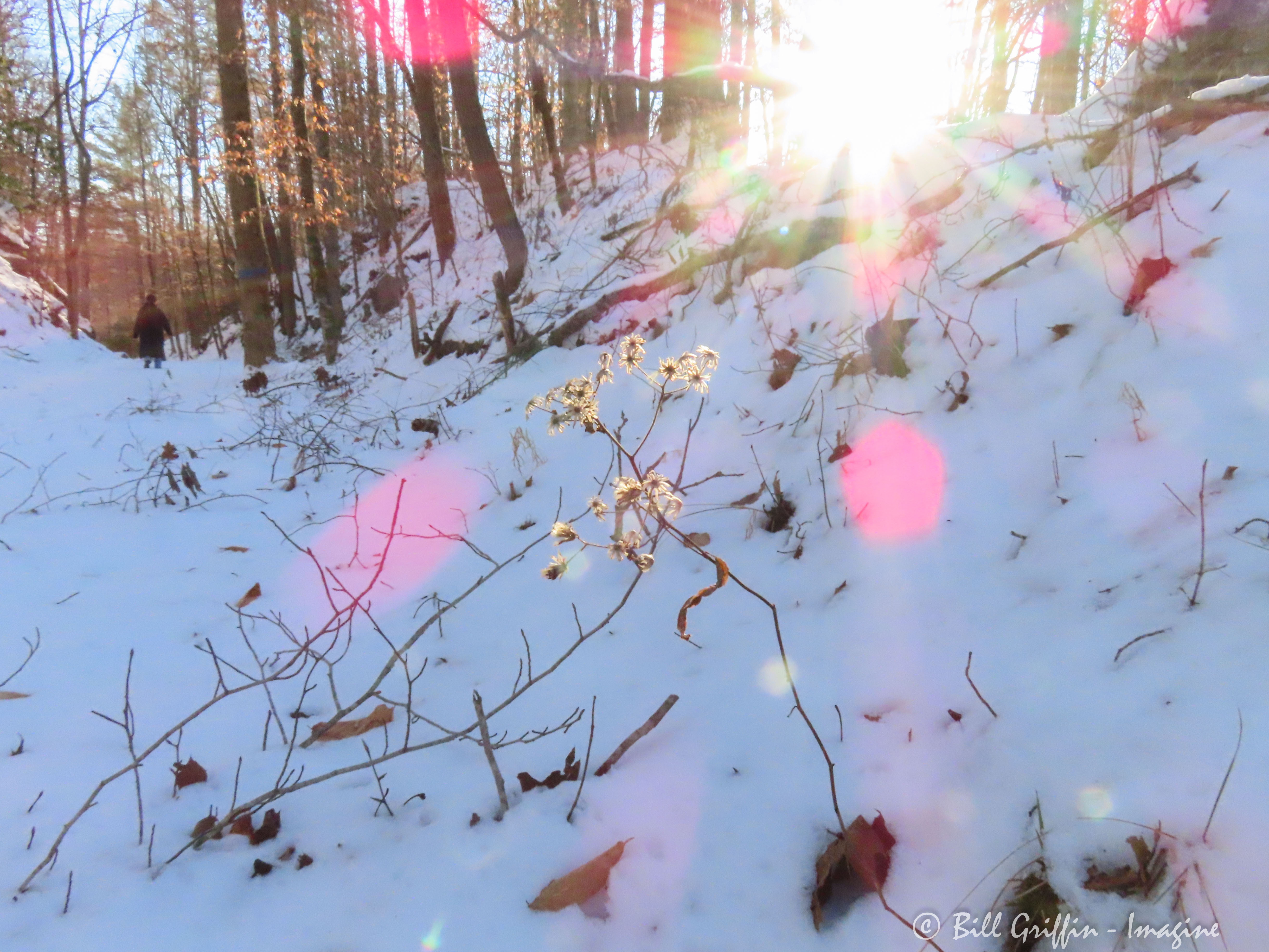
I prepare myself for that love by learning: botany, taxonomy, ecology. But I experience eros by kneeling and feeling the waxy winter leaf of a cranefly orchid; by turning its shadow green face to reveal the rich burgundy of its obverse; by remembering July blossoms when I see the dry seed stalk in January; by imagining the scant slant sunlight kissing that tough leaf to grant life for another summer’s blooms.
.
And I experience the eros of all things through a poet’s careful observation, through the power of language to create juxtaposition and connection. Robert Morgan’s poems are often set in the North Carolina mountains, but his poetry is about everything. Perhaps we, who are just human beings after all, cannot overcome our hominid urges to circle around our small fires and fear and demonize all outsiders. Perhaps we can’t regain our ancestors’ connections to the earth, its plants and its animals, its textures and its smells. Sometimes I imagine we are determined to extinguish every spark that makes us human. But then I spend a quiet hour with poems to are determined to rekindle those sparks.
.
❦
.
The Collected Early Poems of Robert Morgan, available HERE from Press 53reprints in their entirety his first four published volumes: Zirconia Poems (1969); Red Owl (1972); Land Diving (1976); Trunk & Thicket (1978).
.
Read additional selections from this new book at last week’s VERSE & IMAGE.
.

.
❦ ❦ ❦
.
Whippoorwill
.
The dead call at sundown from their places
on the mountain and down by the old mill.
They rise from the cellars of trees
and move up and down the valley
all night grazing like deer.
The call:
a rusty windmill creaks on the prairie.
Bats dipping and rising on ski jumps
are antennae
receiving and transmitting the code.
The whippoorwill interprets the news
from the dead, the unborn.
.
.
2 A.M.
.
A dog barks through the horn of a valley.
Low moon burning in a cedar.
The creek mutters like an old woman
who walks in her sleep among the trees
dreaming of the life after death
when she will lie down like the stream
and flow to the darkness.
.
Robert Morgan
from Collected Early Poems of Robert Morgan, Press 53, Winston-Salem NC; Carolina Classics Editions; © 2024
originally published in Red Owl, W.W.Norton & Company; © 1972
.
❦ ❦ ❦
.

.


 V E R S E and I M A G E
[…] About/Submit […]