Feeds:
Posts
Comments

Archive for March, 2021

[with 3 poems by Tony Abbott]

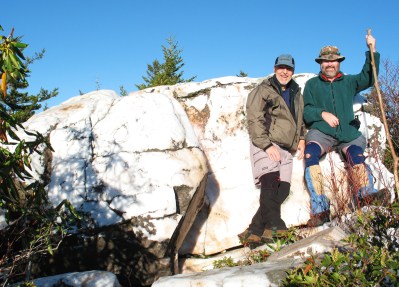
Mike and I met at a remote trailhead below Mt. Pisgah to hike up into Shining Rock Wilderness. We planned to spend one night at our favorite site after reaching it by this unfamiliar approach. End of September, gorgeous reds and golds, brittle blue sky, and we were prepared for cold above 5,000 feet.

No camp fires permitted in a Wilderness Area. We made tea over a little alcohol stove, sat on the ground, and talked until it grew too dark to see. The ultralight 2-person tent Mike had packed was cozy, which is to say it was more like a 1 ½-person tent. We’d be keeping each other warm.

I woke up after midnight in dense darkness and couldn’t breathe. Got out of the tent, pulled on my balaclava, walked away to pee, sat on a log – deep silence, no owl hoot, no chitter of flying squirrels, not one breath of wind. When my butt started to freeze I tried squeezing back into my mummy bag. No good. My chest tightened, the thick black pushed down on my face, I had to claw its hand away. Worst claustrophobia ever.

I finally dragged my sleeping pad and bag out to a level space in the pine needles, wrapped a jacket around my feet, and hunkered in just as the moon rose through the red spruce. Cold light expanded my lungs. At some point, hours creeping, moon in my eyes, I fell asleep. Mike woke me at first sun.

.     .     .     .     .     .

What can bring light into darkness? What hand comforts the clench of fear? What consoling faith casts away doubt? What companion banishes loneliness?

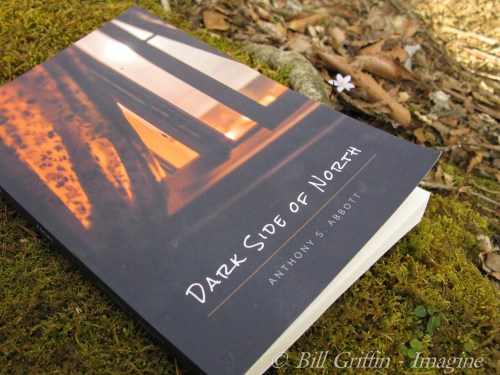
The forward to Anthony S. Abbott’s book Dark Side of North, published posthumously by Press 53 this year, consists of a remembrance presented by Dr. Jacqueline Bussie at Tony’s memorial service on October 17, 2020. Here is an excerpt:

Suffering didn’t make Tony unique. What he did with it did. Tony was the first adult, and the first teacher, I’d ever met in life who was willing to talk about the hard stuff. He taught us that suffering sucks. That suffering denied is suffering unhealed. He taught us to never sugarcoat suffering, smack a pink bow on it, or shove it to the back of the drawer. In one of my favorite lines in Tony’s poetry, he urges us to get down to “the Humpty-Dumpty business of trying to make a jewel out of the cracked pieces of the heart.”

Dr. Jacqueline Bussie, page xiv, Dark Side of North

.     .     .     .     .     .

The Boy from Somewhere Else

lived in the open mouth of the world.
He chewed on the dry branches of time.
He was handsome enough, to be sure,

but there was in his voice
the deep well of absence.
He was with them, but not of them.

His speech was familiar, but not theirs,
and when he told tales
of his drunken uncles and stage-struck

sisters, they nodded politely
and they spoke in their apple-round voices
of kith and kin, and told how their

grandfathers had founded the first
bank in Hitchcock County.
He would wait, this boy.

He would find one day the person
who could hear his music
as blood red leaves matched autumn.

He could not be mistaken about this.
When she came, he would recognize her
at once – as one knows the coming storm

by the first, distant clap of thunder.
Perhaps he could not keep her.
Perhaps one can never keep such a gift.

But, still, she would grace his years – the buds
of his growing up, the rattling trains of the
middle passage, the brittle bones of the slow

descent, the icy nights of the final coming down.

from Dark Side of North, Anthony S. Abbott, Press 53, Winston-Salem NC, © 2021 by the estate of Anthony S. Abbott

.     .     .     .     .     .

The Light in the Window
In memory of Nancy Abbott Hieronymus (1926-2017)

How early I must have known that she was
my true mother, that when she packed her bag
I must go with her. She would keep me safe.

How early I must have known that she was
my true teacher, making the sounds of the words
with her mouth so I could learn them, too.

How early I must have known that she was
my true protector, throwing herself across me
slashing her knee on the broken windshield glass.

Later, when I was nearly grown, cocky sophomore
in prep school, riding the subway home at 2 a.m.,
she left a light in the window on that I

would turn out when I came in. I didn’t know
she stayed awake until she heard the door open
and close, heard the click of the light going off.

Now I sit by her bed and watch her sleep and wake,
sleep and wake, and tell me how she loves
her precious Dick, how she will hold his hand

all the way to heaven. Beyond the light in her window
the evening comes over the island, the deer prick up
their ears, the foxes peek from their dens. In the pines

the gold crowned kinglet waits. She is coming, they say,
our friend is coming, the one who loved us all these years.
Tonight I will go home, and the friends who loved her so

will arrive, one by one, to take her in their arms,
and the next night the angel will stand at the foot
of her bed. You are loved, he will say, and enfold her

with his bright wings. And she will go where that brightness
is and, like a light in the window, shine upon us all.

from Dark Side of North, Anthony S. Abbott, Press 53, Winston-Salem NC, © 2021 by the estate of Anthony S. Abbott

.     .     .     .     .     .

The Long Afternoon

All through the long afternoon
the wind moved in the branches.
I had lived in the city and had seen
only the dust from the tires,
the diesel gas from the gray brown
buses with their leaden burdens.

Here it was different. Here on the grass
we had found by chance, walking
away, just away from everything
and then, a clearing and green
grass and the wind moving
like silver over the water
and in the branches, too. Yes,

all through the long afternoon
the wind moved and we were silent
in awe of the day and leaves
yellow and red and orange,
which floated slowly down
into our waiting hands.
aaaaaaaaaaaaaaaaa Later
I found these leaves in a book
where you had put them for
safe keeping, a book you knew
I would take down and read
some distant starry night.

from Dark Side of North, Anthony S. Abbott, Press 53, Winston-Salem NC, © 2021 by the estate of Anthony S. Abbott


.     .     .     .     .     .

Thank you, Tony. We will continue trying, and we will not stop trying, to make something beautiful from the brokenness that we are. Together. May it be and become so.
.     .     .     .     .     .

The North Carolina Poetry Society has honored Anthony S. Abbott’s memory and shared Tony’s poetry at its January, 2021 literary meeting and with a commemoration in the Winter, 2021 edition of its quarterly publication, Pine Whispers.

The line “the Humpty-Dumpty business of trying to make a jewel out of the cracked pieces of the heart.” is from Tony’s poem Before Forty in his book The Girl in the Yellow Raincoat (St. Andrews Press, 1989) and collected in New & Selected Poems (Lorimer Press, 2009).

.     .     .     .     .     .


.     .     .     .     .     .

2015-06-15Doughton Park Tree

Read Full Post »

[with 3 poems by Denton Loving]

Life is what happens to you while you’re busy making other plans.
John Lennon, “Beautiful Boy

Tomorrow we are driving to Raleigh to see our 3-year old grandson Bert. In person! In the two months since our last in person we’ve visited at least once a week on FaceTime or extended-family Zoom sessions. Often he’s in the bath (easier to keep him in one place); he always wants to show us a toy or especially some of his many books; at least once he’s seen a toy in our background and asked to play with it.

Bert is excited to see us on the little screen but our daughter Margaret tells us that almost every day he asks, “Where’s Granny and Pappy?”

Life is busy happening to us while we’re not able to make hardly any plans at all. Where are we indeed!? All of us are no doubt in the same place: spending a lot of time thinking of things we can’t wait to start doing again when the pandemic has subsided (although it’s time for all of us who’ve learned the definition of pandemic to open the dictionary to endemic). Things to do after – you know you have a list. I’ll bet you’ve even been writing them down.

Herewith I’m starting a list of things I hope to be when the seasons of fear and loss and paranoia are past. If there has been any nano-benefit of living through a pandemic, it might be that I’ve started becoming some of these things already:

Open – to what other people need, to what they’re feeling, less fixated on self
Grateful – for the little things and what now seem like really big things, especially time spent with people I love
Aware of daily changes – in nature, in me and my family, present to the passage of time
Hopeful – life will never be the same, but then again what person actually has stepped into the same river twice? I’m glad I get to keep stepping in every day anew.

.     .     .     .     .     .     .

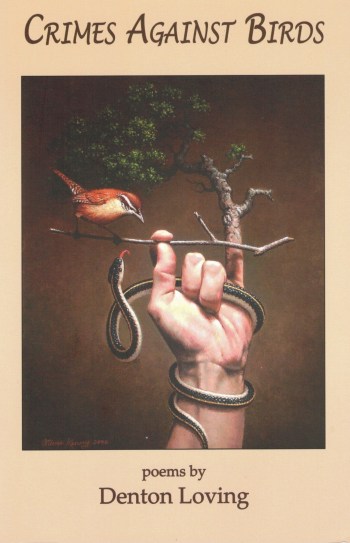
Denton Loving’s book Crimes Against Birds has been sitting beside my desk for a good while – face down because Linda is creeped out by the cover. I am so glad I’ve kept returning to it. These poems have become my pandemic companions. It’s not only because of their intimate relationship with nature, outdoors, farm life. The poems are like rocking on the porch while the sun sets across the mountains and your companions are uncertainty, death, regret, loss, but also beauty and hope – you welcome them all, invite them to sit down and tell their stories while you get to know them. There is comfort and consolation in facing what has to be faced, and as you do the moon rises through the trees.

.     .     .     .     .     .     .

.     .     .     .     .     .     .

What Was Told
(after Rumi)

What was said to the canna lily to make it
open was said here in my heart. What was
told the sycamore that made its wood hard
and bone white; what was whispered
to the storm’s wind to make it what it is;
what made the honeysuckle smell so sweet
in summer; whatever seed was planted
in the core of the mountain
people to make them love
so deeply, fiercely, beautifully;
whatever gives the catawba the pink inside
the white blooms – that is being said to me
now. I blush like the catawba’s flower.
Whatever gave life to letters and words
is happening here. The great sanctuary
within me has opened its doors; I fill
with thanksgiving as I savor the sweet
taste of honeysuckle on my lips, in love
with the voice that speaks also to me.

.     .     .     .     .     .     .

My Father Leaves Harlan on 119

He remembered
when they started the first
eight miles of this new road
from Pineville to Harlan:
it was 1958.
They had closed
the mines. You couldn’t buy
a job anywhere.

Wilse and Stan and I
were on our way to Corbin
to put in applications – I
can’t remember where now.
Was so long ago.
They didn’t take Stan’s
or mine, and they never did call
Wilse back.

We were hungry
and stopped at Grandma’s
in Barbourville.
We came in the noon
of the day. I don’t think
she was too happy to see us
right in the middle of her work
but she fed us good.
Always did.

She’s been deal all these years
and here I am
Still driving
up this new road.

.     .     .     .     .     .     .

Your Very Flesh

I knew a woman who made fudge as thick
and smooth as summer and five times better
than any you ever ate. It’s an art

to make anything that melts on your tongue,
can be savored down deep in your soul. Makes
me want to know how to do it too. Do you

know how to do something that brings simple
joy in its beauty, will be remembered
after you die? Every July, my Nana

made fourteen-day pickles. For days, she soaked
cucumbers in salt water, removed to
cut in perfect slices, submerged again,

drained them and covered them, added alum,
added sweetness, drained and boiled the syrup,
covered again, dedicated fourteen days

to create something in the end that looked too
pretty to eat. But we did anyway. Now, she
is gone, and none of the rest of us will give

fourteen days to the drudgery of pickles.
I’m not only talking food. I know a man
who can quote lines from the classics to suit

any occasion. His gift is not just memory
but also timing and recitation. He’s a walking
anthology of lost verses, forgotten lines.

This same man cuts and sells timber, and I’ve
heard said there’s no one better to use every
inch of wood a tree can yield. There’s no waste

in his bones. Another art. And I bet
when this man stands in the woods with his saw
in hand, he pauses and gives a little

eulogy for the tree he’s ready
to bring down. May, a word from Plato
or john Donne, or this from Whitman:

your very flesh shall be a great poem.


all selections from Crimes Against Birds, by Denton Loving, Main Street Rag Publishing Company, © 2014

.     .     .     .     .     .     .

.     .     .     .     .     .     .

The quotation from John Lennon’s song, “Beautiful Boy,” has also been attributed to cartoonist Allen Saunders in 1957: Life is what happens to us while we are making other plans.

When we meet with Margaret, Josh, and Bert in person we sit around in the backyard in Raleigh, masked if we’re less than 6 feet apart, but we’re allowed to get knee hugs from Bert. The chickens peck around us and garble and coo; Bert runs everywhere and shows us everything; maybe Josh has heated the wood-fired bread oven and makes pizza. If it’s too cold we have to get up and keep moving, maybe walk the Crabtree Creek Greenway. More than once it’s been too too cold and wet and we’ve just had to cancel the visit. But it will never be too cold After.

More about DENTON LOVING, his writing, himself: https://dentonlovingblog.wordpress.com/


.     .     .     .     .     .     .

2017-03-06a Doughton Park Tree

Read Full Post »

« Newer Posts