Feeds:
Posts
Comments

Archive for October, 2020

[with two poems by Debra Kaufman]

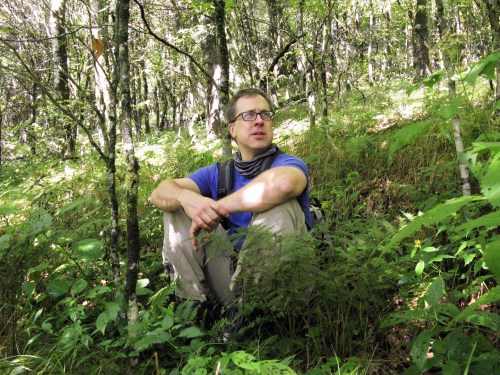
Deep shade, red spruce, heavy moss – the trail switches up, cuts back, winds steadily higher. We can smell the transition, conifer tang, slow decomposition. We can feel it on our faces, in our pores, sweat cooling, wraith of mist blown up the ridge to envelope us. And we feel it somewhere deeper.

Something changes, so gradual we sense it before we know it. Daylight creeps through, one tree with toothed sun-colored leaves, then two; smell of spring and sweet flowering even at the end of autumn; witch hobble and pale mountain asters give way to dwarf goldenrod. Look, here are beech drops, flowers faded, seeds set, never green, their skinny bodies and appendages like effigies set among the trees they parasitize. We stop and breathe. Again, deeper. This is beech gap.

Leave a patch of ground alone long enough and it will grow into what it is meant to be. Its personality is in its community. Why does this beech gap persist? Its elders, Fagus grandifolia, stunted and twisted in communion with mountain maple, wood ferns, sedges – why not fir and spruce intruding? Elevation, precipitation, mountain aspect, soil pH? Centuries-old seed repository in the duff? Visitation by warblers, jays, and small mast-seeking mammals? Protection by allelopathic residues? Protection by mountain spirits?

All of these may define but don’t explain. It is the community that becomes itself: shallow spreading roots and pervasive mycelia, leaf and frond, sporangium and ovule, every one essential to the personality of place.

And you and I? We may choose how tall we stand. We choose which way we face, whether we learn from our elders, teach our children. We rest here for a few minutes and commune with this other. The silence of a ridge-crest glade: fragile or resilient? Retreat or restoration? Will we descend from the mountain and bring this peace, this purpose, into our own communities?
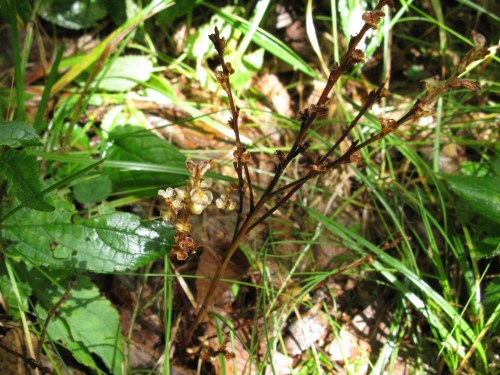
Beech drops, Epifagus virginiana, Orobanchaceae (Broomrape family)


.     .     .     .     .     .     .

These two poems by Debra Kaufman speak to me of reverence and restlessness, of longing for community and the fear of isolation. Are we welcome on this earth and will we welcome others? Will we create more than we destroy?

As described on the cover of her book, God Shattered, Kaufman discovers how personal disillusionment can be a guide to finding the godly within ourselves. These poems lead us to contemplate and understand our place in this fragile world.

.     .     .     .     .     .     .

Great White
An angel is nothing but a shark well-governed.
– Herman Melville, Moby Dick

Everyone carries a shadow.
The less it is embodied in the conscious self,
the blacker and denser it is.

Does a savage self always lurk
just below the surface,
on the hunt, no matter

our good intentions? Is our higher
nature ready to do battle against the dark,
harpoon at the ready?

If, as the Buddha says, there is no I,
does awareness reside
between empty spaces?

I understand so little.
But I can see Aleppo is rubble,
its people scattered;

anyone who listens can hear the cries
of girls being shuttled into brothels,
can imagine comforting someone suffering

here or half the world away.
How do we stop what is sacred
from being ravaged,

witness life out of balance yet not despair?
There must be ways
toward doing what is right.

Why else, as Job asked, would
light be given to a man
whose way is hidden?

The great white shark
is nearly extinct. It can sense
a beating heart over a mile a way.

.     .     .     .     .     .     .

Welcome

You, one of seven billion born
helpless, nearly hairless,

one more chimp-cousin
in our midst:

Will you be swaddled,
neglected, anointed,

will you breathe air
that smells like rain?

Which foods will sustain you,
upon what ground

will you walk? What storm,
fires, floods will sweep

over you, what languages
will you learn, what

dances, what prayers?
Here is my hope for you,

little stranger: may you feel
beholden to this wondrous planet,

may you take your hungry,
humble place in it,

may you dedicate your life
to making it a world worth

revering, holding, passing on.

poems by Debra Kaufman from God Shattered, Jacar Press, © 2019

.     .     .     .     .     .     .

Debra Kaufman grew up in the Midwest but has lived in North Carolina for thirty years. She has published three poetry chapbooks and four full length poetry collections: God Shattered, Delicate Thefts, The Next Moment, and A Certain Light.

.     .     .     .     .     .     .

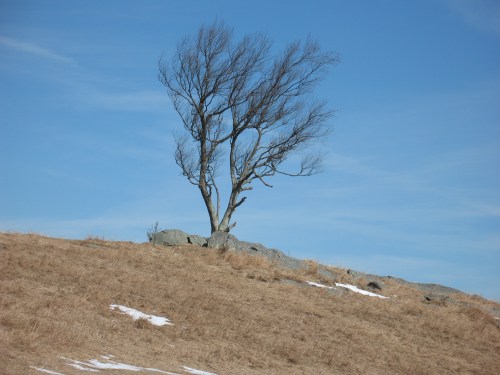
The Beech Gap is a rare subtype of Northern Hardwood Forest, found scattered in small patches surrounded by Fraser Fir and Red Spruce in Great Smoky Mountains National Park and elsewhere at the highest elevations of the Southern Appalachians. The Beech, mixed with small numbers of Buckeye, Birch, and Maple species, are stunted by the cold climate and high winds, with an open understory but relatively rich herb layer. Some patches in the Smokies are fenced to prevent destruction by invasive non-native wild pigs. Why this seemingly stable climax plant community remains stable and is not overtaken by Spruce-Fir remains a mystery.


.     .     .     .     .     .     .

All photos by Bill Griffin from Southern Appalachian Naturalist Certification Program on Southern Appalachian Ecology, September 2020, Great Smokies Institute at Tremont; instructors Jeremy Lloyd and Elizabeth Davis.

.     .     .     .     .     .     .
 

IMG_7952


Read Full Post »

Poem in the Key of E

Some trees keep their color and shape
even beyond the time that we have ceased
to dream. They tease us into faith.

This one I approach from a distance.
Its leaves, like tiny flags of grace,
beckon to me. It is November, and the rain

has pelted us, sweeping masses
of yellow to the sodden earth.
But these leaves stay, and the tree,

bright orange against the now blue
sky, stands against the growing dark.
Some days I am afraid to come,

fearing that a mean and fickle God
will flip the table, leaving me nothing
but a tangle of dark and dirty branches.

The neighbors think I’m weird.
“For Christ sake,” the plumber says.
“It’s just a fucking tree.” Maybe.

I thought that once myself. But now
if I close my eyes hard in the night,
the color comes and the room

slides away. I float upward in this
orange, this strange treeness.
My body is inside, looking out.


Anthony S. Abbott, from The Angel Dialogues, Lorimer Press, 2014

.     .     .     .     .     .     .

Poetry, on some level, is about saving things. . . . Things die; poetry retrieves them.

Tony Abbott graced my life during the few years I knew and worked with him. He was president of the NC Poetry Society while I served on the Board, he was mentor in the Gilbert-Chappell program for students, and he was an inspiring colleague and friend. I sat in awe: Davidson professor, poet and novelist, literary leader. But Tony didn’t want our awe. He was a seeker for meaning in this tangled, sometimes messy human journey and he simply invited fellow travelers.

Perhaps empathy and humility spring from the same root. If one has suffered deeply, one cares for and feels deeply the suffering of others; if one has experienced the frailties and missteps to which none of us are immune, one sets aside pride and judgement and stoops to lift the burden of one’s fellows. If one member suffers, all suffer together with it; if one member is honored, all rejoice together with it.

Tony, with his vast gifts and achievements, embodied empathy and humility. My life is richer for having shared it with him. Now his voice we carry within ourselves.

.     .     .     .     .     .     .

Going Home:
a poem in memory of those North Carolina writers who have gone before us

– Weymouth Center, July, 2009

Late afternoon. I lie in the long grass and wait
for words. The still white clouds mock me. Then,
unexpectedly, the sound of music. I sit up. From
an open window upstairs, the clear sounds
of Dvorak. I know these notes like I
know the timbers of my own soul. Yes.

The English horn sings the theme, and sings it
yet again, with the bass clarinet. And then
the strings enter, like a prayer. Take me home,
Lord, take me home. Now the clarinets,
and the horns like faith answer. Then the strings
whisper softly, yes, and again, yes.

I see Graham Jackson, tears running down his black
cheeks, Graham Jackson, in full dress uniform, playing
“Goin’ Home” for his beloved Franklin Roosevelt, and then
the farmers, young and old, black and white, all
of them poor, who loved the only man they had
ever known as President of the United States, hundreds
standing on the hills of Georgia and the Carolinas
watching the train go by with the body of their lost
leader, watching the train take him home. “Goin’ home”
say the English horns again, and then the clarinet returns.

Here I am, listening, images surfacing – the trim brick walks
of my beloved town, the green hills to the west, rising
and falling like the strings, the waves on the outer
banks crashing like the cymbals, then sliding back
like the clarinets. I see the faces of my friends, I hear
the voices of the poets who have gone before, their words
rising again. Dark skinned and light, old and young, male
and female, children of the valleys and the mountains,
children of the coast and the Piedmont. I am here, they say,
I have made the path for you, and I am still here, my words
as true as the rock face of Cold Mountain.

The music soars and for a moment there is light. The whole
orchestra together in hope. then the English horn alone,
mournful, and the strings so soft, almost a whisper.
The strings carry our love over the hills to the sea,
the horns offer it to the sky, and the strings set it aloft.
It is done. They have gone home, and who and what
they are we carry within ourselves. The evening comes.
I rise from the grass and walk toward the open window.


Anthony S. Abbott, from If Words Could Save Us, Lorimer Press, 2011

.     .     .     .     .     .     .

Poetry, on some level, is about saving things. Even a poem so simple as “Growing Up” in A Small Thing is about saving the wonder of the child in an adult world that conspires to destroy it. Maxine Kumin uses the term ‘Retrieval System’ in one of her great poems. Poetry is a retrieval system. Things die; poetry retrieves them.
from Anthony S. Abbott – In His Own Words

Tony Abbott’s publications at Lorimer Press

Biography and induction into the North Carolina Literary Hall of Fame

The scriptural quotation above is I Corinthians 12:26, New Revised Standard Version

Sam Ragan Poetry Festival of the North Carolina Poetry Society — March 22, 2015

.     .     .     .     .     .     .


IMG_1783

Read Full Post »

« Newer Posts