Feeds:
Posts
Comments

Archive for May, 2011

Many Native American cultures – Iroquois, Oneida, others – express the sacredness of earth and family in this guiding principle: make your decisions according to how they will affect the seventh generation. The idea of planning for seven generations has been adopted by ecologically minded groups from California to Vermont. Engineers, builders, civic planners – “7 generations” appears in their name or their mission statement.

Why seven? Besides being a number with plenty of mystical portent, there’s a practical matter to it. With a good memory, reasonable longevity, and a little luck you yourself have a good chance of knowing personally seven generations of your family. Linda had a long and close relationship with her great-grandmother, who lived into her nineties. In fact I met Great-Grandma White several times when Linda and I were dating (along with a houseful of about fifty cousins, aunts, uncles, and greats, all of whose names I had been carefully coached to memorize – and folks, this wasn’t the rural South, this was the Rust Belt). And if Linda and I live to ninety our grandson Saul will be 35, surely old enough to have had a couple of great-grandkids for us. Add it up – seven generations.

Extended family. Reaaaally extended. It does make you want to think a little more critically about where you place your priorities. Saul, I’ve already planned to bequeath you my best binoculars, solid enough to stand the test of generations, a legacy I hope. May you see things with them that I’ve only imagined.

Imagining. Seeing. It happens when I read this poem Conversations on the Leaving by Marty Silverthorne. I find myself smack dab in the middle of the generations. It’s one thing to experience a poetic image that brings a vivid scene to your mind, but it’s quite another to find yourself in the room, in the conversation, stammering to add your own voice to the dialogue. So poignant, so immediate – I wish I were kin to Marty. Maybe after reading his poetry I sort of am.

The poem is from his book No Welfare, No Pension Plan (2006, Rank Stranger Press, Mt. Olive, NC). The entire collection is exquisitely personal – much of it is an elegy for grandmother, grandfather, father. The language embodies the rough life of the farm and the pride despite poverty of Eastern NC; the language rises with gut-felt power like a revival preacher; the language sings mournful like nightbird and swamp. Great Granddaddy Fred was water, / fluid and free. / In his palms, seeds sprouted; / sap seeped from his pores. (from Water Walker). There are smells and sounds and dog-tired feelings here that we don’t want to lose. We can’t stand to lose them. We can’t afford to. They need to be recalled to the seventh generation.

IMG_9642_crop01

.    .    .    .    .

Conversation on the Leaving

He was speaking of the leavings;
his voice broke in a rhyme,
poverty, poems he had witnessed.

They didn’t leave much – trinkets
mainly trinkets – nothing of value;
you knew their poverty, son.

So I didn’t get much.

Did you get the green elephant?

Yeah, I got the elephant.

Wasn’t it a stencil to draw by,
with a thumb tack for an eye,
wasn’t it a stencil?

No, it was a napkin holder,
a broken napkin holder
she pinned above the plate rack
with a white thumb tack.

Oh a napkin holder! I never knew.

They didn’t leave much – trinkets
just trinkets – old odd things –
that mean nothing to no one, son.

Did you get the horse heads,
the wooden horse heads,
brown, wooden horse heads
nailed above the headboard in the bedroom?

They were dogs.

They were dogs?
I never knew they were dogs.

Yeah, they were dogs.
Cut’m in woodshop
with a coping saw
I’ve still got.

Like I said, I didn’t get much —
trinkets I saved
they were going to throw away.

Your brothers won’t want much;
they don’t remember the oak floors
covered with linoleum
or the day we framed the new cabinets.

Dad, did you remember the church
how about the church;
not the Eiffel Tower but the church?
remember the church? It was broken;
the children broke the church.

Son, I didn’t get much;
they didn’t have a lot to leave
but the church, I got the church,
the family was forged in the church.

 IMG_9719

Four Poems by Marty Silverthorne

Feature at NC Arts Council

Asheville Poetry Review

.     .     .     .     .

IMG_6432

Read Full Post »

[for the first post in this series of four, see May 8]

Years ago, before I’d reached my fortieth birthday, I remember talking to a friend who was looking pretty darn glum about his fiftieth. “Oh come on,” I said, “Just think of it as the half-way point.” I couldn’t understand why that didn’t cheer him up. Now my own fiftieth has got dust and flyspecks on the binding, and apparently I still haven’t memorized its aphorisms. If it’s impossible, as must seem obvious to any rational being, to put right all the mistakes I’ve made, why do I keep looking back? Why do all the possible futures unfolding out of my particular Heisenbergian uncertainty seem to have edges of creeping tarnish?

In this second section of my poem Leave and Come Home, I am struggling with uncertainty. Will our future relationship, mine and my son’s, be bright as the Firethroat or remain out of reach? I think of my own Dad, turning 85 this year. So much of our communication in my younger years was subterranean, never quite reaching the surface. How much angst did I cause him with my long hair and Grateful Dead? (Some other day I’ll share about how Linda helped us re-learn how to hug.) So much I didn’t know about my father, and so long before it occurred to me that I didn’t.

DSCN4536

Several year’s ago Aunt Ellen (Dad’s sister) was going through boxes of papers from their parents’ home and discovered a letter Dad had written to his Mom from Boy Scout camp. He must have been thirteen. He had just passed the requirements to earn Birdwatching Merit Badge and was describing the birds he’d identified. Wait a minute! Big Momso is the bird watcher! You sneaky Dad, you, looking up into those branches all that time and never telling me what you were seeing. Well, I’m telling.

.  .  .  .  .

Leave and Come Home

Horseshoe Island, Newfound Lake, Boundary Waters Canoe Area Wilderness, Minnesota

Last night a pair of Bald Eagles scrawled their wild script
along the silver lake. We lay on high rocks above the water, waited
for the final stars of our adventure to ignite.
Only Hermit Thrush spoke – silence
unaccustomed from our Scouts but habitual
for Josh and me.

This morning I leave him to goad
the younger ones to break our last camp –
when he leaves for college will he goad himself?
I follow the island trails, aim field glasses high
as if the warblers I’ve learned this trip might bestow
some special unction. When I pause they gather
in low branches and cock their heads, a query
I can’t answer. They leave me there.

Almost finished now, this last solitude, this last trail that has tried
to lead back to my son, close enough to hear
the tink of scrubbed pots; high in the spruce
another unnamed voice reedy and ascending
into emptiness. I search, it flees; I scan, it eludes until
on a gray limb in the gray-green canopy with a gray moth
in its needle beak it blazes: Firethroat. Blackburnian Warbler.
And if I rush to camp and pull Josh back in time
will we look up and share the prize
or stare into empty branches?

.  .  .  .  .

[Leave and Come Home won the 2009 Poet Laureate Award of the NC Poetry Society. In four sections, it covers fifty some years of being a son and father to a son. Each section covers a different geography, the sighting of a different warbler, and a new phase in our relationship as a family. I posted section 1 on 5/8; I will post section 3 on 5/22 and section 4 on 5/29.]

.

.

Read Full Post »

Less is more.      –       Ludwig Mies van der Rohe

My high school art teacher was more than eclectic. I can’t see a cityscape without thinking of Lyonel Feininger, and we did an entire unit on the Bauhaus. Gropius, Kandinsky, Klee, there is music in the names. Years later when I began writing poetry, though, I guess van der Rohe’s aphorism had failed to inform. My early stanzas were little bricks, four-square and chunky, nary a chink much less any breath. Did I imagine the proper density of “condensed language” was that of neutronium?

I trust that my current poems can sometimes walk through the woods without the need for supplemental oxygen, but I am still far from mastering that most ephemeral, jewel-like and perfect poetic form. I have yet to write a decent haiku. I get twitchy wanting to add more painted-on layers of complexity. I want the scarlet oak leaf to become a scarlet tanager. I can’t let the image be the image. How many haiku masters does it take to change a light bulb? None, for they are the light bulb.

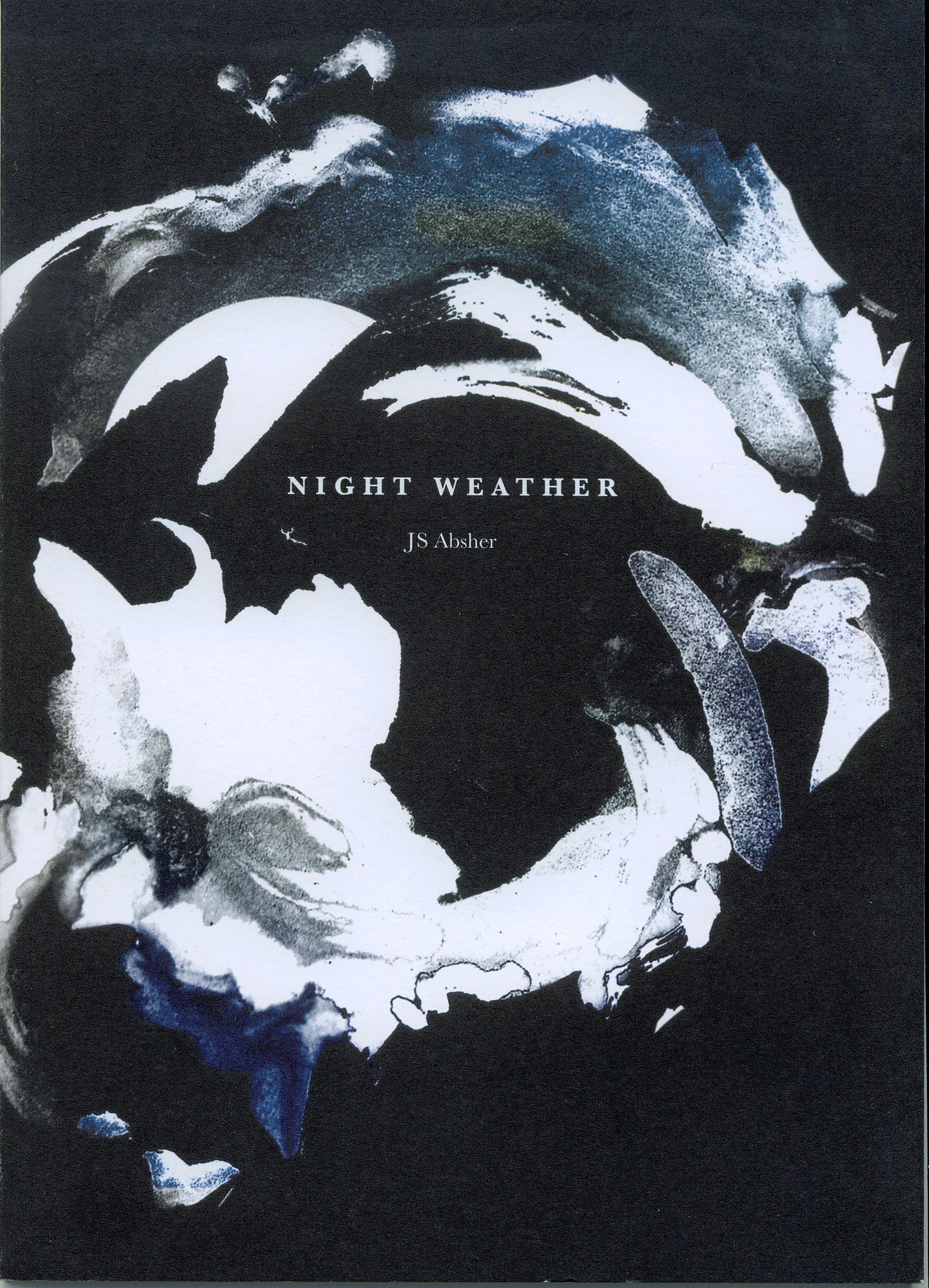
I will have to be content to let that light shine into me by reading Night Weather. Stan Absher’s poems are airy, piercingly bright, yet willing to settle briefly on your palm. Never can they be pinched between thumb and forefinger like a dead specimen. Open to any page, touch your tongue to a line, inhale the pinprick drop of scent as from honeysuckle flower. In the book, the seasons of haiku are punctuated by longer poems, but even these retain the sense of being present in their one precise moment: low sun / raking the leaves / into long shadows.

On your neck, the soft breath of these images. And patiently between the pages, watercolors by Katie Nordt. Also deceptively simple in their color and form. Follow the quiet path that winds among verse and line and season and you discover a deep story unfolding. Complex in its simplicity. From less becomes . . . ever more.

NigntWeather_bamboo01_crop

bamboo

the bamboo grove
glimpse of stray light
butterfly

old house

no one can sleep

the flooring relaxes
on its joists

the downspout
hisses like a snake

in his shorts, Daddy
leans in the open
doorway, smoking

NigntWeather_eno01

Night Weather

JS Absher PoetryNigntWeather_cvr01

Katie Nordt, art and illustrations

.

.

.

.

.

.

.

.

.

.

IMG_0768

Read Full Post »

« Newer Posts - Older Posts »