Feeds:
Posts
Comments

Archive for May, 2011

I’ve made a whole lot of bird lists over the past twenty years. (Made a BIG one yesterday – see the post in a couple of days.)  I’ve got lists for my yard, my neighborhood, for Elkin and Surry County, for Pine Knoll Shores, for NC and a bunch of other states, and then of course the master list, the “life” list.  I’ve even gone on a couple of organized trips where a guide would point to the bird and tell you what it was — then you add it to another list.  And check it off in your database when you get home.

But among all those lists, among the thousands of data points, for some reason there are some individual birds I never forget.  My first Northern Parula – right here in my own backyard, but I waited almost an hour for it to show itself at the tip of the big white oak.  The Black-Throated Blue Warbler Mary Ellen and I spotted near Muskrat Creek Shelter on the AT, our last evening together on the trail.  The Common Yellowthroat Nancy and I stalked through briars so she could see her first one.  On and on.  I’m thankful for each creature’s tiny jewelled body.  I’m thankful they decided not to conceal themselves forever.

The birds I added to my list during organized trips are just not as memorable as the others (well, maybe the Harlequin Duck bobbing in the surf at the pier in Rodanthe . . .).  Am I saying that we treasure most those things we have to work for?  Good Puritan ethic! But that’s not exactly it; I guess I would rather say we treasure those things we discover for ourselves.  The branches are full of warblers – will I raise my eyes and look?

This is the closing section of my poem Leave and Come Home.  My journey as father is about to enter unmapped territory – the mountains and coves of grandfather.  Warblers are returning from their wintering grounds to make a new home.  How have they found their way?  How will Josh and I find ours?  Some vast unseen magnetism compels us.  Perhaps home has always been, although unnamed and so often unseen, that inner will to discover.  Maybe home is always that very thing we hope to find.


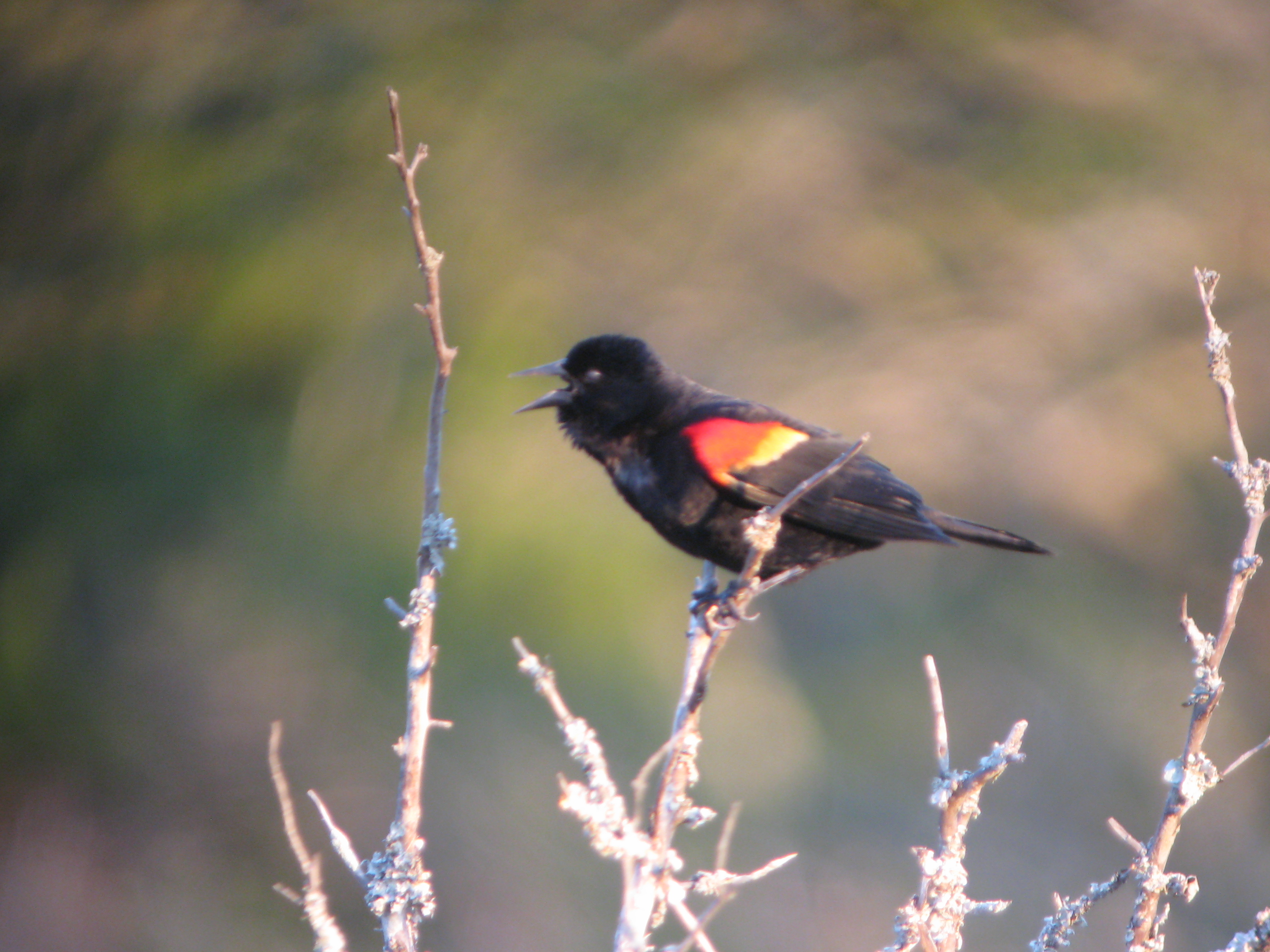
IMG_1009_crop01

.     .     .     .     .

Leave and Come Home
Backyard, Elkin, North Carolina

Which one is home: what I know and leave behind
or what I have yet to reach?
May 1st storms all day and night but this bright morning
frees the migrants from their cover – tree limbs fill
with warblers.  In an hour they’ll resume their passage north,
but for now they’re willing to reveal themselves
if we have the will to notice.

In a few days Josh will become a father. I watch
the corner of his mouth for a hint of one laconic smile . . .
there it is!  He follows a trail of a hundred steps to assemble
my grandson’s crib. Outside the back window
Cardinals jostle at the feeder and

among the poplar blossoms warblers ruffle droplets
from their wings, show off their woodland jewelry,
glean aphids from beech twigs.  In the spotlight
Black-Sided Blue preens in formal dress, then flies.
And does he dream of the feast of insects
at his Costa Rican winter grounds or of the nest
he’ll build at Clingman’s Dome?  Or is it simply
some vast unseen magnetism, cycle of sun and
circling stars that speak to him to reveal
his home?  Point to it, Mom.  Or leave
me to discover it myself – home may yet abide
in what we hope to find.

Tomorrow I will lean into that crib compelled
by stars and magnetism, leave for later the unnameable
complexity of color, shape, song, that unspoken
trail that twists between son and father:
into that soft pink ear, I’ll whisper Redbird.

.     .     .     .     .

[Leave and Come Home won the 2009 Poet Laureate Award of the NC Poetry Society.  In four sections, it reflects some fifty years of being a son and father to a son. Each section covers a different geography, the sighting of a different warbler, and a new phase in our relationship as a family.  I posted section 1 on 5/8, section 2 on 5/15, and 3 on 5/22.  This is the fourth and final section.]


Read Full Post »

A couple of years ago my friend Mike and I went backpacking in the Slickrock Wilderness,  near Joyce Kilmer Memorial Forest.  On day one we reached our camp site in mid-afternoon, about half-way up the mountain along Little Santeetlah Creek.  With tent pitched and bear bags hung, I lay down in a patch of sun to listen to the chatter and riffle of cold crystal over moss-draped boulders, laughter over smoothworn gravel.

As I dozed, water voices sang to me.  Urgent conversations, reminding, cajoling, the words critical but somehow never clear.  I half-dreamed of the people that had walked these hills.  Native hunters stalking deer where the clamor masks the sound of their approach.  Homesteaders sledging river stones to turn to cornerstones beneath chestnut timbers.  Foresters marking the next stand they’ll cut, somehow never reaching the old growth poplar and hemlock at Joyce Kilmer.

So many voices lost in the creek’s murmurings, yet also brought to life in that mutter. Aren’t we as poets the keepers of lost voices?  We capture in a phrase a moment that would have been forgotten, an image that would fade.  If we can speak for those who have no words they will “bless us with their bones.”

This poem by Margaret Boothe Baddour, For the Lost Poets, speaks to all who would be keepers of lost voices.  Seeking a mountaintop, discovering a new high place, she revivifies those poets whose voices might have been overcome by the clamorous falling water of years.  Before we can say, “We are lost,” we find ourselves in a new place with new breath.  Be still, listen for meaning within the whisper, the murmur, the water, the earth.  Someone wants to speak to you.

DSCN4902

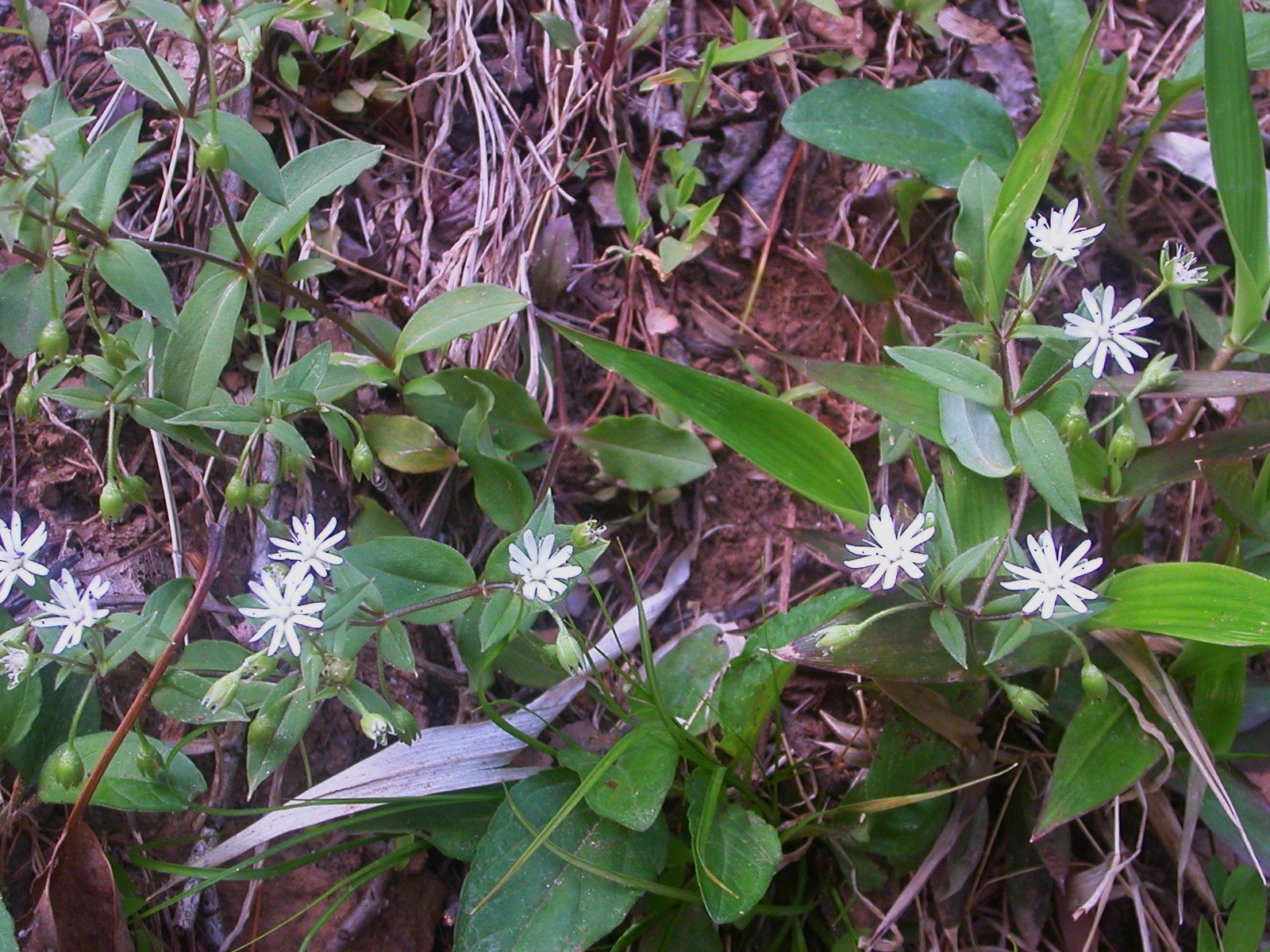
Star Chickweed

For the Lost Poets
           —            Wildacres, 2008

For every day they die among us,
those who knew it was never enough
but hoped to improve a little by living.
             –   W.H.Auden, “In Memory of Freud”

I.  They Whisper to Us
On this mountain top – so high not even birds
fly here and only small, complcated insects
amid the ox-eye daisies and wild yarrow
worry us with their rush-roar-whir –
we brieve for those poets whose rustling voices
the quiet, the strong, even the raucous ones
are lost.  No, not lost.  Only hushed.
They whisper from just over the next hill.

II.  We Are Lost
We lose our way, looking for Roan Mountain
where, folks say, the pale pink laurel grows.
At the crossroads, an old man stand
like a cigar store Indian.  His white mustache
and brogans, his worn overall speak hillbilly
but before we can say, “We are lost, he smiles
gap-toothed and points like a sign: “Turn left,”
he says.  “Three mile uphill to Roan Mountain.”

III.  They Leave Their Words
At the Continental Divide, we glimpse horses
but the cows up here, the cows so black and sleek
where sun shafts the greensward, the water so pure
at the place where it runs downhill to the east
where bugs whir in the clover!  A white moth
brushes our arms.  Like moths, those lost poets
touch, leave their words hanging, alive in the air.

IV.  We Breathe for Them
Flash of fire – a mountain man, wave of water –
an ocean lover, the stillness of stone,
the roar of wind, all those poet friends
whose wise, strong words provoked this world
have now become the earth and air.  They bless us
with their bones.  Now we must breathe for those
who, when they breathed their last, exhaled in verse.

.     .     .     .     .

from Scheherazade and other poems by Margaret Boothe Baddour, Saint Andrews College Press, 2009.

Margaret teaches Humanities, Creative Writing, and Drama at wayne Community College in Goldsboro, NC, where she holds the Bell Distinguished Chair in Teaching.  Among her many awards and honors is the NC Poet Laureate Prize of the NC Poetry Society.

.    .    .    .    .

IMG_0880

Read Full Post »

How often would I have gathered you as a hen gathers her chicks beneath her wing . . . The Gospel of St. Luke

Bogue Banks.  Thirty-four miles long from Fort Macon in the west to the old ferry station at the eastern end, and in most places so narrow you can see both the sound and the ocean from your deck.  And you’re never very many feet from tarmac.

But there is at least one spot on the Banks where you can’t hear the SUV’s grinding along Rte. 58.  Where the live oaks and loblollies are so thick with greenbrier you wouldn’t even think of taking a shortcut.  Where egrets roost in the trees, osprey snag mullet from the inlet, and if you’re real still you can hear the tick and crinkle of a million fiddler crabs tapping their tiny claws to attract a million little females.

The Teddy Roosevelt Natural Area is site of one of North Carolina’s four aquaria, but the real attraction for me and mom are the trails that wind away from the visitors center back into the pine knolls.  Away from sun worship to slow black water and tidal ponds.  And while I’m slapping mosquitoes, Mom is seeing the merest flash of color from a high branch and exclaiming, ” A Redstart!”

DSCN1628

In the steam of the maritime forest and the glare of the strand, parent birds struggle to protect their young from heat.  In this third section of Leave and Come Home, I wonder if I have protected my son adequately from his struggles or too much.  Does a parent ever finish with worrying whether their child will make it?  Will I ever finish questioning whether I’ve been adequate to the task?

.     .     .     .     .

Leave and Come Home
Theodore Roosevelt Natural Area, Pine Knoll Shores, North Carolina

It’s been a long time since anything
surprised me.  By their mere voices I name each bird
that speaks from the rippled heat of jack pine
and yaupon, but I couldn’t tell you a single word
my son would wish to say.  No, that’s wrong.  The problem is
I don’t speak a single word I wish
he’d hear.  Here the birds cover their eggs
not to keep them warm but cool.  They hatch
altricial, blind, but in two weeks they fledge
and fly.  All as it should be.  I feel I have to lay my arm
on Josh’s shoulder not to push him forward
but to hold him up.

This trail crosses black water and climbs a sand knoll
knee deep in mosquitos; I smack
and squirm, but Mom always looks up.  She points
to sunlight coalesced into the shape
of Warbler, Prothonotary, perched at his cleric’s chamber
of commandeered woodpecker hole.
And in your ecclesiastical garments can you accept
confession, the hardest one a father
could admit?  That from reticence, confusion,
or hopes never uncovered like a wing not lifted
from the nestling’s eyes, I haven’t held him up
but held him back.

IMG_0328

IMG_0345

[Leave and Come Home won the 2009 Poet Laureate Award of the NC Poetry Society.  In four sections, it reflects some fifty years of being a son and father to a son. Each section covers a different geography, the sighting of a different warbler, and a new phase in our relationship as a family.  I posted section 1 on 5/8, section 2 on 5/15, and I will post section 4 on 5/29.]

Read Full Post »

Older Posts »