Feeds:
Posts
Comments

Posts Tagged ‘Visions International’

 . 
[poems from VISIONS Issue 110]
 . 
Cataract
 . 
That woman, somewhere in her seventies,
walking this past week without her husband,
her greeting smile the same but not the same,
water like a cataract behind her,
 . 
has managed to sew the morning round her,
given the air she parts the electricity
of apprehension. It recedes. The river
finds its level, and our walk assumes
 . 
The silence of a stranger’s unacknowledged
pain; guessing at the gap between her day
and ours, and shamed of it – who isn’t
shamed by fear and rendered speechless by it?
 . 
A dozen steps or so, and she recedes,
and suddenly there’s too much song and shade.
We’d stepped around the space he’d occupied
as if he were more vivid in his absence.
 . 
Ted McCarthy, Clones, Ireland
from VISIONS, Issue 110, © 2025
 . 
❦ ❦ ❦
 . 
Will the mowers quiet themselves, becoming blind to their appointed vectors? Will the heat pump rest from its pumping? We wait on the porch in fading light for transition / transformation. All afternoon and evening the rattle, grate, thrill of cicadas, but when daylight succumbs they will one by one release their reins to the katydids. The first movement of the day’s symphony, adagio, will merge without intermission into the forest’s boisterous nighttime allegretto. We wait to enter that moment, the duet of final dying cicada and first katydid newly risen. For a few minutes the two will sing together.
 . 
Alchemy it is, a dash of dappled hardwood shade, one lick of humid breeze, stir briefly with cicada song and you will transport me into the presence of my grandmother. Nana holds a dripping glass of tea for 10-year old me as I climb the sandy bluff up from Bogue Sound, between crowding live oaks, little skiff beached below, in my hand a string of croakers and spots. Nana and 20-year old me are in her driveway in Winston, red oaks towering, about to drive her ancient Plymouth to Piggly Wiggly but the “jawflies” are so loud she can’t think what she needs. I will spend half the afternoon trying to down one from its high branch with her BB gun. It decrescendos as it falls.
 . 
This morning I have exercised my gray cells and cochleae by picking out individuals from amidst the cacophony. One species of cicada is a continuous dry rattle like softly shaken maracas. Another is a sinusoidal sharp-edged rasp, a scraper pulled across a guiro. Then a third sudden loud rising crescendo crests and slows, falls back into stillness. And now at once they all cease, all except a single insistent rasp repeated ten times, twenty, and when it finishes its duet is still audible in a faint far tree. The music of their tymbales, the vibration of the living desperate to connect.
 . 
 . 
❦ ❦ ❦
 . 
At the Goodbye Door
 . 
Wind knocks on your door; a mackintosh
slung over its arm, a sigh like coyotes
 . 
as they grate their teeth, their rheumy eyes contagious
with stars, tongues slavered with hope –
 . 
their coats reminiscent of ones you donated to the thrift,
collars roughed up, delicate threads a reminder of what binds –
 . 
how we were together long enough to retrieve the inexplicable.
Satiated, we purged ourselves: You at the goodbye door,
 . 
me sweeping the floor where you stood and always a crooner
in the background singing, Loves a Difficult Wing.
 . 
Dianna MacKinnon Henning, Janesville, California
from VISIONS, Issue 110, © 2025
 . 
❦ ❦ ❦
 . 
we were together long enough
to retrieve the inexplicable,
the spring that swallowed itself –
who isn’t shamed by fear
and rendered speechless by it?
the old fields grow, indifferent
+++++++ lines from Visions Issue 110
 . 
To Bradley Strahan, for forty-five years of gleaning from fields across all the world to plant and harvest Visions-International, Thank You. To Cal Nordt, for over a decade of encouragement and support behind the scenes and for now lifting the harrow of editor, also Thank You. And to Katie LaRosa, for keeping alive the vision of design and art in the service of words, Bravo. This first issue produced by Cal Nordt is again truly international, as are all past issues, although North Carolina is also well represented with poems by J. S. Absher, Rebecca Pierre, Adrian Rice, and Cal himself. The poetry of Visions has always been brief in lines, deep in heart, brilliant in space and atmosphere – this new issue continues the lineage.
 . 
 . 
Information about previous issues of Visions-International, as well as other creative endeavors by Bradley Strahan, is available HERE.
For information about Visions under the imprint Cynosura Press, click HERE.
For submissions to Visions, contact Cal Nordt at calnordt@gmail.com
 . 
 . 
❦ ❦ ❦
 . 
Spring
 . 
The cunning master of nature
sensed my burning thirst
proffered his hand
to the lush spring
and hauled it in.
Driven by immense thirst
I pressed my lips
upon the dry sand
and let my soul wander
through underground paths
weaving like thread
through minerals and crystals,
searching for the spring
that swallowed itself.
 . 
Risto Vasilevski, Smederevo, Serbia
from VISIONS, Issue 110, © 2025
 . 
❦ ❦ ❦
 . 
 . 
Breaking Cloud
 . 
It was the crackle in the airport air
that made me think of Austerlitz
or some such flat, fat battlefield
of long ago; a river, sleek these days
and undisturbed. How easily the ground
is ploughed, the iron underneath stirred
as if always there. After the unease
of take-off, news became history,
a movement of horsemen and grenadiers
on hand-drawn maps. Now clouds part,
vapour trailing like a harrow, a brief
shudder as the landing gear comes down.
Contact, and the bump of runway lights;
impossible, as we taxi, to believe
earth now as other than unshakable.
Still, never more than a breath from anxiety –
for how long more will our children prosper?
The old fields grow, indifferent, their shot
and bone dissolving at the root.
 . 
Ted McCarthy, Clones, Ireland
from VISIONS, Issue 110, © 2025
 . 
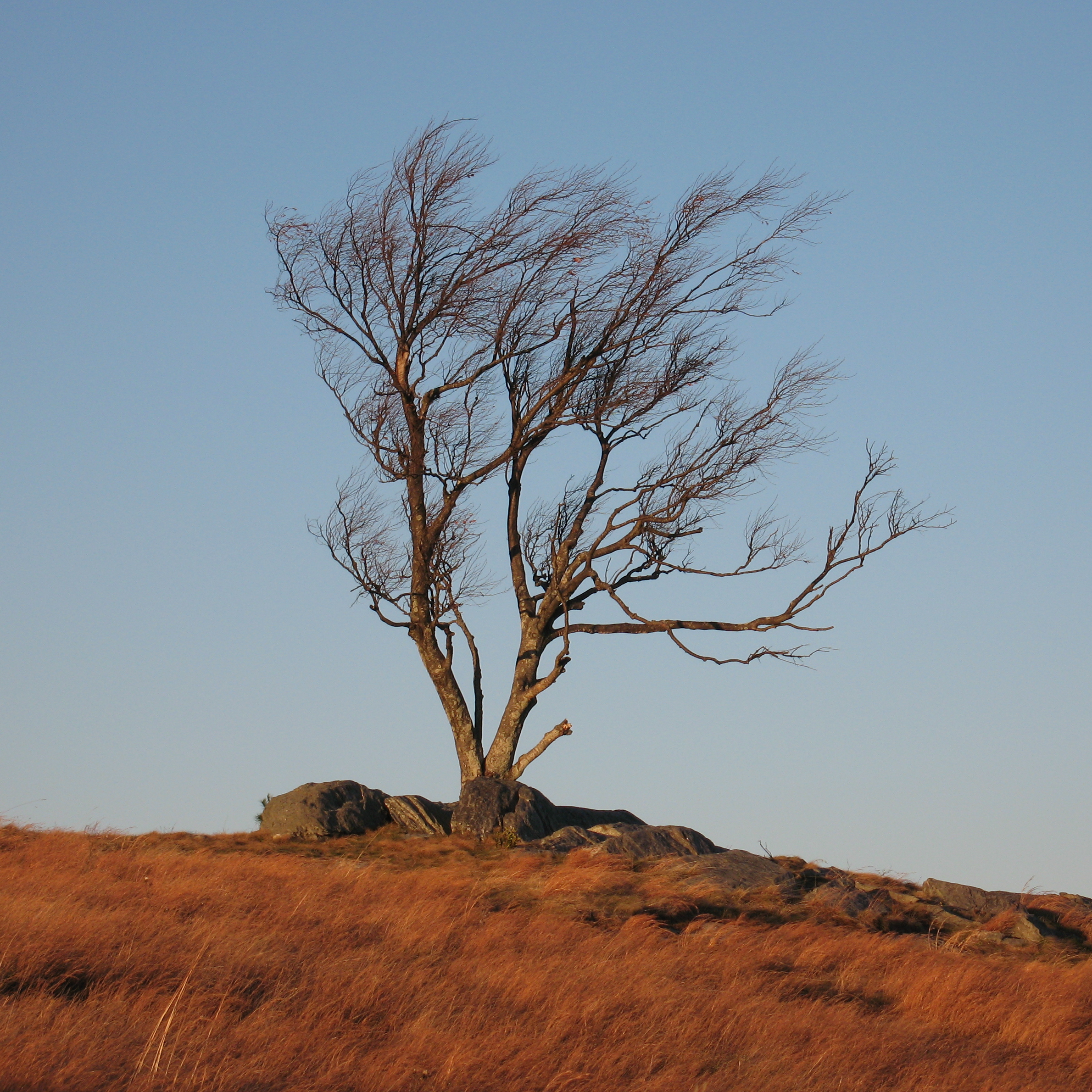
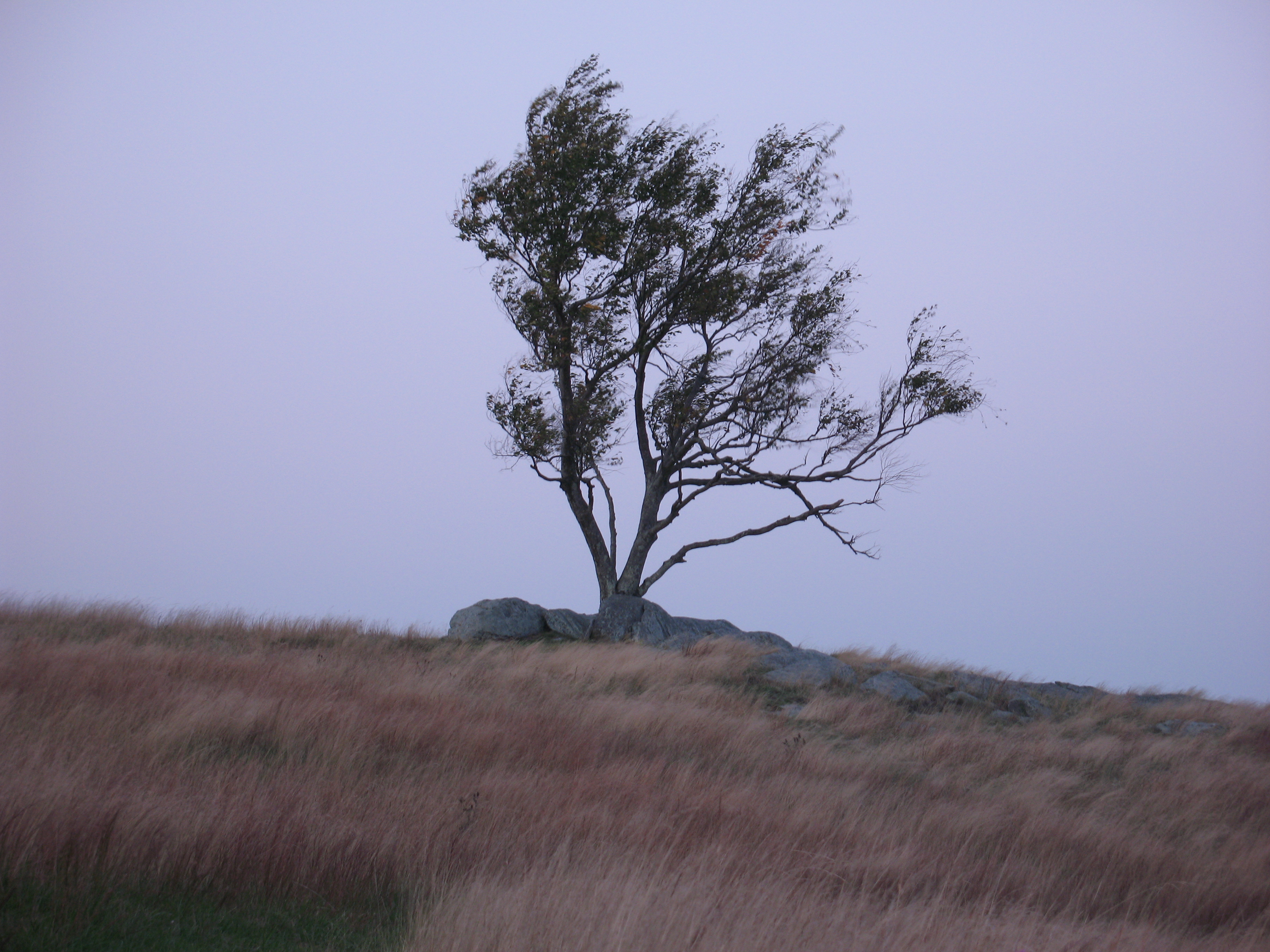
Doughton Park Tree 2025-07-10
 . 

.    .    .    .    .

Several friends have asked me to keep them informed whenever I schedule a guided naturalist hike in our area. I am planning one (maybe two) wildflower hikes in September as celebration of the founding of the Mountains-to-Sea Trail:
Friday, September 12
(and if there’s interest I’ll lead a reprise on Saturday, September 27).

 . 

Sign up at MeetUp.com to receive notifications and to register for events.
Thanks — Bill
 . 
MeetUp.com — MST Segment 6 Events — September 12

Read Full Post »

 . 
[with 3 poems from Visions International]
 . 
The Tending
 . 
Each day made a play for eternity then,
just as now each day shrinks
to a blurry moment’s recall. But still
there is the flat porch roof where a child
would lie down to watch
the clouds slowly changing shape,
 . 
or the blue, unfathomable sky
opening over, and puzzle where he was
before birth, before conception,
or if the world of sensation
had wiped his angel memory.
Cypress-tree shadow reached, as they
 . 
still do, across the lawn at evening,
and again I twist backwards
through a wooden sash window
into the long unoccupied bedroom
of my parents. Old clothes,
a straw-hat clinging to a wall, a stopped
 . 
alarm clock on the mantel.
And here, a navy-striped bolster,
the dent left by their sleeping heads
imagined as touchable still,
the love between us arguing against loss,
the tending they brought
 . 
to each sadness and terror of thought,
but more to an obvious wound –
the skinned knee dabbed
with Dettol; a beaker of oatmeal tipped
into a cold bath as a salve
for sunburn; a sewing needle squeezed
 . 
from a pin cushion bristling
with needles, the small hand held
forward into light, the gentle, tortuous
teasing out of a thistle thorn
and this placed – a charm,
frail tiny, golden – on the child’ palm
 . 
Patrick Deeley – Dublin, Ireland
 . 
❦ ❦ ❦
 . 
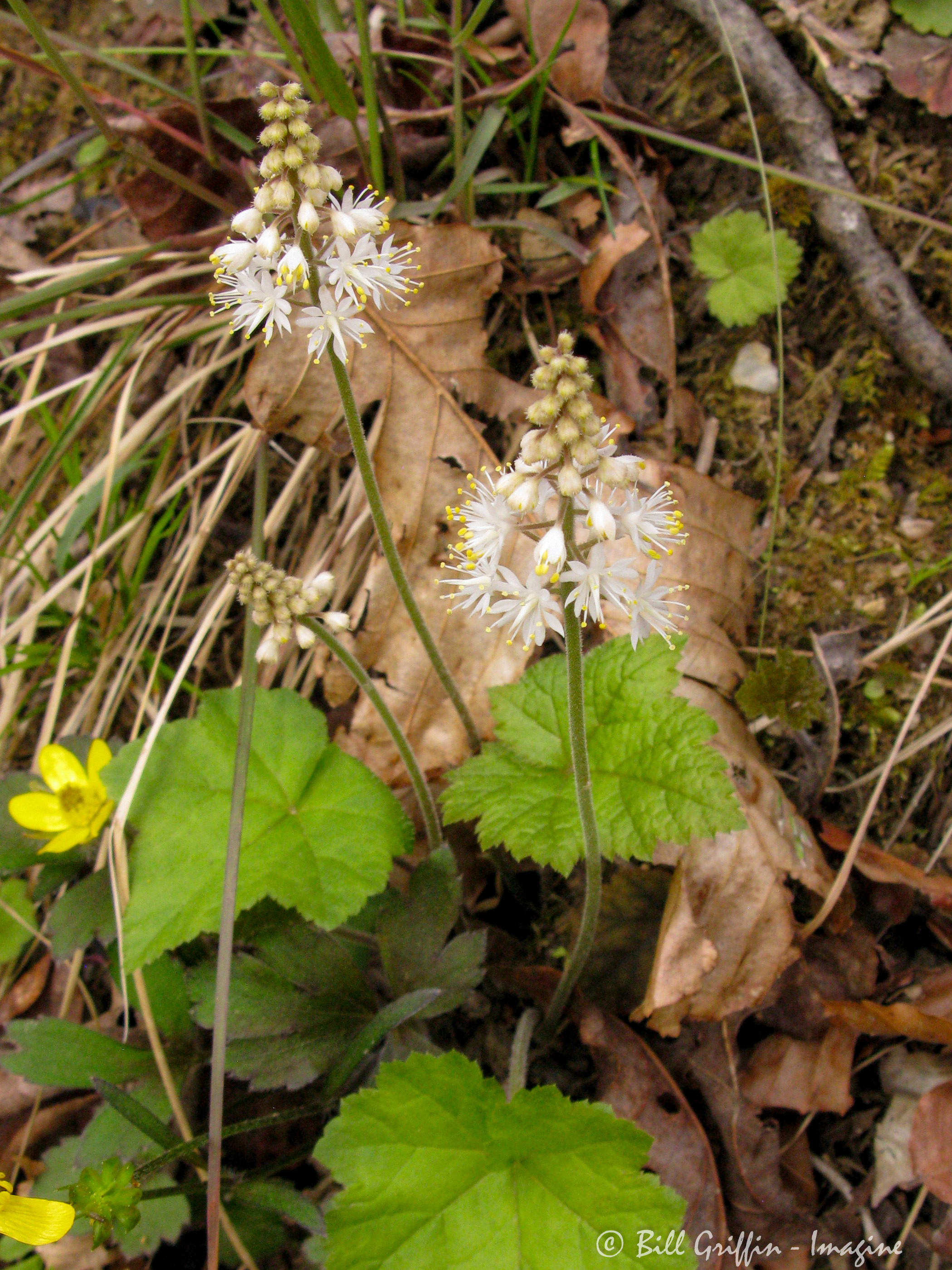
Foamflower
 . 
The last day of March – at the edge of the woods red maple, always impatient, always profligate, spreads its arms to offer a jillion winged seeds, the fire at its twigtips cooled to pale smolder. Deeper beneath the canopy leafbuds are swelling on oak and hickory, tangible pressured suspense, not yet quite to bursting. Ephemerals race to make sugar from thin sunlight before the overstory closes and their beds grow dark. Trout lily and hepatica already bloomed out; bloodroot roaring full throat; rue anemone flinging itself in galaxies up the ridge.
 . 
And what’s this? Foamflower has poked its first slender finger up between last year’s coppered leaves. A pale nubbin, a lifting spike, two or three then tomorrow a full maypole of tiny florets to comprise the rising inflorescence. Tiarella cordifolia, little crowns with heart-shaped leaves. What is its occupation in this temperate glade? What does it promise me other than its beauty?
 . 
Has it promised me anything? Should it? Perhaps I can tell you a story about the company foamflower keeps in this beech-dominated neighborhood: pussytoes, star chickweed, the throng of early blooming companions. Perhaps I’ll kneel to discover its native bee pollinators or wonder how its minute seeds disperse themselves. I might even recognize these felsic outcroppings and recall its family name, Saxifrage, Stone-breaker. But Lord of creation, save me from asking, “What good is it to me?” Expect a poultice of its leaves to heal my burns and scalds? Brew a tea to soothe my mouth and brighten my eye? Shall I read in its signature only whatever good use I can make of it?
 . 
On the seventh day the Lord looked out upon everything created and declared, “It is good!” And then rested. Never let me rest until I have looked around me, all around, water and stone, flower and tree, worm and beetle, turtle and bird, each of them good, in themselves and of themselves. Each one living usefulness that comprises its own being. What is my occupation in this temperate glade? What may I promise all these that surround me? To be a good companion in the community of all.
 . 
 . 
❦ ❦ ❦
 . 
O Doves
(Lima, Peru, 6 am)
and he saw the Spirit of God descent like a dove . . . Matthew 3:16
 . 
Shy ones, the shades of buttermilk
and cirrus cloud,
 . 
forgive the man and woman
cursing the scrabble of your bones on the
bedroom window ledge.
 . 
They are harried creatures
waking out of sleep’s egg
to the greasy clot of day.
 . 
They know only hunger,
which is the world’s stark treason,
 . 
and the mockery of iridescent necks
pecking the gray flagstones for crumbs.
 . 
How can they love the immaculate
cooing of your beaks so high in the blue air,
 . 
having forgotten the signs
of invisible things?
 . 
Maria Rouphail – Raleigh, North Carolina, USA
 . 
❦ ❦ ❦
 . 
the gilded angel on the spire / draws the sun to its dewy face
 . 
landscapes advance / and dig their hooks in the elongated shadow/ you drag behind you
 . 
a child’s sleep soothed by rain’s ticking / on the other side of the earth
 . 
an accordion of hands fixing my hair
 . 
I smooth my quilt, where her dress scraps are stitched
 . 
a pair of wired gold rim glasses / like John Lennon’s
 . 
the water above the springs squeaks like pebbles
 . 
Here is the plain brown envelope with the hand-printed address and the Pete Seeger postal stamp. I slip out the slender booklet, cardstock cover illustrated by Malaika Favorite. Inside a listing of poems and their poets – Bulgaria, North Carolina, Wales, Macedonia, Texas, Ireland. And then the saddle-stapled pages, their lines wandering in the familiar, distinctive font, and the words . . . language . . . images.
 . 
After reading many issues of Visions International over many years, I still wonder how editor Bradley Strahan draws these voices to him. How he creates this international community of human soul. I wonder how he accomplishes it, but I may be learning a bit of what he is listening for, what he seeks and chooses as he compiles each collection. Even more compelling than the stories the poems tell are their images: elemental, bedrock, true. I read phrases that ring with harmonies I’ve never quite heard before and yet they strike as perfectly right and correct. The language is new and yet it enters me and becomes me. (And I have to confess, there is just something about those Irish poets.)
 . 
Here are old neighbors, like Maria Rouphail from Raleigh and Jessie Carty from Huntersville, but here are my new old neighbors from every corner of the earth, all drawn together through their poems. Drop Bradley a line and join the community.
 . 
Visions International / 309 Lakeside Drive / Garner, NC 27529 – 4 issues = $25
 . 
 . 
❦ ❦ ❦
 . 
Drive
. . . roll down the window, and let the wind blow back your hair.
+++ – Bruce Springsteen, Thunder Road
 . 
My first love and I would circle the Blue Ridge
listening to Thunder Road, caught in a spiral –
the song, the earth, and us – a springboard
for leaping. Ancient and settled,
those mountains, a silhouette absorbing music
from our high school parties at the VFW.
Moths and gnats reduced to a fever
clouding porchlights, while kissing was its own
stratosphere. Who needed to breathe anyway?
Not when you’re a new mythology
sharing sixpacks of beer and meadows jacked
in the sweet everlasting – a wildflower
native to the state from which we’d grown.
We kept the geographies of each other’s
bodies beneath our tongues, but the sky
was an impossible parallel. Never mind that
we craved nothing linear. He and I, divergent lines,
a palm reader would have said about the future,
lanterning us in, cloud-swept from the open road.
W didn’t we marry at eighteen, honeymoon
nearby at the Peaks of Otter like all the other
teenage brides? You never asked me if I wanted to
stop. The truth is, I didn’t. I needed to witness
the horizon unobstructed by mountains
where trees shook colors from their crowns,
their roots tangled in bedrock. It was
something of a dance, the way our feet flew
over tar and gravel, spun around blind turns.
The valley that had fevered and pushed us out,
lay spent and sprawled beneath the open windows.
Those nights we rumbled through, we left nothing
but music growing fainter until it was gone.
 . 
Laura Ross – Mount Dora, Florida, USA
 . 
❦ ❦ ❦
 . 
 . 
 . 

Read Full Post »

 . 
[ with 4 poems by Lori Powell]
 . 
Wings
 . 
Not one bird but two,
black bead eyes staring,
feet curled into question marks.
No one but two
as if they’d made the trip together,
flying deluded to batter the glass
they believed was air, trees, clouds –
a whole landscape of death.
 . 
“There is the trash can,” I say
rolling the bodies
onto the white paper sack.
But my son insists on burial
there, in the parking lot
we push the red clay over them,
under a scrawny tree, itself barely alive.
 . 
Are you disillusioned now
small birds, wiser
in red clay than thin air?
 . 
I have my own
pact with illusion
a daily flight into the glass
my own small birds
stunned, not yet dead,
battering the spot
that might yield.
 . 
I will not bury you small birds,
my one chance at wings.
 . 
Lori Powell
from Truth and Lies, Black Buzzard Press, © 2000
 . 
❦ ❦ ❦
 . 
February 24, first naturalist hike of the season. I begin by telling everyone to look close, real, real close – any flowers we find blooming are likely to be tiny. (Although before we embark on the trail we stand for a minute beneath the huge Acer rubrum near the recreation center, a jillion brilliant flowers over our heads.) The pussytoes and star chickweed won’t be visible for another week or two, but we do discover one Virginia heartleaf with little purple buds just opening their mouths. And then there’s hepatica and trout lily.
 . 
Depending on which woods you walk in, one of these two is likely to be the first native flower to bloom. How do they know when it’s time? Those trees towering over them, bathed in lengthening daylight, can use the calendar to decide when to leaf out (although North American trees are surprisingly sensitive to soil temperature as well). What triggers the tiny plants of the understory to flower?
 . 
It’s a critical question because of one critical concept: spring light window. Wildflowers of temperate forests need to do most or even all of their growing before tree leafbuds burst and the canopy closes. We can see this on our walk today in the local orchid species – they make new leaves in late fall, dark green to absorb weak winter sunlight beneath bare trees, and by the time they bloom in summer their leaves will be gone. Hepatica keeps its old purpled leaves all winter, perhaps for the same reason, and will make new green after flowers fade. But fresh trout lily leaves appear only days before the yellow blossoms spring up.
 . 
Here are my observations: a little clump of hepatica may bloom here and there beginning in December if we have a string of warm days. Trout lily,though, is synchronized – see one leaf and you know within days you will see it everywhere, all blooming at once. Hepatica must be more sensitive to soil temperature and trout lily less so, needing a full spring warming to trigger. Or could trout lily even somehow sense daylight beneath those layers of brown leaves?
 . 
Phenology is the term for this study of cyclical biological phenomena: flowering, leaves, migration, nesting, insect hatching . . . . As the climate changes, “phenological mismatch” is dire – flowers may open when no pollinators are available. And if spring warming causes trees to leaf out earlier but trout lily can’t adapt, that critical spring light window may dim too soon for the little mottled fish-scale leaves to store enough root energy for next spring.
 . 
See this article in NATURE for a deeper discussion of forest and wildflower phenology; comparison of North America, Europe, and Asia; and exploration of terms like FFD (first flower date), LOD (leaf out date), Spring Light Window, and Phenological Escape.
 . 
 . 
❦ ❦ ❦
 . 
Without Teeth
 . 
Instead of striding fearless out of the sea
you’ve become the soft creature inside the shell.
The thing you wish you’d said
shouts in your ear all night long
then lies down
with the thing you wish you hadn’t done
and begets children.
Still you believe in hours without teeth,
hours when you can say,
“That’s not my blood seeping into the sand.”
Hope is ground from your bones.
Hope is the shell that winds you
tighter inside its coils.
 . 
 . 
The Origin of Snow
 . 
When I see a black dog in the snow
I stop wondering if you love me.
All the world’s wet places
have brimmed into flower at once,
as if difficult things
could happen this simply
dog in snow, black on white,
and my thoughts come home
like children with wet feet,
leaving puddles everywhere.
 . 
Lori Powell
from Truth and Lies, Black Buzzard Press, © 2000
 . 
❦ ❦ ❦
 . 
How tall is that stack of unread books beside your bed, on the corner of your desk? Has your homeowner’s insurance raised your premium because of the chance of it tipping over onto your head? Has your home’s foundation shifted from the weight? At great personal risk, I’ve snaked a book from a lower stratum in one of my piles before its carbon could be crystallized to diamond. And discovered it’s layered with gems.
 . 
Lori Powell lives on the coast of Maine, where she teaches English to immigrants and refugees.  Her first poetry collection, Truth and Lies (Black Buzzard Press, Visions International) confirms Jean Cocteau: “The poet is a liar who always speaks the truth.” These poems are condensed, crystallized, sharp enough to cut. The poet’s images, at first elusive, gradually blossom and bloom the longer I contemplate. And then, mirabile dictu, the truth on the page no longer belongs to the writer but belongs to me. A window opens and light enters.
 . 
 . 
Truth and Lies is Volume 14 of the Black Buzzard Press Illustrated Chapbook Series, illustrations by Cathie France Nelson. Visit the Press and Visions International HERE.
 . 
 . 
❦ ❦ ❦
 . 
Like a Well of Sweet Water
 . 
That is your mailbox,
your name in black.
I want to leave you something
like a cat leaves her kill
at her master’s door.
I want to be useful
like a throat filled with song,
like a well of sweet water.
I am both cat and bird.
 . 
But what can I give?
My pockets are orphans,
my words have flown,
my head is filled
with useless music.
I would leave you something,
but not today.
The cat’s in the well
and the bird sings, sings.
 . 
Lori Powell
from Truth and Lies, Black Buzzard Press, © 2000
 . 
❦ ❦ ❦
 . 
 . 
IMG_1827

Read Full Post »

Older Posts »