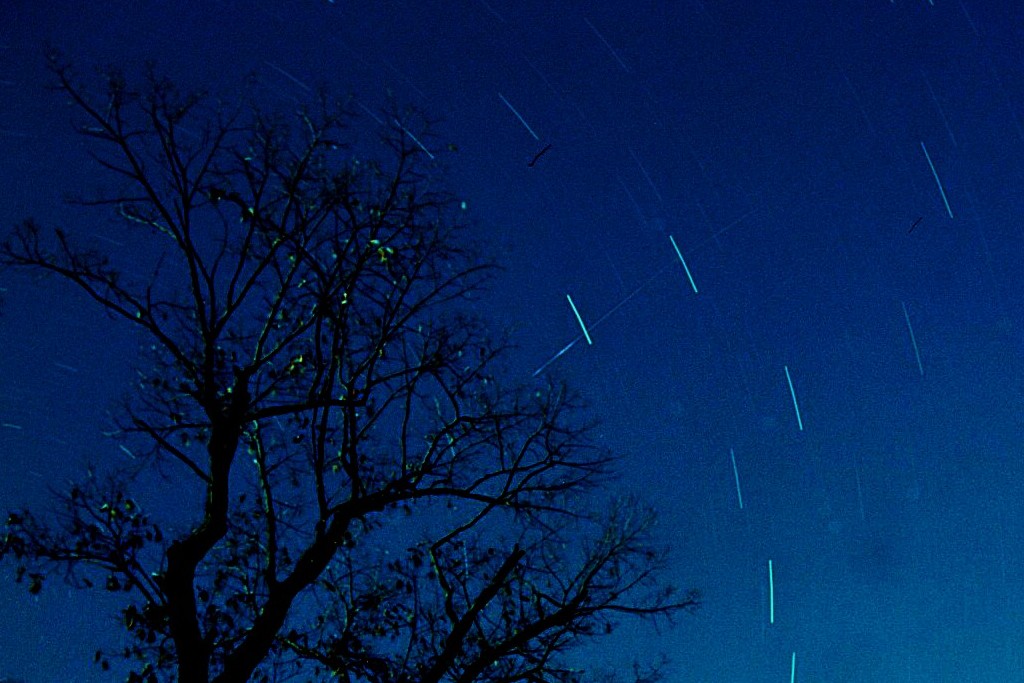
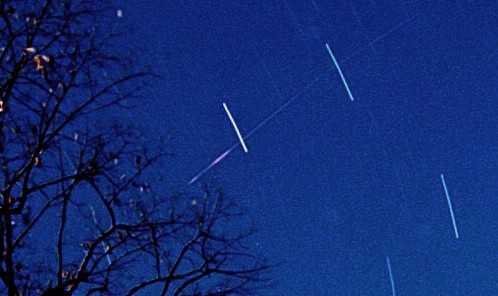
Crab follows the Twins, then Lion uncurls himself into the midnight sky. Bill and I uncurl our mummy bags on Bill’s deserted hillside at the edge of Surry County. The bulky biceps and pectorals of the Blue Ridge have our back. We are miles from town, close to a mile from the nearest mercury vapor thief of dark adapted vision. We’ve put on our longjohns and wool hats to recline in November darkness and be amazed by showers of meteors.
The year before I’d spent a moonless night on a grassy knoll in Doughton Park on the Blue Ridge Parkway. While cold seeped into my backbone and breath frosted my beard, I had watched hundreds of flares and streamers, an utterly silent celestial bombardment without any crash and boom of artillery. This year, though, Bill and I had an unwelcome guest. Luna hovered at our shoulders, the sun full gold across her face. Her glow overpowered all but the brightest meteorite flashes. We had to trust that the stars were falling, but only at long intervals could we see their spark.

. . . . .
My friend Bill Blackley is a moon-bright sky. His poems are the flash of meteorites. When you meet Bill you will be warmed at once by his bright charm and quirky wit. You’ll immediately sense that he never met a stranger. Within the first minute he’ll have you laughing at one of his stories, or he’ll be listening to your own life story with deep compassion.
That’s the illuminated Bill. In the darkness, artillery crashes. I first met Bill in July, 1978. He was Senior Resident, I was a green intern. In all the years since then, though, I don’t think I would have ever really known him if not for his poems. Oh, the charm and wit are there; so many of his poems reach out their hands and just welcome you in. But read on — the crash and conflagration show through on nights when the moon has failed to rise.
. . . . .
These two poems by Bill sneak up on you and bite. An Auger Bit may fool you into thinking it’s a simple reminiscence of the good old days, but its key word ends the first line — son. The speaker is teaching his own son, and the time they share among the tool bins also redeems the speaker, son of an alcoholic who has broken the chains and freed his son. Freed himself. The title itself grabs me — what cutting edge and piercing point can we read between the lines?
I love to play with the title of the second poem, too. Time Piece, it’s a piece about time, not only how we measure time but how we live it, and live through it. And once again there are hidden teeth here. The poem counts milestones of regret across the years, the loss of an heirloom, anger over being a victim of theft, feelings we can all identify with, but then there is the soul scorching image of peeling the watch from the arm of the dead soldier. Our measly hours: this poem struggles, as we all do, to create some meaning from our years and at the end to discover some peace.
. . . . .
An Auger Bit
Let’s rummage together son
this pawn shop aisle, bins
stacked with monkey
wrenches, pulleys, winches
C-clamps, pliers, bastard files
blue snap-lines and ball-peen
hammers antiquated by electric
drivers and laser levels. Your granddad
once worked wooden handles, oiled
calipers, turned them on shipyard steel
in Charleston harbor and launched
battle cruisers. Let’s gather
chisel, plane, hacksaw and slot head
Yankee driver in memory of when
he holstered a yellow folding rule
a blunt pencil in his shirt pocket
before hocking his tools to quench
a thirst for a Four Roses. Let’s mine
bins until we find a gauge calibrated
to plumb whiskey’s undoing.
. . . . .
A Time Piece
Two-finger blow a kiss
goodbye to dad’s graduation
watch left for easy
pickings on a beach blanket. So long
to the self-winding Seiko rolled
in gray sweat pants outside
the handball court where
a thief slipped my treasured piece
into his pocket and beat it
while his lookout grinned. Bon voyage
to the green-rimmed Swatch
a kid sticky fingered
from my pool locker . C’est la guerre
to the radium-dotted Bulova I peeled
off a National Guard soldier in Vietnam
and airmailed, along with his scorched
effects, to Altoona. Adios
to a fourteen-dollar Timex I tossed
to a co-worker when presented a fake Rolex
at my retirement gala. Gods chuckle
at us mortals caching batteries, winding stems
and punching in our measly hours.
[first appeared in Cave Wall Issue #3, Winter/Spring 2008]
. . . . .
Bill Blackley is a retired family physician and a full time advocate for the public’s health. He has saved you and me and a good percentage of our state’s population from cancer and lung disease through his relentless research about and opposition to biomass incinerators. He has also promoted the literary health of our state’s youth as director since its inception of the Gilbert-Chappell Distinguished Poet Series. AND . . . ten years ago he made me take over as treasurer of the NC Poetry Society, which has promoted my literary health (although it didn’t quite save me from cancer). Bill, I owe you, old pal!
. . . . .






[…] https://griffinpoetry.com/2021/04/21/earth-day-eve/ https://griffinpoetry.com/2021/01/08/we-do-favor/ . . . ❀ ❀ ❀ ❀ ❀ . Thank you for visiting…