Feeds:
Posts
Comments

Posts Tagged ‘Southern writing’

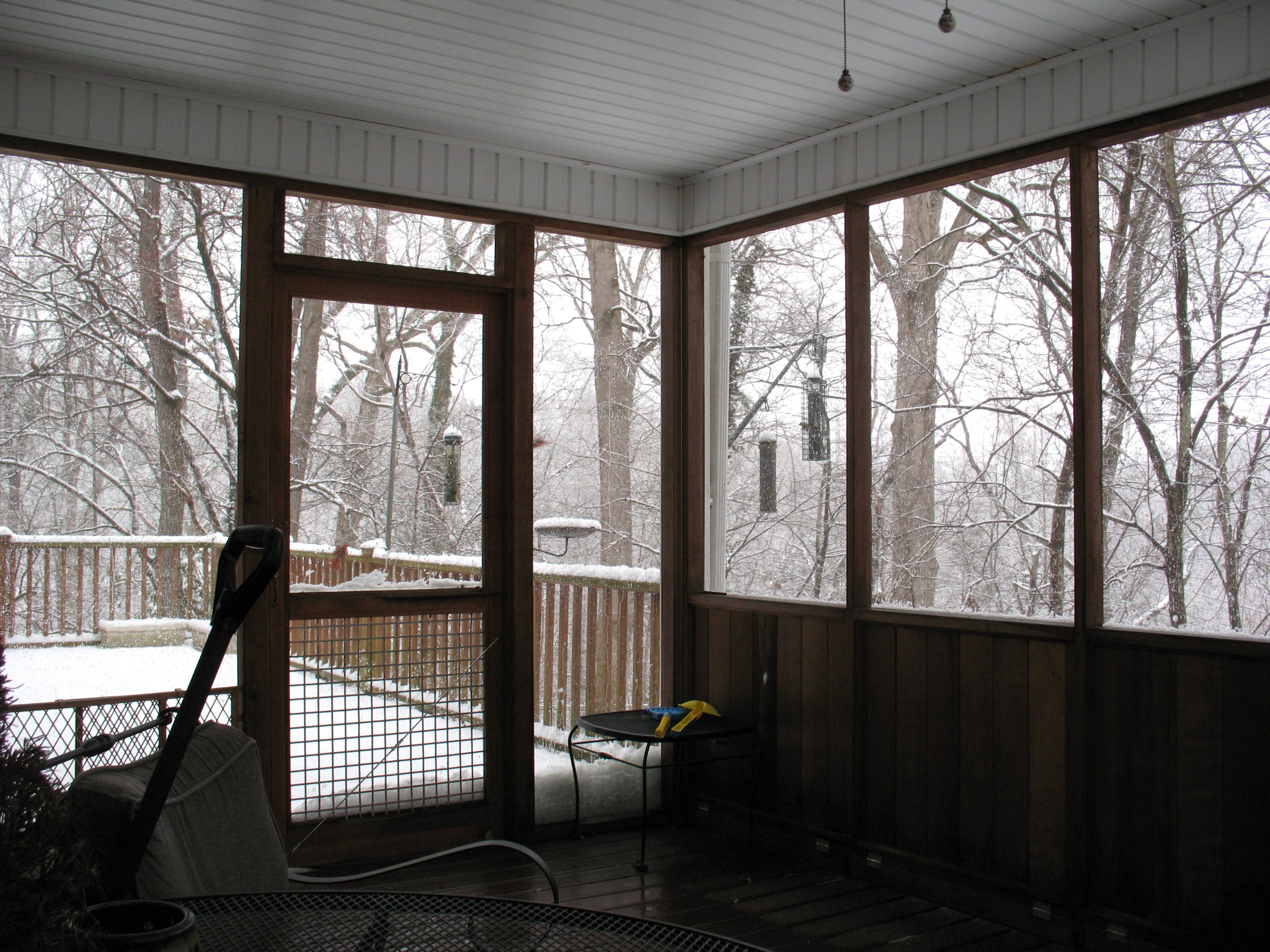
Every workday I’m out the door with a travel mug just as the sun pokes through the pines on Johnson Ridge across the valley. One solace – I leave by the back door, through the screened porch, embraced by the centenary beech before I get in my car. If there’s a little light it’s a herald of goldfinches; if full dark a doe might spook. The ‘possum might still be rooting in the compost. All just outside my porch.

This morning March snow is sifting through the screen and puddling on the planks. Office closed (at least until noon). While coffee perks I shove the screened door open against a drift of heavy white and toss a couple of handfuls of seed to the ground feeders. I huddle against the house until the birds return (they’d only flown twenty feet into the hickory branches). Hello, my friends. On the porch I’m only ten feet from the phone, the bills, the desk-high tasks undone, and three miles away I can hear traffic on I-77 unslowed by a little precipitation, but here is sanctuary.

*      *      *      *      *
Porch_01

How many porches have acquired personality in your memory? Grandmother’s in Hamlet: the swing hanging from heavy chains, for Bob and me a pirate ship, a jet plane. Nana’s in Morehead: the smell of Bogue Sound, the chaise lounge one of us would sleep on when the July nights were too hot; our own first porch, the red rental house in Durham on Green Street, a family portrait with toddler Josh and Margaret just beginning to smile, all of us smiling.

With such an archetype it must have been easy for Maureen Sherbondy to elicit the poems, essays, short fiction that she has compiled into Voices from the Porch (Favorite Gathering Places). It is an anthology broad as a coastline or a rural avenue, but also deep in the secret heart of people gathered and torn. It’s a tangled story of memories and feelings that won’t allow themselves to be laid aside. It is voices that have whispered and will continue to whisper to each of us.

Voices Cover 01

Judith Behar’s poem Evening opens the collection. Like opening a door onto a space of sanctuary, and revelation.

*      *      *      *      *

Evening

Dusk rises from the pond,
misty and green, then gray;
a bullfrog croaks his song
up to the darkening porch
where three women drink wine by candlelight,
the humid air like saris on their skin.
They idly talk of gardening and plans
for summer travel. Work falls away,
lines soften, then disappear
in shadow. A slivered moon
hangs in a cloudless sky.
They clear the dishes, carry their glasses in –
their day ended, the guests depart.
Creatures of the night
swarm in the grass.

*      *      *      *      *

Judith Behar lives in Greensboro and is the volunteer publicity director for Writers Group of the Triad. She has taught English at Guilford College and practiced law in Greensboro for 30 years. Her poems and short stories appear in a number of publications, including contest winners in Pinesong, published by the NC Poetry Society.

*      *      *      *      *

One more reason to consider sitting down in the porch swing and reading this anthology: my short story Overflowing about Jimmy, Nella, and Monty in Surry County and the danger of love.
IMG_7952

*      *      *      *      *

Read Full Post »

My grandson’s favorite Christmas song this year is Holly Jolly Christmas by Burl Ives.  This is really not so astonishing – the first record we ever played for him was a collection of folk songs by Burl Ives.  By the time Saul was two he was requesting him by name: “Play Bur Lives.”

What did astonish me today, though, was realizing that Saul knows all the words to the song.  I was impersonating a fly on the wall with a magazine while he built a little Lego house and had all his Lego men come visit.  The entire time he was working, he sang.  Say Hello to folks you know / and everyone you meet.  Or sometimes just recited.  Hey Ho, the mistletoe, hung where you can see.  With an entire village of different voices, tempos, timbres.  Somebody waits for you / Kiss her once for me!  Sometimes tuneful little boy soprano, sometimes gruff, briefly importuning, and when he noticed me listening quite loud and raucous.  All the Holly Jolly variations.

.     .     .     .     .

A four-year old is a highly evolved little primate.  He knows just how far he can boss Pappy around before he’s crossed the line.  He can ask for ice cream a half hour before supper and convince Pappy the request is not at all unreasonable.  He operates on the rock solid premise that simply wanting a thing fully entitles the person to get it.  Or, and this is much more likely, he knows all the rules full well but also knows from experience that with the one-hundred-and-first request the rule might shatter.

But what happens if I sometimes call the little anthropoid’s bluff and just laugh?  He laughs too, and we go on to the next game.

IMG_3474

.     .     .     .     .

I bought Sarah Lindsay’s book Primate Behavior at a reading she gave in Southern Pines this year.  Reading it is like an archeological dig: each poem must be read carefully, brushed with fine bristles, held up to the sky.  No bulldozers, please.  I’m still working my way, layer by layer.  I’m discovering that there is unrevealed depth and complexity to us hominids.  I wonder, how did Lindsay get hold of my family tree?

.     .     .     .     .

Primate Behavior

What was she looking for, the woman two days from
the end of a wasting death
who told her nursing daughter, “Shave my legs”?
Or the hospital-ridden one
who, coming out of ether, could only keep saying she couldn’t
be comfortable
without her panties on.

If one of us slips on ice, he or she
checks first for an audience, second for broken bones.
We are the apes
with mirrors inside our heads.  We pick our noses,
we fart and enjoy it,
but this is rarely mentioned.  We make fun of outdated clothes.
We listen to music.

In a thick place of mountain bamboo the
gorilla mother
croons and cradles her young one in her arm.
With her other large hand
she catches her own dung and eats it.
A hum of insects and green wet rot.
The father beside her sleeps.  Is it eight-thirty Monday?
His lower lip hangs on his chest.
Alone at her golden oak table
the young lady licks her finger, dots at the grains
of spilled sugar,
and licks it again.

Close to the Pole, where daytime stretches
like taffy
and icebergs move in vast and moaning herd, a furry man
scrawls a few notes in Norwegian.  He cannot carry a tune,
but he can make stew.  He has thought of little else but stew
and warming his feet for weeks.  Realizing
how dirty his face is, he tells himself:
I am here for no personal good, but to help make maps.
I am civilized.  See the word Forward is drawn on my heart.
And he throws some dried fish to the dogs.

from Primate Behavior, Sarah Lindsay, Grove Press, © 1997 by Sarah Lindsay

Sarah Lindsay received her M.F.A. in creative writing from the University of North Carolina at Greensboro and currently lives in Greensboro.  Primate Behavior was a National Book Award finalist.  Lindsay’s latest book of poetry, Twigs and Knucklebones (Copper Canyon Press, 2008), was selected as a “Favorite Book of 2008” by Christian Wiman, editor of Poetry magazine.

.     .     .     .     .

IMG_1609

Read Full Post »

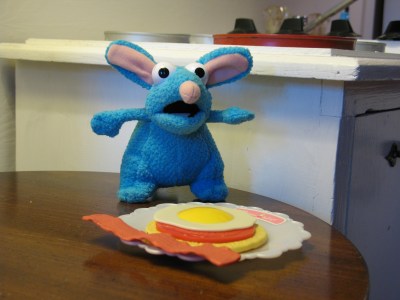
He began life as Blue Mouse, and how apt: pointy nose, bristly whiskers, cupped ears, and of course he’s the color of September sky.  Nowadays, though, when I walk in the kitchen door and Saul careens from across the room, he grabs my hand and says, “Get Blue Rat!  Get Blue Rat!”  Just how has the little creature transformed? Perhaps it’s the prehensile tail (it has wire in it so it can curl and grab things, like little boys’ ears), or the big googly Muppet eyes.  Could be because Blue is three times the size of the life-like field mouse finger puppet that drives the school bus and doesn’t talk much.  Most likely, however, it’s because of Blue Rat’s voice: gravelly, colloquial, with a distinct Bronx accent.

Voice?  Voice, you say?  How did a little stuffed plush critter come by a voice?  Well, from his conception Blue Rat has been designated as my ward.  When it’s play time (and it’s always play time) and we pull out the fuzzy animals, plastic figures, Lego men, Saul commands, “You talk Blue, and I’ll talk all of these.”

Because they all have voices.  Mappy the Hamster doesn’t have a mouth – he sort of mumbles.  Pinky Pie (purple kitty with pink nose) is high pitched and squeaky.  Lego pirates and space men are appropriately gruff and swashbuckling.  Saul “talks” all of those.  I get to talk Blue Rat.  He just looks like the kind of guy who’d be most comfortable chomping a Coney Island while he ogles the girl rats on the boardwalk.  So every afternoon when Saul whips him up a sandwich (plastic pancake, tomato, fried egg), he gustos it down and says, “‘Ey, Baby, dat’s deelishus.”

IMG_4356

.     .     .     .     .

Voice.  (Prepare for a big leap here.)  Voice.  When you read, don’t the characters speak in your mind?  Pitch, accent, cadence.  When you write, don’t you imagine and invent a persona for each creature?  Their voice?  How they say is as important as what they say.

One of my favorite little books is The Bat-Poet by Randall Jarrell.  The whole week I was at the Zoo last summer I carried copies and gave a couple away.  The Bat Poet discovers the voice of Owl, Chipmunk, Mockingbird, and they are all true.  In the end he discovers his own voice, and we discover how odd and wonderful it is to live in the bat-world.

Here are a few stanzas: I hope you’ll borrow or buy the book yourself.  Is there any end to the voices we may speak?

.     .     .     .     .

from The Bat-Poet, Randall Jarrell, pictures by Maurice Sendak, copyright 1964 by The Macmillan company, copyright renewed 1992 by Mary Jarrell

Owl
. . .
The mouse beside the stone are still as death –
The owl’s air washes them like water.
The owl goes back and forth inside the night,
And the night holds its breath

Chipmunk
. . .
Curled at his breast, he sits there while the sun
Stripes the red west
With its last light: the chipmunk
Dives to his rest.

Mockingbird
. . .
A thrush is singing, then a thrasher, then a jay –
Then, all at once, a cat begins meowing.
A mockingbird can sound like anything.
He imitates the world he drove away
So well that for a minute, in the moonlight,
Which one’s the mockingbird?  which one’s the world?

Bat
. . .
The mother drinks the water of the pond
she skims across.  Her baby hangs on tight.
Her baby drinks the milk she makes him
in moonlight or starlight, in mid-air.
Their single shadow, printed on the moon
Or fluttering across the stars,
Whirls on all night . . .

IMG_3692

.     .     .     .     .

New York Times book review of The Bat-Poet from 1964.

.     .     .     .     .

IMG_7491

Read Full Post »

« Newer Posts - Older Posts »