Feeds:
Posts
Comments

Posts Tagged ‘Press 53’

 . 
[with 3 poems by Rick Campbell]
 . 
The Light We Call Winter
 . 
If you see me walking down
the shell road under myrtle
 . 
and Spanish moss, don’t worry.
The road’s a circle and it brings me
 . 
back to my yellow mailbox.
You might give me the name
 . 
of the bird that sat all morning
on the thin branch.
 . 
Give me the last lost months gone
in a haze, sloughed off like an old dog
 . 
shakes himself dry.
Walk with me.
 . 
I won’t say
I don’t need you.
 . 
Rick Campbell
from Fish Streets Before Dawn, Press 53, Winston-Salem NC; © 2024
 . 
❦ ❦ ❦
 . 
When the first Human woke up on their first morning on Mother Earth, they discovered all the other persons watching them. The Plant persons, the Animal persons, the Lichen and Fungus persons, all of them had already been living together on Mother Earth for a very long time and they knew how to get along. Now here was this new member of the family, this Human. No doubt everyone was asking themselves whether this new person would also learn how to get along.
 . 
The Human opened their eyes and the first thing they said was, “How did I get here?” A question Humans would spend a very, very long time trying to answer. Then the Human stood up, looked all around, and asked, “What am I doing here?!”
 . 
At this point the Creator of Mother Earth and Every Living Thing smiled. Yep, those are the right questions. Two of the big ones. And don’t forget the third, maybe even bigger and maybe even more important. The Human noticed all the persons watching – Plant, Animal, Fungus, all of them – and asked, “Who are you?” The Creator smiled even wider. Yep!
 . 
 . 
A nod to Robin Wall Kimmerer and Braiding Sweetgrass for inspiring this little parable. And a nod to Rick Campbell for poking at all the questions until they wake up and try to swim to the surface. The answers you’re going to get in this life depend on the questions you ask.
 . 
Be sure to ask, really, the questions no one knows the answers to. I almost wrote “the questions no one knows how to ask,” but how is something you certainly do know. The more you pay attention, the more you wonder, the more you know how to ask those questions. Not ask like Rodin’s Thinker with your chin on your fist in placid contemplation. More like lying awake at 4 a.m. in a sweat and doubting but asking anyway whether there’s any reasonable hope for you, you Human.
 . 
What am I doing here? I haven’t needed an answer as long as I’ve been always doing, doing. In fact I don’t even know there’s a question until I stop. (Maybe Rodin’s silent seated ponderer is an apt image after all.) In that momentary pause, in that engulfing silence, the questions suddenly loom huge and overwhelming. Why am I? What is my purpose? And cold, dark nothing threatens to bring its answer.
 . 
But then I look around. Who are all these others? All these persons, Human and not, sharing this circle with me? Can we get along? May I know them? It’s never too late to ask. Never too late to try.
 , 
 . 
❦ ❦ ❦
 . 
Practicing Silence
 . 
Outside of NYC, it’s
almost impossible
to be mistaken
 . 
for a mime. Here,
at the edge of the country
I’m just a guy who moves
 . 
silently down crushed shell
roads, through pine forests
in deep sand, past the harbor’s
 . 
broken docks. Ok, yes,
I could talk more, but to whom,
the clerk at the Dollar General?
 . 
What would I find worth saying
more than thanks? Buzzards whirl
over my head like synchronized swimmers.
 . 
Rick Campbell
from Fish Streets Before Dawn, Press 53, Winston-Salem NC; © 2024
 . 
❦ ❦ ❦
 . 
Frank X. Gaspar writes this in the introduction to Fish Streets Before Dawn: In the poem Throwing Starfish Back into the Sea [Rick] wonders how much “good he has done” with his uncertain act of kindness. It is an apt poem, and taken in the context of this collection and its outcries, we see that Rick Campbell’s wanderings and questing are testimony to the core of his art: surviving, yes, but surviving as the step that allows us to pursue any small good we can bring along with us.
 . 
Rick Campbell lives in Alligator Point, Florida, and teaches in the University of Nevada-Reno’s MFA program. He has published seven earlier poetry collections, plus a collection of essays, Sometimes the Light. His most recent poetry collection, Fish Street Before Dawn, from Press 53 in Winston-Salem, North Carolina, is available HERE
 . 
 , 
❦ ❦ ❦
 . 
Xenoglossy
 . 
I once wrote of my mill town
that you can want all your life here.
I was in love with words and
the directions they might lead:
into the temple of furnace fire
and out again? Along
a ridge with hawks drafting
thermals? Blues as it’s bent
at the crossroads? Freight trains
clacking downriver under the cloaked moon?
Just empty space?
 . 
At night I speak in the tongues
of angels and fools: babble
imperfect definitions of desiderate, lack,
+++++++++++++++++++ ought.
 . 
Yesterday, blades of grass parted
as the pygmy rattler sidled away
from my boot. I wanted to call
the hawk in the pine tree
down to snatch it up, but
I had no tongue for hawk.
 . 
What did I know? I am older.
It wasn’t just home that wanted,
not just the valley that lacked.
 . 
Rick Campbell
from Fish Streets Before Dawn, Press 53, Winston-Salem NC; © 2024
 . 
❦ ❦ ❦
 . 
 . 
❦ ❦ ❦
 . 
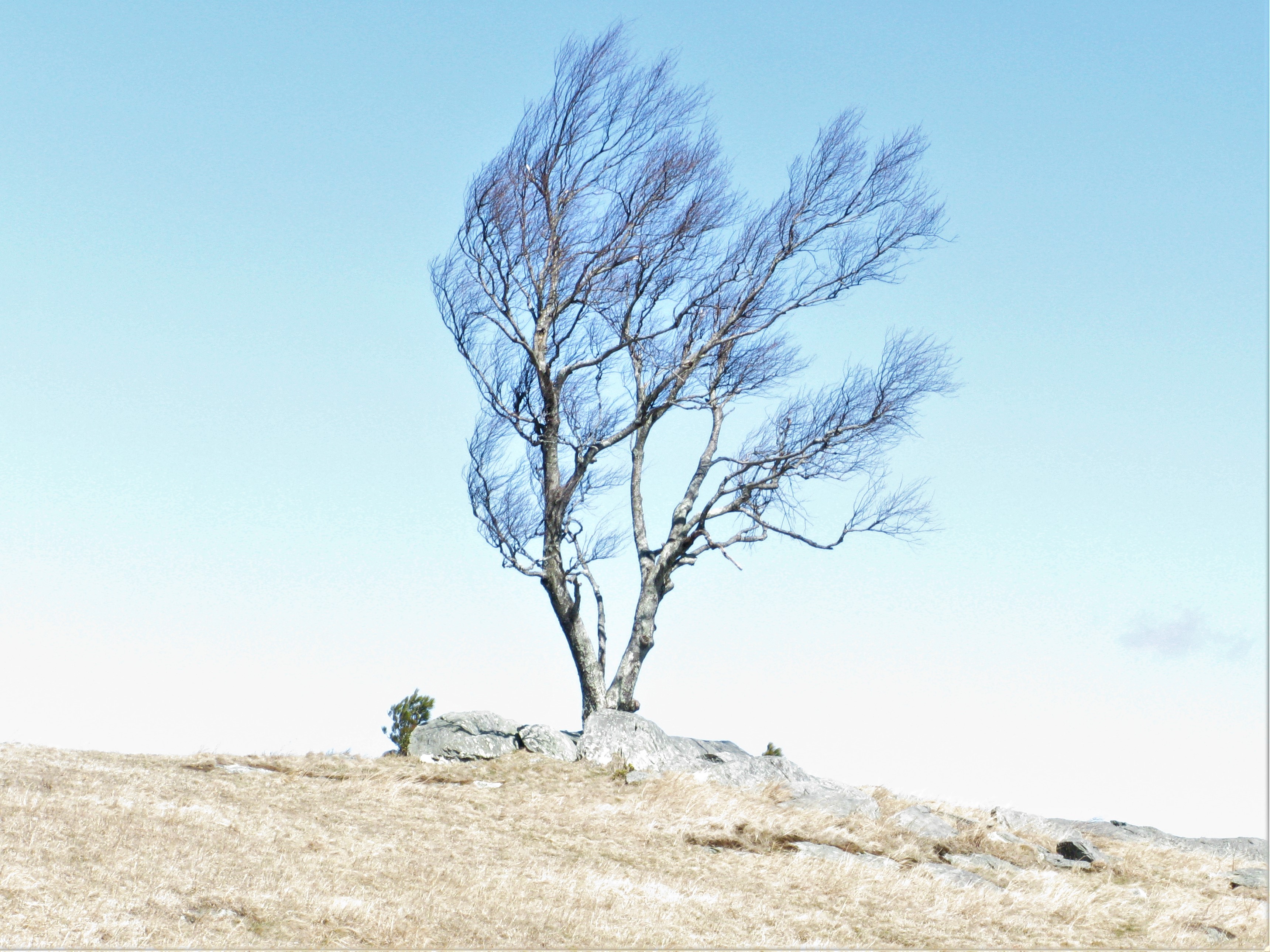
2020-03-07 Doughton Park Tree

Read Full Post »

[with 3 poems by Michael Hettich]
 . 
Core
 . 
The hawk in the white pine shivers, hunched
into itself like a state of being
 . 
we might think had vanished
if we’ve been playing
too long with our gadgets, or making arrangements
to assure our perfect happiness
 . 
sometime in the future. The wind that tossed
cut-down trees
remains a ghost
inside our furniture, like the antique
notion of a soul, and ancient tides
 . 
drew the swirls in the stones that line
our paths. Scars that mark the seasons
 . 
our ancestors lived,
etched like tree rings
into the secrets we don’t even know
we’re keeping; a dream that woke us to forget,
 . 
a blue that dazzles the sky as only
nothing can do, in the morning.
 . 
Michael Hettich
from The Halo of Bees
 . 
❦ ❦ ❦
 . 
Mom has been put to bed, the nurse’s aide has left, and Dad leans hunched in his favorite blue recliner. As he reads each line of his novel, Dad turns his head left to right, back and forth like a cartoon character eating corn-on-the-cob emptying each successive line of kernels, or precisely the opposite, like a typewriter platen that only returns to its starting point when the line has filled itself. Three lines. Five lines. Now Dad’s eyelids droop, his book droops, and just beyond the pocked and cratered moon of his head the windows of the house across the street catch fire with the dying sun. The orange and smoke of the end of day.
 . 
In a few moments Dad will jerk a bit, open his eyes, and read a few more lines. Some additional span of moments beyond that he will put down the book, heave himself from the chair with a grunt, stagger and catch himself on the wall on the way down the hall to bed. Irrelevant. This moment is the luminous, the sun’s reflection filling the neighbor’s windows before they eclipse and darken. This is the fulcrum moment upon which all prior moments and all moments to come must teeter and balance. Perhaps the three of us present in this old house feel its presence as we breathe in and breathe out, the very quiet house hanging by its fingernails to its own particular very quiet light in this dark whirling night-welcoming time-swallowing universe.
 . 
As I continue to watch, Dad turns his head, a fraction of an arc just barely perceptible, left to right.
 . 
 . 
Core – the first poem in the first section of this new collection by Michael Hettich – is indeed the core and carries me there with it. A state of being. The secret interior liveliness of things, of all things. The ghosts that connect every one of us if we believe their essence.
 . 
I can’t turn the page. I have to return to the first line and begin again. Moments coalesce. I reread images and stanzas in different orders. It is a poem of being and a poem of becoming. I am filled with this one poem and overcome with the awareness of secrets residing in the most mundane things that surround me.
 . 
My son-in-law Josh has constructed a hive, a Ritz Carlton of a hive in my view, and he awaits a swarm. He teaches me about the living organism which is a family of bees. When they sense some ethereal signal, perhaps overcrowding or overly plentiful surroundings, the workers begin the special feeding of a newly hatched larva who will grow into a new queen. The hive cannot have two queens. When the new matures, the old queen takes half the workers and leaves to swarm. If Josh is particularly blessed, if the offerings of beeswax and lemongrass with which he has anointed his hive box are acceptable, the swarm will take up residence and begin making new bees. And new honey.
 . 
The thirty “new” poems in this “new and selected” are themselves such a living organism. They move together through darkness to bring flickering glimpses of light as in dreams. They know there is a core and they seek it. They find wildness in everything and they celebrate it. They are “a sudden glimpse into the silence between thoughts.” All the while the writer, and we readers, too, if we follow, questions the person he was and the person he might become. And in the process of all this seeking and discovery, perhaps each of us may encounter the person we are.
 . 
The Halo of Bees, New & Selected Poems 1990-2022, Michael Hettich. Press 53, Winston-Salem NC, © 2023
 . 
❦ ❦ ❦
 . 
Another Kind of Silence
 . 
Sometimes the world grows louder, you realize,
just as the day falls still
and insects whose names you’ll never know
start screaming and laughing, scraping their wings,
then falling silent. It’s as though there were some
 . 
technology that could capture your dreams
and throw them on a screen, to show you to yourself
and confuse you more deeply, you who are not
alone but live in solitude, never
seeing anyone but yourself, even
 . 
when you are talking with your friends and family,
even when you’re moving through a crowd, thinking
 . 
Everything is wild at its core, even
half-asleep evenings in front of the TV,
even listless afternoons shopping
for knickknacks, or food. And food is especially
wild. Just think of all those apples and grains
of rice, just think of that wine
ripening as grapes in the bright sun of some
foreign country, the bees and even
 . 
the bats zig-zagging through the gloaming, singing
as they feast – another kind of silence:
 . 
music your ears are not built to hear,
like the roots of these trees, humming as they soak up
the puddles that have deepened for so many days
you hardly remember how the sunlight feels
on your body, how it makes you squint
and see things differently, the way it makes everything
 . 
waver and shimmer, like a mirage
you walk toward, never arriving.
 . 
Michael Hettich
from The Halo of Bees
 . 
 . 
❦ ❦ ❦
 . 
The Dark House 
.  . 
Trust the simple things, she said then, to lead us
through this dark house, hands outstretched to feel
what we can’t see, as we touch a wall,
a table, or a chair we can sit in and wait
for morning. Maybe we’ll talk of small pleasures
 . 
or just listen to each other’s breath. We might seem to see
dreams flicker through our open eyes,
though it needs to be darker, even darker than it is now,
and they only flicker briefly. Don’t be scared.
We can hold hands and listen for our heartbeats, and maybe
 . 
if we can locate a window in the wall,
we can open it and let the outside darkness
rush in with its clarity and wildness; we can sit here
talking of what we imagine must live
out here, waiting for first light – like we are –
 . 
or moving through the dark like the moon does, pulling
the tides inside us, oceans we might even
swim out in, naked and warm, until morning
when we’ll be out of sight, so far from shore
our lives there might go on without us.
 . 
Michael Hettich
from The Halo of Bees
 . 
❦ ❦ ❦
 . 
 . IMG_7491

Read Full Post »

 . 
[with 3 poems by Maya J. Sorini]
 . 
Eavesdropping on the Dead
 . 
Today I heard a man talk to his mother about her eulogy.
They decided on the color of her funeral flowers –
Purple, and white
He kept reminding her to swallow her water
And finished his sentences with “mama,”
So she would remember she was supposed to be listening.
 . 
I watched a woman brush the oily hair from her husband’s forehead
She spoke like velvet,
Telling him how good he looked
With that tube sticking out of his mouth,
Sitting up today!
 . 
There is Arabic music playing down the hall
Because a patriarch is dying
Zaeem, Omar Almadani
Allah ateyk alf afyeeh
The family told the doctors they were so thankful for them.
 . 
The dead tell stories
They forget to swallow
They sign papers
That say they would like to die soon
They listen to music
They pick flowers
They have tubes in their mouths, in their arms, in their bellies,
They laugh and laugh and laugh
 . 
Maya J. Sorini
from The Boneheap in the Lion’s Den, Press 53, Winston-Salem NC, © 2023
 . 
❦ ❦ ❦
 . 
Mostly I dream about being lost. What is this place that seems so dangerously familiar and yet maddeningly strange? How do I get to where I’m going, and just what exactly might that place even be? And how do I, desperate, find what I need among all this that crowds in to thwart me, this collation that confuses and obscures my seeking?
 . 
Last night I walked through a dim building with stairways and many rooms. I was among people I knew: we were a family or a community or somehow connected. As I encountered one person, then another, they all seemed frightened. We knelt together, one by one. I reached to put my arm around each and said, “We will save the world.” Tears in our eyes. “And this is how we will do it.” But I woke suddenly in the dark with no answers.
 . 
 . 
This afternoon I read Maya Sorini’s new book, The Boneheap in the Lion’s Den. A lot of poetry is about pain. This book is pain. Read it and you will succumb. Enter these poems and they may infect your dreams with Sorini’s refrain: Nobody could / help me.
 . 
During the 40 years I practiced medicine the concept of pain steadily evolved. Not only the neuroanatomical patterns of pain and bioneural origin of pain, but new ideas emerged about the nature of pain, this sensation that we all experience but which is impossible to communicate, impossible to share. Pain has become the fifth vital sign (after pulse, blood pressure, respiratory rate, and temp); every time I take my parents to their doctor, the nurse dutifully asks if they are having any pain. Medical practice has attempted to clinically quantify pain with the ubiquitous one-to-ten scale and its familiar smiley faces and frowny faces. The compulsion by doctors to relieve pain (and perhaps the expectation by patients that it will be relieved) is a factor in our national epidemic of opioid addiction.
 . 
But Maya Sorini’s poems are more than the pain of wounds and fractures. They include but exceed the pain of the death of a loved one, the pain of tragedy and grief. As I read these poems, I learned an odd and non-intuitive physics of pain. Clearly we all cope with pain by pushing it away – like gravity, pain’s effect on us diminishes in proportion to the inverse square of distance or some such. Also pain within a certain minimal radius of proximity can be willed into submission: my migraine, my surgical incision, my grief I can encapsulate in denial or repression and with clenched jaw march on.
 . 
But there is a certain critical distance, or rather closeness, of pain that lacerates unrelentingly – the pain of experiencing the pain of another. Maya Sorini wrote these poems from her months of clinical research in a trauma surgery unit at Washington University in St. Louis, standing in emergency rooms and operating suites as blood dripped into her shoes. Perhaps bullets never penetrated her anatomy, but shards of violent metal tore her. Wounded her. It is painful, yes very painful, to share her distress. Is there any hope for healing from these dreams of flight and helplessness? Can Daniel, gradually succumbing to the carnage of the lion’s den until he himself becomes little more than a boneheap, ever rise up again? Can any of us be saved?
 . 
When I finished the final page of Boneheap, I sat for a time in silence. In shock? I wanted to push away the pain but I had read every single word and they would not be denied. Now what? Perhaps I’m awakening from a dream in which answers flit through my fingers like moths then dissolve into mist with the rising day. Perhaps a dream is some subconscious nudge not to give up looking for answers. Is it a tautology to pronounce that pain must be felt before it can be unfelt? Isn’t unfelt actually the precise opposite of what the dream impels us to seek?
 . 

Maya Sorini, what I’ve felt in reading your words is pain which we have now, after all, shared. In sharing with this reader, may the burden of your pain be lightened.

 . 

 . 
❦ ❦ ❦
 . 
Moratorium
 . 
Say what you mean
Stop saying “expired”
Like it is inevitable for the 28-year-old
To die on a Tuesday at noon.
 . 
Stop keeping it a few words away from you,
Using “expired” because “death” forces
you to think about
Your grandfather’s funeral
When you were 16 and had never seen
Your dad cry before.
 . 
Say what you mean exactly –
Do not say, “we did everything we could”
When what you mean is
“I have given every tear and deep breath I have to this job
But the bullets keep winning.
I don’t want to be
The one telling you
That we lose every
Day to scraps of metal.”
 . 
Say what you really mean:
“Your son is dead.”
 . 
Maya J. Sorini
from The Boneheap in the Lion’s Den, Press 53, Winston-Salem NC, © 2023
 . 
❦ ❦ ❦
 . 
Trauma Surgeon Ars Poetica
 . 
This morning a robin collides with the glass windows of our sunroom. It flies into three panes, then four, then the same one many times, looking for different skies, trying to escape the day. With each thump I think, “this is the sort of thing poets write about, those poets who know how to hide the word death inside of a songbird,” but I don’t know how to talk about blood without speaking the scarlet spatter of it. I say nothing to the red-brown bird, the reflection of the sky’s blue face veined with branches, the feathers so light they seem to shirk the responsibility of falling, the dull thunk ringing in the house, the morning so quiet it becomes prayer, the lined triangle of yellow beak, the black moon of the eye intent on its mirage. I cannot write that poem. I am still thinking about blood. When I see the robin throw itself at the window a fifth, sixth, seventh time, I open the door, I wave my arms, I chase it away.
 . 
Maya J. Sorini

from The Boneheap in the Lion’s Den, Press 53, Winston-Salem NC, © 2023

 . 
❦ ❦ ❦
 . 
Maya J. Sorini is a poet, performer, and medical student from Rockville, Maryland. She received her B.A. in Chemistry from Washington University in St. Louis while engaging in clinical trauma surgery research. Since 2005, Press 53 in Winston-Salem, North Carolina has been finding and sharing remarkable voices through collections of poetry and short fiction. The Boneheap in the Lion’s Den is the winner of the 2023 Press 53 Award for Poetry, selected by Tom Lombardo.
 . 
❦ ❦ ❦
 . 
 . 

Read Full Post »

« Newer Posts - Older Posts »