Feeds:
Posts
Comments

Posts Tagged ‘poetry’

Poem in the Key of E

Some trees keep their color and shape
even beyond the time that we have ceased
to dream. They tease us into faith.

This one I approach from a distance.
Its leaves, like tiny flags of grace,
beckon to me. It is November, and the rain

has pelted us, sweeping masses
of yellow to the sodden earth.
But these leaves stay, and the tree,

bright orange against the now blue
sky, stands against the growing dark.
Some days I am afraid to come,

fearing that a mean and fickle God
will flip the table, leaving me nothing
but a tangle of dark and dirty branches.

The neighbors think I’m weird.
“For Christ sake,” the plumber says.
“It’s just a fucking tree.” Maybe.

I thought that once myself. But now
if I close my eyes hard in the night,
the color comes and the room

slides away. I float upward in this
orange, this strange treeness.
My body is inside, looking out.


Anthony S. Abbott, from The Angel Dialogues, Lorimer Press, 2014

.     .     .     .     .     .     .

Poetry, on some level, is about saving things. . . . Things die; poetry retrieves them.

Tony Abbott graced my life during the few years I knew and worked with him. He was president of the NC Poetry Society while I served on the Board, he was mentor in the Gilbert-Chappell program for students, and he was an inspiring colleague and friend. I sat in awe: Davidson professor, poet and novelist, literary leader. But Tony didn’t want our awe. He was a seeker for meaning in this tangled, sometimes messy human journey and he simply invited fellow travelers.

Perhaps empathy and humility spring from the same root. If one has suffered deeply, one cares for and feels deeply the suffering of others; if one has experienced the frailties and missteps to which none of us are immune, one sets aside pride and judgement and stoops to lift the burden of one’s fellows. If one member suffers, all suffer together with it; if one member is honored, all rejoice together with it.

Tony, with his vast gifts and achievements, embodied empathy and humility. My life is richer for having shared it with him. Now his voice we carry within ourselves.

.     .     .     .     .     .     .

Going Home:
a poem in memory of those North Carolina writers who have gone before us

– Weymouth Center, July, 2009

Late afternoon. I lie in the long grass and wait
for words. The still white clouds mock me. Then,
unexpectedly, the sound of music. I sit up. From
an open window upstairs, the clear sounds
of Dvorak. I know these notes like I
know the timbers of my own soul. Yes.

The English horn sings the theme, and sings it
yet again, with the bass clarinet. And then
the strings enter, like a prayer. Take me home,
Lord, take me home. Now the clarinets,
and the horns like faith answer. Then the strings
whisper softly, yes, and again, yes.

I see Graham Jackson, tears running down his black
cheeks, Graham Jackson, in full dress uniform, playing
“Goin’ Home” for his beloved Franklin Roosevelt, and then
the farmers, young and old, black and white, all
of them poor, who loved the only man they had
ever known as President of the United States, hundreds
standing on the hills of Georgia and the Carolinas
watching the train go by with the body of their lost
leader, watching the train take him home. “Goin’ home”
say the English horns again, and then the clarinet returns.

Here I am, listening, images surfacing – the trim brick walks
of my beloved town, the green hills to the west, rising
and falling like the strings, the waves on the outer
banks crashing like the cymbals, then sliding back
like the clarinets. I see the faces of my friends, I hear
the voices of the poets who have gone before, their words
rising again. Dark skinned and light, old and young, male
and female, children of the valleys and the mountains,
children of the coast and the Piedmont. I am here, they say,
I have made the path for you, and I am still here, my words
as true as the rock face of Cold Mountain.

The music soars and for a moment there is light. The whole
orchestra together in hope. then the English horn alone,
mournful, and the strings so soft, almost a whisper.
The strings carry our love over the hills to the sea,
the horns offer it to the sky, and the strings set it aloft.
It is done. They have gone home, and who and what
they are we carry within ourselves. The evening comes.
I rise from the grass and walk toward the open window.


Anthony S. Abbott, from If Words Could Save Us, Lorimer Press, 2011

.     .     .     .     .     .     .

Poetry, on some level, is about saving things. Even a poem so simple as “Growing Up” in A Small Thing is about saving the wonder of the child in an adult world that conspires to destroy it. Maxine Kumin uses the term ‘Retrieval System’ in one of her great poems. Poetry is a retrieval system. Things die; poetry retrieves them.
from Anthony S. Abbott – In His Own Words

Tony Abbott’s publications at Lorimer Press

Biography and induction into the North Carolina Literary Hall of Fame

The scriptural quotation above is I Corinthians 12:26, New Revised Standard Version

Sam Ragan Poetry Festival of the North Carolina Poetry Society — March 22, 2015

.     .     .     .     .     .     .


IMG_1783

Read Full Post »

[with two poems by Malaika King Albrecht]

Charismatic Megafauna is what people hope to see when they visit Great Smoky Mountains National Park. If traffic barely creeps approaching Cades Cove there must be a black bear feeding near a pullout; if traffic stops altogether Mama has cubs. And if cars are pulled over for a mile along the prairie verge leading to Oconaluftee Visitor Center it means elk are grazing the pasture.

From the center lane I saw the big bull with six-foot rack and a harem of twenty and I slowed but I didn’t stop: the gate into Tremont would only be open from 4:00 to 5:00. It takes at least an hour up and over New Found Gap down to Sugarlands and on west into the Park. Fifteen of us will be arriving for a naturalist course on this final weekend in August, hoping to get personal with that other charismatic Kingdom – Plantae.

Lobelia cardinalis; Cardinal Flower; Campanulaceae

Trees, ferns, and flowers certainly draw many to the Smokies, if only for the deep summer shade and restorative air. Some people are even known to kneel. As winter unscrews her frozen vice we hurry to see ephemerals – trailing arbutus, hepatica, bloodroot. Then arrives the princess of spring’s reign, Trillium, including uncommon Catesby’s and Vasey’s. As we wind through the seasons we lust for phacelia, fringed orchids, lady’s slippers. But what about now at the tail end of summer?

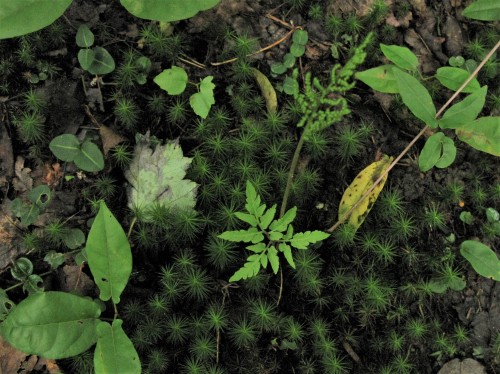
Summer, the season of yellow: asters, wild sunflowers, goldenrod (19 species in the Park), but driving west on I-40 didn’t every weedy median present us with all these and more Asteraceae? Solid gold at 70 mph. Time to slow down. The hour for Latin and Linnaeus is after vespers with our books and guides. In this moment the growl of Harleys on Little River Road can’t penetrate the glade. The rumble of the river into its Sinks reaches us only as subsonic reassurance through our soles. All light has slipped bent drifted through tuliptree and hemlock to recline with us among shaggy green. We are crouched among the ferns.

Botrychium dissectum; Common Grape Fern; Ophioglossaceae

So many different kinds of ferns. Notice blade and stipe, dimensions and symmetries. We “frondle” them to read the hieroglyphics of their spores. We smell them. We struggle to know their names.

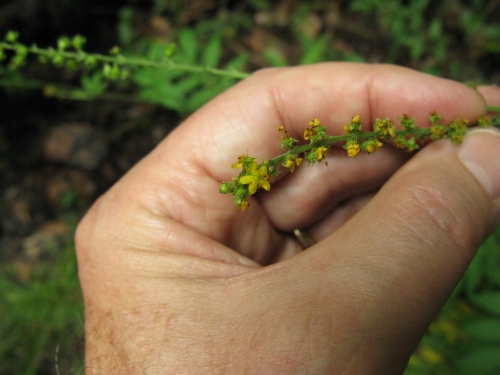
But here’s another fern-like frond, toothed and divided but with a tell-tale: a spike of yellow flowers like sequins in the wildwood. Lean closer. Five-petaled, many threads of stamens, Rose family. Agrimonia, harvestlice, swamp agrimony, but let us name it rose-among-the-ferns. Let us name ourselves sit-and-notice. Call us one-more-among-all-small-things. Look closely. Kneel. The least among the most is what we have come here to discover.

Agrimonia parviflora; Harvestlice Agrimony; Rosaceae

.     .     .     .     .     .     .

Before, during, and after my summer visit to Great Smoky Mountains Institute at Tremont I have been reading Malaika King Albrecht’s newest book of poetry, The Stumble Fields. If a work of art could be a facial expression her book would be a quiet, welcoming smile – the kind that lets you know she is about to share a great confidence. Her poems are revealing in the way sitting patiently in a quiet glade will gradually begin to reveal its true life.

And the spirit that often winds among her lines is, to me, that same spirit that leads us to desire to live truly in this world. Not to skip along its edges but to draw fully and be drawn deeply into it, discovering our selves as we discover the truths of our co-travelers. It is the naturalist urge – to find our connections at every stratum and station.

I am thankful to be connected to Malaika through her words.

.     .     .     .     .     .     .

Lactuca floridana; Florida Blue Lettuce; Asteraceae

Loftin Woods

I’ve wanted to be a single story,
so I could tell you a happy ending
but every breath’s different.
In these woods I’m lost enough
to notice but not lost enough to care.
I find my body when the barred owl
startles the air. I find
my body where white trillium
catches light. I find my body
in the music of cantering horses
singing to sky. Today I could fall
right through this fabric of grass.

.     .     .     .     .     .     .

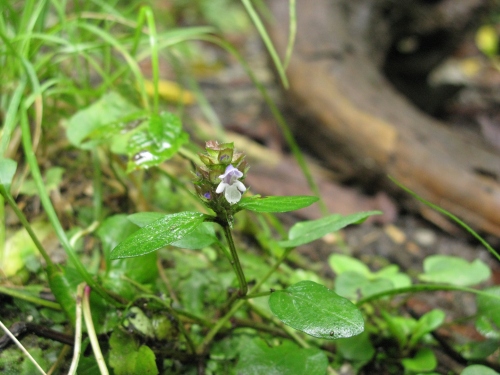
Prunella vulgaris; Heall All; Lamiaceae

Silver Tangle of Brambles at Midnight

Late night you remember God’s first language
is silence. The space between heart beats,

the pause before someone says, Yes,
a brief moment before ebb becomes flow.

So you say, Fine. Don’t talk to me
like God’s a stubborn ghost.

You say, I’ll hear messages
whether you speak or not.

Every closed-door signals detour,
and each broken heart demands

sitting quietly for a time.

.     .     .     .     .     .     .

From The Stumble Fields, Malaika King Albrecht. Main Street Rag Publishing Company, Charlotte, North Carolina. © 2020.

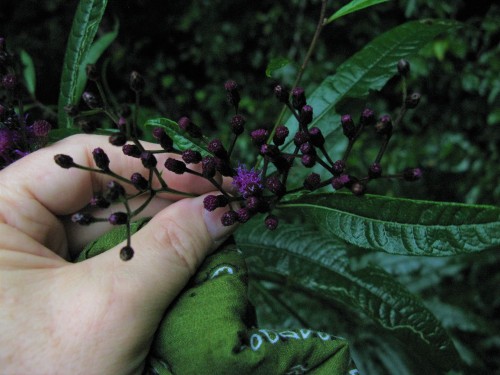
Vernonia flaccidifolia; Tennessee Iron Weed; Asteraceae

.     .     .     .     .     .     .

IMG_0880


Read Full Post »

Young Isaac is strolling through the orchard, another undifferentiated non-linear autumn afternoon of this perplexing equation we call life. Some of the fruit has detached itself and translocated several meters closer to the center of the earth. It has begun, with the help of fermenting microorganisms, to succumb to entropy. Isaac steps in it. He slips.

Isaac’s 70 kilograms, density of water, accelerate at 9.8 meters per second per second. Suddenly prone, the gravity of the situation strikes him. There, 10 centimeters from the tip of his nose, lies a perfect red spheroid. Glossy. Fragrant. The tiny lenticels on its taut unblemished skin are arranged with the symmetry of stars distributed across the heavenly sphere. “What an apple!” young Isaac exclaims, “Artios!” (his years of Greek instruction now finally relevant): That which is perfectly suited to its nature. The essence of appleness.

And how will Isaac’s own essence be transformed by this epiphany? How will yours and mine? No longer undifferentiated, will he discover his many gifts and their ideal trajectory? Will we ours? For are we not each of us an essence, our process of formation either distracted and garbled by the noisy physics of our history and our surroundings or alternatively able to grasp that trajectory perfectly suited to our unique nature? Besides mass and density and the ability to struggle upright against gravity, don’t we human animals also possess the agency of choice and change and discovery?

Isaac sits up and regards the apple. You know where this is headed. It will be 218 years before young Albert slips and falls and realizes that what Isaac experienced is actually the curvature of space. Meanwhile why don’t we all, each of us, sit up and regard our nature. Artios! To become that which is the perfect expression of our nature. It’s about time.

.     .     .     .     .     .     .

I have been a DAVID MANNING fan since I first sat up and discovered poetry. Whether he does it with a compassion that draws me deeper into the circle of human family or with a wry and pointed barb that makes me snort, he regards human nature and tells its truths. I will be the first person in line when his NEW AND SELECTED is released from PRESS 53 later this year.

And I have been favored to preview the manuscript. Wandering these wonderful poems spanning decades I enter an inner landscape and pass from reader to personal companion. There is a deep imagination at work; there is joy and no lack of laughter and sometimes a little weirdness; there are bright moments of insight and connection.

Most of all there is WONDER. No aspect of our human situation or our confounding universe goes unnoticed. David’s artistry gathers a desert landscape, a snatch of opera, a funky conversation and weaves from them with perfect sense and sensitivity an affirmation. When I reach the final page I say, “YES, that is the way it is.”

.     .     .     .     .     .     .

Sailing with Anne

Santa Monica, California, 1950

After her sailing class we cast off
into the ruffled Pacific blue, tide
incoming, echoes of great breakers
lapping the dock. She-the sailor,
the tiller, mine.

As we headed west, tacking
into a strong breeze I remember
marveling at who she was
to do these things. I imagined her
at the helm become Anne Bonny,
running a four-master down,
the setting sun turning red lights
in her hair.

I hope we left something there-
if only a boat paint-scrape
or salt spray from her hair.
Maybe something from that day
was never lost, but joined
the Pacific’s history, some trace
still riding the blue circuit
between the poles, with the sea-grape
and tiny life that make the coral.

.     .     .     .     .     .     .

Star Journey

Sometimes at night I return

to the Griffith Park planetarium

where stars from the surrounding hills

come out to music.

North of Los Feliz

I step from city lights into the night

sky of Patagonia with its wind-swept shores

under the warm lights of Fornax,

Fomalhaut, Alpha Crucis, a bright canopy

of southern stars, to music-Gymnopedie,

Satie’s barefoot dance.

Then, under the soft night sky,

I take off my shoes

and find my way into the stars.

.     .     .     .     .     .     .

David Manning’s NEW AND SELECTED POEMS is anticipated later this year from Press 53.

Star Journey first appeared in KaKalaK 2017 – Anthology of Carolina Poets
Sailing with Anne first appeared in Pinesong: The North Carolina Poetry Society

.     .     .     .     .     .     .

.     .     .     .     .     .     .

IMG_0880

Read Full Post »

« Newer Posts - Older Posts »