. .
[with two prose poems by Mark Cox]
. .
Poem at Forty I Could Not Finish Until I Turned Sixty
. .
The seas below our house pitch deep and soundless. Like sweat engrained in handrails, or the oil darkened edges of our dining room table, every shadow implies more shadow.
. .
Late summer has quieted the cicadas, damped their dwindling number with the lastness of their deaths. There is a chill to the air, no wind at all. My youngest son is twenty days old, feeble, burrowing in and out of awareness, still unsure his body isn’t trying to kill him. He cries to eat, he cries to sleep, he cries as his tiny gut rejects what all must go to waste.
. .
Last week, scientists discovered the bones of a humanoid who fell into a well shaft three million years ago. His wife said he’d turn up! That the world has no pity for the individual life, this is no secret to anyone, yet we just can’t get over it. I am here in the middle of a bed, in the middle of the night, in the middle of my life, my son nestled as if he were my own bones, as if we’ve both toppled forty years down into positions we’ll retain forever. There is no chiropractor for the soul.
. .
The museum of loss has at last opened its doors to me. Scholars cannot agree, the docents say, but almost certainly arms encircling the body was an omen of intimacy. Little is known of the fabled kiss; what remains of crude glyphs and mosaic shards indicate our elders once believed that souls were exchanged. One cannot, of course, touch anything in the museum of oss. One can only view what was once there. Nothing can be imagined and remain the same.
. .
Just what does this portend? There will always be a thermos next to the detonator, a pair of reading glasses weighting the sentence handed down without mercy. An airman in WWII, John Ciardi recounted how once from the blister all gunners sat in, he watched the bomber beside him burning. His counterpart waved up as that other plane went down.
. .
Each age has its designated bandwidth. Without warning, my son is twenty and in love. We are belted in. Splitting space. In his lap, he holds one hand with another, as if to keep its fingers from detaching, as if I’d helped him hurry to the car, and was driving to a hospital. I want my tree back the way it was, he whined, one autumn morning. He was four or so and knew even then what he’s now not able to share.
. .
Much is felt that resists being known. If there are seven billion human beings on earth, then every day is 19 million years of experience, just all at once. Somehow, I find this comforting, though by now you’d think we’d know what we are doing.
. .
Mark Cox
from Knowing, Press 53, Winston-Salem NC; © 2024
. .

. .
❦ ❦ ❦
. .
Better to resist the flux and believe that something stays. At last, he thinks, that is his answer. How still it all is, so utterly clear. Then one bright leaf lets go and changes everything.
++++++Knowing, Mark Cox
. .
It all begins with a question. No, that comes second, first there’s noticing, and noticing that something is different. Wait, even before the noticing there has to be paying attention. No, no, it all begins with this: just being there, moving through the world, part of all the changes.
. .
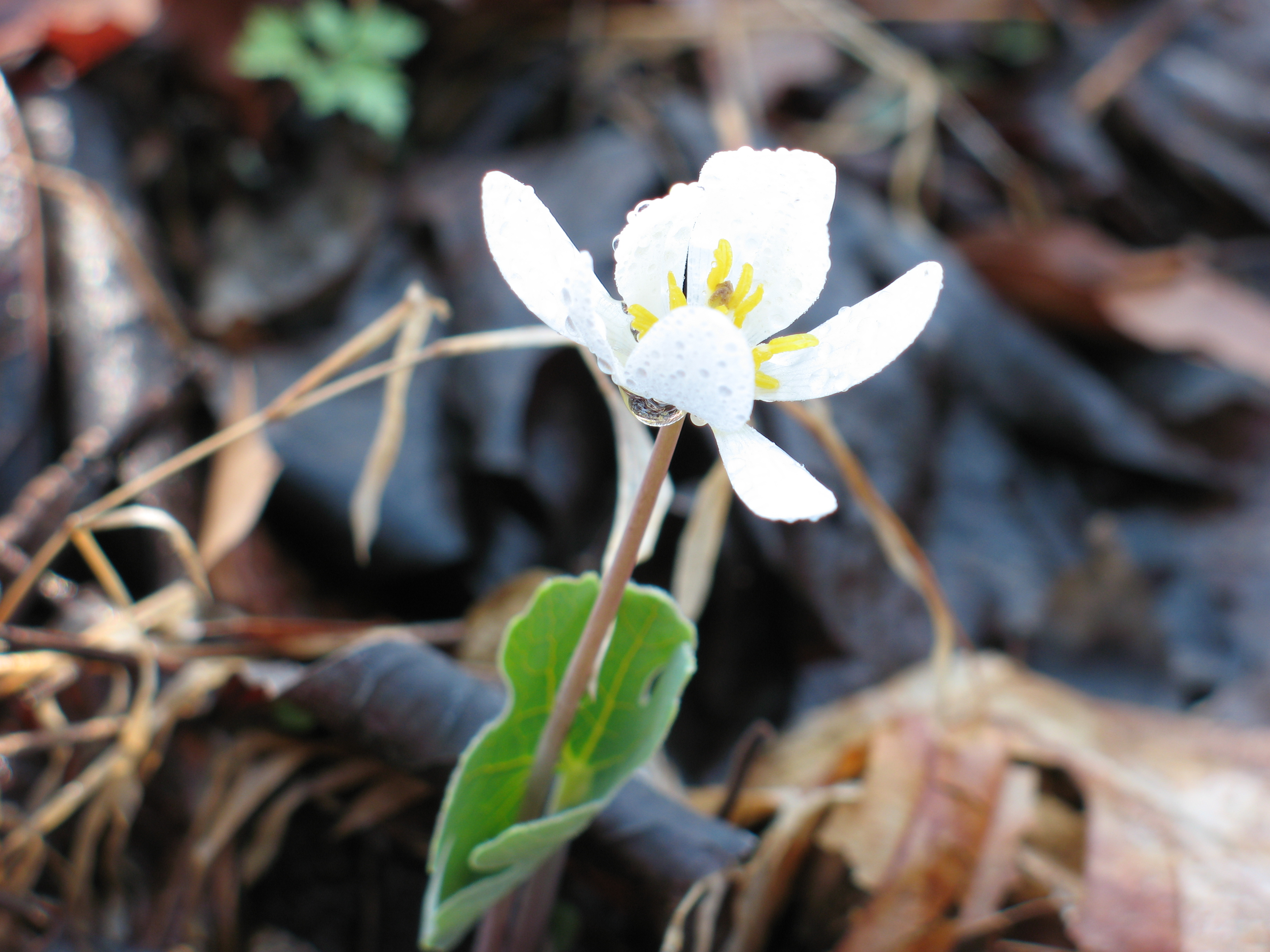
Joe just texted Cynthia and me a remarkable photo taken along a path we’ve walked together more than a few times. Looks like Bloodroot – nothing else has those freaky leaves emerging from the earth like fingers of the undead – but the petals are different. Instead of a circle of daisy-like petals (radial symmetry) they are bunched and doubled. And the center is almost naked as a belly button.
. .
A hybrid, we ask ourselves? But there are no other species in genus Sanguinaria with which to hybridize. A mutant, then. Sure enough, we discover online images of Bloodroot Multiplex with these peony-like blossoms, all of them propagated from a spontaneous mutation first discovered in Ohio years ago. Sterile flowers in which the stamens have reverted to petals. Evolution amok. Now we have the same mutation here in our backyard.
. .
❦
. .
Plants that make flowers first appear in the fossil record 360 million years ago. Their flowers left the seeds exposed – they were naked (gymnosperms = conifers and gingko). Gymnosperms ruled for over 200 million years until the first flowering plants evolved forms that keep their seeds enclosed. But the outcome of the mutations that eventually resulted in plants with such protected seeds, angiosperms, was so successful that they have filled the earth with their variety and diversity. Every plant you see with flowers blooming this spring is an angiosperm (and even a lot whose flowers you don’t see, like grass for goodness sake).
. .
The enclosing ovary which cradles the ovule which will become the seed – what an excellent evolutionary idea! It most likely developed from mutations in fertile leaves which caused progressive curling and enfolding. All the parts of the flower – sepal, petal, stamen – are specialized modified leaves. But whenever we discover a Bloodroot flower with more than eight petals, we can assume that some of the extra petals are stamens which have turned back the evolutionary clock to become petals again.
. .
Is there anything we can hold on to that stays, fixed and static? Is it even possible to imagine something that never changes? Do I even really know what I think I know?
. .
❦
. .
There is only one thing that each and every one of us knows. Mark Cox reminds us what it is in Knowing – it’s something no one likes to talk about, but something Mark’s poetry is able to face and say in a hundred ways until we readers become more than willing to join the conversation. We’ve known it all along, maybe at times we’ve even braced for the brief plunge toward otherness, but in these prose poems we have a guide and a friend who is just as afraid as we are but braver about sharing his fear.
. .
Does a prose poem occupy some evolutionary niche between verse and narrative? Forget its phenotype: brevity, blockiness, absent linebreaks. What’s down deeper in its DNA? It seems to carry all the genes of its poetry forebears – language and imagery, rhythm and music, even internal rhyme – but it is its own genus. Unlike a story, it has no beginning, middle, and end – it is all middle. Crisis and denouement might embrace each other in the same line. (And can we even call them lines when they are all one? Sort of like the question how many grooves there are on a 33 ⅓ rpm LP.) In the poem, everything is happening, but how is it happening? Oh wait, as I read the poem everything is happening in me.
. .
And what happens in me over and over as I read these poems, as it dawns on me that the one thing we all know, each and every one of us, is that we will die, is this: I look up from the page and talk to myself. I query, I wonder, I argue, I confess. I pick up the threads of so many internal conversations left dangling because they were difficult, or scary, or just pushed out of the present by quotidian distractions. I’m not saying that by reading a book by Mark Cox titled Knowing I have gained or been granted my own cosmic knowing. But I have been reminded that I want to.
.

. .
❦ ❦ ❦
. .
Music Box
++ For Ralph Angel
. .
Everything’s just peachy, comes the world report: all clear. We are not pirouetting on the tip of time’s scalpel; we are not screwing deeper into the ground’s veneer. It is just the fleeting dance we do until the delicate box closes, having learned now to bow before hurting ourselves.
. .
Today is Thursday once again and the man next door is off to get his mail. He will wander back reading, as is his wont to do, his wizened leashed dachshund dog sniffing the leaves. The breeze passes over our shrubs and still they stand. A wary sparrow peers from them be we shouldn’t call it hiding.
. .
Yes, we have learned how to brace for the brief plunge toward otherness. We have learned to keep our eyes open to the dark, even if it doesn’t matter. We see most vividly what cannot be seen, and this is always the case.
. .
In the caves of our past, flames flickered on the rough walls. Fear grew there beyond reason and all sense of proportion. Our shadows have always been bigger than we are, the house lights shining up as they do, not down.
. .
It would make sense to be offered a tune now. Something simple and genuine, a tale of longing fulfilled. Something to do with a childhood nightlight, a mother’s cool palm. Whatever it is, it will have to be a memory wound long ago.
. .
Such a blessing might be broadcast from just about anywhere. We receive it on this bureau with no clue wherefrom it issues, which ancient satellite or lofty transmission tower. On and off like a warning beacon, the message beams. Once all is said, one has no choice but to choose. Call it grace, call it wonder, just, as they say, keep it calling.
. .
Mark Cox
from Knowing, Press 53, Winston-Salem NC; © 2024
Music Box first appeared in The Connecticut River Review
. .
❦ ❦ ❦
. .
Mark Cox is chair of the Department of Creative Writing at University of North Carolina, Wilmington. He also teaches in the Vermont College of Fine Arts MFA Program. His six previous books include Sorrow Bread: Poems 1984-2015 (2017) and Readiness (2018). Read more about and purchase Knowing at Press 53 HERE
. .. .

.
❦ ❦ ❦
. .


 V E R S E and I M A G E
[…] About/Submit […]