Feeds:
Posts
Comments

Posts Tagged ‘NCPS’

[with two poems by Lenard D. Moore]

Mockingbird knows both of Blue Jay’s songs: the astringent lament that flings the blue name of the blue Corvid into pathos; the softer plaintive wheedle of him who begs to be thought better of. What does all that conversation signify when it erupts from the beak of the Jay? What meaning has the Mocker usurped, if any meaning at all? Who can listen and understand, and who can answer?

We of different class order family genus species can only speculate why the Mockingbird repeats four times each song he knows, and each song he himself composes, as he hops from the tip of power to the mailbox to the thorn bush and back again and his notes spiral the neighborhood. We are probably safe to bet that Mocker doesn’t care two bits about impressing the Jays. Song as proclamation, song as beacon, song as telegraphy, song as bulwark – let’s just imagine that Mockingbird proclaims music is glory and improvisation is king.

Listen and understand.

.     .     .     .     .     .

I have known Lenard Moore mainly from his haiku. He points the way to that parallel universe which is only a hairsbreadth from ours and then with observation and pointed brush he opens the door.

I also know Lenard as a teacher and mentor to Carolina writers in many, many different organizations and settings, and particularly I remember a meeting about 10 years ago at Weymouth Center in Southern Pines, NC. While Bill Blackley played blues harmonica, Lenard riffed and bopped with his jazz poetry. Now I’m holding a book that brings it back: The Geography of Jazz, issued in 2020 by Blair as a reprint of a publication by Mountains and Rivers Press in 2018.

Sultry, syncopated, steamy – if you can read this book without bobbing your head and tapping your foot you need a little more sax in your life.

.     .     .     .     .     .     .

At the Train Stop

I imagine the quick hand:
Thelonious Monk waves
at red, orange, yellow leaves
from Raleigh to Rocky Mount.
Alone in this seat,
I peer out the half-window
at the rainbow of faces
bent toward this train
that runs to the irresistible Apple,
determine to imagine Monk
glows like Carolina sun
in cloudless blue sky.
I try so hard to picture him
until his specter hunkers
at the ghost piano, foxfire
on concrete platform.
Now I can hear the tune ‘Misterioso’
float on sunlit air.
If notes were visible,
perhaps they would drift crimson,
shimmer like autumn leaves.
A hunch shudders
into evening, a wordless flight.

.     .     .     .     .     .     .

Ascension: John Coltrane

I didn’t pick up the tenor
and soprano saxophones
for legendhood.
I wanted only to explore chords
into progression, step into another world
I had to escape anything too strict,
take ‘Giant Steps’ all the way
from Hamlet, North Carolina.
The music shimmered like a lake
inside me and turned blue.
It was kind of spiritual.
I thought of extending the scales.
I wanted to play on and on,
sail as long as the horn could
and eventually come back again
as if I had never left.
It was maybe the only time
I left my body.

both selections from The Geography of Jazz, Lenard D. Moore, Blair Publishing 2020 reprint, © 2018 Lenard D. Moore

More about Lenard D. Moore, his poetry, and haiku.

 

.     .     .     .     .     .     .

Afterword: Old Jay still has a few tricks of his own. He can mimic perfectly the three Buteos in his breeding range: Red-tailed, Red-shouldered, and Broad-winged Hawks. Nobody messes with Mr. Blue Jay.


.     .     .     .     .     .     .

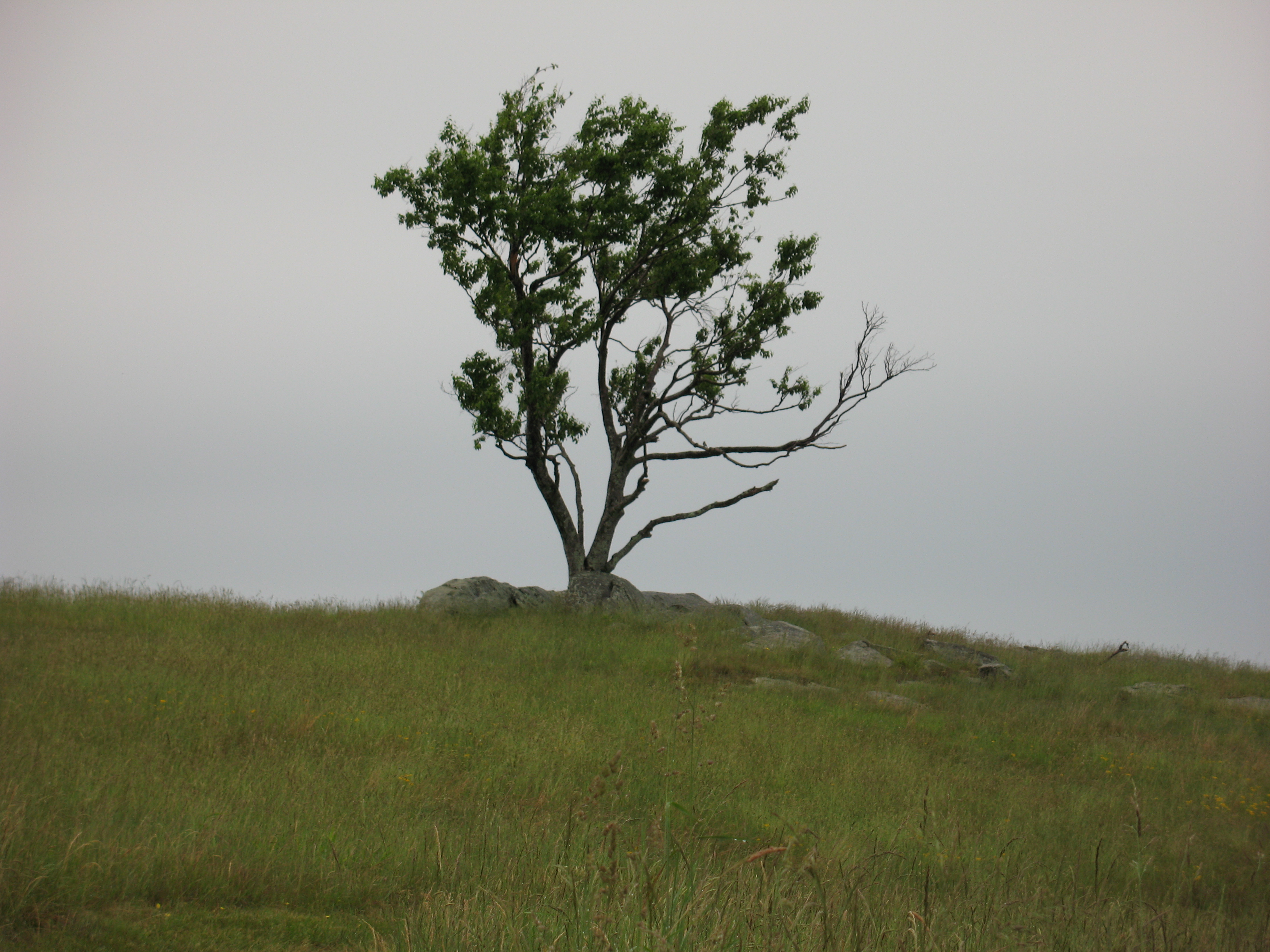
2020-09-08b Doughton Park Tree


Read Full Post »

Poem in the Key of E

Some trees keep their color and shape
even beyond the time that we have ceased
to dream. They tease us into faith.

This one I approach from a distance.
Its leaves, like tiny flags of grace,
beckon to me. It is November, and the rain

has pelted us, sweeping masses
of yellow to the sodden earth.
But these leaves stay, and the tree,

bright orange against the now blue
sky, stands against the growing dark.
Some days I am afraid to come,

fearing that a mean and fickle God
will flip the table, leaving me nothing
but a tangle of dark and dirty branches.

The neighbors think I’m weird.
“For Christ sake,” the plumber says.
“It’s just a fucking tree.” Maybe.

I thought that once myself. But now
if I close my eyes hard in the night,
the color comes and the room

slides away. I float upward in this
orange, this strange treeness.
My body is inside, looking out.


Anthony S. Abbott, from The Angel Dialogues, Lorimer Press, 2014

.     .     .     .     .     .     .

Poetry, on some level, is about saving things. . . . Things die; poetry retrieves them.

Tony Abbott graced my life during the few years I knew and worked with him. He was president of the NC Poetry Society while I served on the Board, he was mentor in the Gilbert-Chappell program for students, and he was an inspiring colleague and friend. I sat in awe: Davidson professor, poet and novelist, literary leader. But Tony didn’t want our awe. He was a seeker for meaning in this tangled, sometimes messy human journey and he simply invited fellow travelers.

Perhaps empathy and humility spring from the same root. If one has suffered deeply, one cares for and feels deeply the suffering of others; if one has experienced the frailties and missteps to which none of us are immune, one sets aside pride and judgement and stoops to lift the burden of one’s fellows. If one member suffers, all suffer together with it; if one member is honored, all rejoice together with it.

Tony, with his vast gifts and achievements, embodied empathy and humility. My life is richer for having shared it with him. Now his voice we carry within ourselves.

.     .     .     .     .     .     .

Going Home:
a poem in memory of those North Carolina writers who have gone before us

– Weymouth Center, July, 2009

Late afternoon. I lie in the long grass and wait
for words. The still white clouds mock me. Then,
unexpectedly, the sound of music. I sit up. From
an open window upstairs, the clear sounds
of Dvorak. I know these notes like I
know the timbers of my own soul. Yes.

The English horn sings the theme, and sings it
yet again, with the bass clarinet. And then
the strings enter, like a prayer. Take me home,
Lord, take me home. Now the clarinets,
and the horns like faith answer. Then the strings
whisper softly, yes, and again, yes.

I see Graham Jackson, tears running down his black
cheeks, Graham Jackson, in full dress uniform, playing
“Goin’ Home” for his beloved Franklin Roosevelt, and then
the farmers, young and old, black and white, all
of them poor, who loved the only man they had
ever known as President of the United States, hundreds
standing on the hills of Georgia and the Carolinas
watching the train go by with the body of their lost
leader, watching the train take him home. “Goin’ home”
say the English horns again, and then the clarinet returns.

Here I am, listening, images surfacing – the trim brick walks
of my beloved town, the green hills to the west, rising
and falling like the strings, the waves on the outer
banks crashing like the cymbals, then sliding back
like the clarinets. I see the faces of my friends, I hear
the voices of the poets who have gone before, their words
rising again. Dark skinned and light, old and young, male
and female, children of the valleys and the mountains,
children of the coast and the Piedmont. I am here, they say,
I have made the path for you, and I am still here, my words
as true as the rock face of Cold Mountain.

The music soars and for a moment there is light. The whole
orchestra together in hope. then the English horn alone,
mournful, and the strings so soft, almost a whisper.
The strings carry our love over the hills to the sea,
the horns offer it to the sky, and the strings set it aloft.
It is done. They have gone home, and who and what
they are we carry within ourselves. The evening comes.
I rise from the grass and walk toward the open window.


Anthony S. Abbott, from If Words Could Save Us, Lorimer Press, 2011

.     .     .     .     .     .     .

Poetry, on some level, is about saving things. Even a poem so simple as “Growing Up” in A Small Thing is about saving the wonder of the child in an adult world that conspires to destroy it. Maxine Kumin uses the term ‘Retrieval System’ in one of her great poems. Poetry is a retrieval system. Things die; poetry retrieves them.
from Anthony S. Abbott – In His Own Words

Tony Abbott’s publications at Lorimer Press

Biography and induction into the North Carolina Literary Hall of Fame

The scriptural quotation above is I Corinthians 12:26, New Revised Standard Version

Sam Ragan Poetry Festival of the North Carolina Poetry Society — March 22, 2015

.     .     .     .     .     .     .


IMG_1783

Read Full Post »

Wow, I really like your enjambment.

To the women who said this to me after a reading last Spring: Where are you? Who are you? I’d like to get to know you better. Let’s get together and talk . . .

. . . about my poetry. Oh, right, about yours, too. About all sorts of poetry. Just remember: the sexiest line in the English (Major) language is, I like your poem.

Because let’s face it, most of the people I run into every day don’t want to hear about my poetry. I’d most likely encounter a blank stare, or even a lynch mob, if I confided, “I’m writing a sestina using the argot of 1930’s gangster Chicago.”

But there must be someone out there who admires my enjambment. I guess I’ll have to place myself at the mercy of the Editors.

*     *     *     *     *

Years ago when I first became afflicted with this obsession Poetry I was writing in a vacuum. Lines tumbling about in my head pressuring to be set down on paper – why does someone do that? For a Pulitzer? Not in a million years. Pushcart? Never heard of it. Fortune? Ha ha ha ha ha! Fame? Of course not . . . well, maybe a little would be nice.

No, I suppose I write for the same reason as all writers: the compulsion to get it onto the page, and to get it right. But how to know if it’s right? I was desperate to have someone read from the growing stack. Not to tell me it was good (OK, it wouldn’t hurt my feelings if they did) but just to confirm that what I was writing was poetry. That the lines communicated what they were meant to. That they connected with the reader.

Having no access to a writer’s group it occurred to me that I should submit to poetry journals. The Editors would let me know how I was doing! Editors are wonderful human beings, but of course they are far busier than I imagined. Most of the feedback they gave came from their Xerox machines. A few had distinctly negative things to say (without ever quite using the word “sucks”). But there was one Editor, one Golden Pen beyond the vale of the SASE, who never failed to encourage.

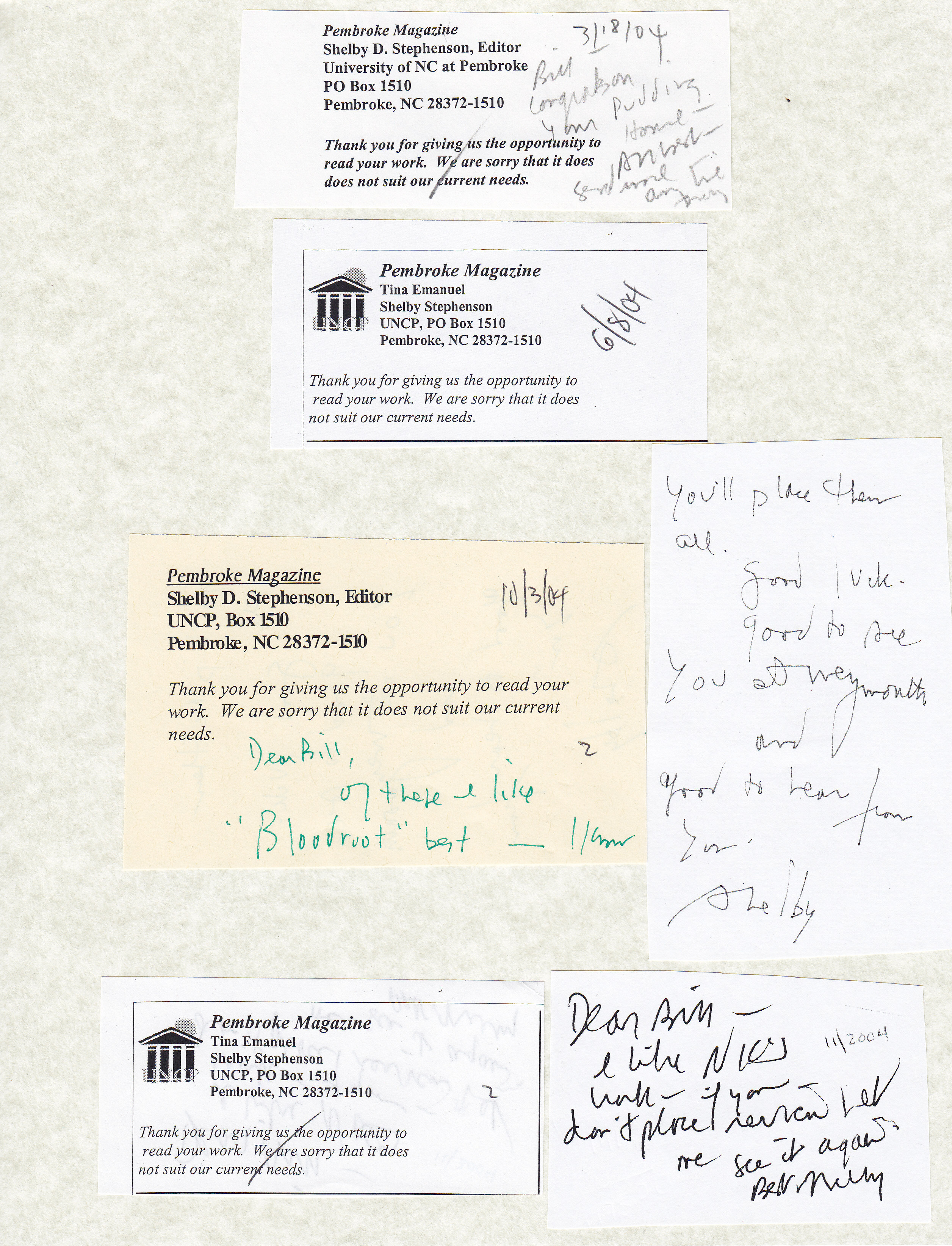
Perhaps you’ve guessed – I’m talking about Shelby Stephenson. Between 1999 and 2004 I sent him seventeen submissions, eighty plus poems. I must have exhausted him! But the tiny slips that returned along with the poems usually said, “Keep writing!” or “You’ll place these elsewhere.” Sometime during those years I met Shelby in person at an NC Poetry Society meeting and then I understood. The concept rejection does not reside in the man’s soul.

*     *     *     *     *

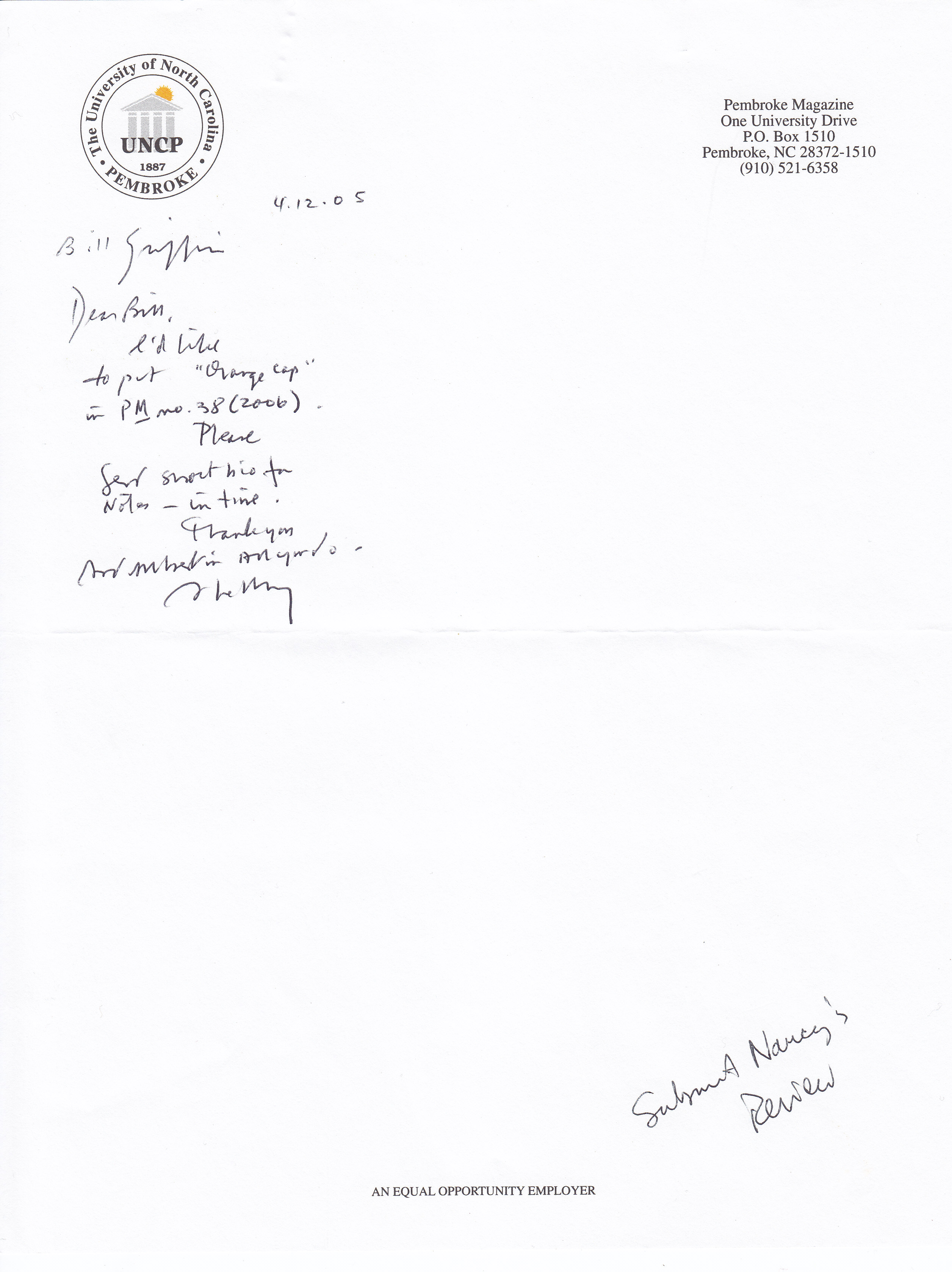
And then on April 14, 2005, I received in the mail an 8½ x 11 page on the Pembroke Magazine stationery. An acceptance. I must have written a real poem at last.

Here are a few samples of the “non-rejection” slips – I saved every one. Here’s the acceptance letter, and here’s the poem Orange Cap which appeared in Pembroke Magazine Number 38 in 2006.

Shelby Rejections 01_0002

Pembroke 2005-04-12

*     *     *     *     *

Orange Cap
for Grady at ninety

Common as dirt; cotton and nylon with a plastic snap band,
stiff front, forehead’s high profile that begs
for jaw ballast of a heavy chew; the kind a man wears
while he primes tobacco, hoes a row of beans,
seep of sweat darkening the brim, its shade
a cool welcome across the man’s red face
while the Piedmont sun sows his ears with slow cancer.
I can see one like it settled low on your narrow head

in many a long day’s field, beneath the nights’ revival tent,
at sixty still cutting timber with your boys,
your bony arms like axe handles, your hoarse chuckle
taming the chainsaw’s growl. You’ll never sit still,
almost ninety now and determined to ride that durned mower
across town, little wagon in tow to carry a brown paper sack –
bread, milk, a slab of streakéd meat
for the creases your daughter cut at the creek bank.

Never still and never capless, one clutched in silent hands
at the hospital that night we lingered with Opal,
last Yadkin County breath struggling from her lungs,
prayers that she’d open her eyes one more time
to your foolish teasing, the only one who could make her laugh –
prayers to be answered in the next life.
For today, always a cap and another to share:
I’ve kept the one you gave me, orange, Kennedy Auto Supply,

dusty then and more so now from its berth
beside these books that don’t tell a single story
that’s as worth hearing. See, I inked your gift’s date
here inside the hem: May 19, 1989. Remember
all the times I’ve rediscovered it, surprised you
at the door with the old blaze perched on my scalp?
Used it to make Opal cluck (but she couldn’t help grinning)?
Coaxed a phlegmy chuckle from your throat?

At each goodbye you ask, Still got that cap?
Like all the things we can’t take off –
the smell of woodsmoke in a canvas jacket,
black tobacco gum beneath cracked nails;
like all the things we’ll wear into glory –
grief, redemption, love for one companion,
shared laughter at an old fool’s tales . . .
yes, friend, I’ve still got it.

first appeared in Pembroke Magazine Number 38, 2006

*     *     *     *     *

IMG_0998

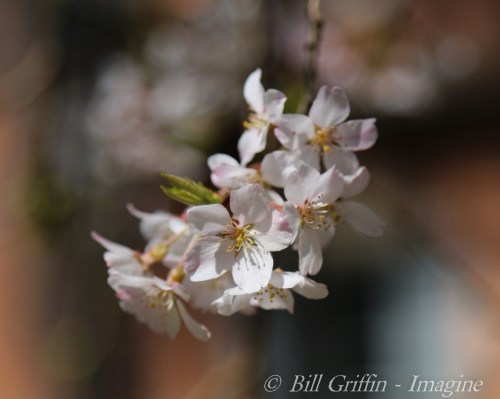
Spring Larkspur, Delphinium tricorne — Appalachian Trail north of Groundhog Creek Shelter, 5/2015

Post script

– I pulled out my copy of Number 38 this summer to leaf through it again and discovered there a host of poets I’ve since some to know and revere: Ronald H. Bayes, Ann Deagon, Janice Moore Fuller, Sharon Sharp, Heather Ross Miller, Nancy Tripp King, Isabel Zuber, Susan Meyers, Ruth Moose, and more. I just want to say, “Holy Cow, Shelby!”

And THANKS!

*     *     *     *     *
Doughton Park Tree #3

Read Full Post »

« Newer Posts - Older Posts »