Feeds:
Posts
Comments

Posts Tagged ‘nature poetry’

July, Knife Lake, half a mile from the Canadian border.  The vireos begin to sing at 4 a.m. and dawn follows right on their tails.  I crawl out of my tent before the boys awaken.  We’re camped on a bluff high enough above the water that the mosquitoes don’t find me for a while, so I just sit among the red spruce, wait for water to boil, and watch the dance of colors on the water.

We paddled to this remote spot yesterday at dusk.  In the Boundary Waters Canoe Area Wilderness, northern Minnesota, you’re only permitted to camp at specified sites, perhap just one in the smaller lakes, half a dozen in large lakes.  Of course there are hundreds of lakes, interconnected by creeks and sloughs and overland portage trails.  This will be our fourth day on the water out of ten.  Yesterday afternoon every campsite we passed had a couple of canoes pulled up the bank; we were afraid we’d be portaging ourselves and our gear to the next lake in the dark before we’d find an unoccupied spot.  Then we glided through a straight, passed a promontory, and the lake opened before us.  No tent, no campfire smoke for miles.  The designated campsites, like the portage trails, are indicated “approximately” on the map — a red dot, no signs anywhere in the wilderness.  On a hunch a boy in the lead canoe tied up to a sapling, rock-hopped to shore, climbed the abrupt bank, and fifty feet above the water there it was.  A fire grate.  Here we were allowed to spend the night.

Now the sun promises to return, a coy suggestion through the conifers on the far shore.  A loon cries, its liquid call mimicked in pastel ripples.  Every minute the lake is different from the minute before.  A phantom of mist here, a reflection of pale sky there; color rising, flowing . . .breathing.

I snapped a photo.  For several years it hung in my office.  I could name the landmarks: that curve of shoreline, sharp flint mouthing the shallows, trees reaching down to the distant notch where our next portage hid.  But where was the dance of sky in water?  Where the ephemeral colors that have no name?  The print on my wall was like words on a page, a dead thing.  It couldn’t breathe, it couldn’t speak . . . except in the fire it lit within my mind.

.     .     .     .     .

Can a poem breathe?  Can it live?  Can it set you down on some elevated vantage you’ve never visited and reveal a place you’ve never dreamed?

I’m looking for that poem.  I want to stare across its rippled surface and discover in its reflections something that words can’t name.

Bud Caywood’s poems have taken me at times to that unnamed place.  He is an artist, a canoer, a fellow birder, and his verse often endeavors to capture that singular moment of inchoate atmosphere.  You want to enter the words he’s placed on the page.  You want to return there.

.     .     .     .     .

GoodMorning

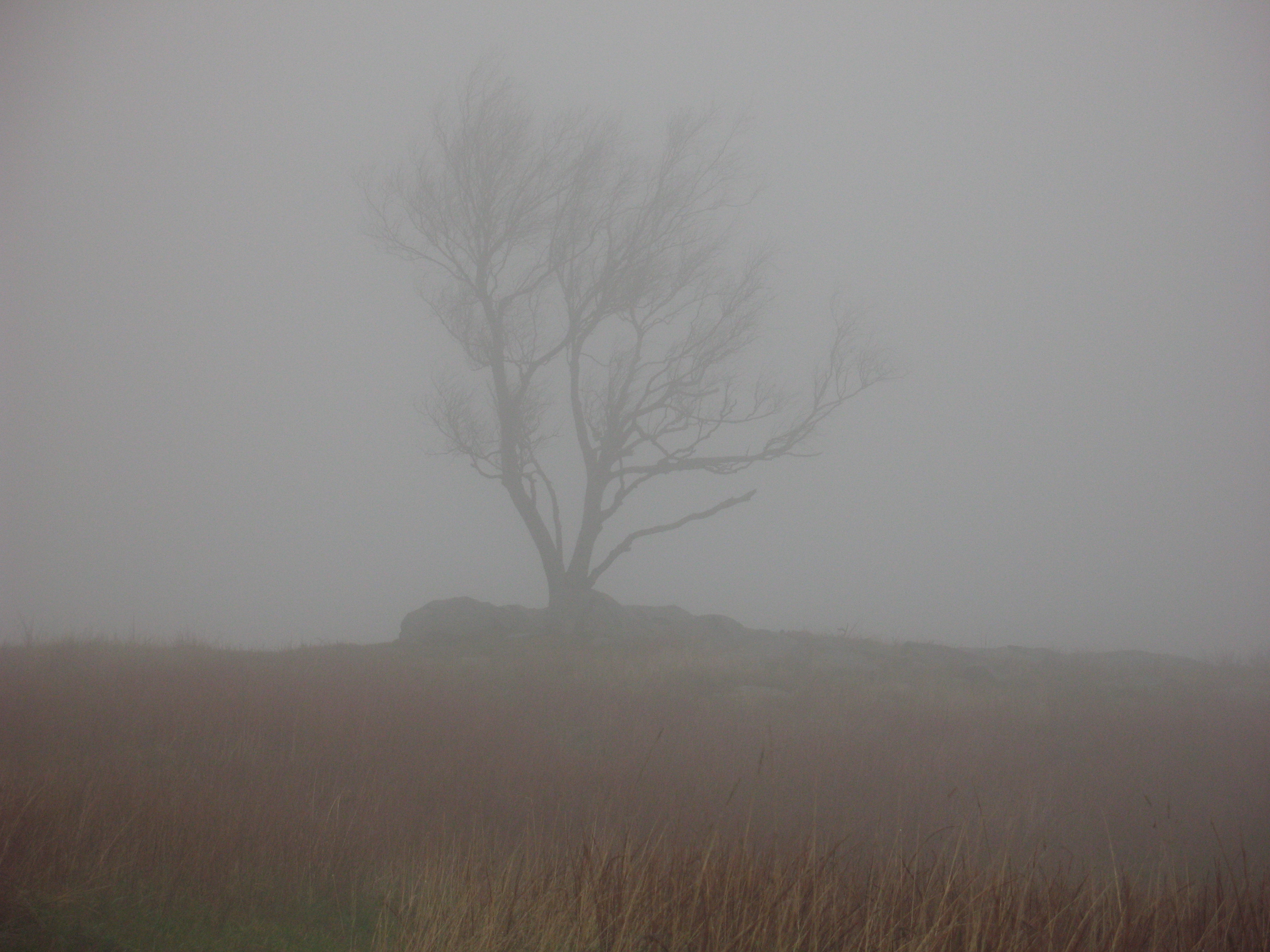
Morning in the World of Fog

See the fisherman crossing the stippled lake,
cutting a swath through the layered

fog of morning.  See how his image
darkens the falling light, brushed out

like a blurred black and white photo,
until thicker fog washes over him.

Now watch the boat docks quiver
in their eerie caress of the wake,

or the skeleton-like crepe myrtles
light-speared through their branches,

or the boathouse holding its stillness
against the thick gray-orange blanket,

while its squeaking hinge strums
one-chord songs again and again and again.

See the gulls appear like angles,
disappear like apparitions,

unwinding the velvet, circle after circle,
as if the sky’s whole element is one in them.

Now hold open your palm;
even the air around you has weight.

.     .     .     .     .

I first met Bud years ago at a reading in Hickory.  He invited me to join the “e-Poets,” and for several years we shared poems with each other every month or so.  We’ve continued our friendship and mutual admiration through the NC Poetry Society and now Poetry Hickory, a monthly reading organized by Scott Owens.  Last month Bud invited me to read, along with Adrian Rice and Tyree Maddox, at an annual poetry night at the Bethlehem Branch Library near Hickory.  Bud arranges art, sometimes accompanied by poetry, every month at the library; he is one of the stalwart perennials who are keeping verse alive in our modern culture.

And I admire his poetry.  Images that breathe.  I will hold onto and return frequently to that closing couplet: “Now hold open your palm; / even the air around you has weight.”

IMG_1964_crop01

Additional poetry by Bud Caywood

Wild Goose Poetry Review

Dead Mule School of Southern Literature

.     .     .     .     .

IMG_6432

Read Full Post »

“Like you and like I.”  True confession time: tell me there hasn’t been at least one time during the week leading up to Christmas that you could have reasonably been accused of being ornery.  Maybe in the last 24 hours even.  Heck, in the last thirty minutes.  Stuck in traffic on Hanes Mall Blvd. – Oh no, I didn’t lean on my horn.  Spouse asking for the fifth time where the wrapping paper is . . . or telling for the fifth time (these are all purely hypothetical situations, of course).  No time to relax, take a walk, look at the hundred photos you just took, write a line.  Makes me darn ornery!

“I wonder as I wander . . .”  So haunting, so probing, so true – this Southern Appalachian carol has always been one of my favorites.  When Linda sings it at church I can feel the bitter wind of Mt. Pisgah through her threadbare shawl.  The questions it raises – “If Jesus had wanted for any wee thing” – seem to pierce my heart.  What do I want?  Where can I find hope?  Or meaning?  An ornery cuss like me?

Ornery – as in grumpy, disagreeable, cantankerous?  Actually the word comes from Appalachian dialect as a contraction of “ordinary.”  Commonplace.  Garden variety.  In other words, you and me. If we’re a little cantankerous at times, well, ordinary people are like that.  The same way we are also sometimes patient with grandkids.  Forgiving of spouses.  Open to sharing our homes, our space, our selves.  Christmas has arrived “in a cow’s stall, with wise men and shepherds and farmers and all.”  Or in the case of Bon Aire Rd., Elkin, with retired chemists and teachers, psychologists and technical writers, bakers and public administrators, artists and doctors (and five dogs, all under one roof). I guess Jesus enjoys hanging out with the ornery.

.     .     .     .     .

IMG_9445

The story goes that “I Wonder as I Wander” was collected by John Jacob Niles in Murphy, NC in July 1933 from a young traveling evangelist Annie Morgan.  For all who may feel Christmas as a harsh mountain winter, I offer this poem as an invitation to awaken to a song of love, assurance, and hope.

.     .     .     .     .

Pisgah Stranger
(Awaken to a Song)

A stranger here, I sleep
Beneath the slash of stars,
The Pisgah forest deep
And friendless.
I close myself to love,
My heart requires the dark;
Can night within this cove
Be endless?

Come, you’ve slept too long
And love grows dim.
Awaken to a song –
Can it be Him?

Is it madness or a dream
That seems to whisper here?
The murmur of a stream
Or singing?
It chants, this still small voice,
I’ve nothing now to fear
For tidings of great joy
It’s bringing.

Come, you’ve slept too long
And love grows dim.
Awaken to a song
And welcome Him!

And now the music swells
As every fir and spruce
Unloose their boughs to tell
The story:
May all God’s creatures wake,
Hearts quickened by the truth,
Invited to partake
Of mercy.

Come, we’ve slept so long
That love grows dim.
Awaken that our song
May worship Him.

Come sing it with the wind
And all the Pisgah throng:
The Child reclines within
The manger!
With owl and bear and deer
My soul’s reborn in song
For none of us is here
A stranger.

Come, you’ve slept too long;
If love grows dim
Awaken to a song
For it is Him!

Waken . . . welcome . . . worship . . .
It is Him!
.
.

Bill Griffin (c) 2011

.     .     .     .     .

IMG_9468

Read Full Post »

Linda’s sister Jodi is a National Park Service ranger in the New River Gorge.  In addition to some of her jobs like cultural and historical interpretation, wildflower walks, and storytelling, she’s also a graduate of the National Outdoor Leadership School: she teaches people visiting the backcountry to Leave No Trace.

Is it really possible to leave no trace of your passing?  Whether it’s an afternoon in the Greensboro Arboretum or ten days on the AT, can you really return from a place with no evidence you were ever there?  In years past the NPS and other outdoor organizations had less ambitious slogans:  Only You Can Prevent Forest Fires; Give a Hoot, Don’t Pollute; Take Only Pictures, Leave Only Footprints; Pack It In, Pack It Out.  But no trace at all?!  Even if all six billion of us recycled, composted, and travelled everywhere we went via shank’s mare, just the act of breathing in and out sends billows of carbon dioxide like a blanket into the atmosphere.  Leave No Trace — are you kidding me?

I wrote this poem, little mouse (trace), with my son and daughter in mind.  At different times one or the other of them has taken extended wilderness treks with me, and we’ve struggled to practice the best stewardship over wild places that we can.  (Margaret’s famous quotation upon reaching a road crossing with a refuse bin and over a pound of garbage in her pack:  “Trash cans rock my world!”)  But the world I want to leave them is not one with a few nice paths through the woods free of candy wrappers.  It’s not just the expectation that a few hikers will know how to erase the marks of their stay when they break camp.  It’s more like some crazy hope that all of us, every one, will retain an acute awareness of our traces right in the very places where we live.  That we’ll regret the unavoidable scars we leave on the earth.  That we’ll celebrate together when we can heal one.

.     .     .     .     .

IMG_7974
.     .     .     .     .

little mouse
(trace)

I want to leave the earth and climb
the snowbank cumulus, kick
my boots into the billow, lean
against my sassafras stick and rise.
Rain licks the slickrock clean

of my prints, greenbriar weaves
wild drapery up the wall, hickory sprouts
through the sidewalk.  I want to leave
no trace of my passing, no more trail
than the cursive of a slender tail

in dew.  Morning sun drinks that cup
and learns a word I never spoke,
someone’s new word for love.  I
want to be no more I but we – creature
loam bud feather; let roots translate

the phosphorus of my dust to fruit.
If you look for me a wren calls.
If you listen the poplar turns to honey
in the sky.  Drink deep this cup.  I want
to leave the earth to you.

.

[from little mouse, Main Street Rag Publishing, 2011]

.

IMG_8005

Read Full Post »

« Newer Posts - Older Posts »