Feeds:
Posts
Comments

Posts Tagged ‘nature poetry’

Brave families at the NC Zoological Park today: heat index topping 100, no respite cloud, scant breeze, water fountains running low.  Even the rhinos and bongo (antelope) had sense enough to find a patch of shade and not budge from it.  But Zoos are made for families, and a good chunk of mine showed up to join me on my first afternoon as Poet-in-Residence.

My kids are 30+; Margaret said she couldn’t remember ever going to the zoo,  Josh said his last trip was in seventh grade, Allison has fond memories but they’re getting pretty fuzzy.  Jimmy and Dana (Allison’s parents, Josh’s in-laws) and I reminisced about the zoos of our youth and how much things have changed.  But four-year-old Saul didn’t need to philosophize – he kept us laughing repeatedly with his hoots of amazement at every new wonder.  The park was closing as we literally dragged him away from the underwater viewing of the harbor seals, and even rides on the tramand the bus had his eyes popping.  And I honestly don’t recall any complaints about the heat.

It’s not just the old cliché about seeing the world through the eyes of a child. It is something deeper, something that is ingrained in our heredity, essential to our lineage.  Something without which we wouldn’t have survived as a species.  Shall I call it the desire to give our children joy?  It is certainly a self-reinforcing phenomenon, a positive feedback loop:  when I see the awe on Saul’s face as he places his hand against the hand of the baby chimpanzee on the other side of the glass, I just want to keep offering him more of those experiences.  More and more.

IMG_2870

.     .     .     .     .

This poem by Peter Makuck captures for me the yin and yang of this sort of desire for our progeny.  We want to protect them from suffering – they will nevertheless experience sorrow.  We want to convey to them whatever meaning we’ve discovered – they will have to discover it for themselves.  My grandson is the apple, all potentiality and sweetness.  I am the stiffening branch.  I can only hope the ground I leave him, when he falls, is fertile.

.     .     .     .     .

 My Son Draws an Apple Tree

I watch it grow
at the end of his dimpled hand
rooted in white paper.

The strokes are fast
and careless, as if the hand
had little time.

Quick black trunk,
a green crown and in the white
air all by itself

a red splotch,
an apple face with a frown
that is his

he gravely says
looking up at me — the stiffening
branch he falls from.

Peter Makuck
from Long Lens, New & Selected Poems, © 2010 by Peter Makuck, Boa Editions, Ltd.
American Poets Continuum Series, No. 121

.     .     .     .     .

IMG_2815

Peter Makuck lives on Bogue Banks, one of North Carolina’s barrier islands.  He was the first Distinguished Professor of English at East Carolina University, where he taught for thirty years until retiring in 2006.  While at ECU he founded and edited the nationally-respected journal Tar River Poetry.  He has influenced a generation of North Carolina poets and writers.

.     .     .     .     .

IMG_2882

.     .     .     .     .

IMG_1948

Read Full Post »

Sometimes when the latest Audubon arrives in the post I dread reading it.  Unsustainable logging in old growth forests in Oregon threatens the marbled murrelet.  Ground water depletion by development in the San Pedro watershed (the major undammed river corridor in the entire intermountain West) may destroy twenty years of conservation gains.  American eel populations have declined ninety percent in the past four decades because of obstructing dams in Eastern rivers.

Does it ever seem to you that we humans just can’t get along with the other species on this planet?  The neighbors cats have eaten most of “my” house finches.  Just one careless chicken farmer upstream on the Big Elkin Creek is enough to silt up what could have been a decent trout stream.  Last week we had to replace about forty yards of sewer line on the steep ridge behind our house, plowing under at least a tenth of an acre of prime wild red raspberries.

I walked along the scraped red clay and exposed roots under the power lines down to the manhole where our sewer ties into the city.  Given the previously impenetrable briars, it was a new perspective on our little four-acre plot in the woods.  I hadn’t realized how massive that sentinel white oak had become in the thirty years we’ve lived here.  It has a Virginia Creeper hanging from it as thick as my arm.  And since the backhoe has knocked down a dozen or so gangly box elders, there’s enough sunlight seeping into our backyard that I’ve sown a pound of wildflower seed . . . after my daughter Margaret and I had picked about a pint of raspberries from canes we’d never been able to reach before.

In New England, a naturalist named Chris Bowser has set up a citizen stewardship program using net-filled PVC pipe to lift eels above the dams and enable them to complete their migration.  My friend Bill Blackley and a local crew are building hiking trails and restoring Big Elkin Creek to make it trout-worthy.  Virginia letter-carrier Rita Shultz has installed a hundred and ten bluebird houses along her route (in her time off) to prevent the birds from nesting in newspaper boxes, and prevent people from tossing out the nests, eggs, chicks and all.  And since February loggerhead turtles, piping plovers, least terns – and dozens of other nesting species – have a safer home on Hatteras Island: the National Park Service issued a new rule that allows off-road vehicles on 28 miles of shoreline, preserving the other 39 miles for wildness.

We might just get to go on living next door to critters.  We might just be able to pump from our hearts enough compassion for critters to make a place for them to go on living next door to us.

.     .     .     .     .

DSCN0523

Bubble

The heat hunkers trenchant, loud.
Lilies are budding on the lake.
Calf-high grass quivers.

He has wanted this moment to exist:
the insect flares blue on a sticky branch,
opening and closing, the size of his hands.

He heart pumps a bubble over the world:
it holds.

Mark Smith-Soto
© 1990 by Trans Verse Press.

.     .     .     .     .

DSCN5178

Mark Smith-Soto is professor of Spanish at UNC Greensboro and has been chairman of the Department of Romance Languages.  His poems appear frequently in the monthly magazine Sun.  He has served as editor or associate-editor of International Poetry Review since 1992.  His first full-length book of poetry, Our Lives Are Rivers , was published by Florida University Press in the summer of 2003.  Born in Washington, D.C., Mark grew up in his mother’s native Costa Rica.

.     .     .     .     .

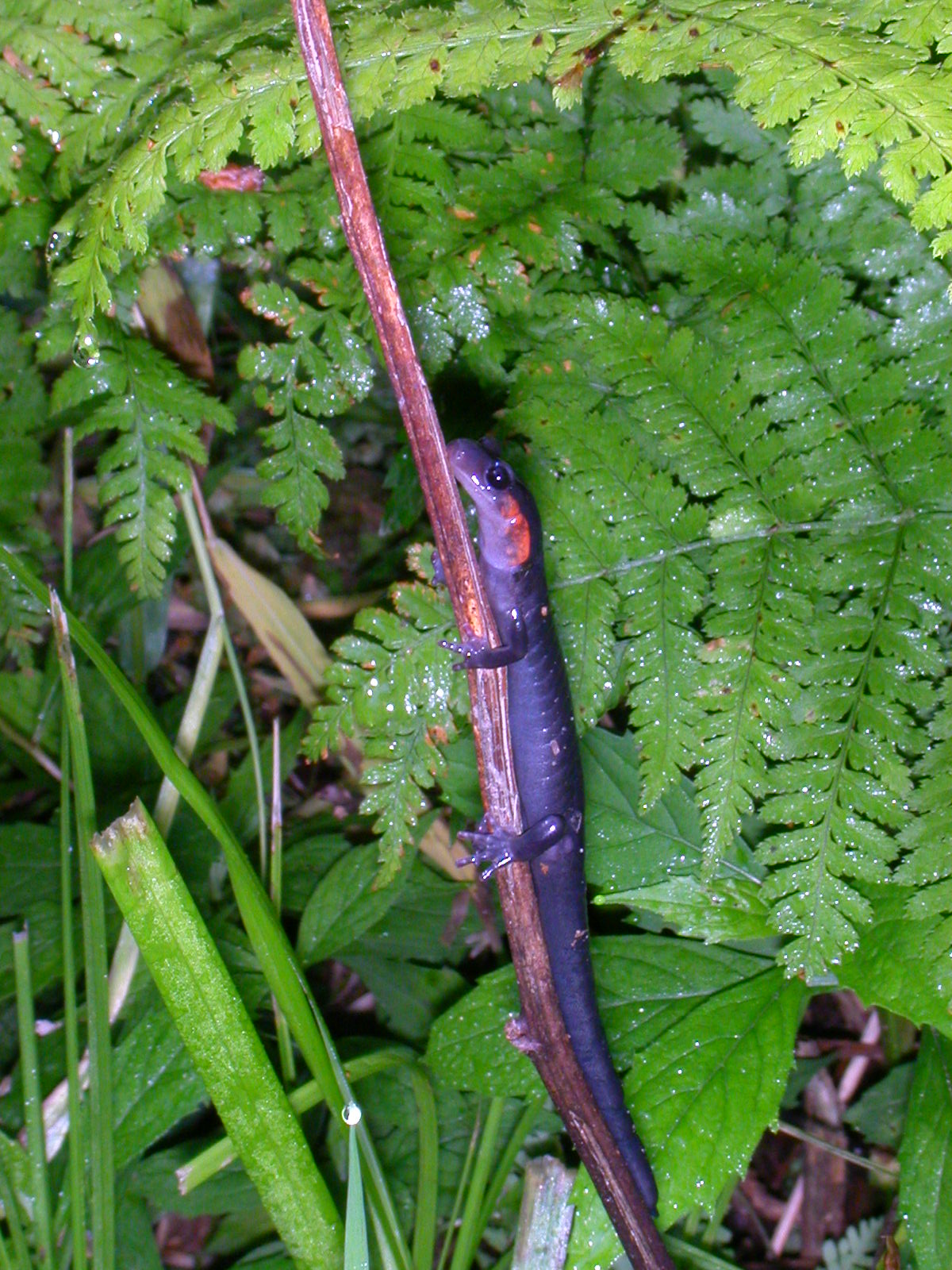
The photo of Jordan’s red-cheeked salamander (Plethodon jordani) was taken near Clingman’s Dome along the Appalachian Trail in 2003.  The cute little Appalachian cottontail (Sylvilagus obscurus) eating jewelweed beneath the stand of bee balm was at Cosby Knob Shelter on the AT (also GSMNP)  in 2007.

IMG_6432

Read Full Post »

Everything I love changes me, and if I can be true to love I will welcome the changes.

Hear the veery in the deep dapple-dark forest.  Hear the descending double-voiced yearning so airy and earthy, old when these broad poplars were jade-and-honey flowers in their mother’s hair, old when these smooth mossed stones had just cracked from their father’s face.  Sit in the silence of light retreating and perhaps the spirit-bird will join you, a momentary apparition of brown leaf shadow and speckled dusk.  With bright eyes it will accept you, hop once, fly, and in the next moment you will hear again, ancient and aching, Audubon’s flute.

.     .     .     .     .

Creekside 01 crop_01

Audubon’s Flute

Audubon in the summer woods
by the afternoon river sips
his flute, his fingers swimming on
the silver as silver notes pour

by the afternoon river, sips
and fills the mosquito-note air
with silver as silver notes pour
two hundred miles from any wall.

And fills the mosquito-note air
as deer and herons pause, listen,
two hundred miles from any wall,
and sunset plays the stops of river.

As deer and herons pause, listen,
the silver pipe sings on his tongue
and sunset plays the stops of river,
his breath modeling a melody

the silver pipe sings on his tongue,
coloring the trees and canebrakes,
his breath modeling a melody
over calamus and brush country,

coloring the trees and canebrakes
to the horizon and beyond,
over calamus and brush country
where the whitest moon is rising

to the horizon and beyond
his flute, his fingers swimming on
where the whitest moon is rising.
Audubon in the summer woods.

Robert Morgan.

[Collected in Word and Witness: 100 Years of North Carolina Poetry, Sally Buckner, editor.  Carolina Academic Press, 1999.]

.     .     .     .    .

IMG_2510

Last Saturday I walked beside the creek and up the mountain with my sister while each veery called to the next that we were on our way.  Today Linda and I drive to Durham to meet my teacher, the first time in over thirty years, and to gather with his students gathering from fifty states.  Already we’ve been cataloguing the changes.  What do I love now that I didn’t love then?  How have I been true to the loves that entered me years ago?  Before the noisy afternoon, I take a moment to listen.  And when my bones are old as stones, trees, moss, how will my voice be recalled?

.     .     .     .    .

IMG_2443

Robert Morgan was born in Hendersonville, North Carolina and grew up on the family farm in the Green River valley of the Blue Ridge Mountains.  He is currently the Kappa Alpha Professor of English at Cornell but has returned to North Carolina many times as visiting professor and writer to Davidson, Duke, Appalachian State, and East Carolina.

The Veery (Catharus fuscescens) is a small thrush of deep moist woods, chestnut brown with a speckled breast.  All thrushsong is melodic and haunting, but to me the veery is most magical.  On a quiet afternoon you clearly hear him singing harmony with himself, the doubled notes possible only with an avian syrinx (unlike my limited tenor’s larynx).

.     .     .     .     .

IMG_6944

Read Full Post »

« Newer Posts - Older Posts »