Feeds:
Posts
Comments

Posts Tagged ‘nature poetry’

Upload Burrowing Crayfish, Cambarus dubius

[with poems by Lesley Wheeler and Bill Griffin]

How? Crayfish taste with their skin. Well, not skin precisely: cuticle is what their carapace is called, their shell, made of chitin. (Read to the end for a science geek discussion of chitin vs. keratin.) It’s hard and it’s tough but it has chemoreceptors that detect dissolved molecules. With their skin, crayfish taste the water. Or smell it.

Taste and smell, inseparable as yeast and flour. Apart only mildly interesting, but mix them together and suddenly it’s 1979, Durham, that little red house on Green Street, waiting at the table with your toddler for hot bread from the oven. Or if you’re Crayfish maybe a tasty caddisfly larva. Or perhaps that taste/smell is Otter on the prowl and it’s time to find a rock.

This big guy (guy: we have our ways of knowing these things, though we don’t like to pry when those pincers are cocked) is possibly an Upland Burrowing Crayfish, Cambarus dubius. Yes, he really is blue; I swear I didn’t touch the hue sliders. (Read to the end for a science geek discussion of crustacean blueness). He was tooling across the level patch near the creek below our house where the Sewer Authority crews clear a path to check their access ports. Lovely spot for a walk, although you might catch the occasional whiff of fabric softener lightly swirled with hydrogen sulfide and anaerobic bacteria. Poop perfume.

Ah, ineffable links, scent and memory. Strolling down the aisle at Food Lion I pass the Downy and my olfactory bulb & hippocampus spark to tell me I’m hiking beside the autumn creek. And look! A Crayfish!

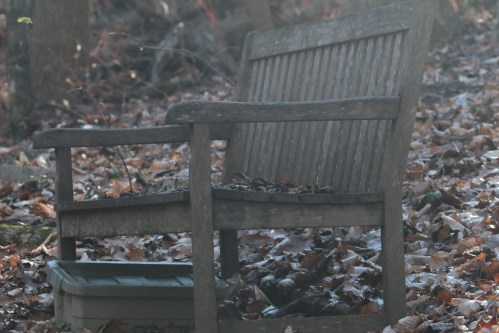
Mountains-to-Sea Trail with Sassafras; near Elkin, NC and Isaac's trailhead

.     .     .     .     .     .

I don’t believe I’ve missed reading an issue of Cave Wall since its inception. Editors Rhett Iseman Trull and Jeff Trull never fail to craft a collection that sparks neurons I’ve been neglecting. In the same way that a forgotten aroma can open a memory door into all the senses, a poem can flash and growl and shudder the reader with sudden insight. Circles, ripples, connections. My college English prof taught a whole semester on it: epiphany. Or an even better word (thank you Caren Stuart for this indispensable addition to the lexicon) – the gasp-sigh.

Invocation by Lesley Wheeler appears in Cave Wall Number 16 (Spring 2020). Something here is thirsty . . . something is called to wake up! How much of each of us is mud, condensation? Shall we pause a moment for spore and mire to convene again within us?

Worship begins with invocation, a call to the divine presence to enter this place. But since divine mystery comprises the entire universe, every boson and lepton, where can we sojourn where the divine is not? Perhaps practicing invocation we are really calling ourselves. Enter this moment. Reside here. Abide with the mystery. Wake up!

.     .     .     .     .     .

Invocation

Bottomland: rouse. Sedge, knotweed:
time to rally. You’ve been lost
in thought, ebb and fuming flood,
since the glacier, thin winters
digging for turtles in cold mud.
Valley was tundra. Elk and moose
drank at water’s brink while firs
invented shade. Panthers melted

into the dark, but spore and mire could
convene again. Softness feed us
and eat our footholds away. Something
here is thirst for living’s every
rivulet, hospitable and
treacherous in her oblivion.
Misty divots. Condensation
beads on the throat, where pulses drum.

What kind of god is this? Her name
just a hieroglyph drawn in muck
by a tentative finger. No
answer but a hissing river.
Drowsy spirit, I’m pleading. Take
this blood shed unseasonably,
mineral gift. Be comfort. Be
danger. Of sleep, of trough. Wake up.

Lesley Wheeler, in Cave Wall Number 16, Spring 2020

Lesley Wheeler is a poet, novelist, scholar, and blogger. She is the poetry editor of Shenandoah.

Sassafras, Sassafras albidum, illustrating the three lobe types

.     .     .     .     .     .

The following poem appears in Snake Den Ridge: a Bestiary (2008, March Street Press). Linda and I collaborated on the book and her illustration appears below (at the time she agreed to interrupt her many other projects because I promised to dedicate the book to my friend Mike Barnett – I can’t even calculate the hours she spent drawing or the height of the field guides and science books piled beside her on her desk).

Crayfish

Just wiggle this rock
and the stream
hums a whole new flavor –
in the turbulence I taste
last night’s shower
on the Ridge
and this morning’s stirring
of awakened larvae.
Tailflap, legtips,
cuticle,
all of me every moment
strummed by roil and eddy,
random caress
of molecules,
divine order of chaos.

I’ll tell you a secret –
God is deliciousness!,

the constant inconstancy
of current
that reveals my breakfast
or Otter on the prowl,
and just maybe
the passing of a lovely
arthropod I long to meet.

Join me! Immerse yourself,
not in Inadu Creek
but in your own lifestream.
Savor it, sense it as I do
in every part of you.

Bill Griffin, in Snake Den Ridge: a Bestiary (2008, March Street Press)

Illustrations by Linda French Griffin.


.     .     .     .     .     .

Chitin is the hard part of invertebrates: cicada exoskeleton, crayfish and lobster shell, squid beaks (and vertebrate fish scales). Keratin is the hard outer part of vertebrates: bird feathers, tiger claws, what little hair I have left. The two are chemically completely different but function in the same way, for protection and structure.

Chitin is a polymer of sugars, glucose with added nitrogen = glucosamine (a polysaccharide), the stuff I take for my bad knee. Keratin is a polymer of amino acids, namely a protein (polypeptide). Here are two more factoids you can’t possibly live without: Keratin resists digestion, which is why cats hark up hairballs. Spider silk is classified as keratin, although production of the protein probably evolved independently of the process in vertebrates.

Crustacyanin is not a Spongebob character. It’s what makes this crayfish blue. Crustacyanin is a carotenoid, which are pigment proteins found in everything from tomatoes to pink flamingos. The crustacyanin is made from stacks of another carotenoid protein (astaxanthin), which itself is red, but depending how many and how it’s stacked can actually reflect the blue portion of the spectrum. Blue crayfish (also look up Blue Lobsters) have a genetic variation in their stacking. If you steam them (perish the thought!!!) the astaxanthin comes unstacked and that’s why cooked crabs, lobsters, and crayfish are bright red.

Brushy mountains reflected in compound eye

.     .     .     .     .     .


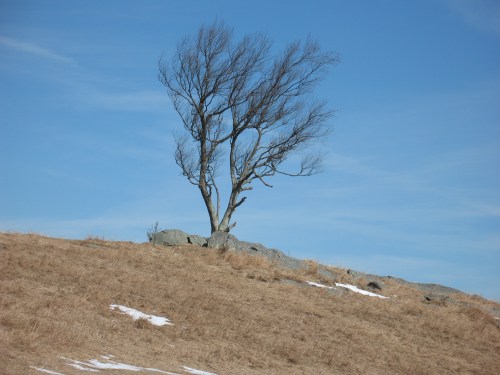
2016-10-17b Doughton Park Tree

Read Full Post »

Appalachian Trail near Clingman’s Dome, 2003

[with two poems by Kathryn Stripling Byer]

.     .     .     .     .     .     .

Summer has skimmed the high ridge like a chimney swift, rarely perching for long. Now on September mornings you can see your breath. First frost certainly won’t dally. Above 6,000 feet you wonder, Where is the South in Southern Appalachians?

And what about these bleached spines and gnarled knucklebones? This phalanx of snags that palisades the highest elevations against the green upon green below? The balsam wooly adelgid arrived on Clingman’s Dome in 1957. By the 1980’s the tiny insect invader from Europe, order Hemiptera, had destroyed more than 90% of the Fraser Fir in Great Smoky Mountains National Park.

This year, though, the Park Service has declared a tenuous truce. Some of those dead snags are forty years old but younger trees spared by the adelgid have matured and are making fertile cones. The very oldest trees, with thicker bark, also seem less susceptible. The insects are still around but you have to hunt for them, whereas during the earliest infestations biologists described the branches covered in wooly bugs as if they had been “whitewashed.”

What is the fulcrum of this new equilibrium? Perhaps the adelgid found easy pickings among whole communities weakened for decades by acid deposition, bad air. Coal-burning power plants up the Appalachian ridge to Canada have added scrubbers. The red spruce that had stopped growing in the ‘80’s are laying on new rings of cambrium. Leave a patch of ground alone long enough and it will grow into what it is meant to be.

Or will it? Depends on what you mean by leave alone. The fir that survive are a little more resistant to the insect, a little more acid tolerant. But what happens as their subalpine microclimate becomes less like Canada and more like Atlanta? Scrubbers remove the nitrogen and sulfur that oxidize to form acids but when you burn carbon you get carbon dioxide. Can’t scrub that out. How many degrees of warming can Fraser fir tolerate? Go higher, it gets cooler. Here in the Park you can’t go any higher than Clingman’s Dome.

Mountain Angelica, Angelica triquinata (Apiaceae - parsley family)

.     .     .     .     .     .     .

Last week I shared two poems from Kathryn Stripling Byer’s first book (1986). The two poems that follow here are from her final book, Trawling the Silences, published in 2019 two years after her death.

Kay Byer takes me into wild places and she brings me home. She names the earth, just naming a thing is a prayer, and she leaves nameless the mysteries that mist from her verses into my soul. She has left this earth, and she has left this earth to me to hold close for the days I will remain. Notice. Learn. Cherish. Tell it.

.     .     .     .     .     .     .

Three for My Trail Guide
for Jim

1.

Ascent

Before I can catch
my breath you right away
start to identify

Wild Ginger,
Mayapple,
Bloodroot.

I’m dizzy with switchbacks
I see rising into
the hardwoods you hail

Sarvis,
Sycamore,
Tulip Tree.

Trillium sweeps down
the hillside like angel wings
come to rest creekside.

You chanting hepatica,
stonecrop, anemone,
we climb until

we reach the summit,
where underfoot
some stubborn lichen

you can’t name
has already claimed
the best view.

2.

Star Grass

You name it
and there it is
at the edge
of the outcropping
over the Gorge.

Not to worry,
I placate the ravens
that harry us,
we won’t be lingering
long in your aerie.

See? Even now we are
striding away
into star grass,
its small spikes of clear
recognizable light.

3.

Galax

Squatting behind bushes,
I smell it nearby, neither bear scat

nor carrion vine, to which naturalists
liken its scent, but the breath

of an old woman lowering herself
to her chamber pot, sighing

as I heard her sigh while I tried
not to listen. Hoisting my backpack

I leave her behind in the underbrush,
glad to be back on the trail

with you, sidestepping tree stump
and blowdown, splashing through

creek bed, striding from switch back
to switch back toward sky we see,

step by step, open its window,
when, almost to summit, I stop.

Breathing hard. The scent
of her following me.

Kathryn Stripling Byer, from Trawling the Silences (Jacar Press, 2019)

.     .     .     .     .     .     .

Silvery Glade Fern, Deparia acrostichoides (Dryopteridaceae - Wood Fern Family)

.     .     .     .     .     .     .

Trawling the Silences

This end-of-March day, I’d rather watch hawks surf the
thermals than contemplate what lies ahead.
Or behind in its wake. In the few hours left, let me keep
my doubts shut, my windows wide open, their sheer curtains
billowing. It’s March, after all, having come in
a lamb and departing a lioness, stalking my back yard,

leaving her paw prints alongside the patient ephemerals
rising again out of leaf litter. Squirrel corn. Spring beauty.
The first rue anemone. Today I would rather
read field guides, repeating the whimsical names
of our nice-dwelling mussels about to be wiped out by backhoes
and bulldozers. Pimpleback, Snuffbucket. Monkeyface
Pearlymussel. Don’t let their names be forgotten,
I’d pray if I prayed, though just naming a thing is a prayer,

wrote Simone Weil, turning her face to the almighty
silences. The silences. Where would we be
without them, what were we, what will we be, oh to be,
and again be, that damn linking verb. I’d rather be tracking
my lioness up to the rim of that mountain top,
I’d rather let be and let go. Let the anemone
cling, the hawks soar, the lioness squander another day
trying to find what she’s looking for. Give her another day,
I ask the Almighty. Give the birds one more day
scolding the rapscallion squirrels stealing birdseed.
I rest my case, carapace, my own little voice trawling
the silences, the bully wind boasting its presence in present-tense,
no linking verb to shut down the show. Let
my lioness lounge in the sally grass. Licking her paws.

Kathryn Stripling Byer, from Trawling the Silences (Jacar Press, 2019)


.     .     .     .     .     .     .

Spruce-Fir forests covered vast areas of the Southeast when glaciers reached their southernmost extent 18,000 years ago. As the glaciers retreated north the Spruce-Fir communities also retreated to higher elevations and now remain only along the highest peaks and ridges above 4,000 feet elevation, mostly higher. Clingman’s Dome at 6643 feet is the highest point in Great Smoky Mountains National Park and indeed along the entire Appalachian Trail. Its impressive swath of Spruce-Fir is also home to the rare Jordan’s Red-Cheeked salamander (Plethodon jordani) found only in the Park. The naturally acid soil and severe climate limit biodiversity compared to lower elevations, but other distinctive high elevation species include mountain ash (Rose family), mountain wood sorrel, mountain asters, glade fern. After sixty years the Fraser Fir seem to be surviving the balsam wooly adelgid invasion, air pollution, acid rain; it remains to be seen how long they will remain in the face of advancing climate change.

from SNAKE DEN RIDGE, A BESTIARY, illustration by Linda French Griffin

from SNAKE DEN RIDGE, A BESTIARY, illustration by Linda French Griffin

.     .     .     .     .     .     .

Photos by Bill Griffin from Southern Appalachian Naturalist Certification Program; Southern Appalachian Ecology, September 2020, Great Smokies Institute at Tremont; instructors Jeremy Lloyd and Elizabeth Davis.


.     .     .     .     .     .     .

IMG_1822

IMG_1609

Read Full Post »

[with two poems by Kathryn Stripling Byer]

Hepatica: its flowers spring up in March before its new leaves. Quick! Before arching limbs furl their green sails and hijack the wind of sunlight, quickly make your tiny seeds from last year’s photons! New leaves will have all summer and fall to glean what the canopy misses.

When Linda and I discover the first hepatica blooming along Elkin Creek each spring we take heart. The world is not such a grim and wintry place. One morning last April we counted 50 individual plants along a mile of trail. Such bounty! How they thrive! How our hearts do!

A few weeks ago I walked one mile of nature trail at Chimneys picnic area in Great Smoky Mountains National Park. At the end of September hepatica leaves are glossy, taut, ready to overwinter. As I strolled the cove, deep cathedral of old growth hardwoods, I estimated within 5,280 feet I saw 50,000 individual hepatica plants.

Sharp-lobed Hepatica, Hepatica acutiloba, Ranunculaceae, buttercup family

Life wants more of itself. Life wants to fill every niche. How many generations, how many hundred, did it take to create this mountain cove topography? Mossed, leafy, pits and mounds left by an ancient giant fallen. The light gap its falling created. Explosion of variety in the margins. Trunks of all sizes and ages in the understory, massive individuals creating the canopy. I didn’t know a black cherry, a silverbell, ever got this big!

Leave a patch of ground alone long enough and it will grow into what it is meant to be. Mountain flanks and shoulders for protection, rain upon rain, limestone subsoil for minerals – the old growth cove hardwood community shelters biodiversity approaching a tropical rainforest. These few sections in the Smokies that the loggers never reached are still revealing new species. Life wants more.

And to what purpose? What is it good for? I could probably list a few dozen reasons the undisturbed and unmanipulated forest is good for me and good for you. But how about this – the thousands of reasons it is simply good for itself.

Black Cherry, a BIG one, Prunus serotina, Rosaceae, rose family

.     .     .     .     .     .     .

Kathryn Stripling Byer (1944-2017) was North Carolina Poet Laureate from 2005-2009 and the first woman to hold that position. She and her family lived in the mountains of western NC (she taught and was poet-in-residence at Western Carolina University); her grace and generosity reached throughout the southeast and beyond. She was teacher and mentor but, even more, she encouraged and celebrated the creative spirit wherever and in whomever it was found. Even me. Thinking of her today brings me joy.

I have gone back to Kay’s first book for these two poems. The Girl in the Midst of the Harvest was her debut collection (Texas Tech Press, 1986) and was re-issued by Press 53 (Winston-Salem, NC) in 2013.

.     .     .     .     .     .     .

The Backwoods

Great-grandmother carried the cadence of Genesis.
Girl cousins up late at family reunions,
we made her an Indian, although her forebears
were Irish. Before her lay darkness, the empty fields
barren as desert until she came forward,
the sweat on her high cheekbones gleaming like eyes
we imagined surrounding her, bob-cat and red fox,
the last of the sleek, singing wolves. Every evening
she shouldered her how and walked home
through the tasselling corn. The Good Lord only knows
what bare feet stalked the backwoods in those days,
what waited behind every woodpile! She brought forth
a daughter with black hair that never curled.
Shy as a fieldmouse, that girl fell in love
with a man scything hay in the twilight. They kissed
twice. A moment she stood in her white dress
and smiled back at us, then she grew fat and sighed
in the kitchen. Four daughter she bore,
and the three who survived scarlet fever
wove grass in their brown hair and danced every night
with the fireflies. They galloped on wild horse
bareback until they got married and gave birth
to us, Southern Belles who could sit in a parlor
all evening and never complain. We could faint
in a handsome man’s arms. We could charm a
a stone wall. But we never forgot the back door,
how to disappear into the darkness, our crinolines rustling
like cornstalks between our legs. We told
this story so well, we inherit its black earth
where women hoe all night, inscrutable as Indians.

Pale jewelweed, Impatiens pallida, Balsaminaceae, touch-me-not family

.     .     .     .     .     .     .

Frost

“Shake the cold from our hands,” you call, running ahead
of me onto the frozen grass. Look, in the garden
your father wrests vines from a tripod of bamboo stakes.
Okra’s grown weary with mourning another year
gone and just yesterday, Darling,
they wore yellow buds in their hair. Like you

twisting a puny chrysanthemum into your tangles
and galloping off on a broomstick. Down Caney Fork
scarecrows come hobbling like old soldiers
leaving their cornfields. They’ll sit by the river
and talk about what the crows told them: a hard winter
coming. Those windy crows, all they keep saying
is cold, cold, and when I see clouds swept
like ice down the creek, I believe them
too easily. Why must the maple leaves rattle

Remember me, as if someday
I’ll forget there were thousands came
falling the morning I felt for the first time you
shiver inside me, no fish as I thought you would be
but a mouse in its burrow? Now you sit in sand
and make birthday cakes, blowing out candles
that aren’t there. I blow on my hands
like an old woman taking no heed of a child
who believes time can be shaken from her like water.

poems by Kathryn Stripling Byer
from The Girl in the Midst of the Harvest, Press 53, © 2013 Kathryn Stripling Byer
first published by Texas Tech Press, January 15, 1986


Mountain bugbane, Cimicifuga americana, Ranunculaceae, buttercup family

.     .     .     .     .     .     .

Mountain Cove plant communities occur in sheltered areas with abundant rainfall in mid- to lower-elevation areas of the Southern Appalachians. Especially the Rich Cove Forest subset, with less acidic and more rich mineral soils, is home to a huge diversity of tree species, flowering plants and ferns, insects, reptiles and amphibians. Original (old growth) forests will have massive individual trees hundreds of years old mixed with trees of all ages where a giant has fallen and allowed sunlight to reach the forest floor. There are a number of these areas where loggers never reached in GSMNP, such as Chimneys and near Cades Cove.

.     .     .     .     .     .     .

All photos by Bill Griffin from Southern Appalachian Naturalist Certification Program; Southern Appalachian Ecology, September 2020, Great Smokies Institute at Tremont; instructors Jeremy Lloyd and Elizabeth Davis.


.     .     .     .     .     .     .


Read Full Post »

« Newer Posts - Older Posts »