Feeds:
Posts
Comments

Posts Tagged ‘nature poetry’

Heavenly body, we circle, approach, broad ellipse, eye each other across the expanse, still closer, with proximity our velocity increases. Will we join, mutual revolution, orbit, or will we sling each other into outer darkness?

Am I speaking to you, lines of verse? Or are you speaking to me? From a distance you attract but how finely do I perceive your true nature? Like the person I have loved for so many years: at the moment I say, “I know the real You,” at that precise moment you surprise me, swift and sudden, slap or caress, and I must humble myself or be humbled by the universe of you.

Heavenly body, I continue. Your placid visage resolves, light that blinds, deepest shadow. We move each other, we move before each other, we move but never cross the same path twice, we flow and bud and the moments we create are like no other moments. There is more to you than can be known.
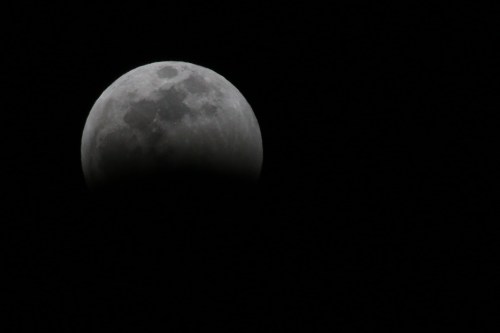
. .  lunar eclipse January 21, 2019; photo by Bill Griffin . .

.     .     .     .     .     .     .

I knew Bruce Lader from a distance. We greeted each other at poetry gatherings, shared the occasional comment about the program or a reader. He was solid and planed as an oak table; he met my eye and I had no fear of being shaken; he invited me into his calm.

And then I read two of his books of poetry. The lines compel you to be shaken. He taught for years in New York City, rough and troubled teenagers, and those characters populate many of his poems. Scary at times. And he writes of relationships and longing, about culture and human frailty in images bright and dark but always hand-hewn and polished from the rock of reality. Joanna Catherine Scott wrote of his book Landscapes of Longing: It does not hold back. Open it with care.

.     .     .     .     .     .     .

Gravity

Fugitives from each other,
they skulk along dark corridors
of denial, kidnap shadows
cast by a slivered moon
of eclipsed emotions.

Wordlessness betrays them
at the apogee of centrifugal flight,
as they ransom the desperate
anodyne of sex.

. . . Without a fingerprint
the tides of bodily language
have shifted elliptic;
will a touch burn or freeze?
mend or violate?
The quark of midnight:
inexorable undertow,

they treadmill between grief
and fault, looking for a vague
similitude of conjunction
nothing can rescue.

Bruce Lader, from Landscapes of Longing, Main Street Rag Publishing, 2009
[first appearance in Poetry Salzburg Review]
.     .     .     .     .     .     .

Siege

All night, freezing rain – the lights
won’t make up their mind;
then everything’s dark. Trees are walking dead.

In the tar pit of time, a transformer
groans like a dinosaur, becomes extinct.
The turncoat furnace sleeps.

Daybreak we are hostages of the ice storm,
light candles, stove, put a bucket
under the leak by the sliding doors,
resuscitate the fireplace, check for damage.

Storm – odd word for weather
so calm where ice builds by degrees,
immures us inside a cold hurricane’s eye.

The neighborhood is a breath
of blown glass. Crack, crash – trees discard
sodden branches. A dove is still
on a telephone wire of silver stalactites.

Debris is strewn over the battlefield
of tree bones. Broken limbs have toppled
the fence, could crush the roof.
We need a generator, radio batteries.
Is there enough food?

Wounded are throwing shivers
helter-skelter against the windows.
A transparent antler points
as a ghost staggers to shelter.

The phone’s gone dead.
In a million offices, packs of wolves
circle, move closer, with fiery silver eyes.

Bruce Lader, from Discovering Mortality, March Street Press, 2005
[first appearance in The Potomac Review]

.     .     .     .     .     .     .
 

Bruce also published Fugitive Hope in 2014, ISBN-13: 978-0991009183.

.     .     .     .     .     .     .
.     .     .     .     .     .     .
IMG_6432

Read Full Post »

[After the fashion of Ralph Waldo Emerson, with apologies; and also with admiration and gratitude to Emily Stein, educator, naturalist, and instructor who prompted, “Make me care about an apple.”]

Behold! [the speaker lifts high in his right hand a bright green globe] Behold . . . the unnamed spheroid before us, orb, minor planetoid, imperfect representation of 4/3 π r3. What shall we call it? What is it?!

Is it Creature? Shall it pick itself up, scuttle about of its own motivation, turn itself ‘round to display its obverse hemisphere presently concealed from our vision?

Is it Mineral, thus created and apportioned and ever so to remain for millennia save it be worked and reworked by wind, water, the abrasion of ever degrading time?

Or is it perhaps . . . Vegetable, and now a revelation of its true nature leaps into my consciousness: is it not Fruit? May we not so surmise when we detect the telltale declivity at its northern pole from whose depth protrudes a brown and spiraled worm so very like a stem? YES, its roundiness, its gloss, its green green GREEN sings life and liveliness, living fruit, fresh, taut, shiny, reflecting what meager light may penetrate these benighted chambers to inspire our minds even as we are inspired by the light of our own great yellow star.

That star which nurtures us has also nurtured our green fruit’s life and growth to this size, this heft, wide in diameter as my four fingers, rounder in circumference than my fist can grasp. Firm and solid it appears, clean and whole, but upon finer inspection decorated with speckles and freckles, minute specks not blemishes but marks of its natural beauty, painted by creation to elevate our perception that Beauty and Truth and even Life itself are not ideal forms that reside solely in the imaginings of philosophers but are real, here before us, weighty, textured, worthy of adulation with all their variations and imperfections, with all their uncertainties, with all our own doubts about how to discover them and what to name them.

But what is Life that we should esteem it so? Life is bruises when we fall. If you prick us, do we not bleed? Life is clamor and confusion that fill the senses to bursting, sight and sound and scent sometimes sweet but oftentimes so foul. Can you convince me that Life is not suffering? Days and years unremitting even such that some might in despair willingly choose to forsake their life?

And yet . . . and yet, where can suffering prevail when we, my fellows, stand together? Where can the horror of decay and decrepitude persist when there is yet Beauty in the world?

Look again upon my treasure’s smiling green visage! Look to the living green that buds and swells and streams through hills and valleys where Life insists it must return to the gray and blasted earth. Look to the green water that calls down from the rocky slopes lithe creatures that hop and slither and find each other, there emphatically to declare their confidence in Life as we discover the motile forms of tadpole and eft.

Look, my friends, into your own hearts and discover there some fresh green shoot arising, a green hope that may yet draw you anew into this day of wonder, a hope that may, my friends, just may [here the speaker bites into the green apple] may taste this sweet! This is what I choose and this is what I treasure – this Life.

I care not what you name my green friend here – seed pod, drupe, jampot, pie bait, cider berry. I name it LIFE. And this rose by any other name would smell as sweet.

.     .     .     .     .     .     .

Mitchella repens – Partridge Berry

This essay was prepared as an oral class presentation for “Skills for Sharing Nature,” Southern Appalachian Naturalist Certification Program, Great Smokies Institute at Tremont, February 23, 2020.

.

Thinking, for Emerson, was not the contemplation of final Truth, but the daily encounter of an active mind with its environment; it was not a special activity but life itself.

Stephen E Whicher, editor
Selections from Ralph Waldo Emerson, Houghton Mifflin, © 1957

.     .     .     .     .     .     .

Apple, genus Malus, is the largest fruit in the family Rosaceae, which also includes plums, pears, cherries, apricots, peaches, quince, blackberries, strawberries, raspberries, almonds, rowan, hawthorne and . . . roses.

.     .     .     .     .     .     .

Viola rostrata – Beaked Violet or Longspurred Violet

The Rhodora
On Being Asked, Whence is the Flower?

In May, when sea-winds pierced our solitudes,
I found the fresh Rhodora in the woods,
Spreading its leafless blooms in a damp nook,
To please the desert and the sluggish brook.
The purple petals, fallen in the pool,
Mad e the black water with their beauty gay;
Her might the red-bird come his plumes to cool,
And court the flower that cheapens his array.
Rhodora! if the sages ask they why
This charm is wasted on the earth and sky,
Tell them, dear, that if eyes were made for seeing,
Then Beauty is its own excuse for being:
Why thou wert there, O rival of the rose!
I never thought to ask, I never knew:
But, in my simple ignorance suppose
The self-same Power that brought me there brought you.

Ralph Waldo Emerson, 1839

.     .     .     .     .     .     .

Middle Prong Little River

The Apology

Think me not unkind and rude
That I walk alone in grove and glen;
I go to the god of the wood
To fetch his word to men.

Tax not my sloth that I
Fold my arms beside the brook;
Each cloud that floated in the sky
Writes a letter in my book.

Chide me not, laborious band,
For the idle flowers I brought;
Every aster in my hand
Goes home loaded with a thought.

There was never mystery
But ‘tis figured in the flowers;
Was never secret history
But birds tell it in the bowers.

One harvest from thy field
Homeward brought the oxen strong;
A second crop thine acres yield,
Which I gather in a song.

Ralph Waldo Emerson, 1846

.     .     .     .     .     .     .

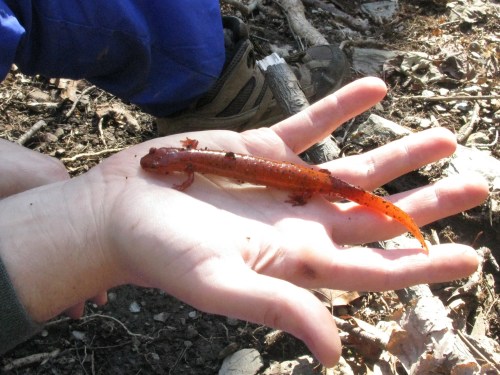
Gyrinophilus porphyriticus -spring salamander

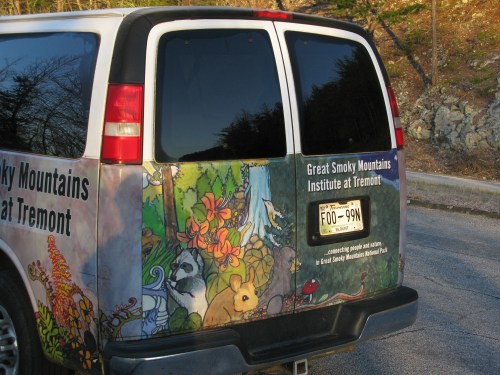
The Southern Appalachian Naturalist Certification Program is administered by Great Smokies Institute at Tremont within Great Smoky Mountains National Park (near Townsend, Tennessee) and offers weekend intensive programs towards a certificate from the University of Tennessee. More information at www.gsmit.org

.     .     .     .     .     .     .


.     .     .     .     .     .     .
IMG_0877

Read Full Post »

I remember the first bird that counted. Clarification: I remember the first bird I counted.

Mom and Dad had rented a cabin so we could join them for a long weekend on Skyline Drive in the Shenandoahs, June, 1988. Did they think their grandkids were Nature undernourished? Mountain vistas, enfolding trees, night sky – we even saw a bobcat at dusk one evening. Maybe I was undernourished.

The second morning we hiked up a lonely trail in deep shade that suddenly brightened. A forest giant had fallen and invited into its space the sun and the sky. And birdsong. (Prime transitional habitat, I’ve since learned.)

Mom spotted a yellow streak come to rest on a bare branch and begin to sing. I focused. What is this?! Never had one of these on the feeder outside my dorm window, never saw one snagging worms on the front lawn. And listen to it sing! What?!

That Chestnut Sided Warbler is the first bird in my list. Well, make that lists: pocket notebooks, index cards, the backs of trail maps. And of the course the database on my hard drive, which has swelled to megabytes. But what’s the big deal? Thirty-five years old and writing down the name of a bird? What?

I wasn’t a Nature-deprived child. We played outdoors until the street lights blinked on. Caught fireflies in our hands and honey bees in jars. Raised tadpoles to peepers. Camps, beach trips, hiking, Scouts; I was out in Nature pretty much, but I count that CSW as the moment I began to notice. This is not just an unpopulated landscape, not a homogenous backdrop for picnics or games or a nice walk. These are things. Individuals. Differentiated. Species. I start by counting birds but then I notice wildflowers and take up botany, notice one side of the ridge has more blossoms and different, it’s geology, get down on my knees for the tiniest blooms and dang there’s a beetle, entomology.

Pretty soon I want to notice it all, the great grand beautiful interconnected mess, ecology, the parts and the whole. I’m becoming a Naturalist – someone who pays attention. Someone who notices.

Chestnut Sided Warbler in Virginia was my gateway drug. How much was I missing all those years before? Now I can’t help but notice. Blame the wrens that scold me every morning in the driveway. Blame my friend Mike who is always so careful to step over every millipede on the trail. Blame Amelia my granddaughter as she watches the crocuses open. And after last weekend blame Emily Stein* as my chief enabler, she and the other twenty hard core Naturalists I joined at Tremont in the Smokies for an intense course in “Skills for Sharing Nature.” As always, begin with some questions:

Where have I come from to reach this place? Why do I care? What is my personal story? What do I have to share?

The answers may arrive like spring buds that swell along the flank of the mountain seeking the summit, a lifetime of questions and answers, but now it’s time to screw up my courage and take Step 2: I’m going to get you hooked on Nature, too. Come here a minute. Try my binoculars. See that little dab of brown fluff that just flew up to that branch? Yes, that’s the one. Let’s see what he has to tell us.

.     .     .     .     .     .     .

* Emily Stein: Great Smoky Mountains Institute at Tremont naturalist educator, youth programs coordinator, and instructor for the February 2020 course “Skills for Sharing Nature,” part of the Southern Appalachian Naturalist Certification Program (SANCP). More information at www.gsmit.org

.     .     .     .     .     .     .

Prayer for the Great Family

Gratitude to Mother Earth, sailing through night and day—
and to her soil: rich, rare, and sweet
in our minds so be it

Gratitude to Plants, the sun-facing light-changing leaf
and fine root-hairs; standing still through wind
and rain; their dance is in the flowing spiral grain
in our minds so be it

Gratitude to Air, bearing the soaring Swift and the silent
Owl at dawn. Breath of our song
clear spirit breeze
in our minds so be it

Gratitude to Wild Beings, our brothers, teaching secrets,
freedoms, and ways, who share with us their milk;
self-complete, brave, and aware
in our minds so be it

Gratitude to Water: clouds, lakes, rivers, glaciers;
holding or releasing; streaming through all
our bodies salty seas
in our minds so be it

Gratitude to the Sun: blinding pulsing light through
trunks of trees, through mists, warming caves where
bears and snakes sleep—he who wakes us—
in our minds so be it

Gratitude to the Great Sky
who holds billions of stars—and goes yet beyond that—
beyond all powers, and thoughts
and yet is within us—
Grandfather Space.
The Mind is his Wife.

so be it.

Gary Snyder (after a Mohawk prayer)
from EARTH PRAYERS, edited by Elizabeth Roberts and Elias Amidon, HarperSanFrancisco, 1991

.     .     .     .     .     .     .


.     .     .     .     .     .     .

IMG_6944

Read Full Post »

« Newer Posts - Older Posts »