Feeds:
Posts
Comments

Posts Tagged ‘Mary Oliver’

 . 
[with poetry by Mary Oliver and Tennyson]
 . 
On Winter’s Margin
 . 
On winter’s margin, see the small birds now
With half-forged memories come flocking home
To gardens famous for their charity.
The green globe’s broken; vines like tangled veins
Hang at the entrance to the silent wood.
 . 
With half a loaf, I am the prince of crumbs;
By time snow’s down, the birds amassed will sing
Like children for their sire to walk aborad!
But what I love, is the gray stubborn hawk
Who floats alone beyond the frozen vines;
And what I dream of are the patient deer
Who stand on legs like reeds and drink the wind; –
 . 
They are what saves the world: who choose to grow
Thin to a starting point beyond this squalor.
 . 
Mary Oliver
from Devotions, the Selected Poems of Mary Oliver, Penguin Press © 2017; originally collected in No Voyage and Other Poems, Houghton Mifflin © 1965
 . 
❦ ❦ ❦
 . 
In the Spring a young man’s fancy lightly turns to thoughts of . . . phenological mismatch.
 . 
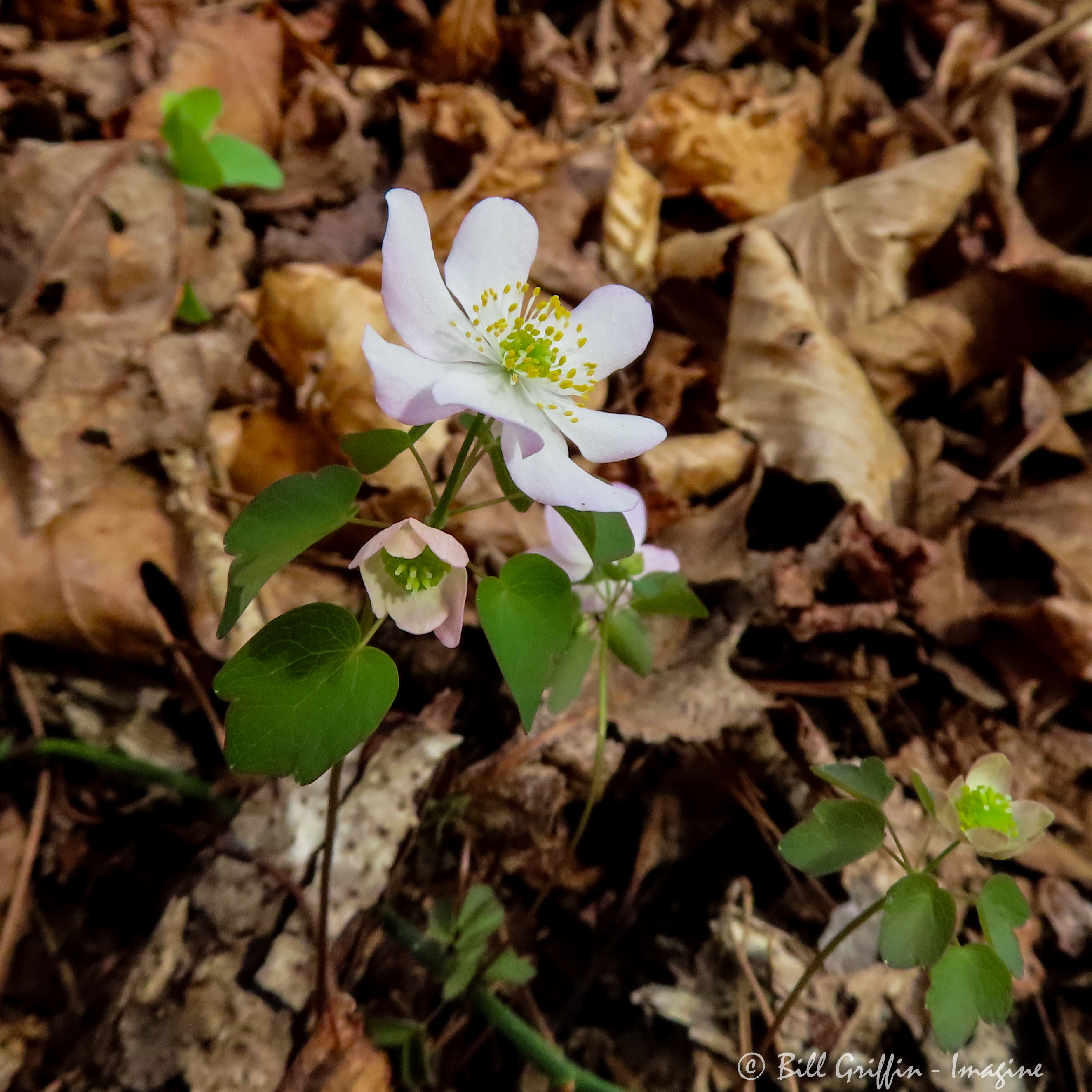
Ah, Alfred Tennyson, better you had continued to tramp the heath and weald of old Locksley Hall and turned away from your infatuations with the inconstant and unreachable Amy. Look here! Amidst the brittle stems of last summer’s arboreal plumage and almost buried beneath autumn’s comforter, an eyelet of green! Gently peel aside the brown leavings of solemn beech and discover: seven pale lilac petals and their swarm of stamens. February 18 and Hepatica has begun to bloom!
 . 
So I hope we’ll be greeted tomorrow, February 22, on our first naturalist walk of the season. Now and every three weeks through April we will tally the progression of blooming along the Elkin Creek Nature Trail. Native wildflowers, these spring ephemerals make their living here beneath the beech / oak canopy. Hepatica, Trout Lily, Bloodroot, Foamflower, they will quickly extend their leaves into the sun before its light can be obscured by budbreak among the overarching trees. Phenological escape – the urgent days of photosynthesis before the canopy closes. These low growing herbs must earn most of their entire year’s salary in just two or three weeks.
 . 
How do they know? What triggers the perennials to leaf and bloom; what swells and opens the leaf buds overhead? What is the key to understanding their phenology (def. – the study of cyclical biological phenomena)? Warming. Soil temperature and air temperature. But some plants are more sensitive to temperature changes and the warming of planet earth than others. In North America, deciduous trees are the most sensitive to warming trends that determine when they will break bud and unfurl leaves. Beech, oak, maple they leaf out earlier as average temperatures increase; Hepatica may not, and so the window of sunlight opportunity shortens.
 . 
This is just one example of phenological mismatch. Imagine how it might affect interconnected species that gradually diverge, out of synch. Will Hepatica have time to turn photons into the sugars it must store for the next long darkness? Will its pollinators and its seed dispersers still thrive in the altered forest? What will our spring walks look like in ten years? in twenty? Alfred Tennyson, I’m afraid there are days I share your melancholy.
 . 
 . 
❦ ❦ ❦
 . 
Wild Geese
 . 
You do not have to be good.
You do not have to walk on your knees
for a hundred miles through the desert repenting.
You only have to let the soft animal of your body
+++ love what it loves.
Tell me about despair, yours, and I will tell you mine.
Meanwhile the world goes on.
Meanwhile the sun and the clear pebbles of the rain
are moving across the landscapes,
over the prairies and the deep trees,
the mountains and the rivers.
Meanwhile the wild geese, high in the clean blue air,
are heading home again.
Whoever you are, no matter how lonely,
the world offers itself to your imagination,
calls to you like the wild geese, harsh and exciting –
over and over announcing your place
in the family of things.
 . 
Mary Oliver
from Devotions, the Selected Poems of Mary Oliver, Penguin Press © 2017; originally collected in Dream Work, Grove/Atlantic Inc. © 1986.
 . 
❦ ❦ ❦
 . 
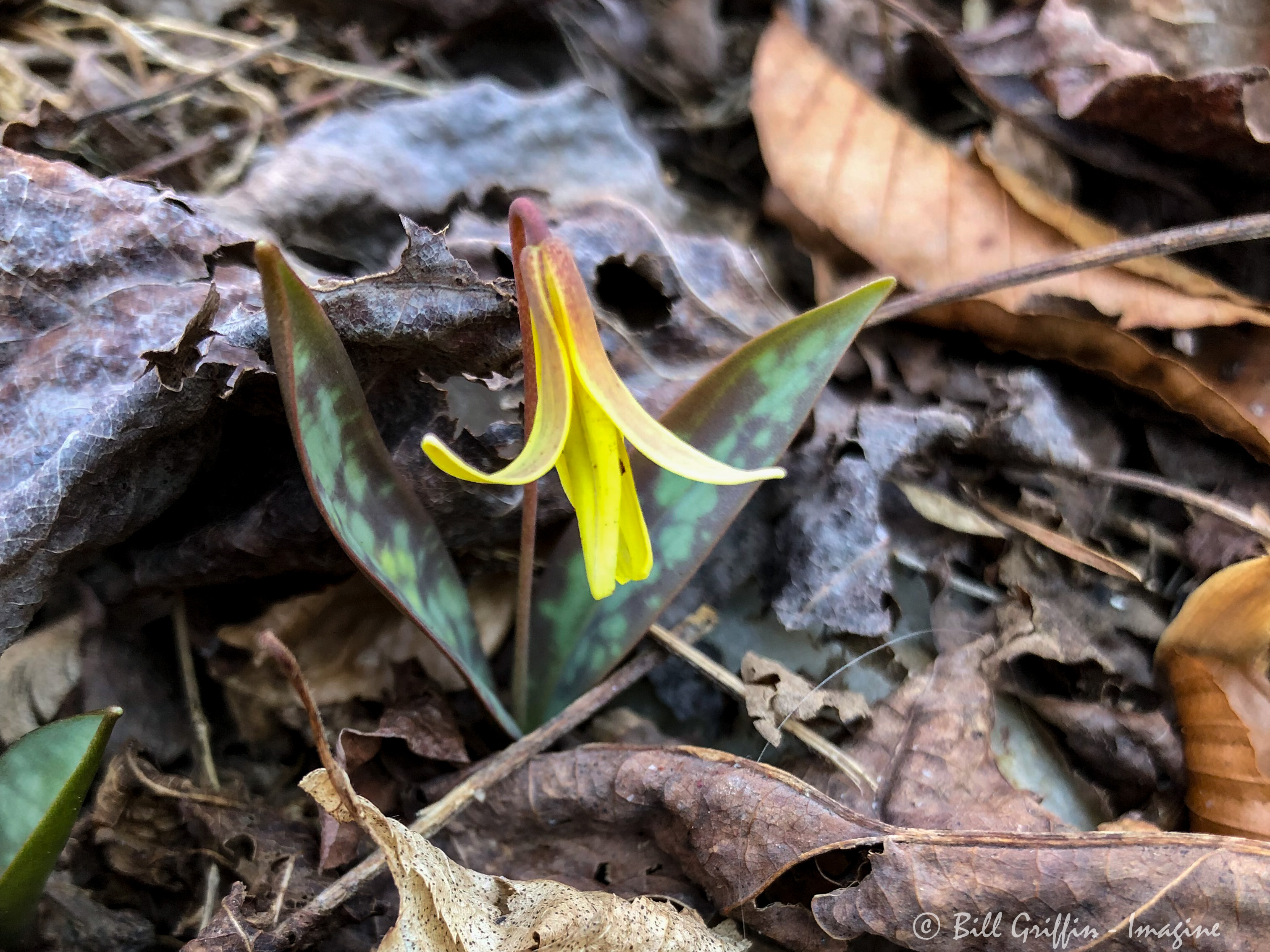
A week after our group walked the trail I am still happy for what the forest shared with us. Yes, one Trout Lily had stretched and curved its petals to open a small yellow flower. Yes, one Hepatica, among the many other slumbering liver-lobed leaves, presented the cold morning after freezing night with a single pale lilac bloom. We knelt closer for its even more remarkable surprise: beneath the blossom nodded two more, sepals already empty of petals and gone to seed. The spring ephemerals know their business and their name. They make more of themselves and fill the world whether we are watching or not.
 . 
I have been watching these flowers but not nearly long enough nor often enough. Nevertheless one remembers – color and scent may spark a flicker of joy into a life that threatens to cloak each day with darkness. On our walk, beside a particular beech tree no different from the hundreds around us, I recall the first time I ever discovered Hepatica blooming in our woods. That year it was the only one I found and I returned to it day after day until it faded. Now here it is again, the very plant. Its leaves are pocked and burnt orange from their long winter’s work. If it has buds, they are still hiding. As yet no new spring foliage. But I will be back to share this brief season with it. Perhaps we will bloom together.
 . 
 . 
❦ ❦ ❦
 . 
Spring
 . 
Somewhere
++ a black bear
++ ++ has just risen from sleep
++ ++ ++ and is staring
 . 
down the mountain.
++ All night
++ ++ in the brisk and shallow restlessness
++ ++ ++ of early spring
 . 
I think of her,
++ her four black fists
++ ++ flicking the gravel,
++ ++ ++ her tongue
 . 
like a red fire
++ touching the grass,
++ ++ the cold water.
++ ++ There is only one question;
 . 
how to love this world.
++ I think of her
++ ++ rising
++ ++ ++ like a black and leafy ledge
 . 
to sharpen her claws against
++ the silence
++ ++ of the trees.
++ ++ ++ Whatever else
 . 
my life is
++ with its poems
++ ++ and its music
++ ++ ++ and its glass cities,
 . 
it is also this dazzling darkness
++ coming
++ ++ down the mountain,
++ ++ ++ breathing and tasting;
 . 
all day I think of her –
++ her white teeth,
++ ++ her wordlessness,
++ ++ ++ her perfect love.
 . 
Mary Oliver
from Devotions, the Selected Poems of Mary Oliver, Penguin Press © 2017; originally collected in House of Light, Beacon Press © 1990.
 . 
❦ ❦ ❦
 . 
Here in closing a few lush stanzas from the overpowering lyric Locksley Hall by Alfred Lord Tennyson:
 . 
Here about the beach I wander’d, nourishing a youth sublime
With the fairy tales of science, and the long result of Time;
 . 
When the centuries behind me like a fruitful land reposed;
When I clung to all the present for the promise that it closed:
 . 
When I dipt into the future far as human eye could see;
Saw the Vision of the world and all the wonder that would be.—
 . 
In the Spring a fuller crimson comes upon the robin’s breast;
In the Spring the wanton lapwing gets himself another crest;
 . 
In the Spring a livelier iris changes on the burnish’d dove;
In the Spring a young man’s fancy lightly turns to thoughts of love.
 . 
Read Locksley Hall in its entirety at The Poetry Foundation
Purchase Mary Oliver’s Devotions at Penguin/Random House
Cutting edge phenological research at Nature.com
 . 
❦ ❦ ❦
 . 
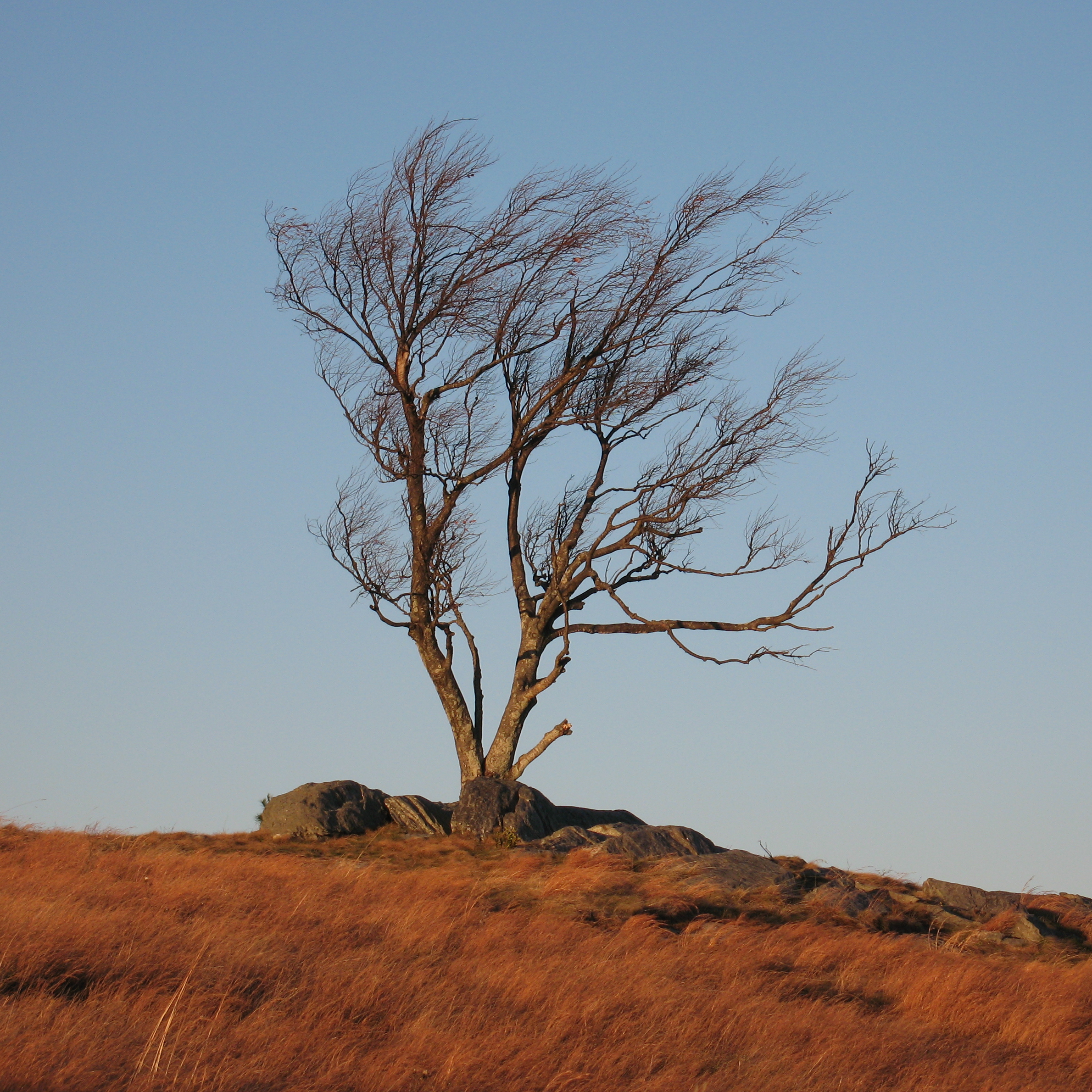
2019-02-09 Doughton Park Tree
 . 

Read Full Post »

[with Pilot Snake by Mary Oliver]

On June 21, I wrote in Tangled my distress at killing, by trying to protect nesting bluebirds, a four-foot long black rat snake. It became entangled in the collar of plastic mesh I’d attached at the base of the birdhouse pole to keep snakes from climbing up the pole to the nesting box. I never saw it there until it began to stink.

The snake’s presence explained the bluebirds’ agitated behavior over the past several days. Once I discovered the dead snake at the base of the post, though, I didn’t see the parent birds visiting the nest any more at all. Had they abandoned the chicks they’d been feeding so obsessively for two weeks? What would I find inside that house? I couldn’t bring myself to look. I hadn’t wanted to kill that snake; I didn’t want the death of birds on my heart as well.

This morning I take down the bird house. I unscrew it and open it for cleaning: an empty nest. A few smears of bird lime but no desiccated baby bird carcasses. They have fledged and flown.

And now in the humidity and sweat of this heat dome morning, I’m moving the cleaned birdhouse to a new location and a new pole. This torpedo-shaped baffle should prevent snakes from climbing to the house, and I’ve added a spiky frill to deter the most persistent climbers. To deter, not to harm. Eat all the mice and voles you desire, O Snake. All my weedy property is yours to roam. Just let me enjoy Bluebird Song this summer.

 . 

 . 

❦ ❦ ❦

Pilot Snake
 . 
had it
lived it would have grown
from twelve inches to a
hundred maybe would have
 . 
set out to eat
all the rats of the world and managed
a few would have frightened
somebody sooner or later
 . 
as it crossed the road would have been
feared and hated and shied away from
black glass lunging
in the green sea
 . 
in the long blades of the grass
but now look death too
is a carpenter too how all his
helpers the shining ants
 . 
labor the tiny
knives of their mouths
dipping and slashing how they
hurry in and out
 . 
of that looped body taking
apart opening up now the soul
flashes like a star and is gone there is only
that soft dark building
death.
 . 
Mary Oliver
 . 

Read Full Post »

 . 
[with 3 poems from The Ecopoetry Anthology]
 . 
First Verse
 . 
I admit the world remains almost beautiful.
The dung beetles snap on their iridescent jackets
despite the canine holiness of the Vatican
and, despite the great predatory surge of industry,
two human hands still mate like butterflies
when buttoning a shirt.
++++++++++++++++ Some mornings
I take myself away from the television
and go outside where the only news comes
as fresh air folding over the houses.
And I feel glad for an hour in which race
and power and all the momentum of history
add up to nothing
 . 
As if from all the mad grinding
in my brain, a single blue lily had grown –
my skull open like a lake. I can hear
an insect sawing itself into what must be
a kind of speech.
++++++++++++ I know there is little
mercy to be found among us, that we have
already agreed to go down fighting, but
I should be more amazed: look
at the blood and guess who’s holding
the knives. Shouldn’t we be more
amazed? Doesn’t the view
just blister your eyes?
 . 
To have come this long way, to stand
on two legs, to be ++ not tarantulas
or chimpanzees ++ but soldiers of our own
dim-witted enslavement. To utterly miss the door
to the enchanted palace. To see myself
coined into a stutter. To allow the money
to brand us ++ and the believers
to blindfold our lives.
+++++++++++++++ In the name
of what? If that old book was true
the first verse would say ++ Embrace
 . 
the world. ++ Be friendly. ++ The forests
are glad you breathe.
 . 
I see now
The Earth itself does have a face.
If it could say I ++ it would
plead with the universe, the way
dinosaurs once growled
at the stars.
++++++++ It’s like
the road behind us is stolen
completely ++ so the future can
never arrive. So, look at this: look
what we’ve done. With all
we knew.
With all we knew
that we knew.
 . 
Tim Seibles
from The Ecopoetry Anthology, edited by Ann Fisher Wirth and Laura-Gray Street; Trinity University Press, San Antonio, TX; © 2020
 . 
❦ ❦ ❦
 . 
I bend to pinch off a few stems as I walk down the drive beside the school. What is this tiny blossom? Four petals no bigger than a sliver of fingernail, lavender, pointed and neat. Whorl of slender leaves. Poking up through asphalt where it hugs the brick wall. I finger the hand lens in my pocket.
 . 
By the time I reach the ball field where the middle schoolers are at recess, I’ve gathered a mini-bouquet of the usual suspects: blue violets, henbit, deadnettle, bittercress. Their teacher turns them over to me and I lay out the plan, an hour and a half of Science Friday. Each takes their little paper cup and we spread out. The neglected. The overlooked. The beautiful in their own tiny tiny way – these are our quarry.
 . 
Sure, most folks would say we’re gathering weeds, and in a minute we’ll discuss that word, “weed,” something growing where it isn’t wanted. For now we scour the waste places, along the storage shed and storm fence, within the winter-brown kudzu invading from the ditch. Their cups fill up with yellow, pink, lavender, blue. After half an hour we sit down at the picnic tables behind the school; I pass around magnifying glasses and ask them to draw a tiny tiny flower as large as they can make it. And they do!
 . 
Are these kids listening while I talk about taxonomy and plant families, about native versus introduced, about flower anatomy of the little mints and asters we’ve discovered? Whether they are or not, I’m pretty confident that there will be days in the future when they look down at their feet and notice something they never paid attention to before.
 . 
It becomes a habit, this paying attention. I can’t not see them now. These tiny tiny flowers are not in my lawn – they are my lawn. OK, sometimes I pull up the mock strawberry and the bittercress when they crowd my “flowers,” and I do dig dandelions out of the front walk, but I’ll not curse them for their tenacity. Instead, I’ll do my best not to make them feel unwanted. I’ll resist the impulse to call them weeds.
 . 
 . 
 . 
Here’s what you’d discover in the mini-bouquet from our paper cups:
 . 
Henbit +++++ Lamia amplexicaule
Deadnettle +++++ Lamia purpurea
Creeping Charlie +++++ Glechoma hederacea
Common Blue Violet +++++ Viola sororia
American Field Pansy +++++ Viola bicolor
Common Dandelion +++++ Taraxacum officinale
Common Groundsel +++++ Senecio vulgaris
Hairy Bittercress +++++ Cardamine hirsuta
Smallflower Fumewort +++++ Corydalis micantha
Yellow Fumewort +++++ Corydalis flavula
Cut-leaved Crane’s-bill +++++ Geranium dissectum
Early Buttercup +++++ Ranunculus fascicularis
Mock Strawberry +++++ Potentilla indica
Common Chickweed +++++ Stellaria media
 . 
And my tiny tiny lavender blossom, the one you wouldn’t even notice for a flower within its handful of green if you hadn’t knelt before it?
Field Madder +++++ Sherardia arvensis
A member of the same family as my all time favorite plant genus, Coffea.
 . 
 . ❦ ❦ ❦
 . 
Scilla
 . 
Not I, you idiot, not self, but we, we – waves
of sky blue like
a critique of heaven: why
do you treasure your voice
when to be one thing
is to be next to nothing?
Why do you look up? To hear
an echo like the voice
of god? You are all the same to us,
solitary, standing above us, planning
 . 
your silly lives: you go
where you ware sent, like all things,
where the wind plants you,
one or another of you forever
looking down and seeing some image
of water, and hearing what? Waves,
and over waves, birds singing.
 . 
Louise Glück
from The Ecopoetry Anthology, edited by Ann Fisher Wirth and Laura-Gray Street; Trinity University Press, San Antonio, TX; © 2020
Scilla, in English also called Squill, is a genus of bulb-forming lily-like flowers that spread in a carpet of blossoms.
 . 
❦ ❦ ❦
 . 
The Lilies Break Open Over the Dark Water
 . 
Inside
+ that mud-hive, that gas sponge,
+ + that reeking
+ + + leaf yard, that rippling
 . 
dream-bowl, the leeches’
+ flecked and swirling
+ + broth of life, as rich
+ + + as Babylon,
 . 
the fists crack
+ open and the wands
+ + of the lilies
+ + + quicken, they rise
 . 
like pale poles
+ with their wrapped beaks of lace;
+ + one day
+ + + they tear the surface,
 . 
the next they break open
+ over the dark water.
+ + And there you are,
+ + + on the shore,
 . 
fitful and thoughtful, trying
+ to attach them to an idea –
+ + some news of your own life.
+ + + But the lilies
 . 
are slippery and wild – they are
+ devoid of meaning, they are
+ + simply doing,
+ + + from the deepest
 . 
spurs of their being,
+ what they are impelled to do
+ + every summer.
+ + + And so, dear sorrow, are you.
 . 
Mary Oliver
from The Ecopoetry Anthology, edited by Ann Fisher Wirth and Laura-Gray Street; Trinity University Press, San Antonio, TX; © 2020
 . 
 . 
❦ ❦ ❦
 . 
Tim Seibles (b. 1955) has received fellowships from the National Endowment for the Arts; he teaches at Old Dominion University and in the Stonecoast MFA program, and leads workshops for the Cave Canem Foundation. First Verse appears in Buffalo Head Solos.
Louise Glück (1943-2023) received the Pulitzer Prize for The Wild Iris (1993), in which Scilla appears and won the 2020 Nobel Prize in Literature. She served as US Poet Laureate 2003-2004.
Mary Oliver (1935-2019) received the Pulitzer Prize for American Primitive (1984) and the National Book Award for New and Selected Poems (1992), in which The Lilies Break Open Over the Dark Water appears.
 . 
More about Trinity University Press and The Ecopoetry Anthology HERE
 . 
❦ ❦ ❦
 . 
 . 
Doughton Park Tree -- 5/1/2021

Read Full Post »

Older Posts »