
.
[with poems by John Brehm (and A. R. Ammons)]
.
Songbird
.
Even thou I have not seen it,
I know how it could be,
how when the skylark flees
from a falcon’s quick pursuit
.
it will turn sometimes and begin
to sing, as if to say, “Being
eaten by a falcon is the last thing
in the world I’m worried about.
.
You cannot catch me, Tra, la, la.
I’ve got breath enough to waste
on a song like this, which you
may as well enjoy before I vanish
.
into air.” And the raptor know
it’s true, knows that anyone
foolish enough to sing in such
a circumstance is quite beyond
.
ever being caught, and that for all
his hunger he’ll be given just
a song, tumbling through the air,
as the body he desires disappears.
.
John Brehm
from Sea of Faith, winner of The Brittingham Prize in Poetry, University of Wisconsin Press, © 2004
.
❦ ❦ ❦
.
For the past two months I am an ant whose dead moth has been lofted by an unseen hand. Go this way, go that way, it’s got to be around here somewhere. Tornado, no power for three days, driveway blocked, hundreds of trees down in our neighbors’ yards and a dozen in ours. Check the roof with the adjuster, walk the property with the arborist, wake up and go to bed with chainsaws and cherry pickers. We’ve lived in this house for forty years and the oak, hickory, maple, tuliptrees where already mature when we moved in. We’ve been used to one deep green engulfing embrace all summer, every summer. Now everything has changed.
.
I took a “break” this month, as I’d promised them last winter, to serve as primary caregiver for my nonagenarian parents while they spent a fond bit of time at their beach house. The first thing I noticed when Linda pulled back into our driveway the evening I returned was . . . WEEDS! Holy cow, fallow earth so used to deep shade must have been preserving this seed cache forever! Pokeberry, pilewort, hawkweed, fleabane, despised mimosa, uncounted escaped purple basil a friend gave me three decades ago – they’re everywhere and BIG! The invasion is overwhelming. As if life weren’t overwhelming me already.
.
After supper I walked out front to check the progress of a volunteer pumpkin that has grown up into the azaleas. Maybe I shouldn’t have instructed Linda to water it twice a week. The black-eyed susans have finally completed their conquest of our borders. Plants – they do enjoy sunlight. I stop in the middle of the roadway and turn to look back at our property. Is this the first time in two months I’ve looked up? Above and behind and around our house – sky. Empty sky. How long before the remaining trees fill it? How long until I lose this dread feeling that nothing will ever be the same?
.
❦
.
A number of years ago I read an anthology that I often return to: The Poetry of Impermanence, Mindfulness, and Joy, edited by John Brehm. When life is overwhelming and being in the moment is about to set my last few hairs on fire, I open to any page. There is no judgement here. No finger-wagging that I am not doing “enough.” There are no spiritual prescriptions or required agendas. I know as I read I’ll simply be sharing with a companion, another human being. It’s nice to be just one human among other humans, from Basho to Billy Collins and Saigyō to Shakespeare, friends all. I am an ant who feels no anxiety for his moth.
.
Then one day my issue of The Sun arrived I discovered these two by John Brehm himself:
.
Wanting Not Wanting
.
I wish I didn’t
want things
.
to be other
than they are
.
but wanting
to be some-
.
one who
doesn’t want
.
things to be
other than
.
they are is
just another
.
way of wanting
things to be
.
other than
they are —
.
and I don’t
want that.
.
.
On Turning Sixty-Four
.
The slowing down
is speeding up.
.
John Brehm
from The Sun. Chapel Hill NC, June, 2020
.
Oh my. Ohhhh my. I photocopied the page and kept it taped the wall beside my desk for months. Eventually I said to myself, “This John Brehm fellow has gotten into my head. I’d better get to know him better now that we’re friends.” I ordered Sea of Faith and was immediately floored (or exalted?) by the inscription: To the memory of A. R. Ammons ( 1926-2001). Oh my, here’s my other perennial poetry inspiration. So to come full circle I share with you another poem which I resemble intimately, this Ammons poem that appears in The Poetry of Impermanence.
.
Old Geezer
.
The quickest
way
to change
.
the
world is
to
.
like it
the
way it
.
is.
.
A. R. Ammons (1926-2001)
from The Poetry of Impermanence, Mindfulness, and Joy. Wisdom Publications, Somerville MA, © 2017
.
. .
.

.
.
❦ ❦ ❦
.
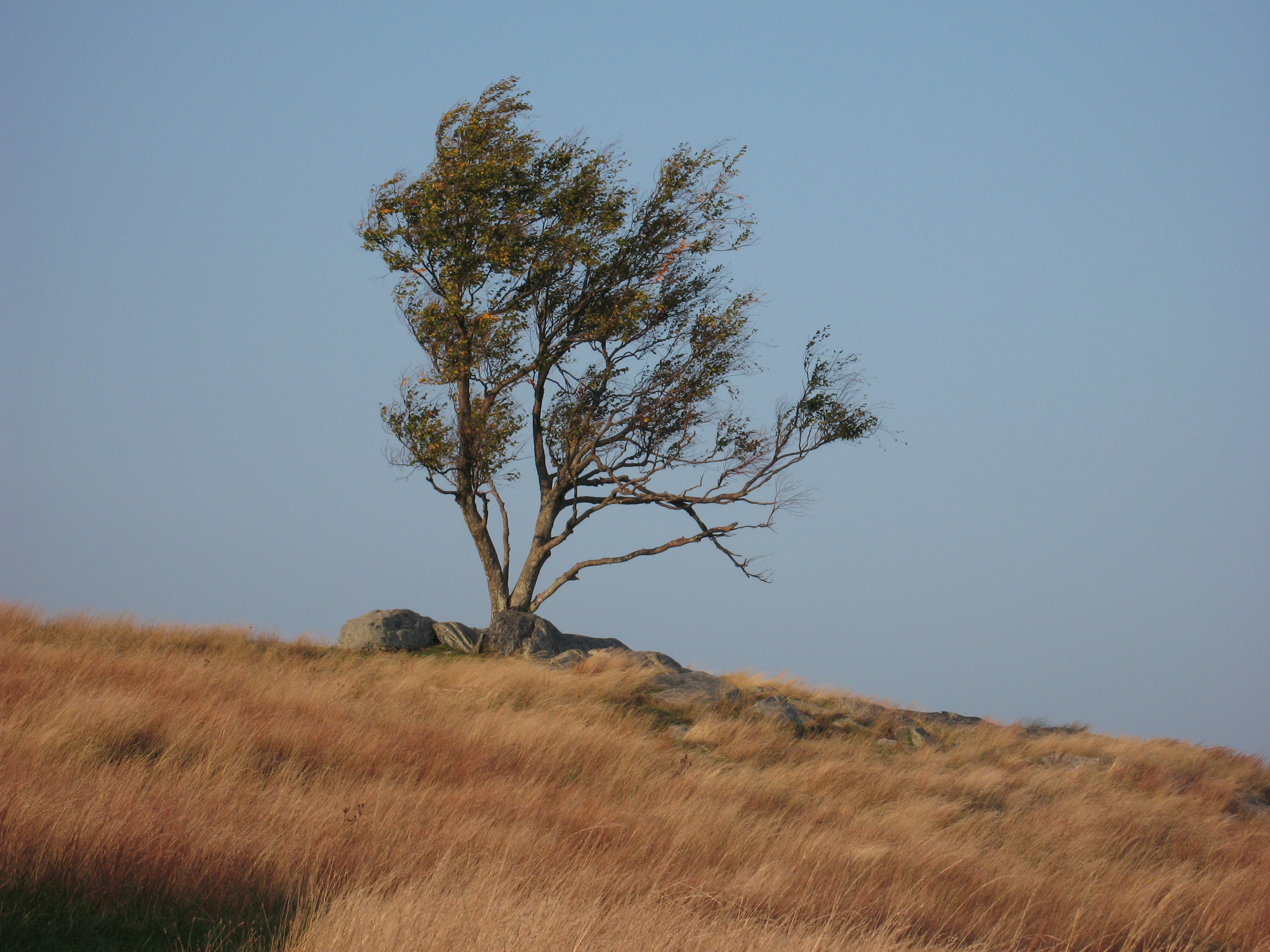
The Blasted Tree
.
Of all of them along the path
that curved for twenty miles
through thickest forest, it was
the blasted tree I loved
best. Among thousands of firs
risen beyond the eye’s reach,
among colossal cedars
with their bark soft
as humid earth, among
groves of slender birches that
filtered winds cast across
these hills from Asia,
among even the hemlocks, gripped
in rocky ground and holding
two hundred years of darkness
in each leaf, among all these
it was the blasted oak
I loved best. Just as the path
turns and ascends, it stands
in a little clearing, like
a signpost to the walker
who would go on farther, as if
to say there is some price
to be paid, or only
the stricken may enter here.
Perhaps because it stood alone
the lightning bolt found its way
to it, the branch that would
have arched above and shaded
the meadow, torn off in a
brilliant flash of the sky’s
violence, ripped cleanly
from the trunk, though you can
still see the black scorched
teeth of the wood where
it broke and let
the limb fall to earth.
It must have been a ghastly
sound and a sight heart-
breaking to behold, the perfect
symmetry and elegance gone
in an instant. And now
a piece of sky no one would
ever have seen from here
come clearly into view,
empty and lue and cleaner
than before because of
the branch’s vivid absence.
I loved the damaged grandeur
of that tree, how it bore
its loss with such composure,
and kept on growing, lop-
sided, irreparable, beautiful,
the catastrophe of its history
written on its body.
And though I am not one
who’s been appointed to say
what trees may mean, it was
no mystery why it could hold
me so still, compel my eye
to such study, whenever
I passed that way.
.
John Brehm
from Sea of Faith, winner of The Brittingham Prize in Poetry, University of Wisconsin Press, © 2004
.

.
❦ ❦ ❦
.
Signs and Wonders
.
I’m not entirely in favor of summer,
what with its drop-dead heat,
its shallow unbothered
.
air of fullness beyond ending or
enduring. Sure I like to see
half the world disappear
.
behind this velvet green pulled from
the magician’s hat of the month
of May just like everybody
.
else. And I’m aware of the sun’s
unbearable importance because
why would we have ever
.
stood upright if not to get the sun
off our backs when we dropped
from the trees onto
.
the burning savannas five million
years ago? Now we can scan
the horizon, carry things
.
in our hands, give and take things to
and from one another. From
which all history
.
follows. Still, I wonder whether
swinging wordlessly from
branch to branch
.
might be better. I don‘t fell all
that thankful towards the
sun for bringing us
.
here or staging this big production,
this overwritten text in which
every meaning contains its
.
opposite – the furious tenacity
of life calling forth the sev-
ering response of death,
.
etc. Just last night I was walking
home thinking is my lover
going to leave me?
.
when a dead bird plummeted
from the sky, slammed onto
a car hood and rolled
.
onto the sidewalk beside me.
I’m as un-Homeric as the
next person, but Jesus,
.
I said, this cannot be a good
sign. Did it have a heart
attack mid-flight, Or
.
was it dropped from the talons
of a predator? Or knocked
out of the sky by an
.
airplane? Or thrown down by
the god assigned to watch
over and comment on
.
my various questions and pre-
dicaments? If we’d stayed
in the cool shade of
.
the forest no birds would ever
fall on us, or if they did we
wouldn’t kill ourselves
.
trying to decipher what they
might foretell. And this
morning coming up
.
the 34th Street subway I passed
a young Russian man hand-
ing out pamphlets, saying,
.
“Jesus is alive. Jesus loffs you.”
I don’t think so but I don’t
know anything, only
.
that it’s hot and we don’t belong
here and our hands betray us
and you’re gone.
.
John Brehm
from Sea of Faith, winner of The Brittingham Prize in Poetry, University of Wisconsin Press, © 2004
.
. 

.
❦ ❦ ❦
You
. 
.
If you would like to buy a book mentioned in these pages:
– – – visit your local independent book store – or –
– – – click the publishers’ links I try to include each week – or –
– – – purchase online at Bookshop.org, where a portion of each sale is returned to independent booksellers. Thanks!




 V E R S E and I M A G E
[…] About/Submit […]