
.
SUMER is icumen in,
+++ Lhude sing cuccu!
Groweth sed, and bloweth med,
+++ And springth the wude nu—
+++ +++ Sing cuccu!
.
Anonymous. c. 1250
.
❦
.
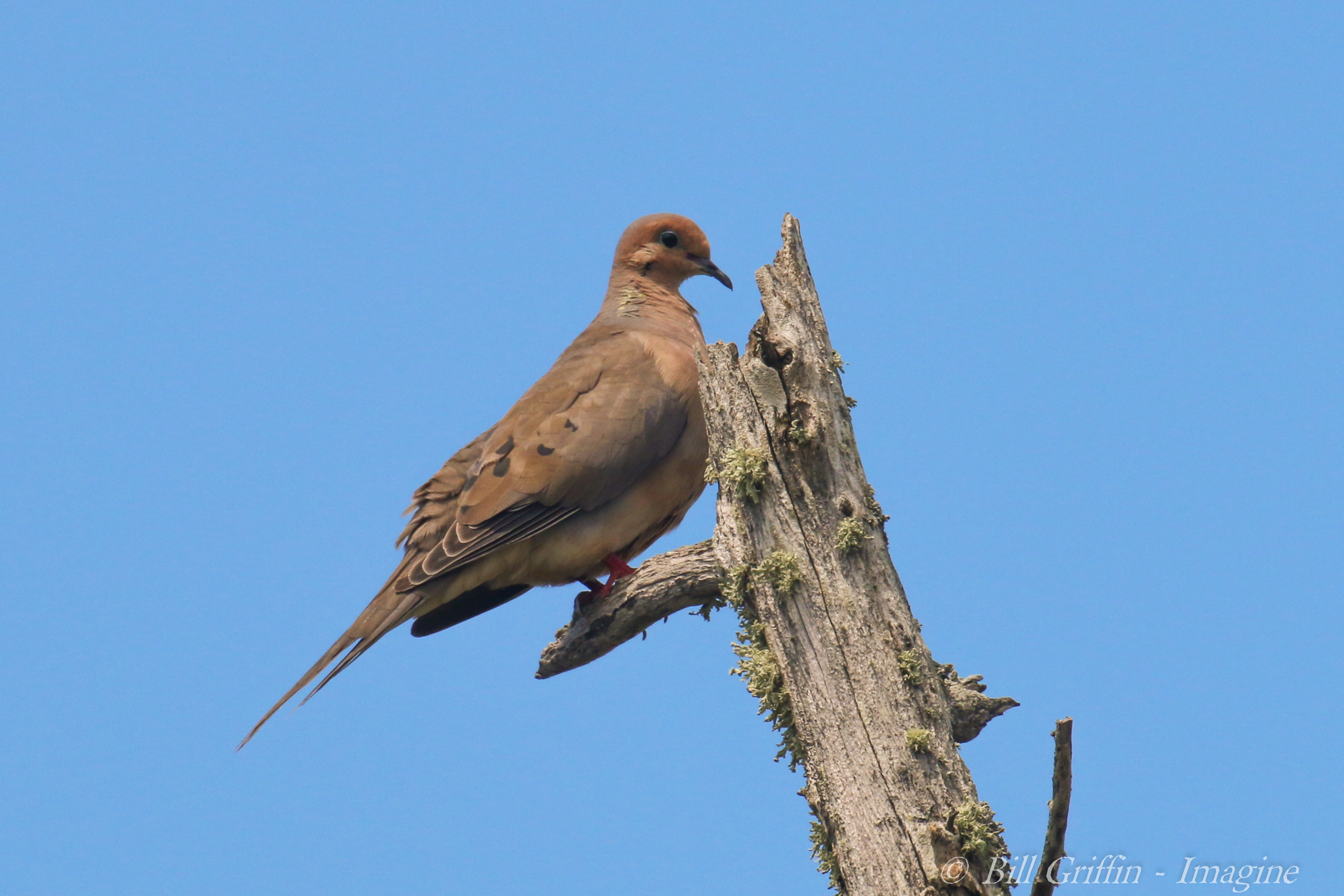
Kahhk, says our local cuccu/cuckoo, the yellow-billed variety, or kowk-kowk-kowk-kowk-KOWK, and often with a preamble tk-tk-tuk-tuk-tuk like a two-stroke engine that won’t quite start but which clearly heralds summer is a-coming in. Yesterday evening as the thermometer lied to us that it would soon dip below ninety and as even the cicadas were gravelling A-flat instead of their usual bright C, I heard two cuckoos in conversation. One was to our west and the other just east of Elkin Creek, where Linda and I were carving a path through the humidity like tired scows. Loudly sing, cuckoo!
.
So that I can hear you! I want to pretend my auditory acuity is not diminishing, but I am forced to confess my limitation when we’re sitting on the back porch and Linda asks (innocently? perhaps not), “Oh, didn’t you hear the Pewee?” Then I focus my attention and cast my receptive net into the green rollers of oak and hickory until, yes!, now I hear it, humble plaintive song of Eastern Wood Pewee, really one of my favorite birds. I would hate to have missed it.
.
The songs of birds are half their personality. Half their presence and their being. And birds are half the personality of the forest. Oh yes, today I will kneel to appreciate the Cranefly Orchid, just beginning to bloom right now mid-July. I’ll focus my gaze on a few centimeters of floral spike rising from the deep shade, but all around me 360 degrees are Vireo, Flycatcher, Woodpecker, Thrush, unseen but unceasing. I might toy with the idea of hearing aides so that I don’t have to ask Linda to repeat herself so often, but I will be ultimately convinced when I miss another Pewee.
.
.
❦
.
The Common Cormorant
.
The Common Cormorant or shag
Lays eggs inside a paper bag.
The reason you will see no doubt
It is to keep the lightning out.
But what these unobservant birds
Have never noticed is that herds
Of wandering bears may come with buns
And steal the bags to hold the crumbs.
.
Christopher Isherwood (1904-1986)
.
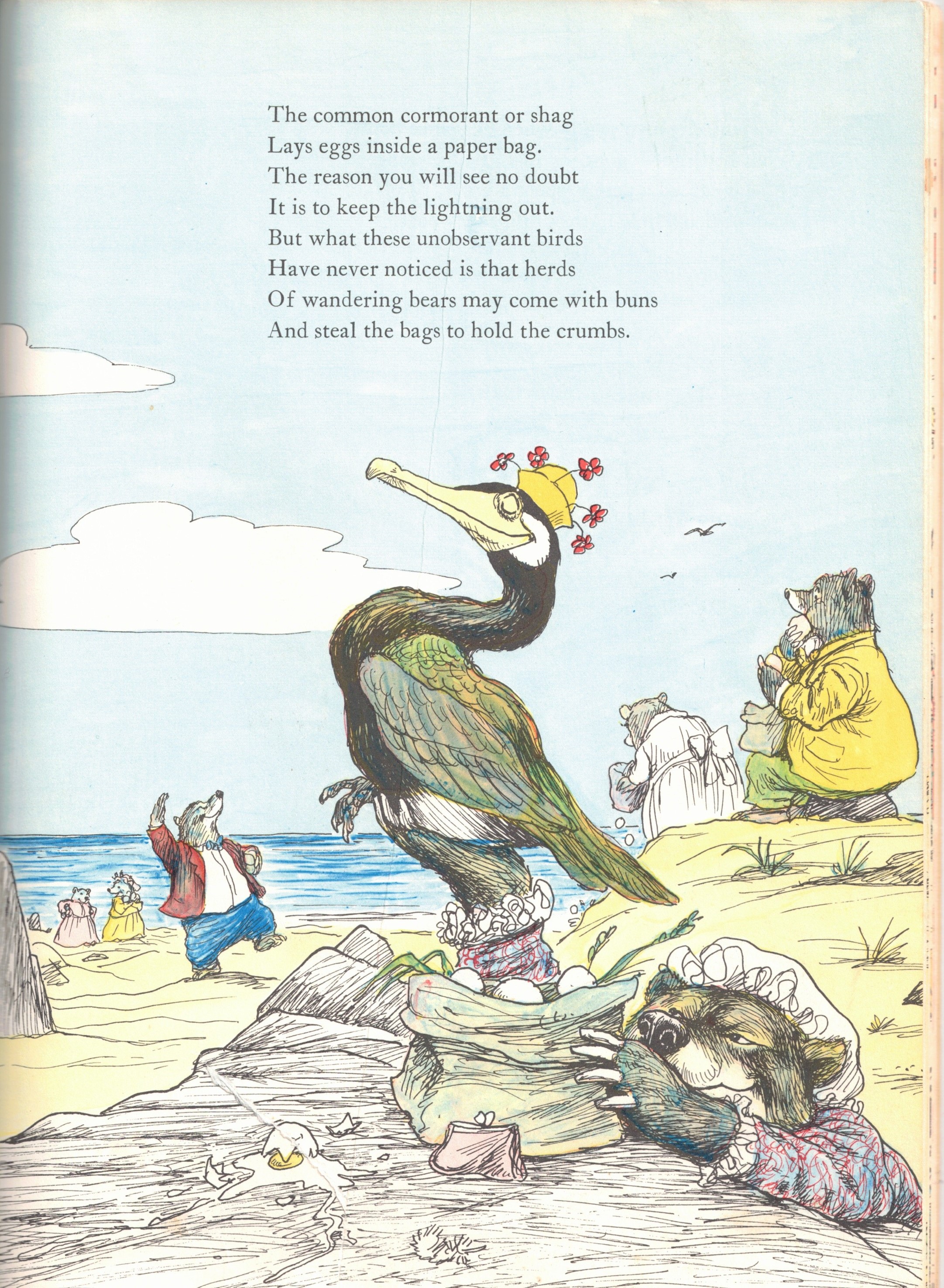
[from A Great Big Ugly Man Came Up and Tied His Horse to Me, A Book of Nonsense Verse illustrated by Wallace Tripp; Little, Brown & Company © 1971]
.
❦
It’s not in summer that cormorants visit Elkin but during spring or fall migration. A few will chance upon our little town reservoir, a welcoming spot for a rest and a snack. Just as Wallace Tripp captured her, a cormorant will perch on the pump housing in the middle of the lake, fluff out her wings to dry, beak tipped up, utterly satisfied. There must be something attractive in the water around her, bream or bass or crappie, because she and her buddies will hang around for a few days before they make like a tree and get out of here. They have summer plans elsewhere.
.
Summer. Birds. Bird poems. This summer our grandson is helping us comb through basement and garage for those preserved toys and mementos it’s time to release into the wild. Duplos – can we really bear to give them away? And the books, the books, the books! We no longer have any teething babes to relish those old board books, and even our 8- and 9-year olds are feeling too grown up for most of my favorite tomfoolery, but I must hold onto my Wallace Tripp. The Emperor of Anthropomorphism. In fact, when I slide into senescence I hope my family has the good sense to pack away all my process theology, quantum reality, and cosmology and just prop me up with Tomie dePaola (for benediction) and Tripp (for belly laughs) to make me young again.
.
❦
.
The Windhover
.
To Christ our Lord
.
I CAUGHT this morning morning’s minion, king-
+++ dom of daylight’s dauphin, dapple-dawn-drawn Falcon, in his riding
+++ Of the rolling level underneath him steady air, and striding
High there, how he rung upon the rein of a wimpling wing
In his ecstasy! then off, off forth on swing,
+++ As a skate’s heel sweeps smooth on a bow-bend: the hurl and gliding
+++ Rebuffed the big wind. My heart in hiding
Stirred for a bird,—the achieve of; the mastery of the thing
.
Gerard Manley Hopkins (1844–1889)
.
❦
.
When we first moved to Elkin in 1981, Chatham Manufacturing still employed 3,000 men and women working three shifts making blankets and upholstery. As I drove home on summer evenings past the lake of cars in the Chatham parking log, I often spotted a Windhover perched on an overhead wire . Hoping, no doubt, to pounce on a house sparrow drawn to someone’s spilled fries or cigarette butts. We don’t call them Windhovers here in the US, and by DNA analysis our American Kestrel is actually not closely related to Hopkins’s Eurasian Kestrel, but on other summer evenings as I drove home through Surry County corn and soybean fields I was stirred more than once to see a tiny falcon hovering above some ill-fated mouse or grasshopper before rocketing into its stoop. Whenever I read Hopkins’s poem, I feel again the ecstasy of that momentary communion with perfect wild creation.
.
Who has never felt the desire to be caught up and become part of that creative spirit? An encounter with a wild thing, the embrace of a child, standing transfixed before a work of art, connection with one perfect phrase read in print, writing a line deep and true: experiences of creation and acts of creativity are so intermingled as to be indistinguishable. Teach me half the gladness / That thy brain must know, / Such harmonious madness / From my lips would flow / The world should listen then, as I am listening now.
.

.
❦
.
To a Skylark (excerpt)
.
Hail to thee, blithe Spirit!
Bird thou never wert,
That from Heaven, or near it,
Pourest thy full heart
In profuse strains of unpremeditated art.
.
Higher still and higher
From the earth thou springest
Like a cloud of fire;
The blue deep thou wingest,
And singing still dost soar, and soaring ever singest.
. . .
.
What thou art we know not;
What is most like thee?
From rainbow clouds there flow not
Drops so bright to see
As from thy presence showers a rain of melody.
.
Like a Poet hidden
In the light of thought,
Singing hymns unbidden,
Till the world is wrought
To sympathy with hopes and fears it heeded not:
. . .
.
Sound of vernal showers
On the twinkling grass,
Rain-awaken’d flowers,
All that ever was
Joyous, and clear, and fresh, thy music doth surpass.
.
Teach us, Sprite or Bird,
What sweet thoughts are thine:
I have never heard
Praise of love or wine
That panted forth a flood of rapture so divine.
. . .
.
We look before and after,
And pine for what is not:
Our sincerest laughter
With some pain is fraught;
Our sweetest songs are those that tell of saddest thought.
.
Yet if we could scorn
Hate, and pride, and fear;
If we were things born
Not to shed a tear,
I know not how thy joy we ever should come near.
.
Better than all measures
Of delightful sound,
Better than all treasures
That in books are found,
Thy skill to poet were, thou scorner of the ground!
.
Teach me half the gladness
That thy brain must know,
Such harmonious madness
From my lips would flow
The world should listen then, as I am listening now.
.
Percy Bysshe Shelley (1792—1822)
.

. . . . .
Several friends have asked me to keep them informed whenever I schedule a guided naturalist hike in our area. I am planning one (maybe two) wildflower hikes in September as celebration of the founding of the Mountains-to-Sea Trail:
Friday, September 12
(and if there’s interest a reprise on Saturday, September 27).
Sign up at MeetUp.com to receive notifications and to register for events.
Thanks — Bill
.
.
.




 V E R S E and I M A G E
Glad to hear from you Jenny. May life continue to surprise . . . ---B