Feeds:
Posts
Comments

Posts Tagged ‘Ecopoetry’

 . 
[with poetry by Mary Oliver and Tennyson]
 . 
On Winter’s Margin
 . 
On winter’s margin, see the small birds now
With half-forged memories come flocking home
To gardens famous for their charity.
The green globe’s broken; vines like tangled veins
Hang at the entrance to the silent wood.
 . 
With half a loaf, I am the prince of crumbs;
By time snow’s down, the birds amassed will sing
Like children for their sire to walk aborad!
But what I love, is the gray stubborn hawk
Who floats alone beyond the frozen vines;
And what I dream of are the patient deer
Who stand on legs like reeds and drink the wind; –
 . 
They are what saves the world: who choose to grow
Thin to a starting point beyond this squalor.
 . 
Mary Oliver
from Devotions, the Selected Poems of Mary Oliver, Penguin Press © 2017; originally collected in No Voyage and Other Poems, Houghton Mifflin © 1965
 . 
❦ ❦ ❦
 . 
In the Spring a young man’s fancy lightly turns to thoughts of . . . phenological mismatch.
 . 
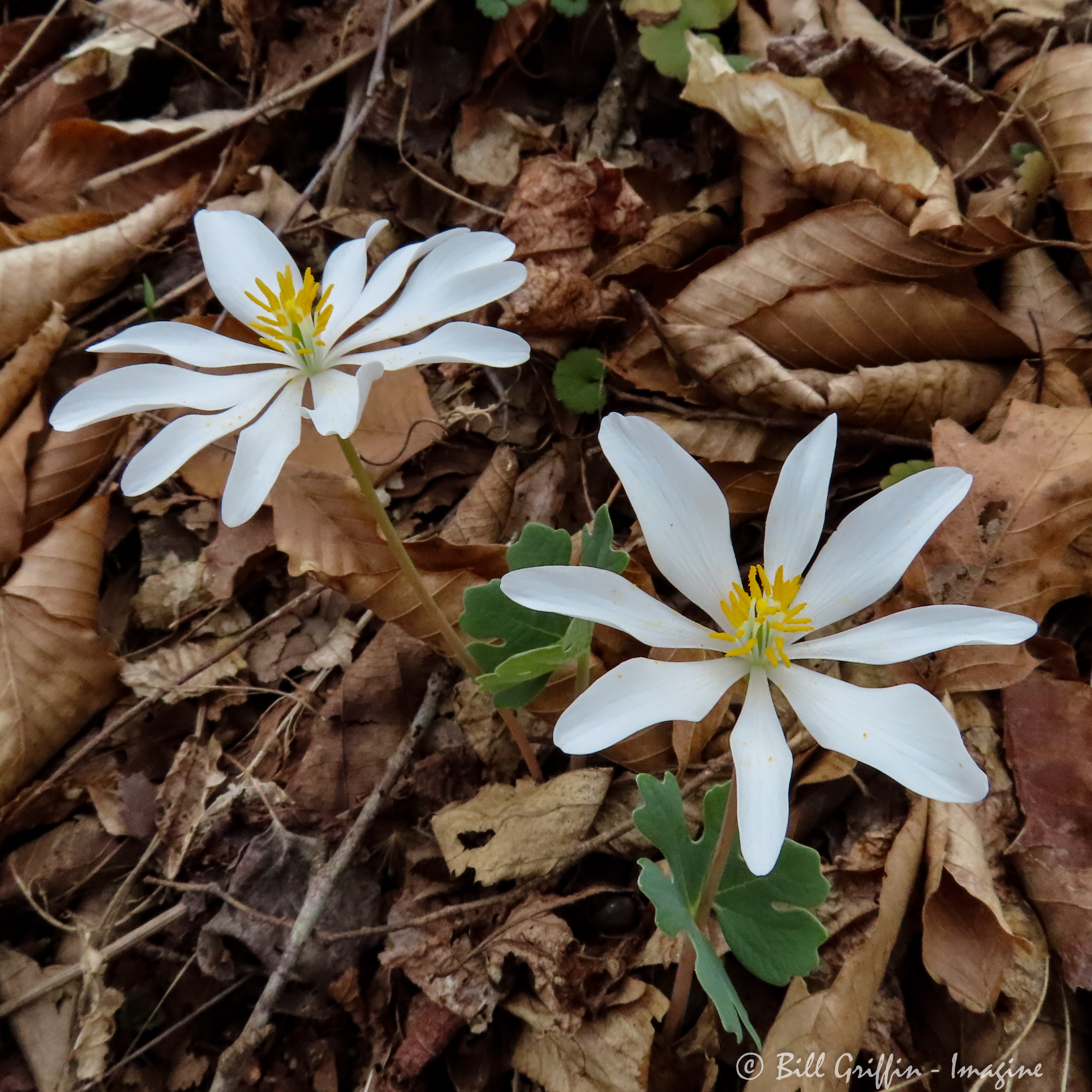
Ah, Alfred Tennyson, better you had continued to tramp the heath and weald of old Locksley Hall and turned away from your infatuations with the inconstant and unreachable Amy. Look here! Amidst the brittle stems of last summer’s arboreal plumage and almost buried beneath autumn’s comforter, an eyelet of green! Gently peel aside the brown leavings of solemn beech and discover: seven pale lilac petals and their swarm of stamens. February 18 and Hepatica has begun to bloom!
 . 
So I hope we’ll be greeted tomorrow, February 22, on our first naturalist walk of the season. Now and every three weeks through April we will tally the progression of blooming along the Elkin Creek Nature Trail. Native wildflowers, these spring ephemerals make their living here beneath the beech / oak canopy. Hepatica, Trout Lily, Bloodroot, Foamflower, they will quickly extend their leaves into the sun before its light can be obscured by budbreak among the overarching trees. Phenological escape – the urgent days of photosynthesis before the canopy closes. These low growing herbs must earn most of their entire year’s salary in just two or three weeks.
 . 
How do they know? What triggers the perennials to leaf and bloom; what swells and opens the leaf buds overhead? What is the key to understanding their phenology (def. – the study of cyclical biological phenomena)? Warming. Soil temperature and air temperature. But some plants are more sensitive to temperature changes and the warming of planet earth than others. In North America, deciduous trees are the most sensitive to warming trends that determine when they will break bud and unfurl leaves. Beech, oak, maple they leaf out earlier as average temperatures increase; Hepatica may not, and so the window of sunlight opportunity shortens.
 . 
This is just one example of phenological mismatch. Imagine how it might affect interconnected species that gradually diverge, out of synch. Will Hepatica have time to turn photons into the sugars it must store for the next long darkness? Will its pollinators and its seed dispersers still thrive in the altered forest? What will our spring walks look like in ten years? in twenty? Alfred Tennyson, I’m afraid there are days I share your melancholy.
 . 
 . 
❦ ❦ ❦
 . 
Wild Geese
 . 
You do not have to be good.
You do not have to walk on your knees
for a hundred miles through the desert repenting.
You only have to let the soft animal of your body
+++ love what it loves.
Tell me about despair, yours, and I will tell you mine.
Meanwhile the world goes on.
Meanwhile the sun and the clear pebbles of the rain
are moving across the landscapes,
over the prairies and the deep trees,
the mountains and the rivers.
Meanwhile the wild geese, high in the clean blue air,
are heading home again.
Whoever you are, no matter how lonely,
the world offers itself to your imagination,
calls to you like the wild geese, harsh and exciting –
over and over announcing your place
in the family of things.
 . 
Mary Oliver
from Devotions, the Selected Poems of Mary Oliver, Penguin Press © 2017; originally collected in Dream Work, Grove/Atlantic Inc. © 1986.
 . 
❦ ❦ ❦
 . 
A week after our group walked the trail I am still happy for what the forest shared with us. Yes, one Trout Lily had stretched and curved its petals to open a small yellow flower. Yes, one Hepatica, among the many other slumbering liver-lobed leaves, presented the cold morning after freezing night with a single pale lilac bloom. We knelt closer for its even more remarkable surprise: beneath the blossom nodded two more, sepals already empty of petals and gone to seed. The spring ephemerals know their business and their name. They make more of themselves and fill the world whether we are watching or not.
 . 
I have been watching these flowers but not nearly long enough nor often enough. Nevertheless one remembers – color and scent may spark a flicker of joy into a life that threatens to cloak each day with darkness. On our walk, beside a particular beech tree no different from the hundreds around us, I recall the first time I ever discovered Hepatica blooming in our woods. That year it was the only one I found and I returned to it day after day until it faded. Now here it is again, the very plant. Its leaves are pocked and burnt orange from their long winter’s work. If it has buds, they are still hiding. As yet no new spring foliage. But I will be back to share this brief season with it. Perhaps we will bloom together.
 . 
 . 
❦ ❦ ❦
 . 
Spring
 . 
Somewhere
++ a black bear
++ ++ has just risen from sleep
++ ++ ++ and is staring
 . 
down the mountain.
++ All night
++ ++ in the brisk and shallow restlessness
++ ++ ++ of early spring
 . 
I think of her,
++ her four black fists
++ ++ flicking the gravel,
++ ++ ++ her tongue
 . 
like a red fire
++ touching the grass,
++ ++ the cold water.
++ ++ There is only one question;
 . 
how to love this world.
++ I think of her
++ ++ rising
++ ++ ++ like a black and leafy ledge
 . 
to sharpen her claws against
++ the silence
++ ++ of the trees.
++ ++ ++ Whatever else
 . 
my life is
++ with its poems
++ ++ and its music
++ ++ ++ and its glass cities,
 . 
it is also this dazzling darkness
++ coming
++ ++ down the mountain,
++ ++ ++ breathing and tasting;
 . 
all day I think of her –
++ her white teeth,
++ ++ her wordlessness,
++ ++ ++ her perfect love.
 . 
Mary Oliver
from Devotions, the Selected Poems of Mary Oliver, Penguin Press © 2017; originally collected in House of Light, Beacon Press © 1990.
 . 
❦ ❦ ❦
 . 
Here in closing a few lush stanzas from the overpowering lyric Locksley Hall by Alfred Lord Tennyson:
 . 
Here about the beach I wander’d, nourishing a youth sublime
With the fairy tales of science, and the long result of Time;
 . 
When the centuries behind me like a fruitful land reposed;
When I clung to all the present for the promise that it closed:
 . 
When I dipt into the future far as human eye could see;
Saw the Vision of the world and all the wonder that would be.—
 . 
In the Spring a fuller crimson comes upon the robin’s breast;
In the Spring the wanton lapwing gets himself another crest;
 . 
In the Spring a livelier iris changes on the burnish’d dove;
In the Spring a young man’s fancy lightly turns to thoughts of love.
 . 
Read Locksley Hall in its entirety at The Poetry Foundation
Purchase Mary Oliver’s Devotions at Penguin/Random House
Cutting edge phenological research at Nature.com
 . 
❦ ❦ ❦
 . 
2019-02-09 Doughton Park Tree
 . 

Read Full Post »

Thunderhead Sandstone outcrop below Ft. Harry Falls, GSMNP

 . 
[with poems about Geology . . . (say what?!)]
 . 
Erosion
 . 
Edges fall first,
silt grains cemented
under thousands of years
sloughed away by wind, rain,
footstep of dog,
sandstone alchemized beneath
weight of mountain
turns sand again
 . 
Subtle rubbing of days shapens us anew,
weathering, the
slowest song of change
 . 
No wonder we wake up some days
wondering at who we used to be.
No wonder we don’t always notice
as our outer edges strip away.
 . 
No wonder the children build castles
made of sand at water’s edge,
even though the castles fall.
 . 
They are practicing for
when they too will feel
what once seemed enduring
slip inside the rising tide.
 . 
Emilie Lygren
from What We Were Born For, Blue Light Press, San Francisco CA. © 2021. Reprinted by permission of the author.
 . 
❦ ❦ ❦
 . 
Geology never intended to trip us up. A mountain’s day is steady and measured, calm as the drip of water, languid as the North Pole’s precession that turns to aim the spinning globe at heaven. All night the mountain’s flow, her stretch, recumbent but restless; at first light she yawns and shudders, her turn and crouch and slow rise; then all morning’s long knotting and gathering to her full height; her relentless stride; a forceful journey, this full day’s labor into evening even as her form, still imposing, diminishes and she reclines.
 . 
Did the mountain even feel the pinprick of water seeping and freezing in minute fissures at her neck? Perhaps a vague itch as lichens scratch to enlarge their circumference, little acid fingernails, a thimbleful of soil. Windborne seeds – would she notice such a light caress when one descends, then its rootlets, its swelling cambium and lignin? One and now another trunk emerges from the crevice, breathing, drinking sunlight, and here comes the day in mammal-time when gravity prevails. A crack, thunder without lightning, slabs and chunks release and roll downslope until they hold at a narrow rib where it crosses below the mountain’s shoulder. Bedrock settled into the new bed it has found.
 . 
Ten thousand human-years pass until you and I puff into view. We slow our pace to climb over and around. Here embedded in the footpath is a softer stratum that has been polished to ebony by a thousand boots. Here alongside the trail we greet the rounder edges and pitted face of earliest falls, sharper clefts and angles  from falls a mountain-day later. Water proving its strength. Lichens still hard at work. Wait a while and this path will open. Geology never intended to trip us up. She simply hopes that we will slow our frantic climbing. Pause here with her for a moment. Look, and simply see.
 . 

USGS map & quartzite vein in Elkmont (?) Sandstone GSMNP

 . 

Common Blue Wood Aster & Thunderhead Sandstone GSMNP

 . 
❦ ❦ ❦
 . 
Anything the River Gives
 . 
Basalt, granite, tourmaline, the male wash
of off-white seed from an elderberry,
the fly’s-eye, pincushion nubbins yellow
balsamroot extrudes from hot spring soil,
confetti of eggshell on a shelf of stone.
Here’s a flotilla of beaver-peeled branches,
a cottonwood mile the shade of your skin.
Every day I bring some small offering
from my morning walk along the river:
something steel, blackened amber with rust,
an odd pin or busing shed by the train
or torqued loose from the track, a mashed penny,
the buddy bulge of snowmelt current.
I lie headlong on a bed of rocks,
dip my cheek in the shallows,
and see the water mid-channel three feet
above my eyes. Overhead the swallows
loop for hornets, stinkbugs, black flies and bees,
gone grass shows a snakeskin shed last summer.
The year’s first flowers are always yellow,
dogtooth violet dangling downcast ans small.
Here is fennel, witches’ broom and bunchgrass,
an ancient horseshoe nailed to a cottonwood
and halfway swallowed in it spunky flesh.
Here is an agate polished over years,
a few bones picked clean and gnawed by mice.
Her is every beautiful rock I’ve seen
in my life, here is my breath still singing
from a reedy flute, here the river
telling my blood your name without end.
Take the sky and wear it, take the moon’s skid
over waves, that monthly jewel.
If there are wounds in this world no love heals,
then the things I haul up – feather and bone,
tonnage of stone and the pale green trumpets
of stump lichens – are ounce by ounce
a weight to counterbalance your doubts.
In another month there won’t be room left
on the windowsills and cluttered shelves,
and still you’ll see me, standing before you,
presenting some husk or rusty souvenir,
anything the river gives, and I believe
you will love.
 . 
Robert Wrigley
from The Ecopoetry Anthology, edited by Ann Fisher-Wirth and Laura-Gray Street, Trinity University Press, San Antonio, TX. © 2020
 . 
❦ ❦ ❦
 . 
“Find yourself a stone, one you can pick up and carry,” our instructor tells us. “Then find me bedrock.” All weekend Elizabeth will be offering us something new every few minutes  – strange vocabulary, stranger stories in deep time, paths upward toward heath balds and downward into the past – but first she offers these two commands. Our substratum. We will build everything upon a stone from the Middle Prong of the Little River, edges knocked round, compressed bits of texture a hundred shades of gray (soon we’ll know to call those bits clasts); and ponderous gray stone rising beside the river, its layers, its planes and fissures (soon we’ll know which is bedding and which foliation). Here we begin our weekend course in the Smokies, 500 million years beneath our feet, asking how it all got here.
 . 
I’m taking my final elective offered by Great Smoky Mountains Institute at Tremont in their Southern Appalachian Naturalist Certification Program – Geology of the Smokies. This is the first time Linda has accompanied me to Tremont, so she’s taking her first course. We know from our readings that these are the most folded, tortured, elevated/eroded/re-elevated/re-eroded square miles in North America. We know that for the next 48 hours we’ll be continuously outdoors except a few hours to eat and sleep. From my previous nine courses, I know Elizabeth Davis as an excellent teacher, patient yet challenging. What we don’t yet fully know is just how truly challenging, physically and intellectually, this weekend is going to be. But here we are on Friday night and we should be getting a clue – Elizabeth is leading us on a hike into pitch darkness, across the shallows on a single-log bridge, and has turned us loose on an island to find our river stones.
 . 
Success. No one falls into the river.
 . 
Tomorrow morning we’ll be picking our way up through a pathless boulder field to a massive outcrop of Thunderhead Sandstone (its compressed sediment, clasts, recycled from the Grenville mountains built almost a billion years ago). We’ll spend the afternoon literally on hands and knees beneath laurel and rhododendron, climbing to a heath bald summit where some really cool rocks are exposed and where we’ll take samples of the low pH soil. Sunday morning we’ll hike a trail so hazardous that the Park won’t even include it on their maps, but along the way we’ll cross major and minor fault lines to discover their rocky transitions, investigate geology’s effect on plant communities, devise some crazy poems and songs about our findings, and end up at beautiful Spruce Flat Falls.
 . 
Late Sunday night, after driving five hours, Linda and I will pull into our driveway and our old bones will creak as we lug our gear back into the house in pitch darkness. At least we don’t have to cross a log bridge to make it to the kitchen door, but when we wake in the morning, stiff and aching, will Linda have a few choice cusswords for me after dragging her along on this adventure? Oh yeah, we’re sore, but only in body. What Linda does have for me is a list of books I need to order. And this proclamation: “You know, after this weekend I really love Geology!”
 . 

Nodding Ladies Tresses growing up through Anakeesta Slate GSMNP

 . 

Elizabeth displays bedding vs cleavage at summit of heath bald near Chimney Tops GSMNP

 . 
❦ ❦ ❦
 . 
The End of the Age
 . 
With wash and ripple and with wave,
Slow moving up the long deserted sand,
The little moon went watching the white tide
Flood in and over, spread above the land,
Flood the low marshes, make a silver cover
Where the green sea-weed in a floating mist
Creeps under branch and over.
The wide water spreads, the night goes up the sky,
The era ends.
 . 
Tomorrow comes warm blood with a new race,
Warm hearts that ache for lovers and for friends,
And the pitiful grace
Of young defeated heads.
Tomorrow comes the sun, color and flush
And anguish. Now let the water wash
OUt of the evening sky the lingering reds,
And spread its coolness higher than the heart
Of every silver bush.
Night circles round the sky. The era ends.
 . 
 . 
Geology
 . 
“Look,” said God;
And with slow fingers
Drew away the mantle rock.
Man followed groping
To touch the flesh of his true mother;
And, standing in great valleys,
He saw the ages passing.
 . 
 . 
Fossil
 . 
I found a little ancient fern
Closed in a reddish shale concretion,
As neatly and ans charmingly shut in
As my grandmother’s face in a daguerreotype,
In a round apricot velvet case.
 . 
Janet Loxley Lewis (1899-1998)
from Poetry Magazine, No. 111, The Poetry Foundation. © June, 1920
 . 
❦ ❦ ❦
 . 
Emilie Lygren has published poems and anthologies and developed dozens of publications focused on outdoor science education. Her first collection of poems, What We Were Born For, was selected by the Young People’s Poet Laureate as the Poetry Foundation’s monthly book pick for February 2022.
 . 
Robert Wrigley has said that “poetry can have a redemptive function. It can look at the chaos you see and make a kind of sense of the smallest part of it.” His poems are concerned with rural Western landscapes and humankind’s place within the natural world.
 . 
Janet Loxley Lewis (1899-1998) wrote novels, stories, and librettos, but she considered poetry the superior form. Theodore Roethke describes her poetry as “marked by an absolute integrity of spirit and often by the finality in phrasing that can accompany such integrity.”
 . 
❦ ❦ ❦
 . 
 . 

Great Smoky Mountains Institute at Tremont GEOLOGY course November, 2024

 .  . 
 Doughton Park Tree 2018-02-09

Read Full Post »

 . 
[with 3 poems by Rae Spencer]
 . 
Innate
 . 
what does a hummingbird know
in its world of nectar and need
 . 
nightly forced to torpor
by the constant urge to feed
through staggering migration
 . 
are its dreams equally desperate?
 . 
does it wake hungry
ill-tempered with beauty
cramped with desire
 . 
suddenly alert to the nature of sugar
aware that satisfaction can only ever be
 . 
illusory
 . 
and what does the hummingbird sense
as it sips the flower’s allure
 . 
does it know of delicate meanings
pitched fever-tight
into its tiny world of furtive speed
 . 
dare I surmise anything?
 . 
maybe nectar is only a meal
sugar an ache that will pass
beauty an accident of form
 . 
and nothing means more than a wing
clasped into the air and released
 . 
effortless
 . 
Rae Spencer
from Alchemy, Kelsay Books, American Fork, UT; © 2024
 . 
❦ ❦ ❦
 . 
Hovering to sip sugar water, flicking your tongue into the red plastic flower, then dive bombed by a lance-tipped green blur – this is daily life for a hummingbird in the Eastern US. We only have the one species here, ruby-throated, and they do not play well with others. When it comes to a choice feeder there is no sharing, unlike the scene in the Western US where a cloud of a dozen birds, four or five different species, will jointly keep a feeder sincerely humming.
 . 
These last two weeks of September we have been visited hourly by the chunkiest hummingbird I have ever seen. The sleeker slimmer birds will chase her away but then she’s right back. (She-birds only; all the males have left for Central America by the end of August and these more svelte visitors and chasers have likely already burned fat as they’re migrating through from farther north). I realize hummingbirds have to bulk up each autumn, entering a period of hyperphagia before migration similar to black bears before hibernation, but this bird is a real hunk. She is going to have no problem making the 800 km flight from Florida to Yucatan, a natural miracle for such a tiny creature who, even at twice her normal body weight, still weighs only 6 grams – about the weight of a postcard, or of the well-sharpened pencil you’ll use to write a note to Guatemala to let them know to expect this ruby-throat in a couple of weeks.
 . 
Audubon NC suggests continuing to fill hummingbird feeders until the second week in October. Abundant sugar will not deter the birds from setting out on their southward journey; their migration is triggered by light, or actually its absence, the diminishing length of day. All creatures live by their own internal clock. For some the clock’s ticks are soil temperature, snowmelt, the movement of water through earth; for others alarms are set by earth’s rotation and the stretch of sunlight and shadow.
 . 
And no creature lives in isolation. What if come clocks tick out of rhythm with the others? In the Western US, when broad-tailed hummingbirds arrive from their wintering grounds they depend on spring-blooming glacier lilies for nectar to replenish their exhausted energy. By 2012, however, biologists noted that the lilies were beginning to open seventeen days earlier than they had several decades prior. Some would already be withered before the hummingbirds even arrived. By 2050 the birds may completely miss the span of lily bloom.
 . 
Phenological mismatch is the term for this consequence of global climate change. What if migrating flycatchers miss their fly hatch? What if flowers bloom to no pollinators? Some species seem to benefit from early spring – marmots have a longer season to chow down and birth more marmettes. Some species can adapt to new timings but many can’t, especially as climate clocks accelerate their vagaries and variations. We can’t yet know all the consequences, but we know our children and grandchildren are experiencing a different world from the world in which we grew up.
 . 
 . 
❦ ❦ ❦
 . 
Belyaev’s Foxes
 . 
When most only wanted their fur
Belyaev wanted their genes
 . 
He selected those he could touch
The ones who ate from his hand
 . 
Exerting curious pressure
On his wild silver stock
 . 
Closed in outdoor cages
To bear Belyaev’s chosen litters
 . 
Where is the gene for submission
For loyalty and bonding?
 . 
Somewhere, it seems
Connected to curly tails
 . 
White stars on the face
Flopped ears and blunt snouts
 . 
Wags and whines and barks
Which compete for favors
 . 
Other than food
So Belyaev’s foxes tamed the men
 . 
With prolonged puppyhood
And after thirty generations
 . 
Heeled happily across their yard
In through the open front door
 . 
Rae Spencer
from Alchemy, Kelsay Books, American Fork, UT; © 2024
 . 
❦ ❦ ❦
 . 
Embryology, cosmology, evolution . . . double helices, insect wings, quarks . . . mystery, contemplation, enlightenment: the poems of Alchemy wend their way through an expanding universe of discovery. There is scarcely a field of science or philosophy that Rae Spencer does not embrace in this collection, using language both precise and technical as well as elevated and elevating. This slim coverlet of atmosphere that supports us, this beneficent congregation of creatures within such mild extremes of warmth and moisture and light, how can one walking through such a place not be inspired?
 . 
And once inspired, what enters us to feed our hearts, what strikes a tonal chord within our minds What shall we believe in? What shall we hope for? Nothing is beneath our noticing; nothing is unworthy of praise. Perhaps the best way to receive Rae Spencer’s expansive embrace embodied in her universalistic collection is as, in the poet’s own words, a patchwork philosophy of wonder (Agnost).
 . 
 . 
Rae Spencer is a veterinarian and lives in Virginia, USA. Alchemy is available at Kelsay Books.
 . 
 . 
❦ ❦ ❦
 . 
Means of Dispersal
When I view all beings not as special creations, but as the lineal descendants of some few beings which lived long before the first bed of the Silurian system was deposited, they seem to me to become ennobled.
++++++++++++++++++ – Charles Darwin in The Origin of Species
 . 
He spent pages contemplating seeds
How some survived in seawater
Others in the crops of owls
In the feces of locusts
In the stomachs of fish
Frozen in icebergs
Dried in a clump of mud
Between the toes of a partridge
 . 
“In the course of two months,
I picked up in my garden 12 kinds of seeds,
out of the excrement of small birds, and these
seemed perfect…”
 . 
How long in the garden?
Hovering over phials of curiosity
Some rank with the rot of failure
Others yielding green secrets
To the man who struggled to ask
Is there another explanation?
And in the end answered himself
With seed, with barnacles and pigeons
 . 
“…from so simple a beginning
endless forms most beautiful and most
wonderful have been, and are being,
evolved.”
 . 
So Darwin concluded
Without the benefit of Mendel’s peas
Or Watson, Crick, and Franklin’s helices
Without diffusion gels
Sequencers and microchips
Argument is as simple as a garden
Heavy and sweet with fruit
Ripe with answers
 . 
Rae Spencer
from Alchemy, Kelsay Books, American Fork, UT; © 2024
 . 
❦ ❦ ❦
 . 
 . 
 . 

Read Full Post »

« Newer Posts - Older Posts »