.
[ poems by Mary Oliver, Scott Owens, Clint Bowman,
Jenny Bates, Michael Hettich ]
.
from Little Alleluias
.
This is the poem of goodbye.
And this is the poem of don’t know.
…
My hands touch the lilies
then withdraw;
…
my hands touch the blue iris
then withdraw;
…
and I say, not easily but carefully-
the words round in the mouth, crisp on the tongue-
…
dirt, mud, stars, water-
I know you as if you were myself.
How could I be afraid?
.
Mary Oliver
selected by Scott Owens
.
Commenting on anything written by Mary Oliver seems presumptuous and superfluous. How could anything I could imagine saying make what she writes clearer? Here, and in poems like, “Wild Geese,” and “The Summer Day,” Oliver seems to reach beyond my consciousness and grab hold of what resides even deeper and then say it in a way that I could never say as clearly, precisely, exactly. “as if you were myself. / How could I be afraid?”
— Scott
.
❀
.
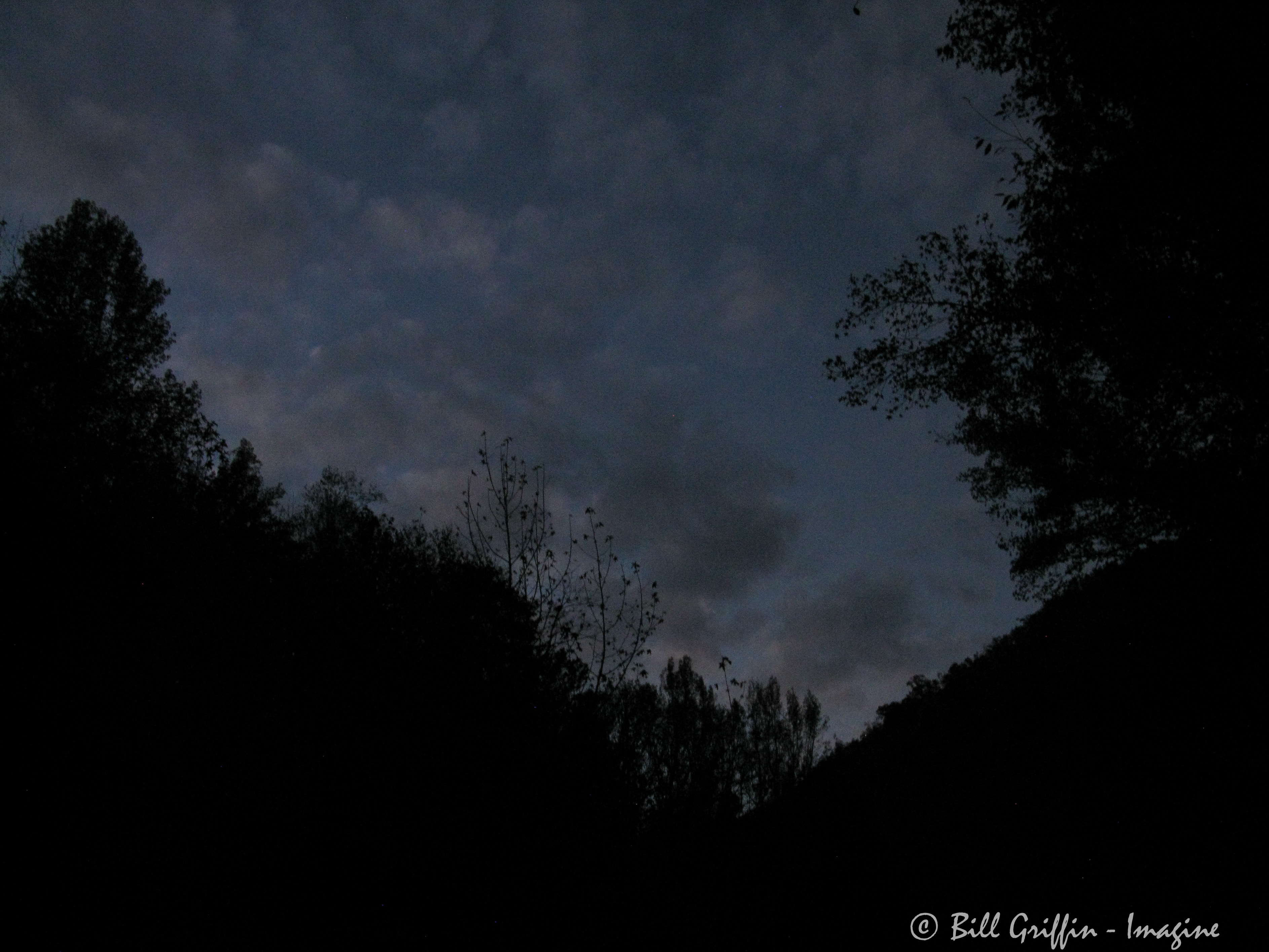
Night in the Forest
.
You hear every twig snap,
every leaf flutter, every
strange unknowable animal sound.
Looking, your eyes widen,
find bits of light to hold onto,
see shadows grow from shadows
separate in slightest breath of wind.
.
You smell animal musk,
taste it in the air,
feel the hair on your arms,
the back of your neck, rise
as you’re certain something
comes closer. Every sense
is filled to overflowing.
.
And yet, amidst the unease,
the urge to panic,
there is also in moments of stillness
a calm, a sense of peace,
of no obligation, no schedule to attend,
you only ever feel here
in the still, in the quiet, in the dark.
.
Scott Owens
.
I started this poem more than 20 years ago when I went camping a lot, usually alone. I was teaching middle school at the time, and when I left the house Friday mornings I would throw my backpack, camping pad, sleeping bag, lighter, flashlight, sawback knife, and a change of clothes into the back of my car. And when school let out, I headed to the mountains and hiked at least 3 miles into the woods before setting up “camp.” It could be scary out there alone, but it was also the closest thing to serenity I had ever felt. The duality of the experience is what kept me doing it again and again, so of course I tried to write about it. I was never satisfied with the end of the poem until 2 decades later when I used 3 consecutive prepositional phrases as the conclusion of a poem about burial, and intuitively this old, unfinished poem sprang back into my consciousness because I somehow knew that was how I wanted to conclude this one too. Fortunately, I’m very stubborn about throwing attempted poems away, and although it took me a while to find the last failed draft, I eventually did.
— Scott
.
✿
.
Unleashed
.
Lately, it’s like I can feel myself aging.
I arrive home and immediately
look for my slippers, slip on a sweater,
put my feet up, close my eyes.
I remember once in the last year
of his life I took my old dog Huck
for a walk in the park. After rain.
The soccer fields were flooded, glistening
with sunlight in shallow pools of water,
and the robins had gathered in huge flocks
to take advantage of rain worms coming up
everywhere. I let Huck off the leash
and for a moment memories of youth
flashed in his eyes once again and he ran
all over chasing the birds up first
in one spot and then in another.
He carried on for longer
than I had seen him run in years.
I hope somehow I know
when I am close to death
and I, too, can have
a last moment of memory like that.
Maybe climb a tree to the top,
round the bases at a ball field,
walk out with no destination
in mind, no concept of how far
I might go before turning back.
.
Scott Owens
.
Time in nature and time with poetry often achieve the same effects for me: renewal, catharsis, perspective, clarity. I tell my students the most important habit in writing, maybe in life, is paying attention. I teach them how to make it a habit: schedule it 7 days in a row; commit to it; follow through. If at the end of those 7 days you’re not consciously noticing more things. Do it another 7 days. Then I give them a few more pointed assignments to help broaden the habit. I tell them ask yourself every day, What am I doing right now? Write down your answer and everything else it makes you think of. I get a never-ending stream of poems beginning with interesting participial phrases. Lastly, I tell them pay attention to the stories you tell people, especially the ones you tell over and over again. If you want to tell the story, especially if you want to continue telling it, then clearly there is something interesting about it. Why haven’t you written it down yet? I usually try to listen to my own lessons, and one story I’ve told over and over is the story of Huck, at 15, chasing the robins. It always felt like such a poignant moment for me, but I only thought to write it down recently when a co-worker told me a story they had already told me before about how they feel “older,” and at the same time I was putting the finishing touches on a manuscript about aging.
— Scott
.
.
❀ ✿ ✾ ❁
.
Threads
.
Sometimes
I want to go back
.
to where the deer
don’t run in my presence,
.
and the frogs keep singing
as I stomp through the creek.
.
Back to where
closets are full
.
of shotguns-
locked and loaded,
.
and the old gas station
is run by a woman
who calls me baby
and takes the tax
off my bottles.
.
Where farmers
offer me cigarettes,
and even though
I don’t smoke,
I entertain the idea
over ramblings
.
about local roads
that stitch together
our kin —
.
threads so tightly knit,
all the heat stays in.
so those frogs
can’t stop singing,
and the deer have learned —
there’s nowhere to run.
.
Clint Bowman
from If Lost (Loblolly Press, Asheville, NC) 2024
selected by Jenny Bates
.
I have chosen to send the poem “Threads” by Black Mountain poet Clint Bowman not only because he is my friend but because he embodies in his words the simplest of truths as it can be towards the natural world. There is no teasing or fakery in his poetry and he is as honest as a walk in the woods with all its variance and subtle candor.
My own poem “Artifice Thoughts” is more whimsical but true!
— Jenny
.
✾
.
Artifice thoughts as I look out the window
see a Deer casually strolling by and I read
it my favorite childhood book
.
I think we envy animals of the wild
what do you say?
.
living by the dark of night the light
of day
pressing into the earth or winging above
they truly know how it works, my love
distilling every moment of time not by
clock or watch or phone line
but by the sky and trees and hollows
surrounding them, their home
they don’t seize up with rain or snow
an occasional sound is how they drop
in to dreams of warm days, cold nights
when swirling stars come out
you can hear them whispering as they
touch the ground
don’t close the gate, our entry point
only wait till the Moon is full.
.
Jenny Bates
.
Thank you for this opportunity Bill to help celebrate and educate on Earth Day 2026. – J
.
.
❀ ✿ ✾ ❁
.
Something Else
.
Suppose, one spring, the birds decided
not to fly north, and the animals
sleeping in the woods decided this year
they’d rather not wake, and turned over instead
for another dream.
.
Imagine one summer the butterflies decided
to stay in their cocoons, or the caterpillars forgot
to wrap themselves up inside themselves
and simply gorged themselves instead
until their season passed. One day the tide forgot to rise.
This is only one way of speaking for the world.
.
Suppose the spiders stopped weaving, mosquitoes
forgot how to suck our blood, bees
decided not to pollinate flowers.
Suppose the sea turtles never returned
to the beaches that bore them, to lay their moon-drawn eggs.
Or suppose for a moment the rivers held still
and the leaping salmon held still in mid-air.
.
Imagine fire stopped burning things to ash
although it still burned. It was no longer hot.
Of course that couldn’t happen. So think of something else.
.
Michael Hettich
.
from The Halo of Bees: New and Selected Poems, 1990-2022; Press 53, Winston-Salem NC (2023)
.
“Something Else” was first published in my 2010 book titled Like Happiness, and though sixteen years have passed since then, it seems to me, looking at the poem now, that the concerns that brought me to write the piece are, if anything, more urgent now than they were then. In asking us to imagine non-human animals and rhythms of nature deciding not to participate in the eternal rhythms of life—a kind of ultimate end-world scenario precipitated in response to human-wrought degradation—the poem (I hope) challenges our complacency. The two italicized lines attempt to articulate a perhaps extreme version of the kind of thinking we all do to deny our complicity. And I think the final line also intends a double reading: we can “think of something else” as a form of denial, or we can do so as a way of imagining a different sort of future.
— Michael
.

.
❀ ✿ ✾ ❁
.
Let us probe the silent places. Let us seek what luck betides us. There’s a whisper on the night-wind, there’s a star agleam too. And the Wild is calling, calling – let us go.
— Robert Service, Call of the Wild
.
We lose our souls if we lose the experience of the forest, the butterflies, the song of the birds, if we can’t see the stars at night.
— Thomas Berry
.
Thank you for celebrating the month of April with International Earth Day (April 22) and National Poetry Month. And thank you, Readers, who have shared poems that connect us to our planet and each other. We will continue posting EARTH POETRY throughout the month of April – and beyond April as well, of course, since EVERY DAY is EARTH DAY!
.
❁
.
Thank you for visiting Verse and Image: If you would like to receive an email each time a post appears, please SUBSCRIBE to Verse and Image using the button on the Home Page.
.
If you have a hard time finding the SUBSCRIBE button on this WordPress site, you can send me your email address and I will add you to the subscriber list. Send your request to
.
COMMENTS@GRIFFINPOETRY.COM
.
Thanks again for joining the conversation.
.
And thank you again and forever, Mike Barnett, for filling the cool deep well of nature quotations which will never ever run dry.
— Bill
.
❀ ✿ ✾ ❁
.

.


Always glad to hear from you, Brad. ---B