Feeds:
Posts
Comments

Posts Tagged ‘Black Nature’

[with poems from Black Nature]

The world of experience speaks the language of the Absolute. In that language, the language of the universe, all of the metaphors which spring offers must simply mean: LIVE!  – – – –  Marilyn Nelson

What makes Spring for you?

When I was a first year med student, every lecture paid homage to the History of Medicine (invariably capitalized). Even today when I read of the recent cholera epidemic in Haiti, I immediately remember Dr. John Snow, the father of modern epidemiology, who arrested the London cholera epidemic of 1854 by removing the handle from the Broad Street pump. When I progressed to the clinical wards at Duke, including Osler Ward, history continued its exposition on morning rounds with frequent pithy quotations by Sir William Osler, such as, “A physician who treats himself has a fool for a patient,” or, “It is astonishing with how little reading a doctor can practice medicine, but it is not astonishing how badly he may do it.”

One quotation baffled me a bit: “One swallow does not make a summer, but one crescent makes malaria.” I quickly learned to recognize the crescent, that minute malaria parasite living inside a red blood cell, and I spent hours at the microscope trying to find just one. But I had little experience of the natural world outside the lecture hall and the swallow part (Osler riffing on Aristotle, I learned later) made no sense. I was stuffing my head with the vocabulary of microbiology and immunology but never even heard of phenology (the study of periodic biological phenomena). The completion by swallows of their long northward migration each year defines the arrival of summer? Of that I had no clue.

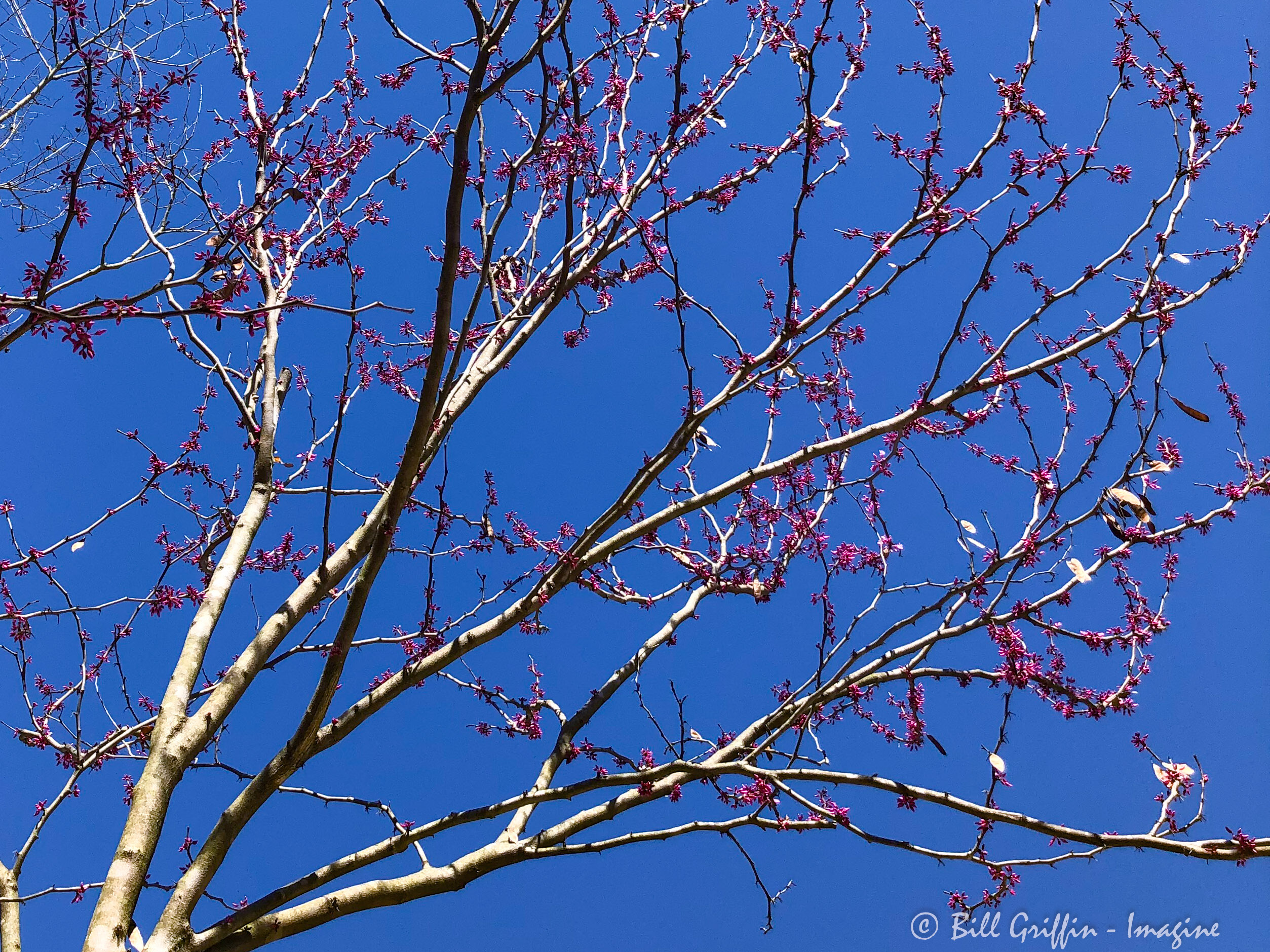
Indeed, one crocus does not make a spring. So what does make spring for you? There’s a stretch of I-40 between Winston-Salem and Kernersville where the surrounding woodland has been sheared back and sun percolates into deep shade. Over the years the native redbuds have leaned into that light. As gray February shuffles so languorously along step by step, a faint golden haze haloes the maples and deepens to peach and brick red. A willow here and there hints of green. It’s coming, it’s coming. Then suddenly, it seems within just days of each other, the redbuds pop their magenta bud covers into lush, rich, raspberry bloom. The solstice hasn’t yet arrived, but for me redbuds do make spring.

❦ ❦ ❦

Spring Dawn

There comes to my heart from regions remote
+++++ A wild desire for the hedge and the brush,
Whenever I hear the first wild note
+++++ Of the meadow lark and the hermit thrush.

The broken and upturned earth to the air,
+++++ By a million thrusting blades of Spring,
Sends out from the sod and everywhere
+++++ Its pungent aromas over everything.

Then it’s Oh, for the hills, the dawn, and the dew,
+++++ The breath of the fields and the silent lake,
And watching the wings of light burst through
+++++ The scarlet blush of the new daybreak.

It is then when the earth still nestles in sleep,
+++++ And the robes of light are scarce unfurled,
You can almost feel, in its mighty sweep
+++++ the onward rush and roll of the world.

George Marion McClellan
from Black Nature: Four Centuries of African American Nature Poetry, edited by Camille T. Dungy, © 2009 University of Georgia Press, Athens GA.
❦ ❦ ❦

This week I’ve been spending time with an anthology I’ve been reading off and on over the past year, Black Nature: Four Centuries of African American Nature Poetry, edited by Camille T. Dungy. Cycle Ten, the final section of the book, is titled Comes Always Spring. We have come through nine other cycles, including Dirt on Our Hands and Disasters, Natural and Other; we have been reminded What the Land Remembers; at last we are left with a hope of renewal. What can make Spring for us as a community, as a shared human family?

GEORGE MARION MCCLELLAN (1860-1934) was born in Tennessee and lived in Kentucky. A poet an minister, he attended Fisk University and Hartford Theological Seminary. He published Poems in 1895 and The Path of Dreams in 1916.

CLAUDIA RANKINE, born in Jamaica in 1963, earned her BA from Williams College and her MFA from Columbia University, and now lives and teaches in California. She is the author of four collections of poetry; Nothing in Nature is Private (1995) received the Cleveland State Poetry Prize.

CAMILLE T. DUNGY has received fellowships from the National Endowment for the Arts, the Virginia Commission for the Arts, the Dana Award, and Bread Loaf. She is Associate Professor of Creative Writing at San Francisco State University. Besides Black Nature, Dungy is also co-editor of From the Fishouse: An Anthology of Peoms That Sing, Rhyme, Resound, Syncopate, Alliterate, and Just Plain Sound Great.

[biographies adapted from the anthology]

❦ ❦ ❦

The Man. His Bowl. His Raspberries.

The bowl he starts with
is too large. It will never be filled.

Nonetheless, in the cool dawn,
reaching underneath the leaf, he frees
each raspberry from its stem
and white nipples remain suspended.

He is being gentle, so does not think
I must be gentle as he doubles back
through the plants
seeking what he might have missed.

At breakfast she will be pleased
to eat the raspberries and put her pleasure
to his lips.

Placing his fingers beneath a leaf
for one he had not seen, he does not idle.
He feels for the raspberry. Securing, pulling
gently, taking, he gets what he needs.

Claudia Rankine
from Black Nature: Four Centuries of African American Nature Poetry, edited by Camille T. Dungy, © 2009 University of Georgia Press, Athens GA.

❦ ❦ ❦

What to Eat, and What to Drink, and What to Leave for Poison

1
Only now, in spring, can the place be named:
tulip poplar, daffodil, crab apple,
dogwood, budding pink-green, white-green, yellow
on my knowing. All winter I was lost.
Fall, I found myself here, with no texture
my fingers know. Then, worse, the white longing
that downed us deep three months. No flower heat.
That was winter. But now, in spring, the buds
flock our trees. Ten million exquisite buds,
tiny and loud, flaring their petalled wings,
bellowing from ashen branches vibrant
keys, the chords of spring’s triumph: fisted heart,
dogwood; grail, poplar; wine spray, crab apple.
The song is drink, is color. Come. Now. Taste.

4
Down anyone’s street-bright invitations.
Suck ‘em. Swallow ‘em. Eat them whole. That’s right,
be greedy about it. The brightness calls
and you follow because you want to taste,
because you want to be welcomed inside
the code of that color: red for thirst; green
for hunger; pink a kiss; and white, stain me
now. Soil me with touching. Is that right?
No? That’s not, you say, what you meant. Not what
you meant at all? Pardon. Excuse me, please.
Your had was reaching, tugging at this shirt
of flowers and I thought, I guess I thought
you were hungry for something beautiful.
Come now. The brightness her might fill you up.

7
Daffodils are up, my God! What beauty
concerted down on us last night. And if
I sleep again, I’ll wake to a louder
blossoming, the symphony smashing down
hothouse walls, and into the world: music.
Something like the birds’ return, each morning’s
crescendo rising toward its brightest pitch,
colors unfurling, petals alluring.
the son, the color, the rising ecstasy
of spring. My God. This beauty. This, this
is what I’ve hoped for. All my life is here
in the unnamed core – dogwood, daffodil,
tulip poplar, crab apple, crape myrtle –
only now, in spring, can the place be named.

Camille T. Dungy
from Black Nature: Four Centuries of African American Nature Poetry, edited by Camille T. Dungy, © 2009 University of Georgia Press, Athens GA.

Mom looks at the Redbud

❦ ❦ ❦

And here’s one final epigram from Sir William Osler, dedicated to William J. Blackley MD, my Senior Resident for the first day I arrived on the ward as a green intern: “One finger in throat and one in the rectum makes a good diagnostician.”

More quotations by the master clinician Sir William Osler can be found here:
“The good physician treats the disease; the great physician treats the patient who has the disease.”

2016-05-08a Doughton Park Tree

Read Full Post »

[with poems from Black Nature]

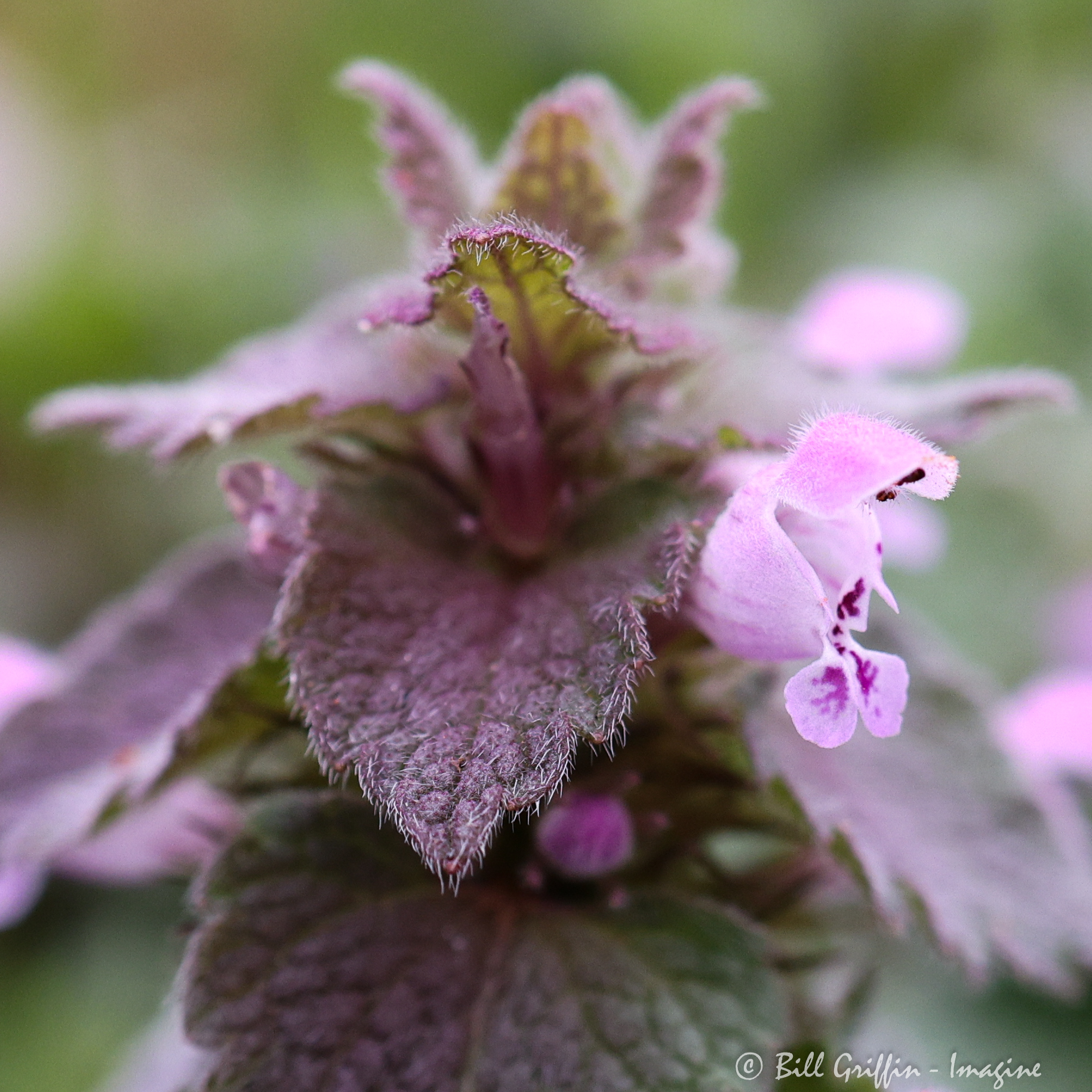
Spring is the blinding chartreuse of winter wheat twelve inches high with last year’s corn stubble poking through. Spring is pocks of yellow narcissus in the woods where a settler’s cabin once stood. And Spring is a deepening lilac blanket that seeps across fallow fields like a flood tide blooming – what is that?

Henbit, Deadnettle, and Creeping Charlie, that’s what. As the earliest spring ephemerals are cautiously blooming in the leafless forest, out in broad sun these three are turning the earth extravagant purple. Driving country roads, I’ve often wondered why fields become so colorful before visited by the plow, and when starting out on nature trails to find the real wildflowers, I’ve casually noticed bright pink and magenta sequins in the hardpack around the parking lot but never scrunched down to look.

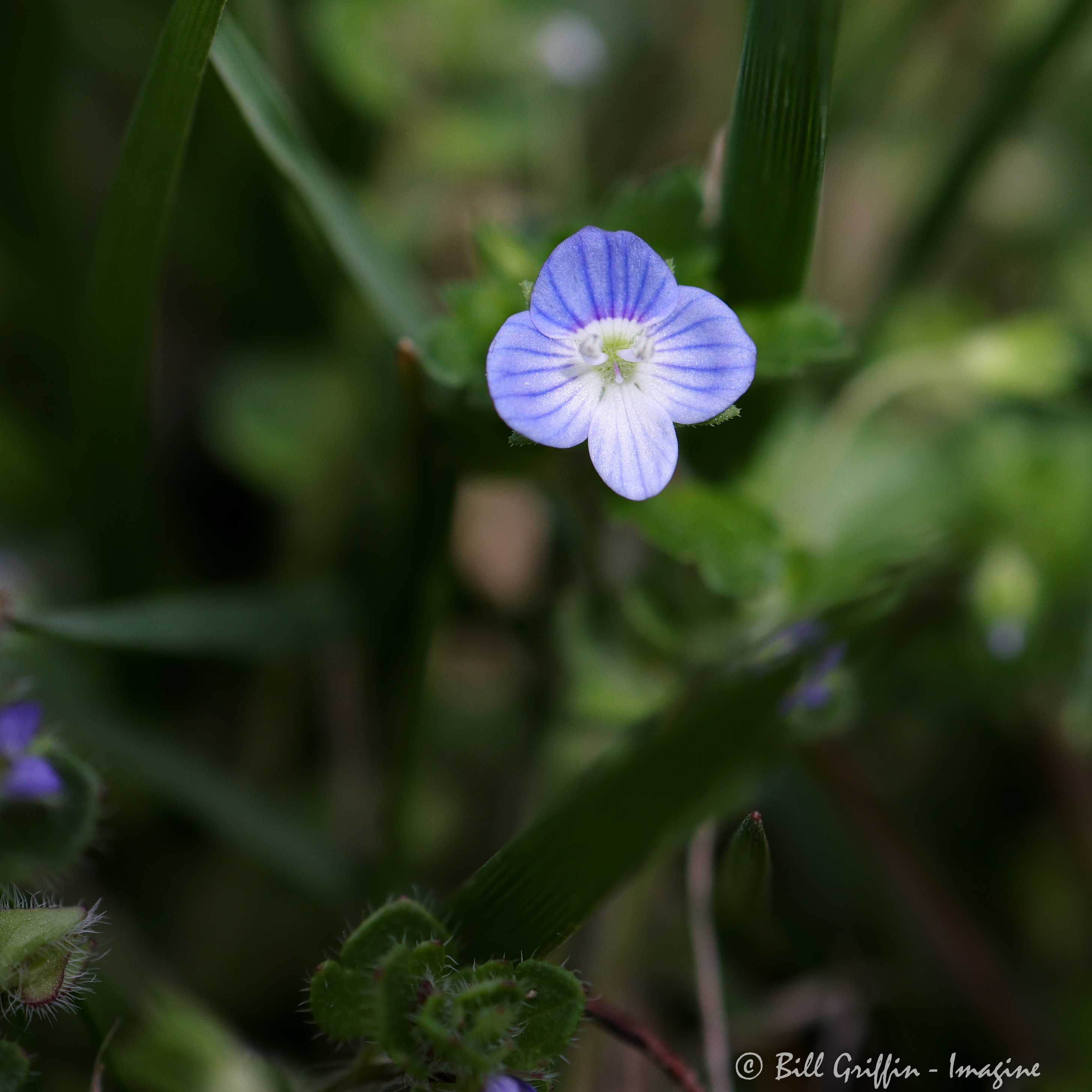
And for the most part not many want to get to know these three members of the mint family, Lamiaceae. They’re weeds, for goodness sake, and introduced non-natives: Henbit from Europe, Deadnettle from the Mediterranean to Western Siberia, Charlie from almost everywhere in temperate Eurasia. But check out those little flowers, even though they’re smaller than the nail on your pinky: typical Mint with five petals partially fused, a long tube and hood on Henbit, broader lower lips on the other two. Streaked and spotted, really pretty if you kneel, even better with a magnifier. I plucked a sprig of Henbit for Linda and she kept it in water in a bottle cap in the kitchen for a week.

You’ve notice Creeping Charlie, also called Creeping Jenny, when you’ve strolled a neglected lawn and smelled spice from the crushed leaves. Deadnettle and Henbit don’t have the typical mint aroma but all three are edible, raw or stewed, and were probably brought here intentionally by early settlers. Before the discovery of hops, Creeping Charlie was used to brew ale, for flavor and clarity. Which causes me to ponder what these little mints are called – does one accrue more names the farther one wanders from one’s roots? Creeping Charlie especially – known as Alehoffs, Cat’s Foot, Field Balm, Gill-over-the-hill, Ground-ivy, Hay Maids, Runaway Robin (and there are at least three other totally unrelated plant species that go by the moniker Creeping Charlie).

Gotta go now – in a few minutes it’ll be too dark to go out front beside the road and pick my salad.

❦ ❦ ❦

Can’t leave out their secret true names:
Lamia amplexicaule
Lamia purpurea
Glechoma hederacea

❦ ❦ ❦

Locus

for Ralph

Here redbuds like momentary trees
+++++ of an illusionist;
here Cherokee rose, acacia, and mimosa;
here magnolias – totemic flowers
+++++ wreathing legends of this place.
Here violent metamorphosis,
+++++ with every blossom turning
deadly and memorial soldiers,
their sabres drawn, charging
+++++ firewood shacks,
apartheid streets. Here wound-red earth
+++++ and blinding cottonfields,
rock hills where sachems counseled,
where scouts gazed stealthily
+++++ upon the glittering death march
of De Soto through Indian wilderness.
+++++ Here mockingbird and
cottonmouth, fury of rivers.
Here swamp and trace and bayou
+++++ where the runagate hid,
the devil with Spanish pistols rode.
+++++ Here spareness, rankness harsh
brilliances; beauty of what’s hardbitten,
knotted, stinted, flourishing
+++++ in despite, on thorny meagerness
thriving, twisting into grace.
+++++ Here symbol houses
where the brutal dream lives out its lengthy
dying. Here the past, adored and
+++++ unforgiven. Here the past –
soulscape, Old Testament battleground
of warring shards whose weapons kill.

Robert Hayden
from Black Nature: Four Centuries of African American Nature Poetry, edited by Camille T. Dungy, © 2009 University of Georgia Press, Athens GA.

❦ ❦ ❦

This week I’ve been spending time with an anthology I’ve been reading off and on over the past year, Black Nature: Four Centuries of African American Nature Poetry, edited by Camille T. Dungy. The poems are arresting and transporting. I’m drawn to them for the nature, and for the black nature. Many of the poems evoke a deep, heartfelt connection to this earth, and many of them speak in voices and share messages I haven’t found in other nature poetry anthologies. Or haven’t found in quite the same tone. Always more to learn, imagination always expanding, life always becoming larger.

ROBERT HAYDEN (1913-1980) published his first collection of poems, Heart-Shape in the Dust, in 1940. He received the grand prize for poetry at the First World Festival of Negro Arts in Dakar, Senega, in 1966 for Ballad of Remembrance. Hayden was appointed as Consultant in Poetry to the Library of Congress in 1976, the first African American to hold the position.

FRANK X WALKER, born in 1961 in Danville, KY, is a founding member of the Affrilachian Poets and a recipient of the 2005 Lannan Literary Poetry Fellowship. He has authored four poetry collections and edited two poetry anthologies, and serves as the editor of Pluck! Journal of Affrilachian Art and Culture.

LUCILLE CLIFTON (b. 1936) has published thirteen books of poetry, a memoir, and more than sixteen books for children. Her honors include the 2001 National Book Award, an Emmy Award, a Lannan Literary Award, and the 2007 Ruth Lilly Prize, among many other awards and honors. In 1999 she was elected a Chancellor of the Academy of American Poets and she has served as Poet Laureate for the State of Maryland.

[biographies adapted from the anthology]

❦ ❦ ❦

Wind Talker

+++ Ocian in view! O! the joy.
+++ William Clark

If I could make my words
dress they naked selves in blackberry juice
lay down on a piece a bark, sheep
or onion skin, like Massa do

If I could send a letter home to my wife
gloat it in the wind, on wings or water

I’d tell her ‘bout Katonka
an all the wide and high places
this side a the big river.
How his family, numbering three
for every star in the sky
look like a forest when they graze together
turn into the muddy M’soura
when the thunder along, faster than any horse
making the grass lay down
long after the quiet has returned.
How they don’t so much as raise a tail
when I come ‘round with my wooly head
and tobacco skin, like I’m one a them
making the Arikar and Mandan think me
“Big Medicine”
Katonka, who walks like a man.

Today we stood on the edge a all this
looked out at so much water
the mountains we crossed to get here
seem a little smaller.

As I watch fish the size a cabins dance in the air
and splash back in the water like children playing
I think ‘bout her an if we gone ever be free
then I close my eyes and pray
that I don’t live long enough
to see Massa make this ugly too.

Frank X Walker
from Black Nature: Four Centuries of African American Nature Poetry, edited by Camille T. Dungy, © 2009 University of Georgia Press, Athens GA.

❦ ❦ ❦

mulberry fields

They thought the field was wasting
and so they gathered the marker rocks and stones and
piled them into a barn +++ they say that the rocks were shaped
some of them scratched with triangles and other forms +++ they
must have been trying to invent some new language they say
the rocks went to build that wall there guarding the manor and
some few were used for the state house
crops refused to grow
I say the stones marked an old tongue and it was called eternity
and pointed toward the river +++ I say that after that collection
no pillow in the big house dreamed +++ I say that somewhere under
here moulders one called alice whose great grandson is old now
too and refuses to talk about slavery +++ I say that at the
masters table only one plate is set for supper +++ I say no seed
can flourish on this ground once planted then forsaken +++ wild
berries warm a field of bones
bloom how you must I say

Lucille Clifton
from Black Nature: Four Centuries of African American Nature Poetry, edited by Camille T. Dungy, © 2009 University of Georgia Press, Athens GA.

❦ ❦ ❦

2016-10-17a Doughton Park Tree

Read Full Post »

[with poems by Carl Phillips, Janice Harrington, Ross Gay]

Green is God’s best idea.

Yesterday afternoon Linda and I drove up the Blue Ridge Parkway for a hike at Doughton Park. Crossing Air Bellows Gap (elevation 1,135 m / 3,724 ft) we noticed the new leaves still flashed mint, gold, orange, pink, some foreshadowing their autumn hues. Once we’d climbed up to the overlook at Bluff Mountain, though, we saw the hardwoods down in Basin Cove fully decked in rich deep emerald and kelly, gradations of green from full summer in the bottoms to pale spring at ridgecrest. Which is all just to say: Go, little Chloroplasts, Go!

The first chloroplast was born about 2 billion years ago when an ancient cell engulfed an ancient cyanobacterium. And then didn’t digest it! The cyanobacterium became a tiny green internal organelle and its chlorophyll turned sunlight into sugar for the big cell; the big cell provided a safe home for the cb. They became first plant cell – a match made in heaven! In another mere billion years or so of reproducing like mad (and cranking out oxygen as a waste product), the earth’s atmosphere changed from having zero oxygen to having oxygen enough to support the development of the first animals. Of which you and I, of course, are two. Thank you, Green!

Postscript re: good ideas and all – Linda and I had parked beneath an oak tree. When we’d finished our five miles (including detour around a herd of steers that grazes on NPS land to keep the balds bald) I opened the car door and raised a visible cloud. Swelling eyes, paroxysms of coughing, nose gusher: oak tree in flower = pollen.

To make a seed you need an ovum and pollen. Every green thing that doesn’t make seeds makes spores instead and is a fern (well, OK, or moss, or liverwort, or lichen, or . . . ). Spores work pretty well but about 400 million years ago the gymnosperms appeared (conifers, ginkgo) and brought with them the first pollen, and when plants became smart enough to make flowers about 135 million years ago (angiosperms) the variety of living things on earth really skyrocketed. Go, Flowers, Go! So if you’ll hand me a tissue, God, I’ll grudge you this: pollen might be your second best idea.

❦ ❦ ❦

The Cure

The tree stood dying – dying slowly, in the ususal manner
of trees, slowly, but now without its clusters of spring leaves
taking shape again, already. The limbs that held them tossed,

shifted, the light fell as it does, through them, though it
sometimes looked as if the light were being shaken, as if
by the branches – the light, like leaves, had it been autumn,

scattering down: singly, in fistfuls. Nothing about it to do
with happiness, or glamour. Not sadness either. That much
I could see, finally. I could see, and want to see. The tree

was itself, its branches were branches, shaking, they shook
in the wind like possibility, like impatient escorts bored with
their own restlessness, like hooves in the wake of desire, in

the wake of the dream of it, and like the branches they were.
A sound in the branches like that of luck when it turns, or is
luck itself a fixed thing, around which I myself turn or don’t,

I remember asking – meaning to ask. Where had I been, for
what felt like forever? Where was I? The tree was itself, and
dying; it resembled, with each scattering of light, all the more

persuasively the kind of argument that can at last let go of them,
all the lovely-enough particulars that, for a time, adorned it:
force is force. The tree was itself. The light fell here and there,

through it. Like history. No – history doesn’t fall, we fall
through history, the tree is history, I remember thinking, trying
not to think it, as I lay exhausted down in its crippled shadow.

Carl Phillips

❦ ❦ ❦

Today’s selected poems are from Black Nature: Four Centuries of African American Nature Poetry, edited by Camille T. Dungy, © 2009 University of Georgia Press, Athens GA.

Carl Phillips is the author of nine books of poetry, most recently Quiver of Arrows: Selected Poems 1986-2006 and Riding Westward. A Chancellor of the Academy of American Poets, he teaches at Washington University in St. Louis.

Janice Harrington (b. 1956) grew up in Alabama and Nebraska. After working as a public librarian and as a professional storyteller, Harrington now teaches in the creative writing program at the University of Illinois at Urbana-Champaign. She has also written award-winning children’s books.

Ross Gay was born in 1974 in Youngstown, Ohio. He is a Cave Canem Fellow and a recipient of a grant from the Pennsylvania Council of the Arts. He teaches poetry at Indiana University in Bloomington and gives readings and workshops in various venues across the country.

❦ ❦ ❦

What There Was

Pine, catalpa, pin oak, persimmon,
but not tree.

Hummingbird, hoot owl, martin, crow,
but not bird

Cannas, honeysuckle, cockscomb, rose,
but not flower.

Wood smoke, corn, dust, outhouse,
but not stench.

A spider spinning in a rain barrel,
the silver dipper by the back porch,
tadpoles shimmying against a concrete bank,
but not silence.

A cotton row, a bucket lowered into a well,
a red dirt road, a winging crow,
but not distance.

A rooster crowing in the evening,
wasps humming beneath the eaves, hounds
baying, hot grease, but not music.

My mother running away at fifteen,
my grandmother lifting a truck to save a life,
an uncle at Pearly Harbor, Webster sitting
at the back of the bus when he looked as white
as they did, but not stories.

The entrails of a slaughtered sow, the child born
with a goat’s face, the cousin laid on a railroad
track, the fire that burned it all, but not death.

This poem, a snuff tin sated with the hair
of all our dead, my mother’s nighttime talks
with her dead father, my great-grandmother’s
clothes passed down, passed down, but not memory.

Janice N. Harrington

❦ ❦ ❦

Thank You

If you find yourself half naked
and barefoot in the frosty grass, hearing,
again, the earth’s great, sonorous moan that says
you are the air of the now and gone, that says
all you love will turn to dust,
and will meet you there, do not
raise your fist. Do not raise
your small voice against it. And do not
take cover. Instead, curl your toes
into the grass, watch the cloud
ascending from your lips. Walk
through the garden’s dormant splendor.
Say only, thank you.
Thank you.

Ross Gay


❦ ❦ ❦


Doughton Park Tree, 2022-05-17A


Read Full Post »

Older Posts »