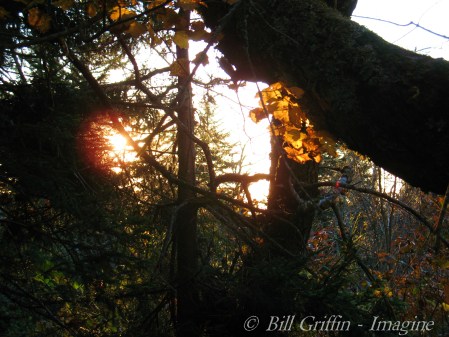
[with 3 poems by Tony Abbott]
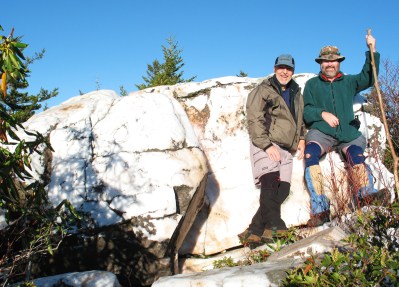
Mike and I met at a remote trailhead below Mt. Pisgah to hike up into Shining Rock Wilderness. We planned to spend one night at our favorite site after reaching it by this unfamiliar approach. End of September, gorgeous reds and golds, brittle blue sky, and we were prepared for cold above 5,000 feet.
No camp fires permitted in a Wilderness Area. We made tea over a little alcohol stove, sat on the ground, and talked until it grew too dark to see. The ultralight 2-person tent Mike had packed was cozy, which is to say it was more like a 1 ½-person tent. We’d be keeping each other warm.
I woke up after midnight in dense darkness and couldn’t breathe. Got out of the tent, pulled on my balaclava, walked away to pee, sat on a log – deep silence, no owl hoot, no chitter of flying squirrels, not one breath of wind. When my butt started to freeze I tried squeezing back into my mummy bag. No good. My chest tightened, the thick black pushed down on my face, I had to claw its hand away. Worst claustrophobia ever.
I finally dragged my sleeping pad and bag out to a level space in the pine needles, wrapped a jacket around my feet, and hunkered in just as the moon rose through the red spruce. Cold light expanded my lungs. At some point, hours creeping, moon in my eyes, I fell asleep. Mike woke me at first sun.
. . . . . .
What can bring light into darkness? What hand comforts the clench of fear? What consoling faith casts away doubt? What companion banishes loneliness?
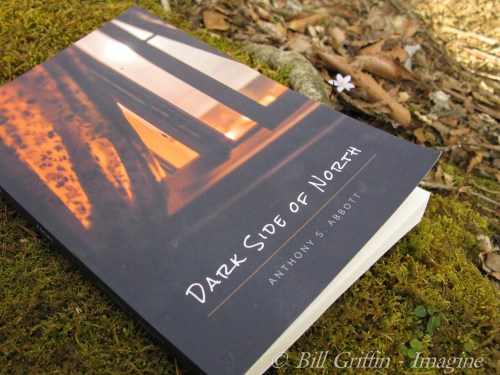
The forward to Anthony S. Abbott’s book Dark Side of North, published posthumously by Press 53 this year, consists of a remembrance presented by Dr. Jacqueline Bussie at Tony’s memorial service on October 17, 2020. Here is an excerpt:
Suffering didn’t make Tony unique. What he did with it did. Tony was the first adult, and the first teacher, I’d ever met in life who was willing to talk about the hard stuff. He taught us that suffering sucks. That suffering denied is suffering unhealed. He taught us to never sugarcoat suffering, smack a pink bow on it, or shove it to the back of the drawer. In one of my favorite lines in Tony’s poetry, he urges us to get down to “the Humpty-Dumpty business of trying to make a jewel out of the cracked pieces of the heart.”
Dr. Jacqueline Bussie, page xiv, Dark Side of North

. . . . . .
The Boy from Somewhere Else
lived in the open mouth of the world.
He chewed on the dry branches of time.
He was handsome enough, to be sure,
but there was in his voice
the deep well of absence.
He was with them, but not of them.
His speech was familiar, but not theirs,
and when he told tales
of his drunken uncles and stage-struck
sisters, they nodded politely
and they spoke in their apple-round voices
of kith and kin, and told how their
grandfathers had founded the first
bank in Hitchcock County.
He would wait, this boy.
He would find one day the person
who could hear his music
as blood red leaves matched autumn.
He could not be mistaken about this.
When she came, he would recognize her
at once – as one knows the coming storm
by the first, distant clap of thunder.
Perhaps he could not keep her.
Perhaps one can never keep such a gift.
But, still, she would grace his years – the buds
of his growing up, the rattling trains of the
middle passage, the brittle bones of the slow
descent, the icy nights of the final coming down.
from Dark Side of North, Anthony S. Abbott, Press 53, Winston-Salem NC, © 2021 by the estate of Anthony S. Abbott
. . . . . .
The Light in the Window
In memory of Nancy Abbott Hieronymus (1926-2017)
How early I must have known that she was
my true mother, that when she packed her bag
I must go with her. She would keep me safe.
How early I must have known that she was
my true teacher, making the sounds of the words
with her mouth so I could learn them, too.
How early I must have known that she was
my true protector, throwing herself across me
slashing her knee on the broken windshield glass.
Later, when I was nearly grown, cocky sophomore
in prep school, riding the subway home at 2 a.m.,
she left a light in the window on that I
would turn out when I came in. I didn’t know
she stayed awake until she heard the door open
and close, heard the click of the light going off.
Now I sit by her bed and watch her sleep and wake,
sleep and wake, and tell me how she loves
her precious Dick, how she will hold his hand
all the way to heaven. Beyond the light in her window
the evening comes over the island, the deer prick up
their ears, the foxes peek from their dens. In the pines
the gold crowned kinglet waits. She is coming, they say,
our friend is coming, the one who loved us all these years.
Tonight I will go home, and the friends who loved her so
will arrive, one by one, to take her in their arms,
and the next night the angel will stand at the foot
of her bed. You are loved, he will say, and enfold her
with his bright wings. And she will go where that brightness
is and, like a light in the window, shine upon us all.
from Dark Side of North, Anthony S. Abbott, Press 53, Winston-Salem NC, © 2021 by the estate of Anthony S. Abbott

. . . . . .
The Long Afternoon
All through the long afternoon
the wind moved in the branches.
I had lived in the city and had seen
only the dust from the tires,
the diesel gas from the gray brown
buses with their leaden burdens.
Here it was different. Here on the grass
we had found by chance, walking
away, just away from everything
and then, a clearing and green
grass and the wind moving
like silver over the water
and in the branches, too. Yes,
all through the long afternoon
the wind moved and we were silent
in awe of the day and leaves
yellow and red and orange,
which floated slowly down
into our waiting hands.
aaaaaaaaaaaaaaaaa Later
I found these leaves in a book
where you had put them for
safe keeping, a book you knew
I would take down and read
some distant starry night.
from Dark Side of North, Anthony S. Abbott, Press 53, Winston-Salem NC, © 2021 by the estate of Anthony S. Abbott
. . . . . .
Thank you, Tony. We will continue trying, and we will not stop trying, to make something beautiful from the brokenness that we are. Together. May it be and become so.
. . . . . .
The North Carolina Poetry Society has honored Anthony S. Abbott’s memory and shared Tony’s poetry at its January, 2021 literary meeting and with a commemoration in the Winter, 2021 edition of its quarterly publication, Pine Whispers.
The line “the Humpty-Dumpty business of trying to make a jewel out of the cracked pieces of the heart.” is from Tony’s poem Before Forty in his book The Girl in the Yellow Raincoat (St. Andrews Press, 1989) and collected in New & Selected Poems (Lorimer Press, 2009).
. . . . . .

. . . . . .


 V E R S E and I M A G E
Very true. And not that she ignores the grief and woe of living but somehow makes all of life a…