Feeds:
Posts
Comments

Archive for the ‘Imagery’ Category

[2 poems by Lucinda Trew]
if you wish to grow a garden, first seed
your soul with sadness
 . 
for it helps to have an ache, a molecule
of sorrow that will swell, release and drench
the patch of earth you claim
 . 
like a weather plane sowing stingy clouds
with silver beads of iodide, lush promise of rain
something withheld – a slip of rue, s spore
of woe to bury – a slender sprig of remembering
your shallow place in all of this
 . 
a cloister of green where secrets are safe
where worm and peat, centipede and muddy
trowel will carry melancholy to the seedling
graves you dig
 . 
for a garden is forgiving – a copse confessional
a place for penance – pulling weeds, snapping
roots, kneeling in dirt
 . 
and tending, gently tending, to fragile shoot
breaching bud, those in need of holding up
and the healing grace of fresh tilled ground.
 . 
 . 
when trees fall
 . 
from natural cause – nor’easter, drought
decrepitude – they lean in, one upon another
++++ a prayer of knotty hands
 . 
we pray, too, in other ways, holding one another
close in crook and crutch of branch, and nests
++++ for those in need of cradling
 . 
we unfist fingers, unwind clocks, hold one another
in a basketweave of leaf and twig and comforting
++++ like trees, we slant
 . 
against wind and time, hearts and boughs that break
from storm and thorn and toppled crowns
++++ we ease one another
 . 
to ground, to the resting place of forest floor
to beds of moss and tender mercies yielding to ash
++++ as we all fall down
 . 
Lucinda Trew
from What Falls to Ground, Charlotte Lit Press, Charlotte, NC; © 2025
++++
IMG_9468
 . 
♦   ♦   ♦   ♦   ♦
 . 
I love these poems for their compassion in the deep sense of that word, “suffering together.” In reading these lines I am able to pause and slant against the wind of my own doubt and daily struggles. Lucinda writes, “a poem is a bone / in the graveyard of remembering.” In memory I visit the bones of loss and pain but also the roots and seeds of what may again grow into joy. In the music of Lucinda’s words and phrases, the myth and earthy origins her poems suggest, the impermanence of all things resting the midst of rising sun and growing plant – in these I rediscover hope. Yes, we all fall to ground. Yes, we may ease each other as we fall.
 . 
 . 
Lucinda Trew lives and writes in the red clay piedmont of North Carolina, USA. What Falls to Ground is her debut collection and is available from Charlotte Center for the Literary Arts.
 . 
Additional poetry by Lucinda Trew at VERSE and IMAGE:
 . 
 . 
IMG_1948
 . 
 . 

Saturday’s Submission – Once a week on Saturday I feature one or two poems sent to me by readers. If you would like to consider having your poem appear, please see the GUIDELINES here:

About


Read Full Post »

 . 
[with poems by Janis Harrington]
 . 
Suicidal Ideation
 . 
Think of dark starlings, each a ringleader,
invading your hanging backyard feeder.
Magnets for their kind, they muster, rout
more timid species from seed and suit.
Fast and fertile breeders, they multiply,
a flock of hundred swells to thousands.
Screeching and squawking rapacious hoodlums,
they give no quarter and sing no harmony,
waging war with incessant cacophony.
No calm, no détente; nonstop attack.
In waves, like bombers, they dive and peck.
Wing to wing, they block sun, moon, stars, finally
 . 
blot out all light, transforming noon to midnight.
No escape. a full eclipse of hope.
 . 
Janis Harrington
from How to Cut a Woman in Half, Able Muse Press, San Jose CA; © 2022
 . 
❦ ❦ ❦
 . 
Life is a dream. / You are the projector. You are the screen.
 . 
Dad is sitting at the new table beside the front window. The sun has settled; the ocean is pink and purple, at rest. Someone has helped Dad transfer into an upholstered chair and pushed his wheelchair into a corner. He is talking with his youngest grandchild while they work a puzzle. Everyone has arrived. Everyone surrounds him.
 . 
This is the image I create and cultivate after hanging up the phone. Bob has called to assure me that their eight-hour drive to the coast presented only surmountable obstacles. Now they’ll spend a week at the beach house celebrating Dad’s 99th birthday. Dad has been longing to be there for a year. He started asking me how soon he could go even before Mom’s memorial service last September.
 . 
Last night Linda and I argued about a related family wrangle. She was angry at the person sharpening their claws. I told her it was bedtime and I was determined to put conflict out of my mind for eight hours. Let dreams sort it. Of course, I then woke at 3:00 and ruminated for an hour or two. Isn’t this supposed to be the week of no worries, Dad safe in the arms of my brother and his family? After a year of all manner of arrangements, finagles, and complications, after each nurse’s phone call and the anticipation of the next one, aren’t I allowed to flip the ON switch for peace?
 . 
What the hell does that even mean, I am the screen and the projector? That I alone make my life what it is? Or that I imagine I do? In dreams the tangle of images and juxtapositions is supposedly the effort by my unconscious to shuffle into some semblance of meaning all my disparate and disconnected moments. Perhaps Dad won’t scuffle out of an unfamiliar bed after midnight and break his hip. Perhaps the worst is not always just about to happen. Scientists have discovered through meticulous testing and observation that there are indeed other species besides Homo sapiens that can imagine and anticipate the future. God help them.
 . 
 . 
❦ ❦ ❦
 . 
How to Cut a Woman in Half
 . 
Fate, a cruel magician, vanishes her husband,
leaving her table with half as many plates,
shower rack missing half its towels,
bed half empty. The trick: after the blade falls,
she shrinks herself into half of her former life.
But is he truly absent? She wills
each day’s crawling hours to end, certain
he waits in sleep’s tempting garden –
there’s no hope of persuading her
that dreams are merely pan’s sleight of hand.
Eventually, she will emerge on stage,
appearing unharmed, performance complete.
Does it matter what is real or illusion if,
when she steps from grief’s box, she feels whole?
 . 
Janis Harrington
from How to Cut a Woman in Half, Able Muse Press, San Jose CA; © 2022
 . 
❦ ❦ ❦
 . 
Solo
 . 
The Buddhist acupuncturist, gazing beyond
the veil, report that Nick at last, has shed
earth’s weight. His soul, presently in the astral state,
has embraced its destiny – like the wayward
gray whale, whose biological mandate
to migrate finally required
his recent swim from bay to open ocean.
 . 
Annie’s turn, now, to exit sorrow’s cul-de-sac,
navigate rocky channels to new seas,
resisting the sirens’ call of what used to be,
accepting she and Nick must make solo passages:
his voyage, to collective consciousness,
without form or visible home;
hers, to find a port in life’s physical realm.
 . 
Janis Harrington
from How to Cut a Woman in Half, Able Muse Press, San Jose CA; © 2022
 . 
 . 
❦ ❦ ❦
 . 
This sonnet sequence by Janis Harrington is mournful, painful, piercing. It reveals every face of suffering but also every facet needed for healing. How to cut a woman in half? Divide her from the person she loves most dearly. Dissect away with blunt shears half of her being, her essence. How to put her back together? That is a long and painful process and no certain sunrise on the horizon, although a sister is required and is present. I treasure the metaphor nearing the book’s final pages: Together, we flew close to grief’s center, / our wings sturdier than wax and feather.
 . 
How to Cut a Woman in Half was finalist for the 2020 Able Muse Book Award and is available HERE. Janis Harrington’s first book, Waiting for the Hurricane (St. Andrews University Press © 2017) won the Lena M. Shull Book Award of the North Carolina Poetry Society. Discover more about Janis HERE.
 . 
❦ ❦ ❦
 . 
Acroyoga
 . 
Flex your trust muscle, the instructor advises,
making us giggle. Annie and I alternate
as flyer or base, each of us able
to bear a sister’s weight. Now, my back on the mat,
our hands clasped, my feet supporting her thighs,
I straighten my legs to ninety degrees –
my turn to hold her aloft. Acrobat of strength
and grace, she soars, escaping sorrow’s labyrinth.
Her liberty has freed me. Being her spotter,
daily witness to her reckoning with loss,
released my heart’s stubborn resistance
to Pete’s fate, long mourning of his absence.
Together, we flew close to grief’s center,
our wings sturdier than wax and feather.
 . 
Janis Harrington
from How to Cut a Woman in Half, Able Muse Press, San Jose CA; © 2022
 . 
❦ ❦ ❦
 . 
 . 
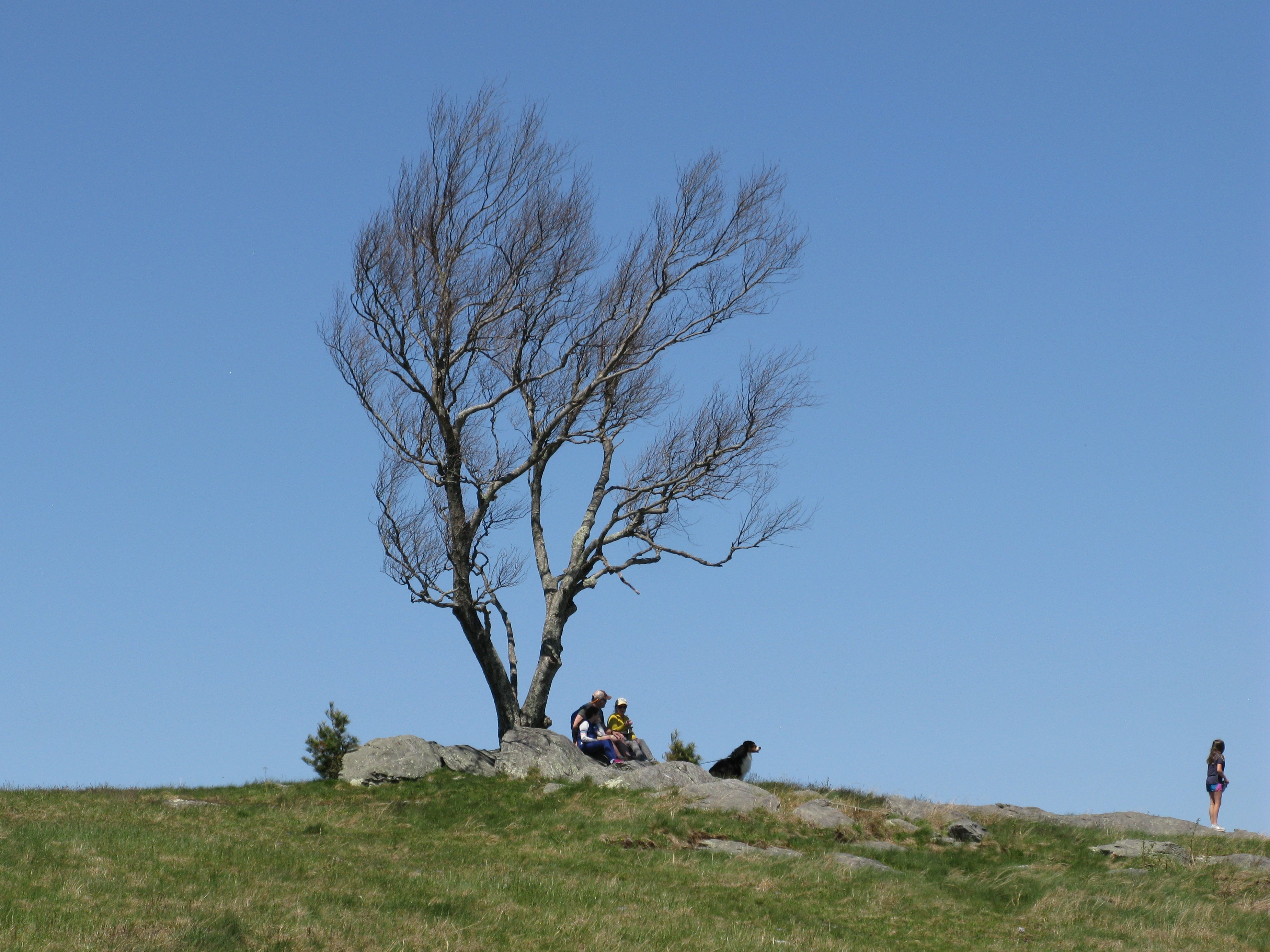
2020-09-08b Doughton Park Tree
 . 

Read Full Post »

 . 
[with 2 poems by Catherine Carter]
 . 
Crow cosmogony
 . 
The day we made the world, scattered
shattered sand across the deep
steeps and hollows of the sea,
we were playing with chance,
a stance few other gods admired.
We retired then from creation and let things
sing as they would, go
to whatever end luck called good.
We could, and did, breath in a platypus here,
a shearwater there – evolution
our solution to dogma and fate,
the weight of always being in charge
of stars, shoals, plague, all that –
but by and large, we let go, let
sweat and thought fall away,
stray like questing possums
or blossoms of blown snow.
So it was. We didn’t worry how
our sowing would grow. We went back
to hacking with our thick
black bills at death and waste, harrying
carrion, even as the dead
bled ever more numerous over the new
true-straight roads, here
where we shaped the bright turns
and returns of the world, invited
night in: do that, and you get
what you get. Despised
as flies, we pick through pale grass
for carcasses gone flat and dry;
we rise under your very wheels
from meals scant and cold, bring
strings of gut back to our young. But so
goes the world, when you let it go,
throw yourself in its rolling motion, chance
chance: we live on broken squirrels
in the world we made this way.
 . 
Catherine Carter
from By Stone and Needle, Louisiana State University Press, Baton Rouge LA; © 2025; winner of the L. E. Phillabaum Poetry Award for 2025
 . 
 . 
❦ ❦ ❦
 . 
The postmark is 03-09-97. Linda found the torn envelope, letter inside, at the bottom of a box of mementos she’s still sorting from her parents’ home after their deaths over a decade ago. Dear Dad . . . It’s me writing to my father-in-law, the nuclear physicist. I’ve got an idea for a new story and I need your help. Dad French and I would sometimes share first drafts with each other, his hard science fiction that could use a cool breath or two of metaphor, my airy prose in desperate need of some fact checking. So here’s my pitch:
 . 
Imagine a craft traveling to Proxima Centauri, 4.25 light-years away. It’s under a constant acceleration of 2G for the first half of the voyage, then 2G deceleration for the second half. What would be its peak velocity at the mid-point? And how much time will pass for the voyagers relative to earth time? 
 . 
Relative is the operative word. Dad French was an Einsteinian guru. His favorite Saturday afternoon pastime was to lean back on the couch with a big yellow legal pad and work through the equations of Special Relativity. He felt that he had identified a flaw and was determined to elucidate (from the Latin, “bring it into the light”). The most I could understand from his explanations of time dilation is that any object, whether charged particle or self-aware being, as it approaches the speed of light experiences a slowdown in the passage of time. To me on that spaceship there’s no difference in the ticking of my clock, but if my buddy back on earth could listen in he’d hear an expanding silence between each tick and the next.
 . 
But big deal. Who hasn’t felt time speed up or slow down in certain situations? Man, last week was so busy it just flew by.  – or – I feel like I’ve been sitting in this waiting room for a week. We human beings are just rubbish at time. If you asked that charged particle, it would know to the femtosecond how long since it got spat out of the cyclotron. My perception of time, though, is all tangled with context and saturated with subconscious. Don’t even ask me how long I’ve been sitting here at this keyboard, much less whether a certain something happened five years ago or ten.
 . 
Which is why, when I wake up in the dark, I avoid looking at the clock. If I should still happen to be lying there with my brain in fifth gear when light begins to seep around the shades, when any hope of re-entry into the land of Nod is laughable, then I don’t want to know how long it’s been. I don’t want to know that I’ve just spent two hours on this inventory of all my faults and failings. Surely no more than a handful of ticks. Grant me the bliss of imagining I’m half way to Proxima Centauri at nine-tenths the speed of light and I have all the time in the universe.
 . 
 . 
Oh, and here is what else I found in that old envelope along with the letter: a Post It stuck to the page with these lines in Dad French’s handwriting.
 . 

Park French

 . 
❦ ❦ ❦
 . 
Choptank bluegills take part
in the creation of the world
 . 
You couldn’t say bluegills create the stream.
Torn from the stream, they choke
on blazing air. And yet. Those nests,
those few dozen shallow divots together
pocking the creek bottom in dimples
rich with sunfish generations: changing
creekbed, reshaping foundation.
That steady fan-flow of air-
bearing water over eggs settled among
the pebbles, ever so slightly changing
the river’s braiding and unbraiding. That labor
of life: the work to work
with the current as it is and yet
to change it just enough, to manifest
a place a little better for bluegills, co-creating
the world in concert with oxygen exchange,
tectonic motion, that smashed and gash-
edged hubcap pinning down an immortal
plastic bag, the gravity of the moon, whirligig
beetles inscribing creek-skin with runes
written in water, whatever God you say. Flood
of protestors in the street’s torrent, choking
on blazing air. A woman stirring cut
onions over heat, changing them just enough
to turn their burning tears to something
a little more sweet. Fingers moving the pen, the keys,
the lever, and the air and ground
of our lives ever so slightly shifting
in response, recreated (ever so slightly) anew.
The fearful fact: it matters what you do.
 . 
Catherine Carter
from By Stone and Needle, Louisiana State University Press, Baton Rouge LA; © 2025; winner of the L. E. Phillabaum Poetry Award for 2025
 . 
 . 
❦ ❦ ❦
 . 
What is left for us to believe in? What even matters? When hate is the day’s currency, those who can’t bring themselves to live on hate are emptied and cast aside. As if! Whatever. It’s all just relative, anyway. But stone is still stone, underfoot, under earth, under all, and if you rub the lodestone along the needle and suspend it by a thread, it will still swing north.
 . 
And so these poems. Crows and bluegills continue to create the universe and stirring onions in a skillet continues to make the world just that much sweeter. There is still truth you can pin down, categorize, calculate, and right alongside that truth is the truth of breath, discovery, awe. I am not afraid to say it, Catherine: you make me believe that even I matter. How could any of us walk through a world that smells a little of skunk; feel sun on our face while the grass turns that sun into sugar; tremble one moment at the closeness of death and the next moment laugh as life surprises us; travel these lines of verse into strange realms and incantations that transform into our own familiar muscle and blood and mind; how could we do all this and not discover that we matter and that this planet we love matters?
 . 
I believe. That there is still hope for us all. And for all that surrounds us.
 . 
 . 
Catherine Carter’s By Stone and Needle is available from LSU PRESS.
If you read one book of poetry this year, make it By Stone and Needle. These poems are comforting and harrowing, enlivening and enlightening. They are true.
I featured two additional poems from the collection at last weeks posting (October 10, 2025).
 . 
 . 
❦ ❦ ❦
 . 
 . 

Read Full Post »

« Newer Posts - Older Posts »