Feeds:
Posts
Comments

Archive for the ‘poetry’ Category

All Wild Animals

[with a poem by Brigit Pegeen Kelly]

Prepare for a long poem today. To discover some destinations takes a bit of traveling. Have I missed my turn? Have I totally misunderstood the directions? Then suddenly it becomes familiar, a place I’ve never imagined but somehow always knew I would reach.

First left after the Carter Falls Trailhead, Bob told me, then watch for the vineyard. I’ve already driven a mile farther up Pleasant Ridge than I expected. Sudden blind left, swerve onto Preacher Field Road, but there’s no vineyard in sight. Well, think, Bill – you’re meeting up on the west bank of Elkin Creek so you’ll have to cross water somewhere. The country road becomes all elbows and knees and wanders down into the little valley. Here’s a bridge. Now we’re meandering back uphill.

And here’s the vineyard, gravel farm drive, crunch down past the barn on right through the pumpkin field to where the trail crew is parked. They’re standing beside the old grave plots talking tools while one man kneels to trace the dates on a headstone: 1751-1848, William Harris, who served three years as General Washington’s body guard then settled here to farm.

We can hear the upper falls from here; glint and sparkle tease us through the oak and sourwood . For the next three hours we’ll follow Bob’s little pink flags with our mattocks, shovels, loppers, Pulaski. Almost too steep to stand and swing in some places. Bench an 18-inch wide footpath, almost every strike flashing sparks on stone (did you say granite or dammit?). Give it just the right camber, slope & runoff. We inch through morning with the murmured encouragement of Big Elkin Creek at our backs and the first draft of a new trail emerges.

So far the trail doesn’t come from anywhere or go anywhere. Today it just enjoys its windings between chestnut oak and beech, through greenbrier and grapevine, and is more than happy to take us with it.

.     .     .     .     .     .     .

.     .     .     .     .     .     .

All Wild Animals Were Once Called Deer
Brigit Pegeen Kelly (1951-2016)

Some truck was gunning the night before up Pippin Hill’s steep grade
And the doe was thrown wide. This happened five years ago now,
Or six. She must have come out of the woods by Simpson’s red trailer—

The one that looks like a faded train car—and the driver
Did not see her. His brakes no good. Or perhaps she hit the truck.
That happens, too. A figure swims up from nowhere, a flying figure

That seems to be made of nothing more than moonlight, or vapor,
Until it slams its face, solid as stone, against the glass.
And maybe when this happens the driver gets out. Maybe not.

Strange about the kills we get without intending them.
Because we are pointed in the direction of something.
Because we are distracted at just the right moment, or the wrong.

We were waiting for the school bus. It was early, but not yet light.
We watched the darkness draining off like the last residue
Of water from a tub. And we didn’t speak, because that was our way.

High up a plane droned, drone of the cold, and behind us the flag
In front of the Bank of Hope’s branch trailer snapped and popped in the wind.
It sounded like a boy whipping a wet towel against a thigh

Or like the stiff beating of a swan’s wings as it takes off
From the lake, a flat drumming sound, the sound of something
Being pounded until it softens, and then—as the wind lowered

And the flag ran out wide—there was a second sound, the sound of running fire.
And there was the scraping, too, the sad knife-against-skin scraping
Of the acres of field corn strung out in straggling rows

Around the branch trailer that had been, the winter before, our town’s claim to fame
When, in the space of two weeks, it was successfully robbed twice.
The same man did it both times, in the same manner.

He had a black hood and a gun, and he was so polite
That the embarrassed teller couldn’t hide her smile when he showed up again.
They didn’t think it could happen twice. But sometimes it does.

Strange about that. Lightning strikes and strikes again.
My piano teacher watched her husband, who had been struck as a boy,
Fall for good, years later, when he was hit again.

He was walking across a cut corn field toward her, stepping over
The dead stalks, holding the bag of nails he’d picked up at the hardware store
Out like a bouquet. It was drizzling so he had his umbrella up.

There was no thunder, nothing to be afraid of.
And then a single bolt from nowhere, and for a moment the man
Was doing a little dance in a movie, a jig, three steps or four,

Before he dropped like a cloth, or a felled bird.
This happened twenty years ago now, but my teacher keeps
Telling me the story. She hums while she plays. And we were humming

That morning by the bus stop. A song about boys and war.
And the thing about the doe was this. She looked alive.
As anything will in the half light. As lawn statues will.

I was going to say as even children playing a game of statues will,
But of course they are alive. Though sometimes
A person pretending to be a statue seems farther gone in death

Than a statue does. Or to put it another way,
Death seems to be the living thing, the thing
The thing that looks out through the eyes. Strange about that . . .

We stared at the doe for a long time and I thought about the way
A hunter slits a deer’s belly. I’ve watched this many times.
And the motion is a deft one. It is the same motion the swan uses

When he knifes the children down by his pond on Wasigan Road.
They put out a hand. And quick as lit grease, the swan’s
Boneless neck snakes around in a sideways circle, driving

The bill hard toward the softest spot . . . All those songs
We sing about swans, but they are mean. And up close, often ugly.
That old Wasigan bird is a smelly, moth-eaten thing.

His wings stained yellow as if he chewed tobacco,
His upper bill broken from his foul-tempered strikes.
And he is awkward, too, out of the water. Broken-billed and gaited.

When he grapples down the steep slope, wheezing and spitting,
He looks like some old man recovering from hip surgery,
Slowly slapping down one cursed flat foot, then the next.

But the thing about the swan is this. The swan is made for the water.
You can’t judge him out of it. He’s made for the chapter
In the rushes. He’s like one of those small planes my brother flies.

Ridiculous things. Something a boy dreams up late at night
While he stares at the stars. Something a child draws.
I’ve watched my brother take off a thousand times, and it’s always

The same. The engine spits and dies, spits and catches—
A spurting match—and the machine shakes and shakes as if it were
Stuck together with glue and wound up with a rubber band.

It shimmies the whole way down the strip, past the pond
Past the wind bagging the goose-necked wind sock, past the banks
Of bright red and blue planes. And as it climbs slowly

Into the air, wobbling from side to side, cautious as a rock climber,
Putting one hand forward then the next, not even looking
At the high spot above the tree line that is the question,

It seems that nothing will keep it up, not a wish, not a dare,
Not the proffered flowers of our held breath. It seems
As if the plane is a prey the hunter has lined up in his sights,

His finger pressing against the cold metal, the taste of blood
On his tongue . . . but then, at the dizzying height
Of our dismay, just before the sky goes black,

The climber’s frail hand reaches up and grasps the highest rock,
Hauling, with a last shudder, the body over,
The gun lowers, and perfectly poised now, high above

The dark pines, the plane is home free. It owns it all, all.
My brother looks down and counts his possessions,
Strip and grass, the child’s cemetery the black tombstones

Of the cedars make on the grassy hill, the wind-scrubbed
Face of the pond, the swan’s white stone . . .
In thirty years, roughly, we will all be dead . . . That is one thing . . .

And you can’t judge the swan out of the water. . . . That is another.
The swan is mean and ugly, stupid as stone,
But when it finally makes its way down the slope, over rocks

And weeds, through the razory grasses of the muddy shallows,
The water fanning out in loose circles around it
And then stilling, when it finally reaches the deepest spot

And raises in slow motion its perfectly articulated wings,
Wings of smoke, wings of air, then everything changes.
Out of the shallows, the lovers emerge, sword and flame,

And over the pond’s lone island the willow spills its canopy,
A shifting feast of gold and green, a spell of lethal beauty.
O bird of moonlight. O bird of wish. O sound rising

Like an echo from the water. Grief sound. Sound of the horn.
The same ghostly sound the deer makes when it runs
Through the woods at night, white lightning through the trees,

Through the coldest moments, when it feels as if the earth
Will never again grow warm, lover running toward lover,
The branches tearing back, the mouth and eyes wide,

The heart flying into the arms of the one that will kill her.


All Wild Animals Were Once Called Deer from SONG by Brigit Pegeen Kelly, BOA Editions, January 1st, 1994; © 1994 by Brigit Pegeen Kelly.
First appeared in The Massachusetts Review, Vol. 34 No. 4 (Winter, 1993)
and featured on Poetry Daily October 18, 2021.

More by Brigit Pegeen Kelly:
The Poetry Foundation
The Academy of American Poets

.     .     .     .     .     .     .

.     .     .     .     .     .     .


Read Full Post »


[with 3 poems by Susan M. Lefler]

Forty-four years ago this month, Linda delivered our son Josh after an epic display of Lamaze prowess. We had celebrated Thanksgiving with friends; we suspect the sweet potato pie induced labor. We lived in Durham, NC, and her parents and mine plus all our family lived in Ohio, five hundred miles away. Ooh, how they wanted to get their hands on that baby boy. First grandchild on both sides, Linda and I both the oldest sibs.

I was just weeks away from my last day of med school at Duke. Benevolent powers granted me Christmas off and my Dad, as I recall, bought the tickets with a plane change in Pittsburgh. If you notice that current day lavatories have baby stations it’s probably because so many callers contacted the authorities after being grossed out by us changing poopy diapers on the main concourse.

We finally cinched ourselves in for the last leg. The flight attendant noticed us – curly brown locks, rosy cheeks, has anyone ever been so young? – and remarked, “You must be brother and sister!”

Then she saw the tiny well-blanketed bundle nuzzling Linda’s breast. “Ahhh,” she said, “I guess not.”
. . . . .

Yesterday Linda and I got our COVID boosters at Walgreens. There was a moderate queue (Yay, Surry County, y’all go get them shots, OK?!). Waiting, masked, yawn, plenty long enough for Linda to forge friendship with the white-haired woman ahead of us and share a few chuckles. We were last in line when the pharmacist stuck her head out the door of the procedure room and called, “Griffins!”

I asked if we should come in together. She looked us over – hiking boots, matching gray pony tails, has anyone ever been together so long? – and said, “Yeah, if you really are together and it’s not just a coincidence that you both have the same last name.” The pharmacist never cracked a smile but I think she looked pleased when, after our needle jabs, Linda said she wished she could hug her.

Define long. In 1985 Linda and I figured we’d been “going together” longer than we hadn’t. In 1995 we calculated we’d lived in North Carolina half our lives. Are there any family stories we haven’t already told each other twice? Is it still likely a stranger would think we’re brother and sister?

When I look at Linda I see her father. When she speaks I hear her mother. What does a stranger see when they look at you? Your history is a cipher. Your thoughts inscrutable. Your desires a swirling mist. The most that stranger can know about you is how you respond to the next person in line. How you react to the person that hurts you.


.     .     .     .     .     .     .

Midwinter Garden

While I stir the soup, my husband digs.
He’s building me a garden in the center
of the barren yard. He marks out paths
with careful edges, makes them long
and straight. Already he plans walls, a gate.

Mind you, nothing grows yet.

While he digs and scatters time
like seeds, he dreams the blooms
full as we were at the start
when gardens grew from us, opening
like Fuji mums released from the confines
of their nets. He leaves the center blank
for a fountain, for the pond, a waterfall . . .
he dreams big and works to prove
that we can look at frozen ground and see
the cold tight seed begin to break,
greening toward spring.

In case spring should come late
leaving the garden t its frozen fate,
I stir the soup.

Susan M. Lefler
all selections from Rendering the Bones, Wind Publications, © 2011 by Susan M. Lefler

.     .     .     .     .     .     .

Susan Lefler is a native North Carolinian who lives in Brevard and has authored a photographic history of that area published by Arcadia Press. The three sections of her poetry collection Rendering the Bones delicately weave family heritage into a journey of moods, observations, trials – the longing we all have to find our way home. In the final section she cares for her parents as they decline through their last days. If we are to live in this world, we must all join her struggle through grief to discover meaning. To see, even in frozen ground, the cold tight seed begin to break.

.     .     .     .     .     .     .

Moon Stick

I want a counting stick to count the moon,
one notch at a time to mark, one thousand
and eight moons since my father’s birth,
five wards, depending how you count,
each month rolled into years, each year
into the next until we couldn’t tell
that time had passed, but we could see
his energy sigh out of him, and I leaned in
to ask old Cowboy Death, astride his big-assed
horse with the sag in the middle like a nag
too worn for use: how wide is dying?
Or is it dry and thin? Is it round
like the blood moon that lifts
above the mountain, or narrow as a bone
and hard to penetrate?

I want to ask if he keeps company with those
he’s taken out, or do new prospects
occupy his time? I want to ask
how many moons he plans to let go by
until he takes my father up, slings
him over the back of that old horse,
and heads away, letting the last moon
slide behind the mountain as he goes.

Susan Lefler

.     .     .     .     .     .     .

About Ashes

Ash Wednesday in the church, I listen
to the ancient words of dust and grief
punctuated with the hiss
of oxygen. Words crunch in my mouth
like little bones.

Slow bodies move forward
to the rail, kneel, submit
to ashes marked on skin, remembering
the palm green fronds, the bloom, the fire
that brought them here.

At home, I shovel ashes from the hearth
until I fill a scuttle full, the very one
my grandfather used to load coal
from the towering pile
next to the chickenyard, piece
by piece to keep the grate alive.

I load the remnants of dead trees
into a heap and haul them to the yard.
I’ll feed the lilacs with them.
They like ashes.

When the shovel lifts
for the last time, one spark
smolders still, telling the tale
once more of who we were,
of who we long to be, of what it means
to come awake, and waking
see.

Susan M. Lefler

.     .     .     .     .     .     .

.     .     .     .     .     .     .

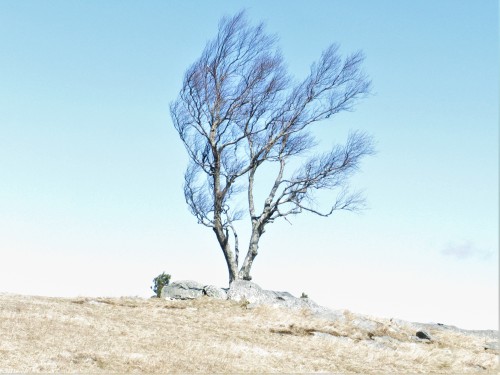
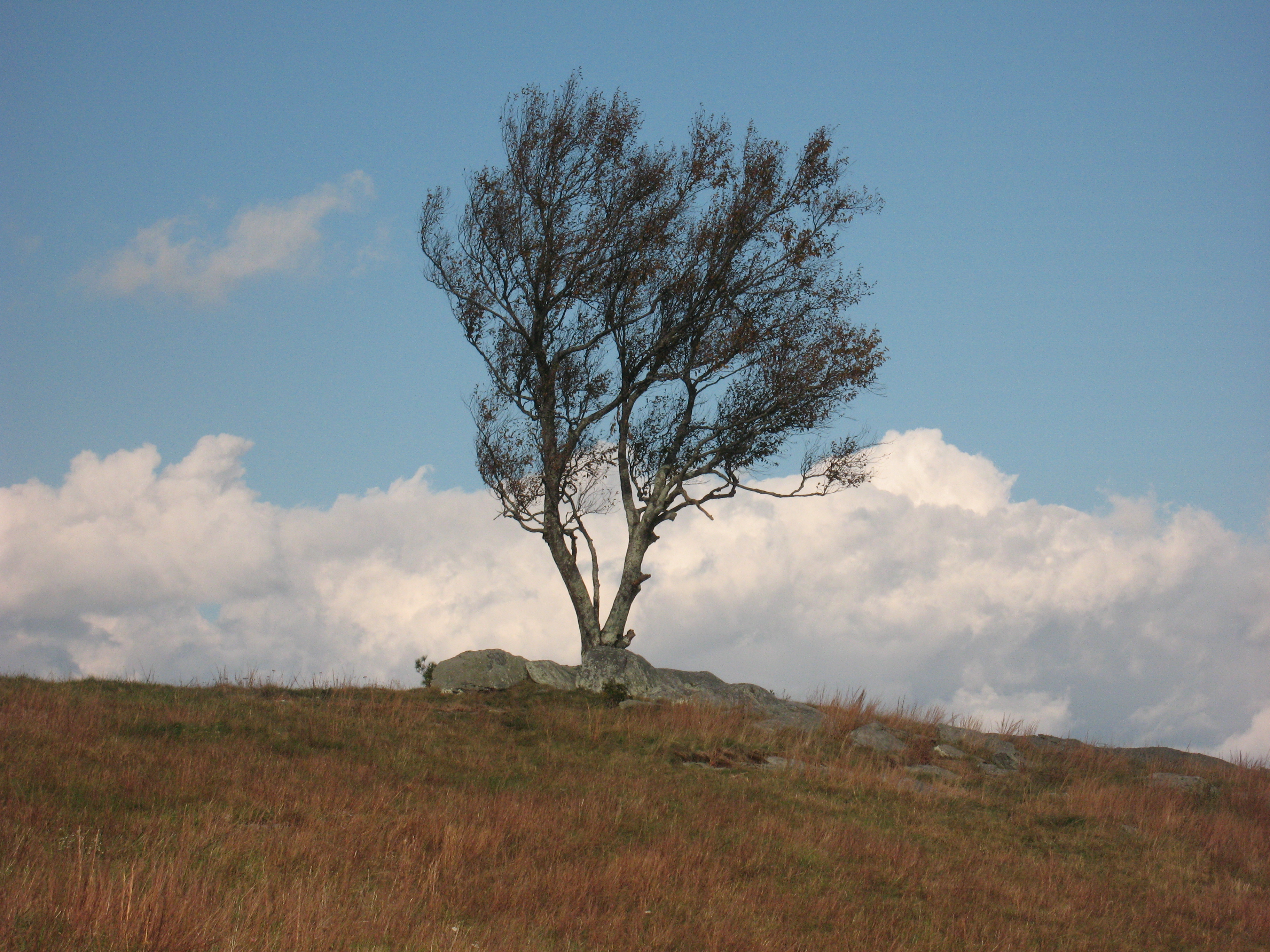
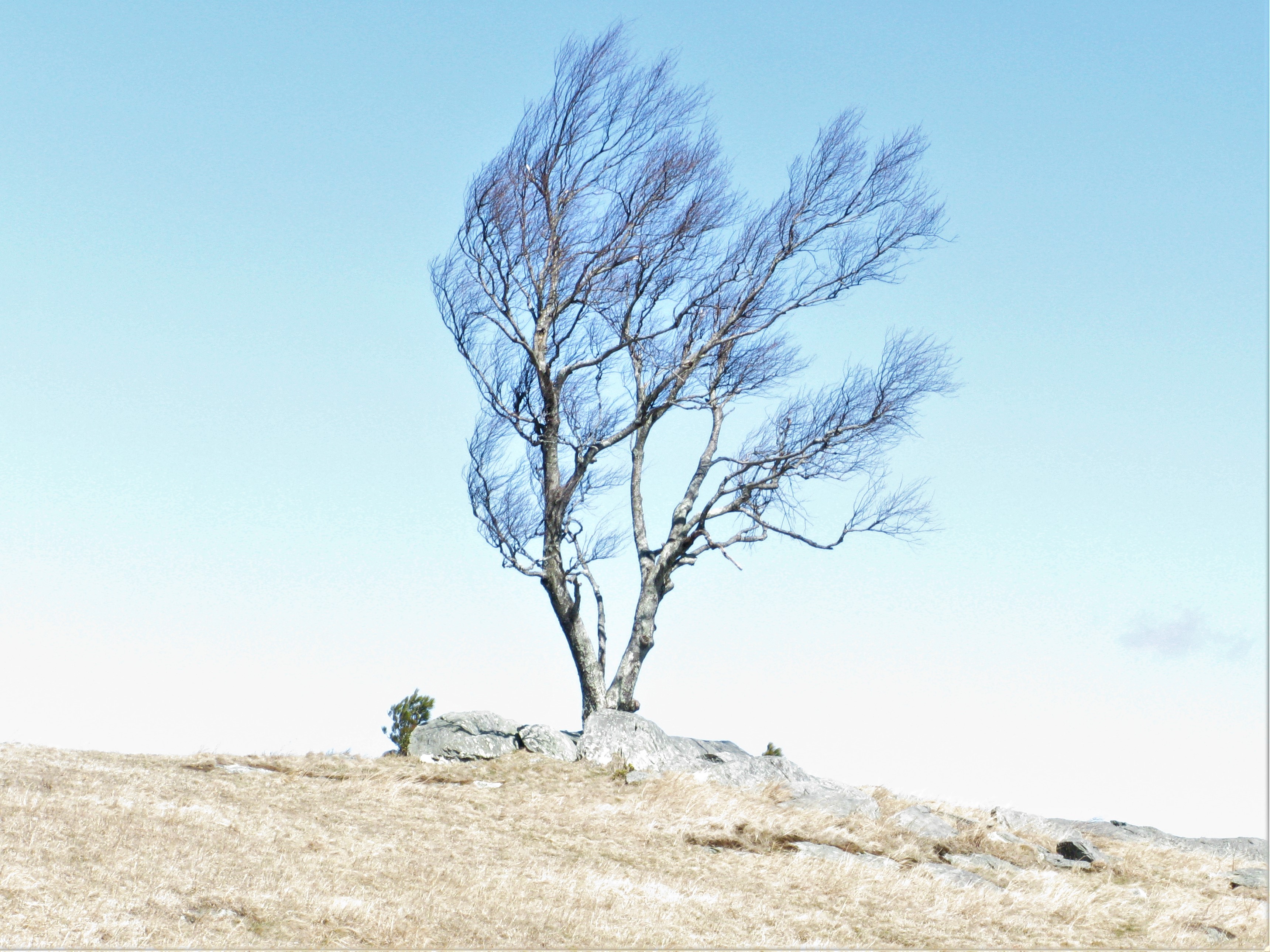
2014-06-30a Doughton Park Tree

.     .     .     .     .     .     .

Read Full Post »
[poems by Jeanne Julian]

The cosmos blossoms by the rotting stump.

“That’s not scary.” We’re hiking through the Haunted Forest with Amelia, age 5. Tree limbs drip with giant cobwebs and red-eyed spiders, bats dangle, skeleton hands reach up from pine needle cemeteries beside the path. The crew has outdone themselves decorating this stretch of the Mountains-to-Sea Trail that, except for the month of October, is nicknamed the Enchanted Forest. Now Amelia stops and calls, “What’s that?!” at the skull-faced ghost bound up in chains, but it’s more curiosity than apprehension.

Past the Halloweeny stretch, though, I see something well off the trail that causes me to stop and exclaim, “Look!!” An immense fairy ring coaxed forth by last week’s rain: chain of mushroom caps that loops and twists and branches through the pines before doubling back on itself. On and on, a new arc & angle appears every place we look. At the word fairy Amelia is instantly engaged. What sprite danced here before us? What might be hiding beneath the ghost-white caps?

I’m thinking, Dang, that is one big organism, mycelia threaded through at least a half acre.

Amelia is thinking, Wonder . . . wonder . . . wonder.

.     .     .     .     .     .     .

.     .     .     .     .     .     .

The Reservoir

I’m looking for Wildcat Road.
There’s a “Free Manure” sign,
two blossoming magnolias, and a boy
who, up here, gives this passing car
an over-the-shoulder glance
as he walks. I’m going the wrong way.
But, here’s a turn for a road
sharing the reservoir’s name.
Clouds cover the sun and move on.
Light sweeps the hills, harried by gloom.
Birches whiten and fade again.

There’s the expanse of lusterless
water through leafless trees:
I’ve found it, rounding a bend.
Angle and clouds shift, and
the landscape remembers its colors
as if a lady’s fan had opened
revealing a scene in lapis, henna, and rhinestone.

We sat her, on this rock,
years ago – April then, too – learning
to touch, and in late summer embraced
there, on the dam where youngsters
scrawl their names indelibly.
In the silence, eddies of air sound “hush”
at my ear. Those antique fans were meant
to conceal, weren’t they, and
we in shadow to forget.

Jeanne Julian

.     .     .     .     .     .     .

These three poems are from Blossom and Loss by Jeanne Julian (Longleaf Press, Methodist University, Fayetteville NC, © 2015). The delicate volume follows the seasons with all the imagery and metaphor that organic cycle can reveal. Sometimes the captured moments, the vignettes, the narratives are so personal they become cryptic, but as I read on I discover my own stories flowing forth to fill unspoken phrases. Thus does poetry enlighten and inspire. Thus does it become, in the words of Andrea Hollander, entertaining and useful.

The cosmos blossoms / by the rotting stump. from Jeanne’s poem Loss and Blossom

.     .     .     .     .     .     .

Haunted

Each Halloween we hang
ghostlets in the tree,
by morning off they’ve blown.

My friends’ lost boy: how
had he been retrieved? By whom?
Alone? What varnish glossed his veins?

In the hospital they hung
on every beat and breath,
clung to any chance

until their changeling offspring
splintered, vanished, leaving a hollow
husk for them to burn

like autumn leaves or questions or endless
mourning muddled with routine,
travail of the telling and retelling,

dread burden of cereal in bowls
recalling a pajamaed imp held
in the lap, reading The Giving Tree aloud.

How unstoppably he must’ve lapped it up,
a lacquer lulling the limbic brain
until the one dose shoved him over

that last callow October. Still each Halloween
children clamber up the steps for sweets.
“See, I am a butterfly,” the smallest says.

Jeanne Julian

.     .     .     .     .     .     .

Melting

The snow that attacked so frantically while we slept
has blistered into water on the branches.
We also melt ut not as completely as Baum’s witch,
who cannot suffer water. Remember the crooner
in the small-town lounge, that ersatz L.A. club,
who kissed you on the left eyelid
when you were twelve? Remember that first
swig of Colt 45 Malt Liquor? Remember the cocoon
of oblivion that sucked you under before
the scalpel splayed your belly flesh? Remember
how the pressure of one finger spirals
your inner hold into ripples of languid indifference
to all but feeling?
One day too soon you’ll let go for good.
Dripping from the eaves, the fresh liquidity
will patter on unheard while you dissolve –
easily, let us hope, easily, and neither up nor down, while
on the roof the newly fallen expanse, unsullied,,
luxuriates under the sun.

Jeanne Julian

.     .     .     .     .     .     .


.     .     .     .     .     .     .

IMG_7491

Read Full Post »
« Newer Posts - Older Posts »