Feeds:
Posts
Comments

Archive for the ‘Ecopoetry’ Category

 . 
[With poetry by Joy Harjo and Wendell Berry]
 . 
For Calling the Spirit Back from Wandering the Earth in Its Human Feet
 . 
Put down that bag of potato chips, that white bread, that bottle of pop.
 . 
Turn off that cellphone, computer, and remote control.
 . 
Open the door, then close it behind you.
 . 
Take a breath offered by friendly winds. They travel the earth gathering essences of plants to clean.
 . 
Give it back with gratitude.
 . 
If you sing it will give your spirit lift to fly to the stars’ ears and back.
 . 
Acknowledge this earth who has cared for you since you were a dream planting itself precisely within your parents’ desire.
 . 
Let your moccasin feet take you to the encampment of the guardians who have known you before time, who will be there after time. They sit before the fire that has been there without time.
 . 
Let the earth stabilize your postcolonial insecure jitters.
 . 
Be respectful of the small insects, birds and animal people who accompany you.
Ask their forgiveness for the harm we humans have brought down upon them.
 . 
Don’t worry.
The heart knows the way though there may be high-rises, interstates, checkpoints, armed soldiers, massacres, wars, and those who will despise you because they despise themselves.
 . 
The journey might take you a few hours, a day, a year, a few years, a hundred, a thousand or even more.
 . 
Watch your mind. Without training it might run away and leave your heart for the immense human feast set by the thieves of time.
 . 
Do not hold regrets.
 . 
When you find your way to the circle, to the fire kept burning by the keepers of your soul, you will be welcomed.
 . 
You must clean yourself with cedar, sage, or other healing plant.
 . 
Cut the ties you have to failure and shame.
 . 
Let go the pain you are holding in your mind, your shoulders, your heart, all the way to your feet. Let go the pain of your ancestors to make way for those who are heading in our direction.
 . 
Ask for forgiveness.
 . 
Call upon the help of those who love you. These helpers take many forms: animal, element, bird, angel, saint, stone, or ancestor.
 . 
Call your spirit back. It may be caught in corners and creases of shame, judgment, and human abuse.
 . 
You must call in a way that your spirit will want to return.
 . 
Speak to it as you would to a beloved child.
 . 
Welcome your spirit back from its wandering. It may return in pieces, in tatters. Gather them together. They will be happy to be found after being lost for so long.
 . 
Your spirit will need to sleep awhile after it is bathed and given clean clothes.
 . 
Now you can have a party. Invite everyone you know who loves and supports you. Keep room for those who have no place else to go.
 . 
Make a giveaway, and remember, keep the speeches short.
 . 
Then, you must do this: help the next person find their way through the dark.
 . 
Joy Harjo
from Conflict Resolution for Holy Beings by Joy Harjo. Copyright © 2015 by Joy Harjo.
 . 
❦ ❦ ❦
 . 
[Great Smoky Mountains National Park bids Bill farewell during the last moments of the Tremont Writers’ Conference:]
 . 
Goodbye, Love. Thanks for dropping by. This is your last chance to slurp up the prompts you were thinking you might be handed while you’re here. Your last opportunity to be inspired. Which means what, exactly? Inspire, breathe in, be filled with spirit. But did you think I’d tip you up like a funnel and just pour right down? Think back to that little exercise in your application and cull one word – community. This is something I know all about, I the Queen of Connections, I the web of interactions, whether in a gram of soil beneath your feet or spanning the entire watershed of this Middle Prong that flows past you right now – community.
 . 
I’m more than willing to speak. I live to show myself to you. Take a closer look at my image in that postcard and read the fine print: International Biosphere Reserve. But did you notice how small those letters are compared to the beech and oak overtowering? The subtext is, you don’t have to be such a geek about it. Oh sure, learn my names, my histories, my ecologies, but please, for at least one moment, forget about words on paper, Human Person, and just look around you.
 . 
Right around you – seven faces peering back (eight, if you count Jeremy arriving with the coffee delivery). What have you found here, and what will you keep? It’s more than friendship, it’s more than a shared task and a common goal. It’s connection. Don’t drop it. Don’t lose it. And what I’m really saying is . . . See you later!
 . 
 . 
 . 
More than a week has passed and I’m straining hard to hear the Middle Prong. Where has that connection flown? What was the sound of that beckoning? Have I traveled too far beyond its reach, too many highway miles, too many turnings within?
 . 
Here I am surrounded by books and papers, electronics and plastics, literally surrounded: Amelia says, “Your office is a big mess, Pappy.” Surrounded and cumbered by the “should’s” and “got to’s” that no doubt fill your world as well. First phone calls of the day: a change in tomorrow’s doctor appointments for Mom and Dad; on hold and digital assistant waiting for their financial manager; negotiating the week’s schedule. If only the tinnitus I constantly live with sounded more like wind in the pines and rushing water.
 . 
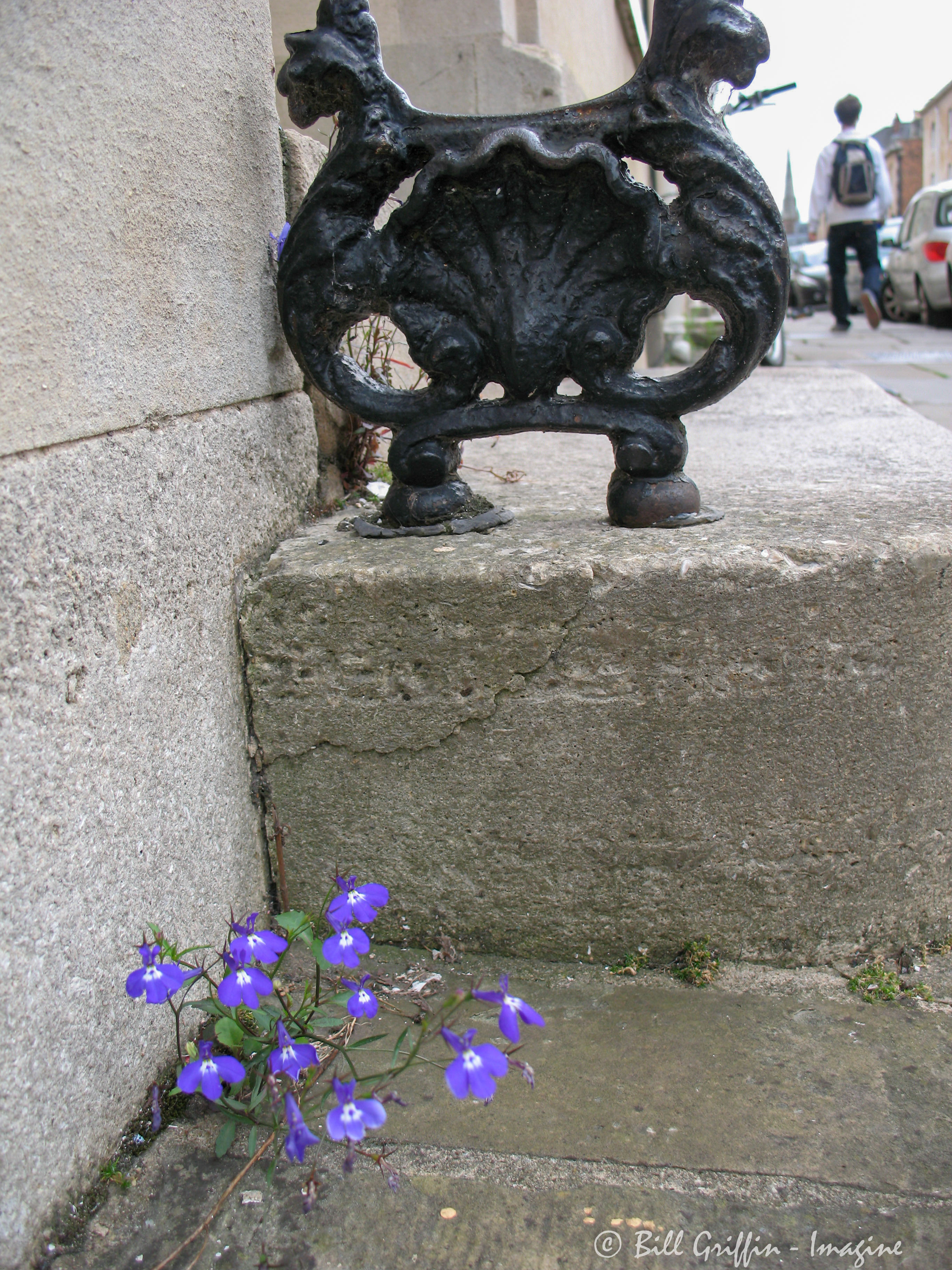
But right now a female cardinal is craning to reach the suet feeder I’ve hidden in the center of the holly outside my window. In an hour, Linda and I will take our first walk together on a new little sprig of MST I helped work on this month. I am rich in these connections and many more. I grieve for those who don’t experience community. Who walk past the little purple flower sprouted through the concrete and never see it. Who feel mostly alienation and suspicion for the human beings around them, much less the non-bipedal creatures. Who cut themselves off from the voice of wind that wants to fill them and let them breathe deep. Philosophers and poets write heavy volumes about the sickness in our human spirits when we separate ourselves from the earth. What is our reply?
 . 
Perhaps this Voice is saying, “C’mon, little Man. You know some folks who need to hear me. Spin a few connections!” See you later. See you now!
 . 
❦ ❦ ❦
 . 
 . 
 . 
❦ ❦ ❦
 . 
Manifesto: The Mad Farmer Liberation Front
 . 
Love the quick profit, the annual raise,
vacation with pay. Want more
of everything ready-made. Be afraid
to know your neighbors and to die.
And you will have a window in your head.
Not even your future will be a mystery
anymore. Your mind will be punched in a card
and shut away in a little drawer.
When they want you to buy something
they will call you. When they want you
to die for profit they will let you know.
So, friends, every day do something
that won’t compute. Love the Lord.
Love the world. Work for nothing.
Take all that you have and be poor.
Love someone who does not deserve it.
Denounce the government and embrace
the flag. Hope to live in that free
republic for which it stands.
Give your approval to all you cannot
understand. Praise ignorance, for what man
has not encountered he has not destroyed.
Ask the questions that have no answers.
Invest in the millennium. Plant sequoias.
Say that your main crop is the forest
that you did not plant,
that you will not live to harvest.
Say that the leaves are harvested
when they have rotted into the mold.
Call that profit. Prophesy such returns.
Put your faith in the two inches of humus
that will build under the trees
every thousand years.
Listen to carrion — put your ear
close, and hear the faint chattering
of the songs that are to come.
Expect the end of the world. Laugh.
Laughter is immeasurable. Be joyful
though you have considered all the facts.
So long as women do not go cheap
for power, please women more than men.
Ask yourself: Will this satisfy
a woman satisfied to bear a child?
Will this disturb the sleep
of a woman near to giving birth?
Go with your love to the fields.
Lie easy in the shade. Rest your head
in her lap. Swear allegiance
to what is nighest your thoughts.
As soon as the generals and the politicos
can predict the motions of your mind,
lose it. Leave it as a sign
to mark the false trail, the way
you didn’t go. Be like the fox
who makes more tracks than necessary,
some in the wrong direction.
Practice resurrection.
 . 
Wendell Berry
Copyright © 1971, 1972, 1973 by Wendell Berry. Excerpted from The Country of Marriage. Reprinted in THE SUN June, 2014
 . 
 . 
❦ ❦ ❦
 . 
Today’s poems were offered as direction for meditation while visiting our “secret spots” during several days at Great Smoky Mountains Institute at Tremont. Any program at Tremont always includes space for quiet reflection while outdoors in nature, whether your secret spot is halfway up the Lumber Ridge Trail or a big smooth rock beside the Little River.
 . 
Joy Harjo (born 1951) was appointed the new United States poet laureate in 2019. Born in Tulsa, Oklahoma, in 1951, Harjo is a member of the Mvskoke/Creek Nation. She is the author of several books of poetry, including An American Sunrise, (W. W. Norton, 2019), and Conflict Resolution for Holy Beings (W. W. Norton, 2015). She is a current Chancellor of the Academy of American Poets and lives in Tulsa, Oklahoma.
 . 
Wendell Berry (born 1934) is an American novelist, poet, essayist, environmental activist, cultural critic, and farmer. He is an elected member of the Fellowship of Southern Writers and a recipient of The National Humanities Medal, along with many other awards and honors. On January 28, 2015, he became the first living writer to be inducted into the Kentucky Writers Hall of Fame.
 . 
❦ ❦ ❦
 . 
 .  . 
❦ ❦ ❦
 . 
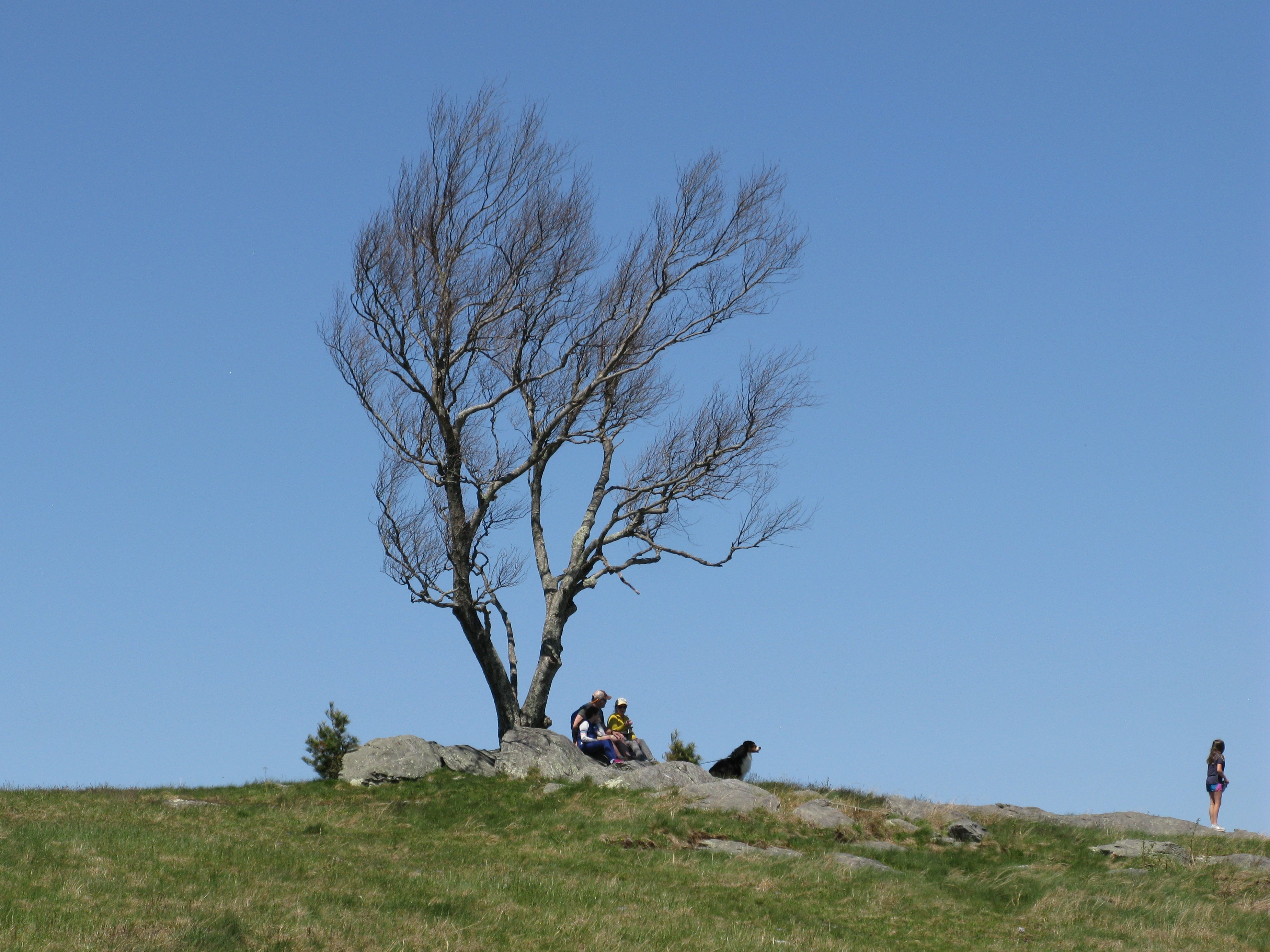
Doughton Park Tree -- 5/1/2021

Read Full Post »

 . 
[with poems by the 2023 Tremont Poetry Cohort]
 . 
Awaken
 .  . 
You came because the river quiets your soul,
the sassafras soothes and sweetgum settles.
Have you gotten your breath? Do you remember who you are?
Leave us, now; it’s our time to sleep. You go, awake.
 . 
Sarah Small / Alcoa, Tennessee
postcard – Mother bear & cubs
 . 
❦ ❦ ❦
 . 
The Little River is singing ‘October Blues’ and I can listen if I’ll just roll down my window. Leaving the Smokies on a Sunday morning, who would have imagined such a glut of traffic, but I can make the choice to gentle my right foot and blend with the flow. And here on the right comes another choice: I pull off at Chimneys and flush the press of schedule and itinerary from my mind.
 . 
A ten minute climb into old growth hardwood cove and road noise no longer penetrates. Every few steps another chipmunk whistles its alarm. Fecund – whoever coined that word was smelling this place. The carpet is bright green hepatica saving up to flower in just a few months, the understory is summer seedhead bounty and autumn wood asters blooming like crazy, and the overstory is way up there, crooked and knobbed, reaching and mingling and only allowing an occasional glimpse of Balsam Point.
 . 
I’ve been waiting since breakfast and now I pull out the small slip of lined paper Renée gave me, a personal parting note; she prepared one for each of us in the cohort. “Read it later,” she had said. I’m going to trust she won’t mind if I share one line: “I came to this conference with some heaviness and I’m leaving with light and a sense of belonging.” A mystery, a wonder, an inexplicable blessing that in just a few days eight strangers can so deeply connect.
 . 
 . 
❦ ❦ ❦
 . 
[untitled]
 . 
You’re not a flightless bird,
+++++ your wings held tight
against your breast;
+++++ unfurl your plumage,
Go from here with boldness,
+++++ revel in your glory.
 . 
Jeannine Jordan / Lima, Ohio
postcard – Wild Turkey
 . 
 . 
Community
(the Park speaks)
 . 
Inspire, breath in, be filled with spirit –
think I’d tip you like a funnel and pour
right in? Look around this circle and take
a lesson from the Queen of Connection.
 . 
Bill Griffin / Elkin, North Carolina
postcard – entrance to GSMNP
 . 
❦ ❦ ❦
 . 
Frank fans the deck and asks us each to select one. They’re postcards, of Great Smoky Mountains National Park, face down so we can’t see what we’ve picked. “The card has picked you,” Frank suggests. “What is it telling you about why you are here and what you’ll take with you when you leave?”
 . 
This is our last exercise during our last session of this inaugural Tremont Writers’ Conference. Can it be only three days ago that Frank X Walker introduced himself to us as an artist who speaks Poet? Besides the language of linebreak and word choice, what Frank so incisively speaks is creativity, challenge, connection, community. Oh yes, we learn to critique each other’s poems through his quiet observations. Yes, we engage in color studies and sound studies and we write to prompts. But Frank is not teaching us to be writers – he is teaching us to be human. His carefully considered comments touch our gifts and expose our needs, and even more than that he weaves us seven into a whole whose true commitment is to bring out the best in each other.
 . 
After ten or fifteen minutes of writing – channeling the voice we are hearing in our card’s image – Frank stops us and presents his next to last prompt: now break that all down into four lines. We probably should have seen this coming. We really aren’t ready, though, for his final instruction. He has us each pass our card two people to the left, write our home address on the fresh card we’re holding, then pass it back right to its original owner. Each of us will write our four-line poem on our card and mail it, and in a few days we will each receive a poem from one other member of the cohort.
 . 
We won’t be driving home from this gathering to resume our scribbling in isolation. We will be watching the mailbox (and text messages) with a tingle. We are now a creative family. We are connected.
 . 
 . 
❦ ❦ ❦
 . 
The Experience
 . 
Like me, a yearling bear,
caged and carried away.
You came for the experience.
Imagine me gone. Write it.
 . 
Kim Hayes / Weaverville, North Carolina
postcard – Ursus americanus, Black Bear
 . 
 . 
Somewhere, Sometime
 . 
Sunlight  in this open field
Safely wander, graze
Trust the treeline
Grow. (I am growing, too.)
 . 
Suzanne Bell / Pisgah Forest, North Carolina
postcard – deer graze in Cades Cove
 . 
❦ ❦ ❦
 . 
Connecting People with Nature is the motto of Great Smoky Mountains Institute at Tremont. Amen! In completing the Southern Appalachian Naturalist Certification Program at Tremont, I have felt the web of connections forged there welling up in me and changing me. One begins with the name of a thing, then comes to recognize how it makes its living and gets along with its neighbors, until at last there dawns an appreciation of the deep interdependence and kinship of all life, place, and planet. One living community.
 . 
But if ecology is the study of living communities, poetry also has its ecology. How does the poem bring together all these living bits that make it come alive? Its images, its allusions, its music? How does the poem make its world equally real to or perhaps even more real than the world speeding by outside my window?
 . 
It seems to me that the technique we learn at Tremont, the Naturalist Method, is entirely congruent with the Poetic Method – Pay Attention; Ask Questions; Make Connections; Share. All of this we try to do when we “speak Poet.” And Frank X Walker has certainly enabled every bit of this in us during our few days of communion with mountains, rivers, bears, each other. It is a language of laughter and surprise. It is a language of change and growth. It is a language of discovery, insight, and awe. We are leaving Tremont bubbling with its voice and overflowing with its joy. Poetry, and Nature, are how we connect.
 . 
 . 
 . 
❦ ❦ ❦
 . 

[untitled]
 .
Born on the top, nestled through the sides, tumbled to the bottom.
Again and again.
Those mountains captured and created.
Then they carried.

Renée Whitmore / Vass, North Carolina
postcard – sunrise through mountains in Cades Cove

 . 
 . 

Clouds in my Skin

You are here
Not to burn through the mist
To roll around in the slick slopes
Of your soft hope—this knowing, this peace

Sophia Fortunato / Bozeman, Montana
postcard – mountain ridges fading into blue mist

 . 
❦ ❦ ❦
 . 
The Poetry Cohort of the First Tremont Writers’ Conference, October 15-29, 2023, is Jeannine Jordan, Bill Griffin, Sophia Fortunato, Sarah Small, Renée Whitmore, Kim Hayes, and Suzanne Bell. Our teacher, mentor, guide, and brother is Frank X Walker from Lexington, Kentucky, speaker of poetry, professor at University of Kentucky, and former state Poet Laureate.
 . 
Other instructors at this inaugural conference are Janet McCue (Non-Fiction) and Annette Saunooke Clapsaddle (Fiction) and the featured speaker is Richard Powers, Pulitzer Prize-winning author of The Overstory. Jeremy Lloyd, Tremont Manager of Field and College Programs, has been the primary organizer, assisted by Tremont staff Elizabeth Davis, Erin Cantor, Lyndsey Kessler, education director John DiDiego, and many others.
 . 
This conference was also made possible through the integral participation and partnership of Great Smoky Mountains Association and Creative Services Director Frances Figart. Thank you!
 . 
 . 
 . 
 . 
 . 
❦ ❦ ❦
 . 
IMG_1783

Read Full Post »

 . 
[ with 3 poems by Jack Coulehan]
 . 
Darwin’s Prayer
++++ He saw Darwin on his knees, and there
++++ was no difference between prayer and
++++ pulling a worm from the grass.
++++++++ Roger McDonald, Mr. Darwin’s Shooter
 . 
Bright bunches
of gardenias
bloom in November,
 . 
the loam at their feet
moistened by dew
and spongy with debris.
 . 
As I fill my container
with handfuls of earth
alive with these
 . 
marvelous worms,
perfected in being
by the wisdom
 . 
of randomness,
I’m astonished
by gratitude.
 . 
from The Talking Cure: New and Selected Poems. Plain View Press, Austin TX, © 2020
 . 
❦ ❦ ❦
 . 
Last night the storm whispered its secrets into my dreams. A long dryness, a vain hoping. This morning the drought has ended and flood warnings will as well in an hour or so. Linda and I head to the E&A rail trail beside Elkin Creek to laugh and point at the heights reached by frothy current. To breathe in the hot seethe and funk of saturated forest. To celebrate.
 . 
The sadness of the creek slams us, stops us, stills us. Its churning water is the color of pumpkin soup; Spike the Heron does not stalk here; the rattle of Kingfisher is silent, fled. Oh yes, we generally get muddy after a downpour, but never this bad. Miles from here, north of Carter Falls, the dry weeks have parched and cracked 500 acres of tobacco field. No riparian buffer, no catchment pond, not one single fuck does the tobacco farmer give for all of us downstream: when rain eventually returns it can’t slow itself, can’t soak the earth. It has no choice but to sluice foaming into the creek carrying inch-acres of red clay with it.
 . 
 . 
The poems in Jack Coulehan’s The Talking Cure are expansive; they span the human experience and human influence. Many of his poems have arisen from his decades as teacher, physician, healer; the lines are populated by his patients and their struggles. So often these lines also reflect his own struggle, both to heal and be healed. Other poems explore his family through the generations. Others reflect his deep relationship with literary figures that formed him and with teachers who informed him.
 . 
In all of these poems I sense a web of connection. As humans we must all struggle to discover our purpose in being. In this struggle each of us is touched by the people we allow to approach us, to close in, to climb over the wall. And each of us touches others and touches the earth: the human experience and the human influence.
 . 
I selected these three poems in particular for their focused peering into that influence, and also for their universality. Jack Coulehan is a humanist, a person who believes that human beings have it within their power to improve the lives of other people whom they are willing to touch. So often, so easily and thoughtlessly, so many of us focus only on our power to dominate, to harm. We easily destroy the earth itself without even noticing. Let us stop and think. Let us feel. Let us touch and allow ourselves to be touched. Perhaps each of our individual lives can enlarge its span. The power of many begins with the power of one.
 . 
We are all downstream from someone, and all upstream.
 . 
 . 
❦ ❦ ❦
 . 
The Cherry Orchard
++++ If a great many remedies
++++ are suggested for some disease,
++++ it means the disease is incurable.
++++++++ Chekhov, The Cherry Orchard
 . 
The end of the century
has come upon us
without a sign of release
or the beginning of justice.
We’re selling the orchard
to pay our debts
and reminiscing about
love’s excitements,
life’s mistakes. I suspect
a century ago the hearts
of the people sitting here
were just as generous,
intense, and cruel as ours.
 . 
A miniature flower
thrives in the moisture
and dust of a broken
pavement – this is the gist
of the matter. We want
so strongly to believe
the flower will spread
everywhere. How quickly
it dies! If the disease
had a cure, we would not need
so many remedies.
 . 
Jack Coulehan
from The Talking Cure: New and Selected Poems. Plain View Press, Austin TX, © 2020
 . 
❦ ❦ ❦
 . 
Garden of Endurance
++++ Cassia grandis, Costa Rica
 . 
Cassia fruit covers the forest floor,
a blanket of black sausage stinking
in the heat as it decomposes,
a mote in the eye of permanence.
 . 
Built for grinding by gigantic teeth,
Cassia’s fibrous case condemns its seeds
to suffering, with neither mastodon
nor megatherium alive to free them
 . 
and distribute their undigested life
in mounds of shit. Its glory left behind
by climate, tooth, and claw, Cassia
endures by the grace of rodents
 . 
that gnaw its weakest fibers
and let a few fertile seeds escape
before they rot. Anachronistic
fruit, your survival – sweet tickle
 . 
of a breeze, illusion of peace,
diminishment that overcomes
extinction – is an inheritance
for my kind, too. A hopeful omen.
 . 
Jack Coulehan
from The Talking Cure: New and Selected Poems. Plain View Press, Austin TX, © 2020
 . 
For additional poems by Jack Coulehan, see last week’s post, Plow Straight, from August 25, 2023.
 . 
 . 
❦ ❦ ❦
 . 
Join me in celebrating the release of my newest poetry collection, How We All Fly, from The Orchard Street Press.
 . 
Poet Patricia Hooper comments: “Through close observations of the physical world, these clear, direct poems yield insights into the corresponding life of the spirit.” And Rebecca Baggett says this: “Throughout these poems, but particularly toward the collection’s end, How We All Fly leads the reader up and onward, infusing even inevitable losses with tenderness, trust, and hope.”
You may sample the opening poem from the collection here:
Thank you for your support, both of the writing you discover here and of the literary arts!
 . 
You may purchase a copy of How We All Fly directly from me by mailing a check for $15 (postage included) to this address:
++++++ 131 Bon Aire Rd.
++++++ Elkin, NC 28621
Please make your check payable to Bill Griffin.
 . 
If you would prefer to pay via PayPal, please contact me for transaction details at:
++++++ comments@griffinpoetry.com
 . 
 . 
[Patricia Hooper is author of Wild Persistence, University of Tampa Press. Rebecca Baggett’s most recent book is The Woman Who Lives Without Money, Regal House Publishing.]
 . 
❦ ❦ ❦
 . 
IMG_0880, tree
 . 

Read Full Post »

« Newer Posts - Older Posts »