.
[with 3 poems by Les Brown]
.
Pause
.
I placed my hand on the moon
++++ to keep it from its course,
to stop time in the comfort of night
++++ when sleep subdues sounds
of machines and urgent voices.
++++ Starlight and still moon
are enough to guide my stroll.
++++ I cross the meadow
among sparse trees,
++++ where snowy crickets cry fast
with time kept by heat
++++ of past day’s searing sun.
I lie down and listen
++++ for the whippoorwill
whose call is rare now,
++++ watch fireflies wink love calls.
I will hold the moon until
++++ the world stirs and wonders
why the night endures,
++++ with dreams of Earth
where fires do not rage,
++++ floods do not drown,
spiraling winds cease,
++++ oceans retreat from shores
and the cricket cries slow
++++ once again.
.
Les M. Brown
from A Coming of Storms, Main Street Rag Publishing, Charlotte, NC; © 2024
.
❦ ❦ ❦
.
Light rain in the woods, droplets coalesce and cascade through the upper canopy, tuliptree, oak, & hickory, until they freefall onto our heads and shoulders. A fat drop flicks a browned leaf or blinks in the duff. We imagine small creatures leaping up from the earth and then they do! Angel-winged insects are bobbing up and down to touch the fresh damp with the tips of their abdomens, animated by moisture. Linda watches one female Cranefly, notices nearby a delicate floral spike with angel-winged florets, and says, “Look, it’s planting orchids!”
.
Cranefly Orchid and Cranefly, so like each other, elongated nectar tube of the flower resembling the long abdomen of the insect ending in its ovipositor, but so unlike! Except in our visual imagination they’re not related at all . . . or are they? Both favor moist woodlands with a nice layer of decomposing vegetation. Both reproduce in midsummer, by bloom and seed or egg and larvae. Both look a little creepy if you’re not fond of long spindly legs.
.
Altogether unrelated, entirely different Kingdoms – Animalia and Plantae – and yet these two are related ecologically, if simply by the places in which they thrive and by the company they keep. They live in community. But mightn’t the relationship go deeper? All living creatures on this planet are genetically related; we share many of the same genes for basic functions like metabolism, DNA replication, and protein synthesis, share them with every bacteria, archaea, fungus, protist, and plant. Compare the genome of any plant – Cranefly Orchid – and any animal – Cranefly – and you’ll discover hundreds of identical genes. It’s one big family tree, this Kingdom Earth, with some pretty twisted and winding branches, and yet all connected to the same trunk.
.
❦
.
Alas, the Cranefly is not planting orchids. She’s laying eggs in the moist duff; they’ll hatch into larvae called leatherjackets. She doesn’t care a whit for her namesake orchid, which is pollinated by Owlet Moths (Noctuidae). The Cranefly Orchid’s tiny flowers twist either left or right as they progress up the stalk (raceme), so that as the moth’s long proboscis probes the nectar tube she gets a dusting of pollen on one or the other of her large compound eyes. And carries it with her to the next flower.
.
.

.
❦ ❦ ❦
.
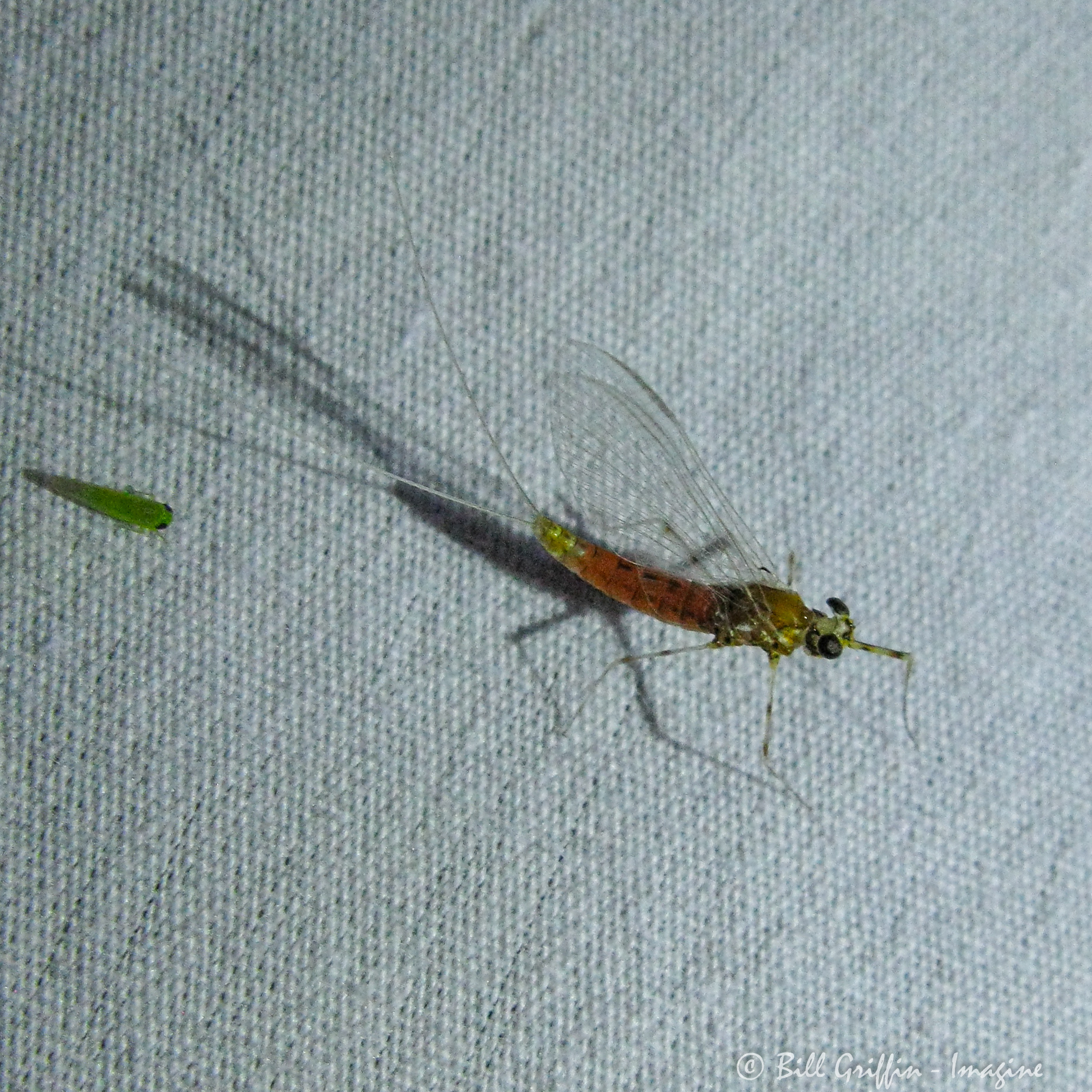
Mayfly Swarm
.
Night on the Pearl River, steaming warm –
our small boat pierces the tunnel of blackness.
Beams of head-bound lights play
across the dark slow current.
.
We tease out an occasional moccasin,
quiescent in boughs of bald cypress.
Lock on bright-lit eyes of river frogs,
the hungry raccoon eating a mussel.
.
The motor pusher our johnboat upstream –
Suddenly, a blinding blizzard
of white-winged snow rises.
Shimmering mayflies fill the blackness.
.
They are in our eyes, nostrils, mouths, ears,
and hair, an erupting silent lace-winged storm.
Millions rise in singular ecstasy, then die.
Their gossamer bodies blanket the river.
.
Fertile eggs drift into black depths.
Frog, fish, and bird devour the dead,
a one-night feast, a gift, a magic cycle
of lovers, death, and satiated flesh.
.
Les M. Brown
from A Coming of Storms, Main Street Rag Publishing, Charlotte, NC; © 2024
.
.
❦ ❦ ❦
.
Les Brown’s new book, A Coming of Storms, has plenty of vivid and hair-raising (literally) descriptions of black cumulonimbus monsters plowing down the mountainside to batter us with hail and impale us with jagged barbs of lightning. The storm he’s really warning us of, however, is metaphorical and of our own making: the devastation of Planet Earth by that most destructive invasive species, Us. Among these poems are Lamentations for the now diminished towns and farms where our lives were once so rich, Jeremiads proclaiming the dire future we’re creating for ourselves, and the Psalmist’s tender recollection of family homestead, tender sojourns in nature, and all the smells and tastes and feel of our fertile world at its best.
.
Les has all the necessary credentials of a prophet. He grew up in the rural mountainscape of North Carolina; his poetry is most poignant when populated by his grandparents, uncles, neighbors. He earned a Ph.D. in Biology and taught ecology to college students all his working life. He himself feels most personally and pointedly our loss of unspoiled fields and forests, our disconnection from the earth that sustains us. I wish he were here beside me this afternoon so we could both get our knees dirty investigating Cranefly Orchids and Rattlesnake Plantain. I’ll be looking forward to his next observation, and holding my breath for a cooling breeze of hope.
.
❦
.
A Coming of Storms is available from Main Street Rag Publishing.
.
❦ ❦ ❦
.
Think seeds, not bullets
.
++++ melons instead of bombs.
Drink wine, rest a while
++++ instead of scorching earth.
Rip off epaulets
++++ and but on bedroom shoes.
Call mothers. Tell them
++++ their children are safe
Revere the earth,
++++ cool it.
Grow chanterelles,
++++ not mushroom clouds.
Bend barrels
++++ and weld triggers
into metallic art.
++++ Read a different Good Book.
Let only birds tweet.
++++ Read only magazines
instead of loading them.
++++ What is beneath the skin
of an apple?
++++ It is a simple question.
.
Les M. Brown
from A Coming of Storms, Main Street Rag Publishing, Charlotte, NC; © 2024
.
❦ ❦ ❦
.

.


 V E R S E and I M A G E
[…] About/Submit […]