[with poems from Black Nature]
The world of experience speaks the language of the Absolute. In that language, the language of the universe, all of the metaphors which spring offers must simply mean: LIVE! – – – – Marilyn Nelson
What makes Spring for you?
When I was a first year med student, every lecture paid homage to the History of Medicine (invariably capitalized). Even today when I read of the recent cholera epidemic in Haiti, I immediately remember Dr. John Snow, the father of modern epidemiology, who arrested the London cholera epidemic of 1854 by removing the handle from the Broad Street pump. When I progressed to the clinical wards at Duke, including Osler Ward, history continued its exposition on morning rounds with frequent pithy quotations by Sir William Osler, such as, “A physician who treats himself has a fool for a patient,” or, “It is astonishing with how little reading a doctor can practice medicine, but it is not astonishing how badly he may do it.”
One quotation baffled me a bit: “One swallow does not make a summer, but one crescent makes malaria.” I quickly learned to recognize the crescent, that minute malaria parasite living inside a red blood cell, and I spent hours at the microscope trying to find just one. But I had little experience of the natural world outside the lecture hall and the swallow part (Osler riffing on Aristotle, I learned later) made no sense. I was stuffing my head with the vocabulary of microbiology and immunology but never even heard of phenology (the study of periodic biological phenomena). The completion by swallows of their long northward migration each year defines the arrival of summer? Of that I had no clue.
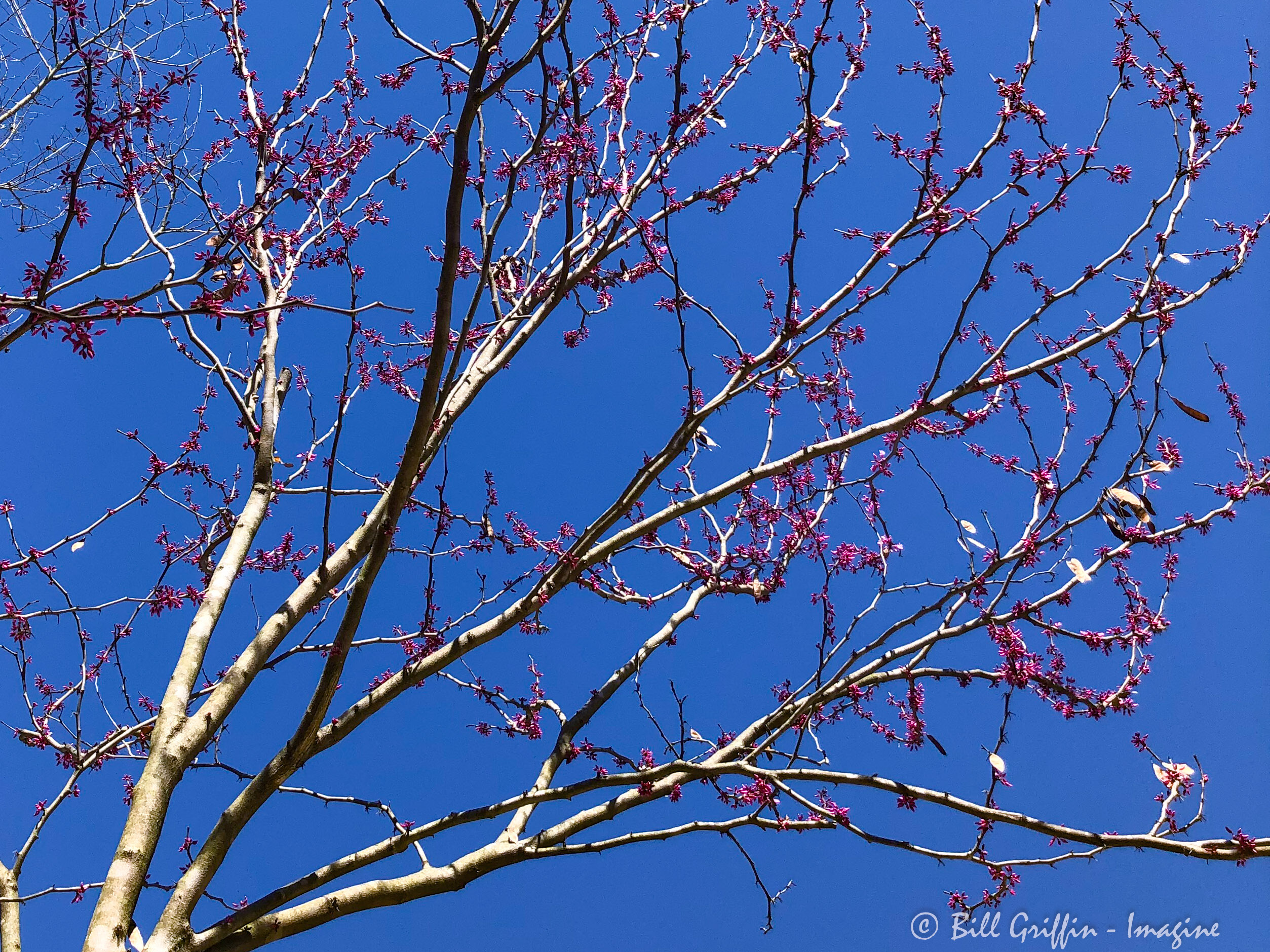
Indeed, one crocus does not make a spring. So what does make spring for you? There’s a stretch of I-40 between Winston-Salem and Kernersville where the surrounding woodland has been sheared back and sun percolates into deep shade. Over the years the native redbuds have leaned into that light. As gray February shuffles so languorously along step by step, a faint golden haze haloes the maples and deepens to peach and brick red. A willow here and there hints of green. It’s coming, it’s coming. Then suddenly, it seems within just days of each other, the redbuds pop their magenta bud covers into lush, rich, raspberry bloom. The solstice hasn’t yet arrived, but for me redbuds do make spring.
❦ ❦ ❦
Spring Dawn
There comes to my heart from regions remote
+++++ A wild desire for the hedge and the brush,
Whenever I hear the first wild note
+++++ Of the meadow lark and the hermit thrush.
The broken and upturned earth to the air,
+++++ By a million thrusting blades of Spring,
Sends out from the sod and everywhere
+++++ Its pungent aromas over everything.
Then it’s Oh, for the hills, the dawn, and the dew,
+++++ The breath of the fields and the silent lake,
And watching the wings of light burst through
+++++ The scarlet blush of the new daybreak.
It is then when the earth still nestles in sleep,
+++++ And the robes of light are scarce unfurled,
You can almost feel, in its mighty sweep
+++++ the onward rush and roll of the world.
George Marion McClellan
from Black Nature: Four Centuries of African American Nature Poetry, edited by Camille T. Dungy, © 2009 University of Georgia Press, Athens GA.
❦ ❦ ❦
This week I’ve been spending time with an anthology I’ve been reading off and on over the past year, Black Nature: Four Centuries of African American Nature Poetry, edited by Camille T. Dungy. Cycle Ten, the final section of the book, is titled Comes Always Spring. We have come through nine other cycles, including Dirt on Our Hands and Disasters, Natural and Other; we have been reminded What the Land Remembers; at last we are left with a hope of renewal. What can make Spring for us as a community, as a shared human family?
GEORGE MARION MCCLELLAN (1860-1934) was born in Tennessee and lived in Kentucky. A poet an minister, he attended Fisk University and Hartford Theological Seminary. He published Poems in 1895 and The Path of Dreams in 1916.
CLAUDIA RANKINE, born in Jamaica in 1963, earned her BA from Williams College and her MFA from Columbia University, and now lives and teaches in California. She is the author of four collections of poetry; Nothing in Nature is Private (1995) received the Cleveland State Poetry Prize.
CAMILLE T. DUNGY has received fellowships from the National Endowment for the Arts, the Virginia Commission for the Arts, the Dana Award, and Bread Loaf. She is Associate Professor of Creative Writing at San Francisco State University. Besides Black Nature, Dungy is also co-editor of From the Fishouse: An Anthology of Peoms That Sing, Rhyme, Resound, Syncopate, Alliterate, and Just Plain Sound Great.
[biographies adapted from the anthology]
❦ ❦ ❦
The Man. His Bowl. His Raspberries.
The bowl he starts with
is too large. It will never be filled.
Nonetheless, in the cool dawn,
reaching underneath the leaf, he frees
each raspberry from its stem
and white nipples remain suspended.
He is being gentle, so does not think
I must be gentle as he doubles back
through the plants
seeking what he might have missed.
At breakfast she will be pleased
to eat the raspberries and put her pleasure
to his lips.
Placing his fingers beneath a leaf
for one he had not seen, he does not idle.
He feels for the raspberry. Securing, pulling
gently, taking, he gets what he needs.
Claudia Rankine
from Black Nature: Four Centuries of African American Nature Poetry, edited by Camille T. Dungy, © 2009 University of Georgia Press, Athens GA.

❦ ❦ ❦
What to Eat, and What to Drink, and What to Leave for Poison
1
Only now, in spring, can the place be named:
tulip poplar, daffodil, crab apple,
dogwood, budding pink-green, white-green, yellow
on my knowing. All winter I was lost.
Fall, I found myself here, with no texture
my fingers know. Then, worse, the white longing
that downed us deep three months. No flower heat.
That was winter. But now, in spring, the buds
flock our trees. Ten million exquisite buds,
tiny and loud, flaring their petalled wings,
bellowing from ashen branches vibrant
keys, the chords of spring’s triumph: fisted heart,
dogwood; grail, poplar; wine spray, crab apple.
The song is drink, is color. Come. Now. Taste.
4
Down anyone’s street-bright invitations.
Suck ‘em. Swallow ‘em. Eat them whole. That’s right,
be greedy about it. The brightness calls
and you follow because you want to taste,
because you want to be welcomed inside
the code of that color: red for thirst; green
for hunger; pink a kiss; and white, stain me
now. Soil me with touching. Is that right?
No? That’s not, you say, what you meant. Not what
you meant at all? Pardon. Excuse me, please.
Your had was reaching, tugging at this shirt
of flowers and I thought, I guess I thought
you were hungry for something beautiful.
Come now. The brightness her might fill you up.
7
Daffodils are up, my God! What beauty
concerted down on us last night. And if
I sleep again, I’ll wake to a louder
blossoming, the symphony smashing down
hothouse walls, and into the world: music.
Something like the birds’ return, each morning’s
crescendo rising toward its brightest pitch,
colors unfurling, petals alluring.
the son, the color, the rising ecstasy
of spring. My God. This beauty. This, this
is what I’ve hoped for. All my life is here
in the unnamed core – dogwood, daffodil,
tulip poplar, crab apple, crape myrtle –
only now, in spring, can the place be named.
Camille T. Dungy
from Black Nature: Four Centuries of African American Nature Poetry, edited by Camille T. Dungy, © 2009 University of Georgia Press, Athens GA.

Mom looks at the Redbud
❦ ❦ ❦
And here’s one final epigram from Sir William Osler, dedicated to William J. Blackley MD, my Senior Resident for the first day I arrived on the ward as a green intern: “One finger in throat and one in the rectum makes a good diagnostician.”
More quotations by the master clinician Sir William Osler can be found here:
“The good physician treats the disease; the great physician treats the patient who has the disease.”




 V E R S E and I M A G E
Very true. And not that she ignores the grief and woe of living but somehow makes all of life a…