Feeds:
Posts
Comments

Posts Tagged ‘Southern writing’

[After you read this post, move on to my revised definition of the
SOUTHERN SENTENCE POEM
at
https://griffinpoetry.com/2012/11/25/when-the-train-whistle-blows/
And send me your offerings at our Facebook page:
https://www.facebook.com/SouthernSentencePoem?ref=hl ]

Last month after a poetry workshop we all went out for lunch.  Someone had been reading a book of Buson and Issa, and we got to complaining about how hard it is to transmigrate haiku from Japanese to English.  Syllable counting aside, Japanese haiku has so many formalities that just don’t translate.  Each word is drenched in a thousand years of cultural nuance; lotus, frog, mountain, they all have layers of meaning very difficult for an outsider to grok.  Why do we even try to write haiku ourselves?

At some point we came up with the idea – note here that no alcohol was involved in these discussions – that we Southern poets need a poetic form we can call our own.  I remember us laughing about what we might call such a thing;  the term “Bubba” seems to have come up a few times, with various prefixes and suffixes.  At the end of the day, though, we hadn’t really developed anything substantial.

.     .     .     .     .

IMG_8370

I’ve been thinking about that conversation ever since, and I’m now ready to unleash upon the literary world a new poetic form: the Southern Sentence Poem.  Besides consisting of a single sentence (which actually ain’t too Southern, knowing how we like to tell long-winded stories), each Southern Sentence must include all three of the following:

1 – Place.

A word or phrase has to place the poem in the American South.  It can be the name of a town, a geographic feature, a mention of some typical flora or fauna, even an ACC university.

2 – Past.

We Southerners make fretful Buddhists – we just can’t let go of the past.  The poem can be “in the moment” but it requires a reference to the past: kinfolk, a historical event, a personal experience (inevitably with a bad outcome, of course, but lesson learned).

3 – Culture.

Let the New Englanders and the Californians and the Canadians come up with their own poetic form – this here poem is about the South!  The reference to Southern culture can be food, customs, language/slang, clothing, agriculture or business . . . even anthropologists have a trouble defining the word “culture.”

IMG_0118

And to my mind a really good Southern Sentence would be seasoned with a drop of bittersweet.  Aren’t some of our great themes sin and redemption, hurt and healing, always at least a little hopefulness?  And it is ever appropriate to inject a little humor.  Just one additional rule: no cussed semicolons.  I love semicolons, but they are just too damn Yankee.

.     .     .     .      .

IMG_2550

Help me out.  Send me some Southern Sentence Poems.  If I get a whole passle of them I might start a whole new blog, or at least give them their own page.  Any comments and enlargements on my three rules?  Make the form your own.

AND . . . can anyone think of a better name than Southern Sentence Poem?

Finally, here are a couple of examples (it’s only a coincidence that each is 3 lines; that’s not one of the rules):

.     .     .     .     .

Nana said she despised those “jawflies,”
cicadas that filled the oaks around her house,
but every August I think of her.

.     .      .      .      .

In Nana’s preserves each fig
was suspended in gold – the summer sunset
on Bogue Sound.

.     .     .     .     .

IMG_7788

.     .     .     .     .

Read Full Post »

It’s been a few years since I saw a patient with their fingers stiffened by black gum, so tarry and mean you just absolutely couldn’t get it off.  For years they were regulars, members of several local families, and by late August I’d usually treated two or three of them.  Oh, they didn’t consult me to take care of the black gum.  That was a fact of life.  They’d come in with a sprained back from first priming (bending over to pull the lowest leaves, the first ones to ripen).  Or one of their kids would be vomiting from green tobacco sickness when the morning dew permitted the nicotine to penetrate her clothing and permeate her skin.  (The older ones all smoked or dipped, and a little extra nicotine didn’t phase them.)

To say tobacco farming has changed is like saying calling to your neighbor has changed.  The wood-fired tobacco barn has gone the way of the rotary dial phone.  The government bought back all the allotments, but you can imagine plenty of other reasons why you see so many fewer acres of tobacco in Surry County now (and so many more acres of grapes).  On top of that, those big steel gas-fired curing barns just ain’t as picturesque.  And I guess the kids have all gone off to college, because I don’t see them with that black gold on their fingers during priming any more.

.     .     .     .     .

I moved to Elkin over thirty years ago to join Jonesville Family Medical Center right where rural nirvana blooms, the juncture of Wilkes, Yadkin, and Surry Counties.  Some days over lunch, one of my nurses shared stories of her farming childhood.  When priming was finished and the barn was full the whole family would join in the curing – cousins, uncles, the tribe.  The men had to tend the fire all night long to keep the heat just right.  The women would bring baskets of supper; the kids would play until way after dark; someone would break out a fiddle or a guitar.  There was probably a Mason jar of something potent being passed around in the shadows beyond the firelight, but my nurse wouldn’t want to make any accusations.  She and the other youngsters would bed down in quilts and blankets around midnight, and when the sun came up across the fields, there Mama would be with cold milk and biscuits.

.     .     .     .     .

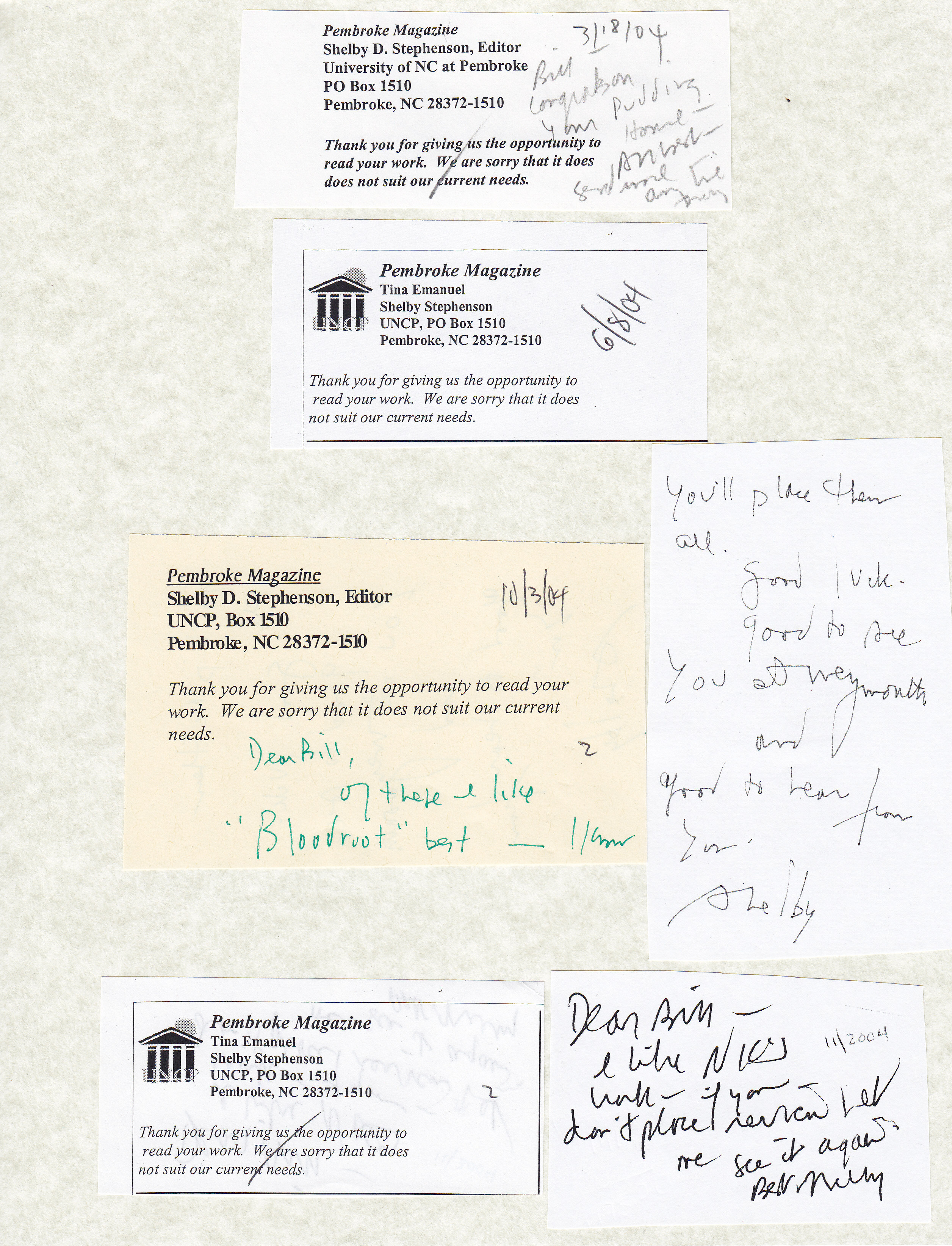
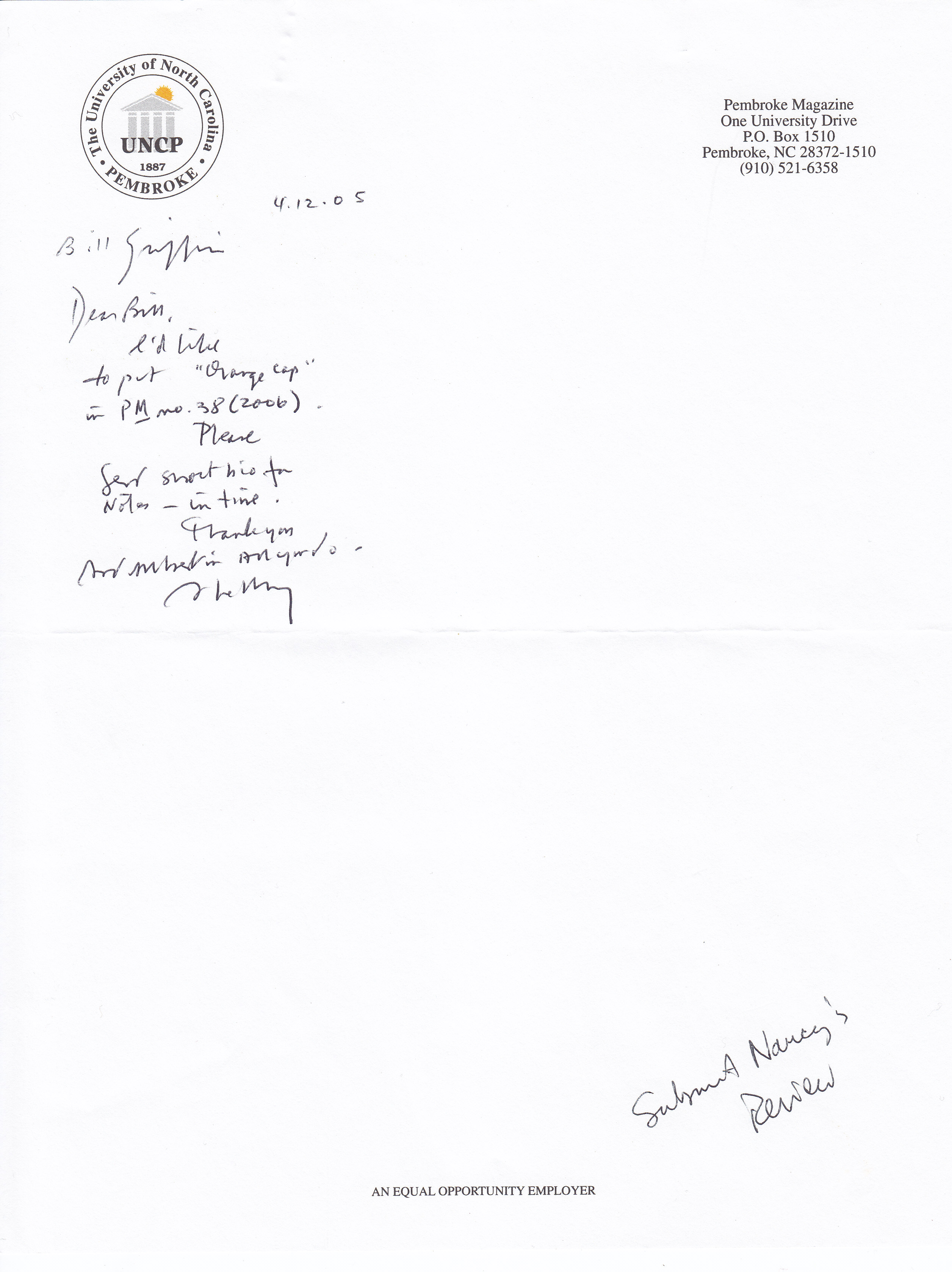
Who’s going to keep these stories alive for us?  Thank goodness for Shelby Stephenson.  I wonder if Mrs. Stephenson, watching her little boy helping with the priming, could have imagined he would go off to college and come back home a professor.  Could she have imagined him turning the black gum into poetry?  As English Prof at UNC Pembroke, as editor of Pembroke magazine, as author of numerous volumes, and as picker of a mean guitar, Shelby has given the old stories new voice, new breath, new life.

.     .     .     .     .

Tobacco Days

The rows almost ridge themselves, shaping the year again
towards seasons that let the dust of sandlugs
fall into yesterdays lost in failed crops, quick dreams.

*   *   *   *   *

I lay on the warm ground of the Mayo barn at four in the morning
hoping Brother would oversleep.
The flatbed trailer bounded across the ditch,
the Farmall Cub droned.
“Morning, boys.”  I climbed the tierpoles.
Taking the top, I handed down four sticks at a time to Lee to
Paul who packed the trailer.  From my perch I
stirred the sun through airholes uner the eaves.
The barn emptied, we walked through dew to breakfast.
Dreams drifted awkwardly, Brother’s Big Man chew
rolling over in sand-dust.

*   *   *   *   *

The tobacco greens for the farmer who dives into the dirt,
renewed in the smell of warehouses,
golden leaves in the lightholes bringing the legged sunlight in.
Dew in dust, a musk in  mist,
the tobacco tips one more time on the prime,

a sea of blooms
bobbing in ninetyfive degree wisps of heat,
adhesive tape slipping over blisters.

My bare feet burn on the ground and I shuffle
toes into dirt for moisture, inching stalk by stalk
down endless rows in the ten-acre field where short rows
fade into plumbushes and shade.

The mules on the drags relax through the hot, climbing
July days, the frying dust, and you wonder if you’ll ever
get the gum off your hands.

Shelby Stephenson
from Finch’s Mash © 1990 by Shelby Stephenson

.     .     .     .     .

IMG_0768

Read Full Post »

In three weeks my cousin Pat is going to take a small step into the vast unknown.  Pat Riviere-Seel is going to spend a week at the NC Zoological Park in Asheboro as its first Poet-in-Residence.  She and I have been whispering and tittering (in the email sense) about her preparations almost daily because just a few weeks after her sojourn ends I am going to follow her in the same role.  And yes, before you ask, the curators have promised fresh straw in our cages.

How does one  qualify to become a Zoo Poet?  The decision process of the artistic committee that established this new program remains obscure to us, the selected, but I can tell you a little about Pat’s qualifications as a poet.  She has the ability to imagine herself into unimaginable personalities.   She can speak in the voices of the voiceless . . . so many voices.  To read her poetry is to be touched, mind and heart, by people you could never otherwise have known.

Perhaps some of this creative skill has grown from her affliction, as she describes it, of “recovering journalist.”  In the thousands of interviews and articles over the years, how many personalities consumed her?  How many epiphanies when she suddenly saw with another person’s eyes and felt the whole of their motivations?  In her book The Serial Killer’s Daughter, Pat has completed the astonishing transition from journalist to poet.  Through the poems speak not only the daughter and mother, but other family members, victims, onlookers.  The story as it unfolds, and as the daughter begins to suspect, gives me a chill every time I read it.  It can’t be easy to weave together fear and desperation with calculating cruelty and still leave the reader with a sense of compassion, but my cousin Pat is someone ever willing to take a step into the vast unknown.

IMG_7418

.      .     .     .     .

My Brother’s Keeper

My brother doesn’t believe me
when I tell him it’s no accident
everyone close to Mama dies.

Always Mama’s favorite, he’s
the smart one, college degree,
office job.  He can’t afford

a stain of doubt ringing
the collar of his starched
life.  How could he forget

what happened when
he enlisted:  Mama declared
the Army wouldn’t take him,

a widow’s only son.  Two weeks
she railed like a street preacher
calling to the lost.  My brother claimed

Mama’s grief soured his stomach.
It’s nothing, he told me.  Just the stress
from seeing Mama so upset.

He forced himself to eat with us
the day before he left.  No cake,
he said to me.  But Mama insisted.

Clumsy, she screeched
as I slipped
and the cake shattered.

© Pat Riviere-Seel, The Serial-Killer’s Daughter, 2009, Main Street Rag Publishing Company.  Additional sample poems at Pat’s homepage.

.     .     .     .     .

IMG_7419

Yes, Pat and I are really cousins.  Her great-grandfather, the Reverend J.N.S. Daub, is also my mother’s great-grandfather.  That makes us second cousins one generation removed.  (Your attention please:  due to the vagaries of genealogical arithmetic, this does not mean that Pat is old enough to be my mother.)  We discovered this connection only about ten years ago when we met at an NCPS meeting and she mentioned that she’d just attended a family reunion in Lewisville.  I said, “Hey, that’s where my great-great-grandfather is buried,” then later mailed her a photo I’d taken of the headstone.  Cosmic!

And as far as her being selected as Zoo Poet, I also happen to know that Pat has written a number of poems about bears.

The Poets-in-Residence will be offering adult and youth workshops during our weeks with the animals.  For more information about Pat, me, and the third Zoo Poet Michael Beadle follow these links!

.     .     .     .     .

Read Full Post »

« Newer Posts - Older Posts »