
.
[with poetry by Dr. Jack Coulehan]
.
The Act of Love
.
How foolish Celia must look
to the Haitian cab driver
on the Medicaid run!
.
She wears a white communion dress
the week before Easter, a sign
she brings me something more pressing
.
than the pain in her shoulder
and the son who doesn’t talk to her
because his wife is embarrassed.
.
Her hips creak in conversation,
her knees grind, but even crepitant joints
are modestly silent and stand aside
.
when Celia hands me a potted plant
for my office – an act of Christian love,
she says, not a sign of being personal.
.
As for me, I’m stunned
out of the ordinary anger
at failing to help her
.
by the waxy leaves of her gesture
and I receive this wafer of the season,
heartbroken for no reason.
.
Jack Coulehan
from The Talking Cure: New and Selected Poems. Plain View Press, Austin TX, © 2020
.
❦ ❦ ❦
.
To plow a furrow straight, keep your eyes on the far edge of the field, not back over your shoulder. I didn’t much take my own advice, seems like, those forty years as a small town family doc. Most of the time I recall just struggling to make sure the big wheels were turning while the mud got deeper. Towards the end I could see the hedgerow approaching and I recognized what was calling – to have one last face to face with my patients. Except there was precious little face to face during those final six months. Pandemic saw to that.
.
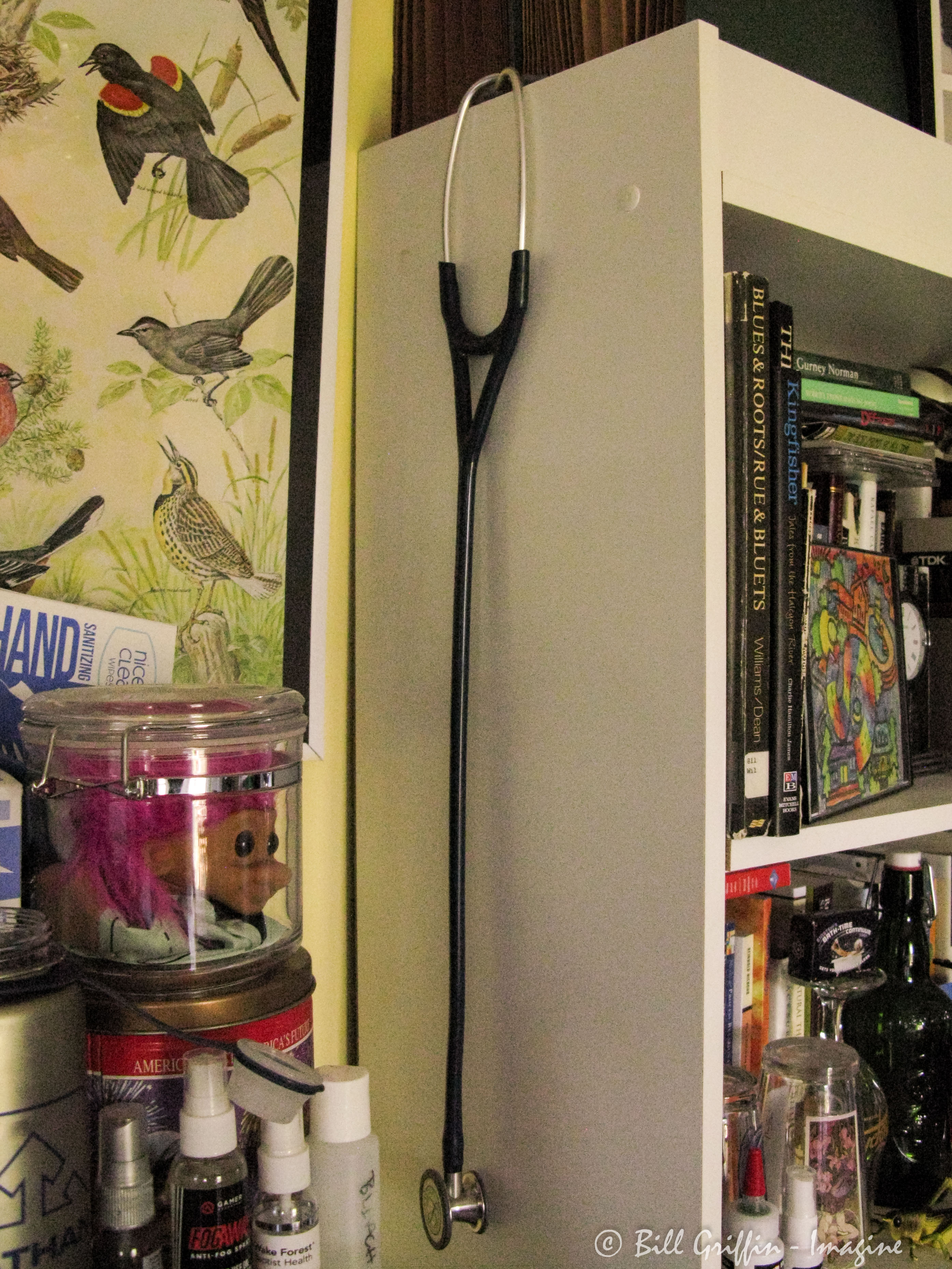
And when you finally run out of field? Wedge around and plow a parallel straight back? Or hop down, push through the hedge. See what’s waiting next field over. OK, OK enough with all this rural agronomy metaphor. It’s three years now since I, as we say, hung up the stethoscope. The anxiety dreams have settled down to just once or twice a week, or else I sleep through and don’t remember them. I passed a former patient on the nature trail last week and she didn’t recognize me. The off duty anonymity I craved for years in this little cloistered town, well, here it is. And so . . .
.
. . . I ask myself what those forty years meant. Anything? Did I do good? Did I make a difference? Does anyone besides me remember? Perfect time to open this book of poems by Dr. Jack Coulehan MD. I’ve picked it up a dozen times but laid it back down. I know his name from chance meetings in the pages of JAMA and Annals of Internal Medicine. I see that he once directed the Stony Brook Center for Medical Humanities. How does anyone make sense of anything? He’s bound to have the prescription.
.
The Talking Cure – yes, that’s it: the first hard lesson I learned and the one I never stopped relearning. Biochemistry, microbiology, pharmacology and all the rest, those were fun. Difficult and challenging, but just what I loved. What was hard, what caused this introvert to gulp and begin to sweat, was opening the door and be expected to sit down with a stranger and talk. And now I’m thinking back forty-three years, to the first week of my Family Medicine Residency at Duke: before I opened that first door to a new patient, I sat with my mentor and began to learn, not to talk, but to listen.
.
Forty years of listening. The times I failed to communicate, augured in, crashed and burned and the patient’s resultant look of anger or distrust or despair, those are all still bright daggers in my side. But the many times we connected, the moments of trust and understanding, those may not be as clarified or stark but they have left a golden glow on my western horizon. Listening is learned; listening is work; listening is an active intervention. Here comes Linda. Here comes seven-year old Amelia. There is always more listening to be done.
.

.
❦ ❦ ❦
.
Poem for David
The day you died your sheepish letter came
begging me to write Dilaudid for the pain.
On flying home – your goddamn migraines
back again. After the second bleed
your mother was as good as dead, your dad
a wreck. You begged me to forgive your sick
activities last year, frightening my kids,
bringing meth into my home. I’m clean,
you wrote, Rehabbed in the Vets for months.
.
Your drowning made the local Evening News –
a body bobbing at the rocks a quarter mile
beyond the rapids. Swimming when a seizure
took him. An accident, they said. But no.
You hated water, had never learned to swim.
Heroin, Dilaudid, meth. Your manic flight
to help the victims of explosions, earthquakes,
fires – your merciless adrenalin.
Chaos and emptiness tracked you home.
.
In our Appalachian town, I stood like wax
beside your open casket. Above you –
an arrangement of roses from a woman
names Terri. I hovered near the guttered flame
your father had become, recalling the months
you spent tending the wounded in Vietnam,
your endless shifts in hospitals back home.
I pictured forgiveness – an orchard
carpeted with apples, bruised and fallen.
.
Jack Coulehan
from The Talking Cure: New and Selected Poems. Plain View Press, Austin TX, © 2020
.
. . . . . . . .
❦ ❦ ❦
. . . . . . . . . .
The Talking Cure
+++ for David Pearson, MD
.
At eighty-one, my friend, who once was told
he’d never graduate in medicine
because his heart was tender, climbs the stairs
after seeing his last patient. For years
he’s helped a retired lieutenant examine
the slippage of his inner knots by talking.
.
We sip iced tea. They don’t teach the talking
treatment anymore. We used to be told
that words matter. Remember? He’s examined
syllables and silence as his medicine
for decades. His cheeks ravaged by the years
on steroids, twitch with dampness, and he stares
.
at melting ice cubes. He recalls the stairs
to paradise – that’s irony talking
though regret – and he’s dissecting the years
with sharp New England. wit. I never told
him of my weakness, but he knew. Has medicine
hardened his heart? I avoid examining
.
mine, not today, as we examine
the world through a kitchen window, and I stare
at Narragansett Bay, a medicine
just visible between the trees. Talking
rakes up leaves. What’s beneath? Truth be told,
neither of us has ended where those years,
.
when youth seduced us, promised. Every year
accounted for, but when I examine
my conscience – and expression that tells
a lot about my childhood – what stares
at me is gratitude, not guilt. Talking
to my friend this afternoon is a medicine
.
that pares away scarred skin, a medicine
of acceptance – his fighting for years
to be heard, the ease with which I talked
a good game – all of which we examine
with astonishment. I descend the stairs
to the door as we continue talking
.
of medicine and our examined
routes, frenetic years, a world that stares
at pain without telling while we do the talking.
.
Jack Coulehan
from The Talking Cure: New and Selected Poems. Plain View Press, Austin TX, © 2020
.
❦ ❦ ❦
.
Jack Coulehan is a Professor Emeritus of Family, Population, and Preventive Medicine at Stony Brook University, and Senior Fellow of the Center for Medical Humanities, Compassionate Care, and Bioethics. Jack graduated from St. Vincent College (BA) and the University of Pittsburgh (MD, MPH), completed his residency in internal medicine at the University of Pennsylvania and Wake Forest University, and did a fellowship in community health at the University of Pittsburgh. On the medical faculty at Pitt, he co-founded the Center for Medical Ethics and the Western Pennsylvania Ethics Consortium. Along with Marian Block, Jack developed one of the first doctor-patient communication courses required for students in American medical schools.
.
Jack’s poems and essays appear frequently in medical journals and literary magazines, and are widely anthologized. Twice a finalist in national small press poetry contests, Jack is the author of seven collections of his poems, including most recently The Talking Cure: New and Selected Poems (2020). His award-winning textbook The Medical Interview: Mastering Skills for Clinical Practice is now in its 5th edition. Jack edited Chekhov’s Doctors, a collection of Anton Chekhov’s stories with physician protagonists, and co-edited three anthologies of poems by physicians, Blood & Bone, Primary Care, and Grit, Gravity, and Grace.
.
[author bio adapted from Stony Brook University Center for Medical Humanities, Compassionate Care, and Bioethics]
.
❦ ❦ ❦
.
.




 V E R S E and I M A G E
[…] About/Submit […]