Keep close to Nature’s heart, yourself;
and break clear away once in a while,
and climb a mountain or spend a week in the woods.
Wash your spirit clean.
John Muir

. . . . .
Why have they come? Why have they driven hundreds of miles of highway and another twenty of Forest Service gravel to this Deep Gap? Why have they tracked down my friend Mike Barnett and persuaded him to share with them everything they will need to know to spend a few nights on the trail? Why forsake comfort for mist, rain, steep switchbacks, cold nights, hard ground? Why have they come here?
Now they huddle at the trail head – Judy, Nora, Cathy, Gloria, Joan, Nancy – median age 65 (just a wild guess, Ladies!). They pull on fleece and rain gear because we’re already above 3,000 feet and it’s mid-October. Mist condenses on the leaves and drips like rain. The plan is to hike the AT for three days with everything we need to survive on our backs: food, stove, water & filter, tent, mummy bags, and lots of layers for nights just above freezing. We’ll reward ourselves the third night with a short side hike to Albert Mountain and hope to catch the sunset and sunrise from the 5,280 foot summit and fire tower.
That sunrise seems a long way off as we hunker down for the first night half-way up Standing Indian Mountain. It’s pitch dark , a “hunter moon,” first new moon after equinox, but what does absent moon matter when we are engulfed in cloud with thunder echoing ridge to ridge as lightning strikes the summit? Kids, I just want to let you know that your grandmothers are some tough-ass mountain women – they wake up the next morning joking that the howl of wind and rain had caused them to miss George Clooney’s surprise midnight visit. And the only complaint I hear is when Joan comes back from digging a cat hole just as the mist lifts to reveal a nice rainproof privy not twenty yards from our camp site.

Our second night we stop at Beech Gap, a saddle between peaks with a good spring and level tent sites. The stars burn cold as diamond just above our shoulders; we are wearing every layer of clothing we’ve carried. I ask, “Why? Why did you go to so much trouble to put this trek together?”
Judy was the instigator. She told Nora she wanted to hike at least one stretch of the Appalachian Trail before she died. Nora replied, “Gee, I know someone who’s been taking kids on high adventure hikes in the mountains for twenty years, and his sister-in-law Carol is my good friend.” Nora called Carol, Carol called Mike, and Mike said, “OK.” (I still haven’t asked him why he said yes!) Wheels began to turn. It began to look like Judy’s promise to herself that she’d have something big to to tell her grandchildren would be fulfilled.
Nora invited others, and Mike’s wife Nancy makes six. One had hiked with her family as a child and wanted to recapture that feeling. One walked miles every day and wondered if she could handle the challenge of doing it uphill with a pack. Another had become concerned about her stamina and embarked on a course to improve her fitness; now she wanted to kick it up a notch. One had never experienced mountain wilderness. All of the women had come with a frank openness to experiencing something new. Something challenging.
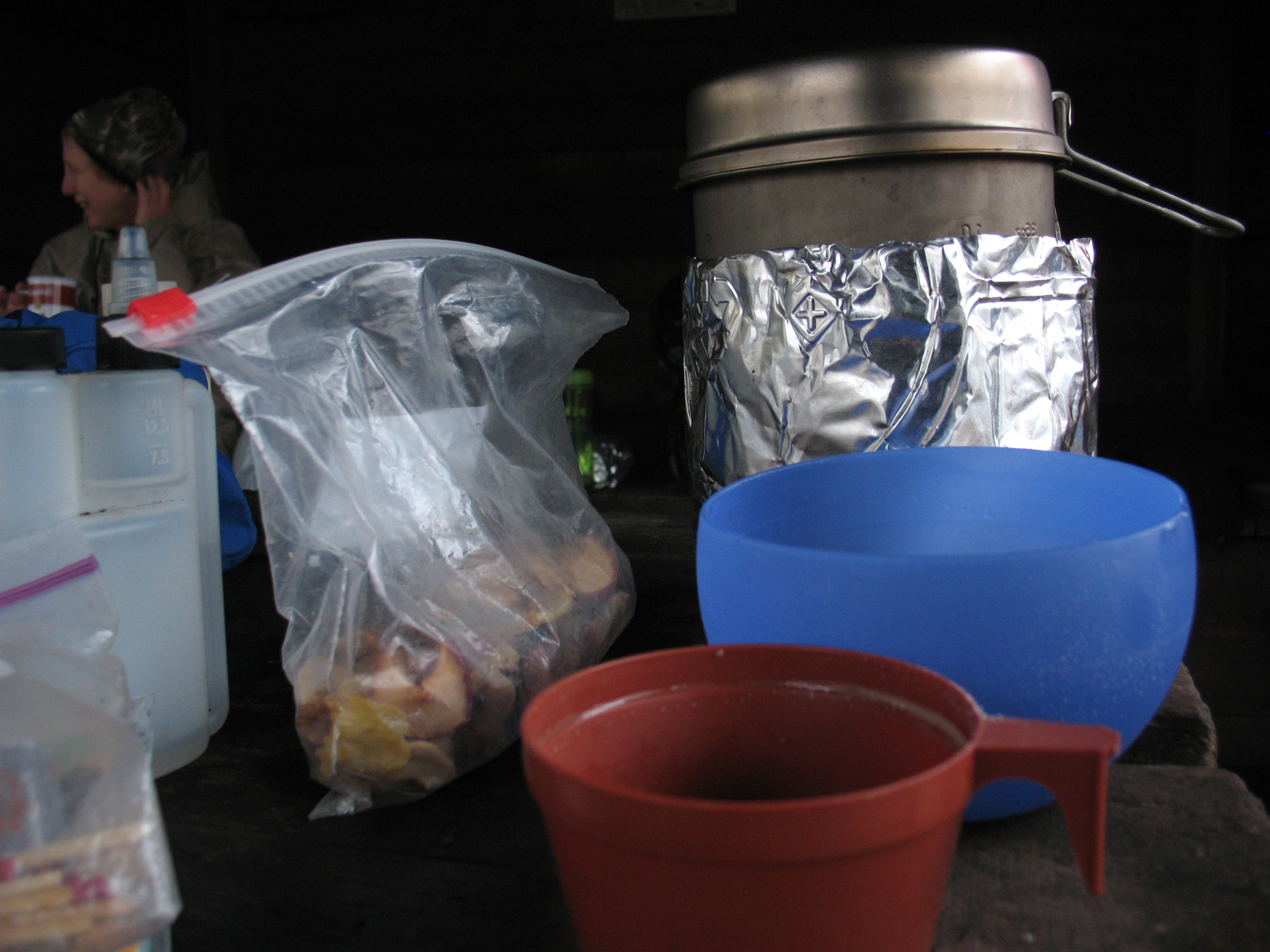
There are plenty of obvious physical challenges to spending a night on a mountain. Just deciding what you’re willing to carry vs. what you’re willing to live without can become a metaphysical exercise. Then there’s the trail itself. Where will I find water? Will the spring be dry? How many uphill miles before my buns turn to steel? How much huffing and puffing before I have a heart attack?
Physical challenges are obvious, but they are illusory. I may be thirsty now, but I will drink later. When the trail is steep, I walk more slowly. I stop and rest. Tired and sore? Leaves are falling that I may scrape together for a bower. Strange noises in the night? My companions are close by.
I’m guessing there are still more reasons we’ve come to these mountains that none of us have yet spoken. I’m certain there are reasons we couldn’t even have named until after we took this walk together. There are reasons we’ll discover only with days and weeks of contemplation to come. A taste of wildness – remote, unforgiving, pristine, elemental. An assurance of self – I made it, I persevered. Connection, unvarnished and unabashed – each one of us making our small offering to the survival, and the joy, of the group. And a much larger connection – wind, trees, slopes, stars . . . we are part of this living realm and can’t exist without it.
Why have we come here? That’s exactly what we’re still discovering.

. . . . .
Final question: Why did Mike ask me if I’d like to come and lend a hand as general schlepper, filter pumper, water boiler, story teller? Because he knew as soon as the word “mountains” left his lips I would be saying, “YES!”
. . . . .
Forever Mountain
Fred Chappell
for J.T.Chappell, 1912-1978
Now a lofty smoke has cleansed my vision.
I see my father has gone to climb
Lightly the Pisgah slope, taking the time
He’s got a world of, making spry headway
In the fresh green mornings, stretching out
Noontimes in the groves of beech and maple.
He has cut a walking stick of second-growth hickory
And through the amber afternoon he measures
Its shadow and his own shadow on a sunny rock.
Not marking the hour, but observing
The quality of light come over him.
He is alone, except what voices out of time
Swarm to his head like bees to the bee-tree crown,
The voices of former life as indistinct as heat.
By the clear trout pool he builds his fire at twilight,
And in the night a granary of stars
Rises in the water and spreads from edge to edge.
He sleeps, to dream the tossing dream
Of the horses of pine trees, their shoulders
Twisting like silk ribbon in the breeze.
He rises glad and early and goes his way,
Taking by plateaus the mountain that possesses him.
My vision blurs blue with distance,
I see no more.
Forever Mountain has become a cloud
That light turns gold, that wind dislimns.
This is continually a prayer.
. . . . .
from The Fred Chappell Reader, St. Martin’s Press, (c) 1987 by Fred Chappell

. . . . .
A brief postscript: Mike has told me several times of his instructions to Nancy that his ashes are to be strewn from the top of Standing Indian Mountain. By noon on our second day the mist had lifted, and we ate lunch at that summit with glorious views of the autumn-hued ridges extending to an infinite horizon. Mike, I hope it’s years in our future, but I can’t think of a better spot to lend the flora a little potash and calcium for all eternity.
. . . . .
Our true home lies outside, deep in the wilderness of forest and mountain, river and desert and sea, the source of our being and the destiny of our great meandering blundering dreaming journey through time. Like Odysseus in his wanderings, we are homeward bound whether we know it or not.
Edward Abbey

. . . . .






 V E R S E and I M A G E
Thank you for the sanity of poetry offerings in these troubling times.