Feeds:
Posts
Comments

Archive for the ‘poetry’ Category

I learned today from our friends at CHARLOTTELIT that Dannye Romine Powell died on October 10, 2024. She was a joyful and fearless supporter of literature, the arts, and poetry in North Carolina for many decades, and whenever I asked her advice or permission to use her work, she was a gracious friend.

I am re-printing this post from December 30, 2020 so that we can share again these evocative poems by Dannye. In Memoriam.

 . 

❦ ❦ ❦

 . 

NEW

 . 

[with poems by Dannye Romine Powell]

When we lower her pack from the tree where it has swung all night like a bell mocking the bear, the skunk, she opens it and screams: a fairy crown atop her sweatshirt and socks, a perfect round nest and four perfect hairless mouse pups like squirming blind grubs. We peer in awe, shepherds at the manger.

Mother mouse has hidden herself — she is not in the pack with her babies. We lift the nest intact, hide it in a bush beside the tree, nestle leaves around. Mother will sniff out her precious ones, reclaim her treasure. But we have other lambs to tend.

We eat, stow gear, shoulder our packs, face the trail, and consider: the pack was in the tree just one night; the nest is woven from meadow grass where we slept; the mother who climbed – how many trips up and back? – was heavy with her brood.

Miles before us, a new year before us – how heavy will each day’s burdens become before night brings rest?

.     .     .     .     .     .     .

A new book by Dannye Romine Powell arrived in the mail this week: In the Sunroom with Raymond Carver from Press 53 in Winston-Salem. I meant to read one or two poems this morning but I have read them all. A central persona that weaves through the collection is Longing: she visits rooms in old houses, unfolds memories into the light, shares the pain that others might lock in closets. Grief shared conceives within us hope to rekindle joy. Sharing grief, sharing joy, we become more human.

.     .     .     .     .     .     .

The Secret

Light glazes the near-empty streets
as I drive. Beside me, my grown son asks
if a secret I thought I’d kept buried
is true. A secret
that can still catch fire.
We stop on red. A bird flies
by the windshield. My father’s words:
Easier to stand on the ground
and tell the truth than climb a tree
and tell a lie. Now, I think. Tell him.
I stare at my son’s profile,
straight nose, thick lashes.
I remember, at about his age,
how a family secret fell
into my lap, unbidden.
That secret still ransacks a past
I thought I knew, rearranging its bricks,
exposing rot and cracks,
changing the locks on trust.

.     .     .     .     .     .     .

In the Night, the Wind in the Leaves

swirled and rustled
out our open window as if
for the first time,
as if we never were,
the earth newborn, sweet.

And what of us – asleep
on the too-soft bed
in the old mountain house?

Gone.

Also our children.
the ones who lived, the ones who died
before they grew whole. All night

the breeze swirled and rustled
through the leaves as if it played
a secret game, swirling
and rustling all night

as if we never were.

from In the Sunroom with Raymond Carver, Dannye Romine Powell, © 2020 Press 53

.     .     .     .     .     .     .

Dannye Romine Powell has won fellowships in poetry from the NEA, the North Carolina Arts Council, and Yaddo. Her poems have appeared over the years in The Paris Review, Poetry, Ploughshares, The Southern Review, Harvard Review Online, Beloit, 32 Poems, and many others. She is also the author of Parting the Curtains: Interviews with Southern Writers. For many years, she was the book editor of the Charlotte Observer. In 2020 she won the Randall Jarrell Poetry Competition for her poem “Argument.”

.     .     .     .     .     .     .

Read Full Post »

 . 
[with 3 poems by Britt Kaufmann]
 . 
Constant
 . 
The only constant is change.
 . 
In any function, the constant is the number
hanging out alone, no variable at its side.
It is what it is.
Until calculus, when C becomes fixed but unknown.
 . 
The coach’s wife says to him,
“Nothing changes, if nothing changes.”
He says nothing, but nods.
 . 
Always plot time on the x-axis:
It’s the independent variable, always marching on.
Until it isn’t.
Like the shortest distant between two points is a straight line.
Except it might not be.
 . 
I remember the non-trad who thought she could effectively argue
against non-Euclidian geometry to my old math professor,
both of whom then were younger than me now.
 . 
How flat our first knowledge becomes.
 . 
My future-physics-professor daughter
returns from the equator where she learned the Pachamama hug:
a spiral, like how they see time:
each moment a chord with harmonics of past and future.
What did they learn, so close to the sun,
watching the stars,
which is seeing time . . .
 . 
We learn orbits, as if the sun didn’t also fly.
The helix of our DNA, more akin
to our planets’ corkscrew through the dark.
 . 
I stare at images from the newest telescopes at the planetarium
in my Appalachian Mountains:
lost and dizzy trying to fathom the immense void.
Alone in the universe is really
alone in time.
 . 
And what of the twins:
One went to space,
traveled so fast he became measurably younger.
Sure that plot twist shows on a graph,
crumpled into a ball, tossed in a trash can,
so he could keep his birthright.
 . 
how precious this tiny world we burn. A magi’s gift:
watch chain and tortoise shell become slag and ash.
For what purpose, this rain of myrrh?
 . 
Britt Kaufmann
from Midlife Calculus, Press 53, Winston-Salem NC; © 2024
 . 
❦ ❦ ❦
 . 
TIME must be straight as an arrow, because you know if an arrow’s shaft has the least warp the bolt will veer and never come near the target, no matter how perfect your aim. Time must be restricted and prescripted like the graph’s x-axis, proceeding forever to the right with its hatchmark divisions each precisely the same distance from the last one and to the next one. Time must have some plan that makes everything make sense.
 . 
Time being so steady, so reliable, how is that I’ve awakened from this busy dream, its urgencies and deviations and long drawn out doings, convinced that I’ve surely slept sound until down only to press the alarm and it’s 1:00 AM? How has time, restless and relentless, accelerated through these past two months of scheduling and planning Mom’s memorial service, then continued speeding right up to the flurry of texts and calls that crowd the minute when I shut off my phone and enter the chapel and the music begins, still stretching and rapping even until the reaching into my pocket and the unfolding of the poem I will read just before the closing hymn?
 . 
And now time unspools and uncoils. A few hours on the porch this morning while the minute hands takes its own good time to tick over, everything shared with family over the past 48 hours seems to slow and spread. The passage is not yet in focus but shows its desire to take shape. Hours became minutes, now expanding again into hours. Time an arrow, or time a wave? Sinusoidal – will it crash or will the long swell fetch from some distant shore and lap our toes? One deep breath. I can’t yet recognize what I’m seeing, but I see that recognition might become possible, might just possibly someday arrive.
 . 
 . 
The past is everything that has slipped the shackles of the present, but a memory is a bit of present still cupped in your hands. Not a crystal of time, not preserved in amber, but a flickering candle of time whose flame creates shapes of its own.
 . 
My younger sister tells me her earliest memory of our mother is being rocked in the wicker chair in which she still rocks herself at her home in Black Mountain. My memories are wisps and phantasms; I can’t say I see those moments, more that I can feel brief spaces and elapses shared with Mom when I was a toddler.
 . 
One vignette is clearer, though. We have boarded an airplane (in New York where we still lived? bound for NC to see Mom’s parents?) and we suddenly realize I don’t have Puppy. Did I leave him behind in the taxicab? Perhaps I wail, but when Mom hands me to the stewardess (this is 1955) and rushes away to find that cab, I feel a shriek rising even though I can’t hear it in memory. How long? How long? But now here she comes, Mom holding Puppy, back at last. Memory complete. Did we take off and land and get hugs from Nana and Grandpop? Perhaps, but all that memory tells me is that my mother was brave and undaunted, and that she would do anything for the little boy she loved.
 . 
 . 
❦ ❦ ❦
 . 
Coastal Prayer
 . 
In the pre-dawn glow, the pelican aunties
look down on me from their pier posts in sleepy disapproval,
their eyes set in Dia de los Muertos faces
as I paddleboard the calm intracoastal
before the boats wake.
 . 
No, not me, out to sea, among the crashing waves,
yet still in waters beyond my depth on tremulous footing
where little fishes leap like dashes on a slope field,
the beauty of their tiny splashes mar the surface and make light
a terror flight from a predatory snapper.
 . 
Give me a rule to follow:
+++ The constant rule through all these changes,
+++ The power rule to not give in,
Devise some rule so I make a difference
 . 
Britt Kaufmann
from Midlife Calculus, Press 53, Winston-Salem NC; © 2024
 . 
❦ ❦ ❦
 . 
Why poetry, if not to struggle to make sense of life? (And if poetry can make sense of calculus and astrophysics at the same time, well, bonus!) And what is life if not its changes? An academic physician I knew referred to an unplanned occurrence which produced an unexpected benefit as “a fortuitous concatenation of events.” How fortuitous for Britt Kaufmann to concatenate calculus, the mathematics of change, with the middle years of life, that time of accelerating change in our bodies, our psyches, our circumstances, and reveal to us such a beneficial poetry.
 . 
The set of all mathematical metaphors, as Britt so skillfully displays in Midlife Calculus, is very large, perhaps approaching infinity. The obtuse angles of her students’ exasperating density; the pointed and poignant trigonometry of the arc of her aunt’s dementia; even the calculating language of literary journal rejections: all of these and many more become functions and variables in the grand equation Britt sets herself: the struggle to make sense of it all. Perhaps there is no solution. Perhaps we can find some small gateway to acceptance, even joy, in irrational numbers. Perhaps I will come to the final page of this engrossing book, breathe deeply, and turn back again to page one.
 . 
 . 
Midlife Calculus is available from Press 53.
 . 
 . 
❦ ❦ ❦
 . 
outlier
 . 
+++ with gratitude for Julian of Norwich
 . 
. . . but all shall be well
of a morning when
the dog thumps her thick tail on the kitchen tile,
a greeting, like the first cup of black coffee
 . 
and all shall be well
of an afternoon when
in February’s chill, green cotyledons
sprout under lights in the laundry room
 . 
and all manner of things shall be well
of an evening when
the weather warms, so windows are thrown wide
to the spring peepers’ sundown song
borne in on eddies laden with lilac
 . 
. . . all shall be well,
and all shall be well,
and all manner of things shall be well
 . 
Britt Kaufmann
from Midlife Calculus, Press 53, Winston-Salem NC; © 2024
 . 
❦ ❦ ❦
 . 
 . 
 . 

Read Full Post »

 . 
[with poems by Michael Hettich, Kenneth Chamlee, Katherine Soniat]
 . 
First View – Chicago Lakes
 . 
Sleet needles past my fastened collar
as we rise into the house of rain.
Mr. Byers of the Mountain News
has horsed us up this flyspeck path
with avowals of Alpine views but
now is silent. I think he has missed
the spur trail. My blood is gelid,
fingers numb beyond recovery.
Clouds tickle and drip and when we crest
this timbered ridge I will ask that-Oh!
Sublime cirque! The Alps surpassed again!
Stay the mules-I must-I need my paints,
stool. Fifteen minutes, please you; see how
the near lake mirrors the breaking storm
with light fine as milkweed fluff, that one
pearled peak soft as the edge of heaven!
 . 
Kenneth Chamlee
from The Best Material for the Artist in the World; Albert Bierstadt, a Biography in Poems, Stephen F. Austin University Press, Nacogdoches TX; © 2023. Finalist for the 2024 Brockman-Campbell Award for the best book of poetry published by a North Carolina writer.
 . 
❦ ❦ ❦
 . 
First Nature, Once Removed
 . 
Is childhood different from any body of (loose) clothing or rising water? Make
of it what you will. +++ I did. +++ +++ Some are grounded by target practice
 . 
but return with leaks known as homesickness for life. +++ +++ Wobbly
flotilla of cargo I was . . . no water-wings to inflate. Imagine those wings
 . 
I did not have +++ but suspected were present +++ when it was calm enough
to reflect and pull faces into focus. +++ +++ Wishing is like sadness at sea.
 . 
Say, you are on a beach with waves – the circular myth of family collapsing.
I had this part-time job of being a daughter apart – job that paid in tips
 . 
for those with damp inward pauses. +++ +++ Deep water girl
who keeps washing up anywhere. +++ +++ +++ Everywhere.
 . 
I was a surprise to those gathered in bed. +++ How I rose to float in
on a man and woman dancing in bed. +++ +++ Or were they clouds?
 . 
I could not keep them straight +++ +++ (though they were trying
hard to act happy) +++ like knives flying simultaneously as birds
 . 
at twilight.
 . 
Katherine Soniat
from Fates: Starfish Washup, Etruscan Press, Wilkes University, Wilkes-Barre PA; © 2023. Finalist for the 2024 Brockman-Campbell Award for the best book of poetry published by a North Carolina writer.
 . 
 . 
❦ ❦ ❦
 . 
The Parents
 . 
One morning, my wife and I followed our eight-year-old
daughter along a crowded beach
just far enough behind her that she wasn’t aware
we followed, as she walked with her energetic stride,
swinging her arms as though she were singing.
 . 
We marveled at her independence, at her
fearlessness; we compared her to other
children we knew, who would never have ventured
so far with such self-confidence.
 . 
We were congratulating ourselves on our excellent parenting
skills, laughing proudly at her spirit,
wondering where she was going with such
lively determination, when she stopped
 . 
and turned to look back: she was crying, with such
deep heaves she could hardly, breathe, desperately
lost. She’d been frantically looking for us
and the place we’d left our towels–she feared
we’d forgotten her, gone home without her.
 . 
What could we say, kneeling beside her
in the bright sun–we’d been right there
the whole time, behind her, laughing affectionately
at the way she walked, as she walked
 . 
the wrong direction to find us, at the way
she looked from behind as she searched for us,
as she howled in such terror
we thought she was singing?
 . 
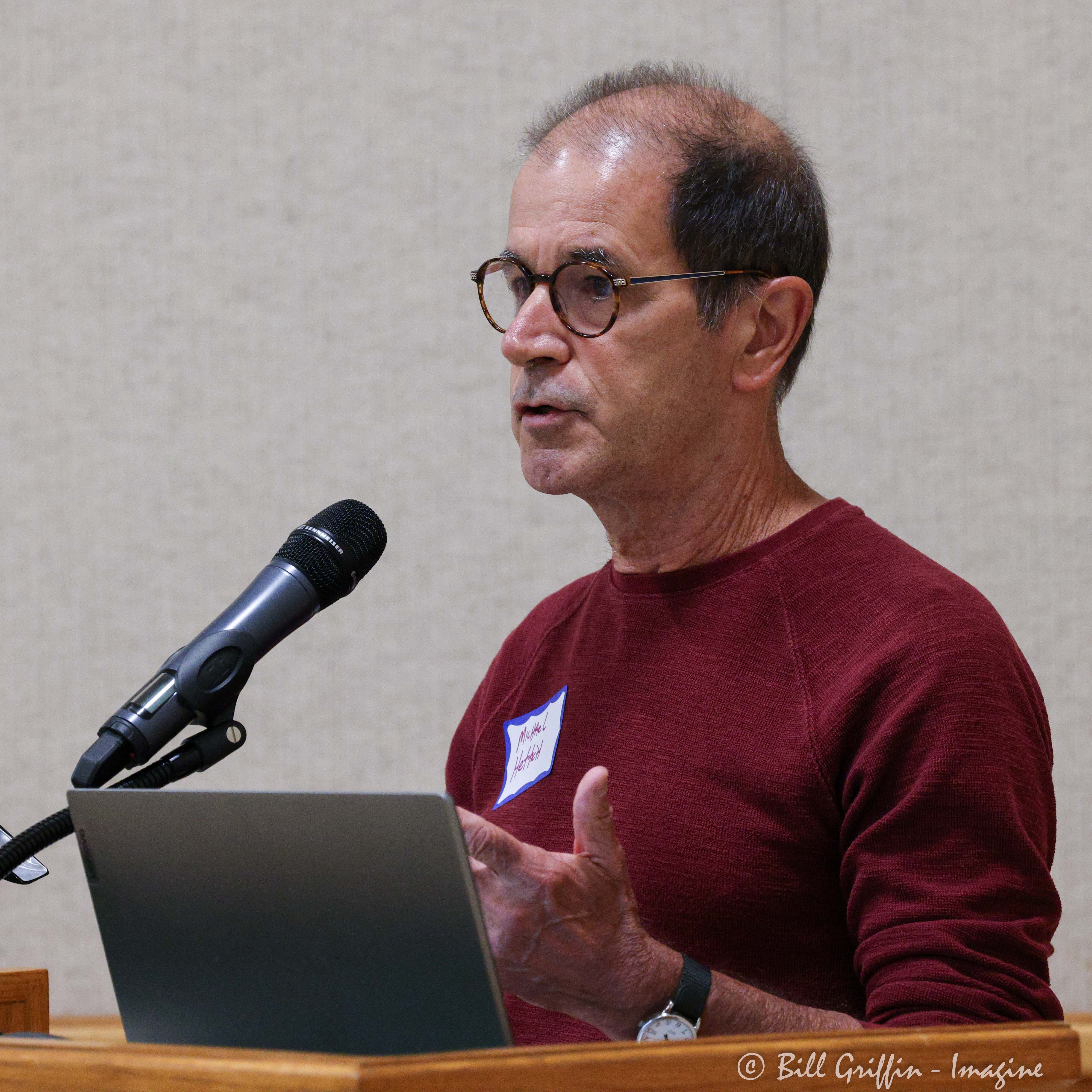
Michael Hettich
from The Halo of Bees: New & Selected Poems, 1990-2022, Press 53, Winston-Salem NC; © 2023. Winner of the 2024 Brockman-Campbell Award for the best book of poetry published by a North Carolina writer.
 . 
 . 
❦ ❦ ❦
 . 
Which is better, to expect beauty and encounter exactly that, or to arrive without expectation or anticipation and be surprised by joy? Which is worse, to open the window on a forecast of sun and discover drizzle, or to walk around every day under a cloud with no awareness of a sun above? Which is worse, to tool around for years just one county removed from your anger, or to cross the line and smack into it head on? Which is better, fond memories of the past or even fonder memories of the future?
 . 
Each of today’s three poems appears in books selected by Eric Pankey, this year’s judge of the Brockman-Campbell Award of the North Carolina Poetry Society: winner Michael Hettich for The Halo of Bees and finalists Kenneth Chamlee, The Best Material for the Artist in the World, and Katherine Soniat, Starfish Washup. What if everything we can sense and see turns into something wholly unexpected? Don’t the most beautiful creatures sometime pack the deadliest stings? What if even time itself slips us up, the solid past dissolving into mist and mud, this moment twisting inside out like a Moebius strip? What if a poem doesn’t begin or flow or lead us where we anticipated, and what if it doesn’t end as we hoped?
 . 
 . 
Emerging from COVID’s virtual meetingspaces two years ago, the NC Poetry Society made a studied decision to emerge as well from its long tradition of meeting four times each year in Southern Pines at Weymouth Center for the Arts & Humanities. Last September’s meeting convened at the North Carolina Museum of Art in Raleigh. Each September meeting serves to showcase readings by contest winners: the Brockman-Campbell Book Award (NCPS); the Lena Shull Poetry Manuscript Award (NCPS); the Randall Jarrell Poetry Competition (NC Writers Network); the Susan Laughter Meyers Poetry Fellowship (NCPS and co-sponsor Weymouth Center for the Arts and Humanities); and the Jackie Shelton Green Performance Poetry Prize (NCPS in partnership with NC Literary Review and East Carolina University).
 . 
This September 14 NCPS gathered at the North Carolina Arboretum outside Asheville. As if award winning readings in such a beautiful venue were not enough, the afternoon program connected the gardens, mountains, and wild spaces into a workshop by Kathrine Cays, “Writing the Natural World.” Kathrine offered many prompts and led a guided meditation to coax us to listen to the voices of earth and sky around us, and to the voice within us that reaches to connect with nature. (See last week’s poem by Mary Oliver, Sleeping in the Forest, which Kathrine read to open her workshop.) How can I sense the communities and individuals that create my world? What do flower, tree, bird, beetle want to say to each other, and to me? How can I discover my true place on earth and return gratitude and reverence in a way that sustains me, and sustains the earth?
 . 
 . 
 . 
 . 
 . 
❦ ❦ ❦
 . 
2024 Contest Winners
 . 
Brockman-Campbell Award: given annually to the best book of poetry published by a North Carolina poet during the past year
Winner: Michael Hettich, The Halo of Bees
Finalist: Katherine Soniat, Starfish Washup
 . 
Lena Shull Award: honors the best manuscript of unpublished poetry written by a native or resident of North Carolina
Winner: Doug Sutton-Ramspeck, Smoke Memories
Honorable Mention: Maura High, Field as Auditorium
Honorable Mention: Becky Nichole James, Little Draughts and Hurricanes
 . 
Susan Laughter Meyers Fellowship: in honor of the life and work of Susan Laughter Meyers; co-sponsor Weymouth Center for the Arts and Humanities
Winner: John Amen
Honorable Mention: Maria Martin, Terri McCord, Claudine R. Moreau, Erica Takacs
 . 
Jaki Shelton Green Performance Poetry Prize: honors the best performance poem by a writer who fits the NCLR definition of a North Carolina writer; co-sponsor North Carolina Literary Review / East Carolina University
1st Place: Edward Mabrey
2nd Place: Jess Kennedy
3rd Place: Marcial “CL” Harper
Honorable Mention: Alessandra Nysether-Santos, Regina YC Garcia, Brenda Bailey
 . 
Randall Jarrell Poetry Competition: one poem by any writer who is a legal resident of North Carolina or a member of the North Carolina Writers’ Network; sponsored by NCWN
Winner: Lee Stockdale
Honorable Mention: Jackson Benton, Mary Alice Dixon
More information about all North Carolina Poetry Society contests HERE
 . 
❦ ❦ ❦
 . 
 . 
 . 

Read Full Post »

« Newer Posts - Older Posts »