.
[ two poems by Betty Adcock]
.
.
Two Words
.
++++ for Gerald Barrax
.
Far west of this late afternoon,
mountains I’ve never seen search California’s
sky for snowdrifts. I can only guess
at shapes of trees and flowers
born of such high thrift.
On the flats below, nothing greens.
Rainshadow.
++++++++++++It is a word for thirst.
.
In my country, small birds are surging
into October. They gather at dusk,
their pillar of smoke swirling
over the dead chimney,
a dream getting ready to dive,
the fire going backward.
Swifts.
++++++++It is a word for visible wind.
.
Imagine the lives of such words.
Subtle as the interiors of antique jars,
they shape their enclosed dark
because we hold them to be;
and name after name, they give us the many.
.
If we should break the clay,
as we can, able to do anything,
believing as we do in no vessel,
believing in fragments, in nothing –
night would step out, the old
wild messenger
bearing the same steep shade,
the same configurations of black wings.
. .
Whatever we hoped to say,
it was there all the time.
.
Betty Adcock
from Intervale: New and Selected Poems, Louisiana State University Press, Baton Rouge LA; © 2001. First published in Nettles (1983).
.
❀ ❀ ❀
.
Revenant
.
Horizontal in my green coat,
resting my head on a log, I must have seemed
some part of autumn that refused to turn,
under the flicker’s scissoring and squirrel’s
scribble against an iron sky.
.
And this is a simple story. Let loose
it will run by itself to the place
where blanched sun laced through near-bare branches
and the day seemed to pour from the hawk’s gyre.
.
To doze in the woods is to rest on the hard edge
of fear, so you’re awake
to what you can neither see nor dream
nor come at with a name.
And yet I thought at first of hikers
in that crash of leaves, a sound that dimmed
at the edges then came back all wrong
because there was no order in it,
no human rhythm.
.
I did not quite cry out but froze the moment
I saw him see me, saw the heavy-antlered head
alter its slant.
He moved in the slow way animals will seem
to move in children’s picture books,
on each page larger, clearer –
until he was so close I saw the shine
on raised black nostrils,
and I though stupidly of creeks,
how they go black with mystery
underneath the winter’s lens of ice.
.
Browsing the leaf-quilted floor, huffing,
the deer edged closer, stopped, his eyes on mine;
and the moment went sly as a dream, the world
unhinged a little, light with reckoning and change.
But there was no revelation. None.
No help for the poet’s old protean
longing to become, to be undone.
.
Whole minutes – two? three? A look, a tangle
of otherness tight as bramble, odd
as a long fall. Noting
had ever happened or ever would
while I could hear that stranger-breath and see
each separate shoulder-hair shift color as he blew
a snort like a horse’s. How exact the hoof’s design
on fallen leaves, lifting and setting down
with such small sound I might be still alone.
.
And someone now is saying this is one of those
dense and symbol-laden moments poets make
to force and tease, the whole thing false
with sexual curvature and hidden weight.
This could be the father coming back
in the form he killed. Or the father’s
nemesis. Or it could be a sweet communion,
that old lie.
.
Finally huge and motionless as a tree
and nearer than my senses wished to know,
he took on, like a cloak, the simple dusk.
And if that looks like poetry, like loss,
the shadow of loss, or memory like black water
on his sides, the let it be
these words as good as any.
++++++++++++++++++++He leapt straight up
as if to lose that covering thought.
He turned and caught
the barest gilding of last light
and stirred the leaves to sharp explosion
and was gone. A distant brushy rustle.
.
It took me longer to begin to leave.
Some tears shook from me without regret or reason,
a kind of backward praise. For what,
I neither know nor quite forget.
.
Betty Adcock
from Intervale: New and Selected Poems, Louisiana State University Press, Baton Rouge LA; © 2001. First published in The Difficult Wheel (1995).
.
.
❀ ❀ ❀ ❀ ❀
.
Betty Adcock was six years old when her mother died. Could losing your entire world at such an age cause you to hold more fiercely and deeply to your new world through all the days that follow? Her poetry pierces me with the painful acuity of its remembering, its seeking, its discovering. There is always another question, another quest. She never arrives at a comfortable shore.
.
Betty often uses tangible artifacts as anchors for her narrative – an old photo of her on the day of her mother’s funeral, her father’s wood carvings that she must clear from his old roll-top desk after his death. The artifact, however, is servant to her imagery, which wrenches and lofts and growls in the throes of imagination. Today I helped my father set up a little Christmas tree in his nursing home room. When I cleaned out his attic last year, I selected from within his and Mom’s many boxes of Christmas decorations a shoebox full – less breakable, more memorable. As we pulled them out and placed them on the tree today, I imagined where they may have come from, why this or that one in particular might have been chosen or crafted or purchased.
.
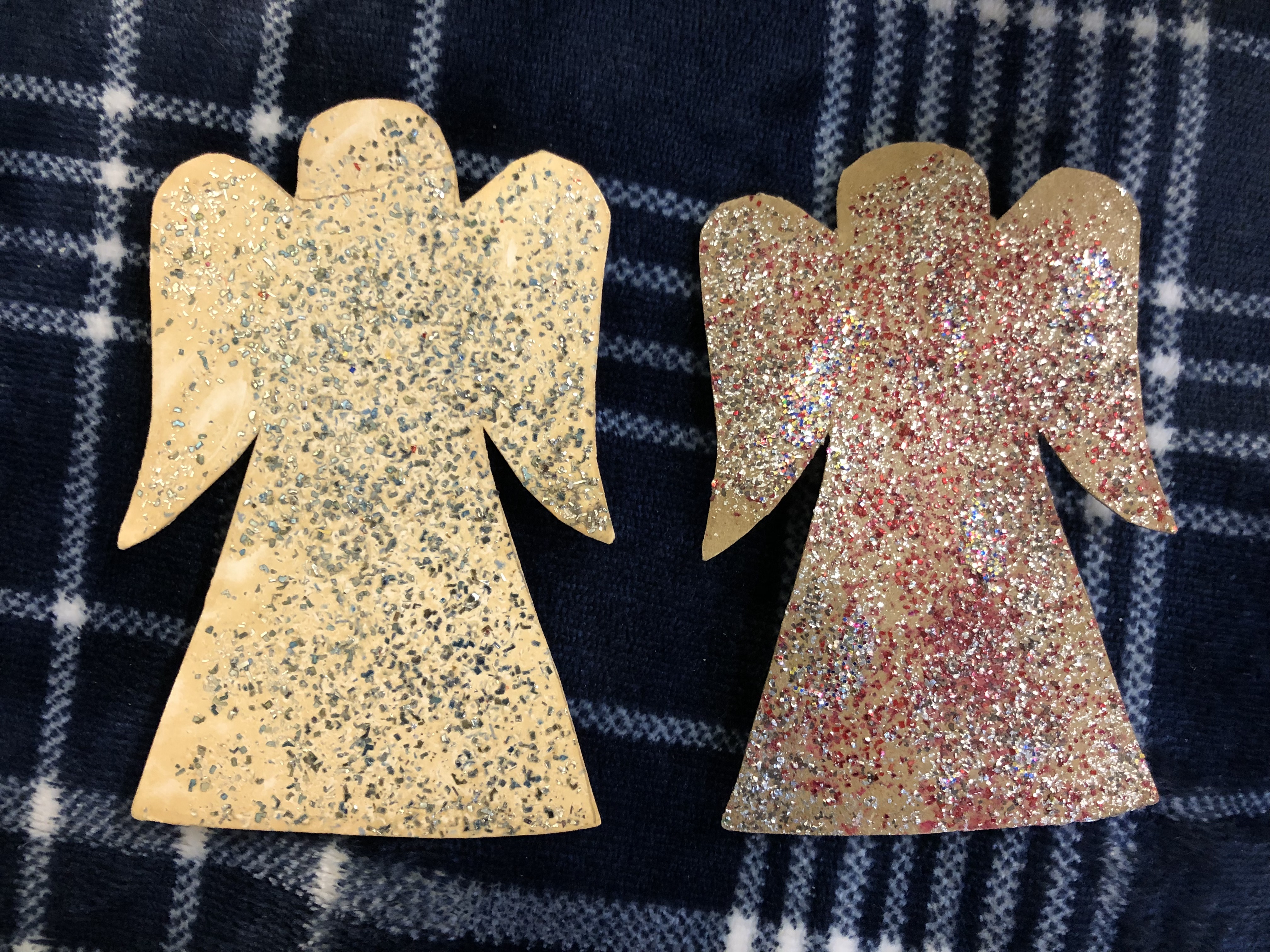
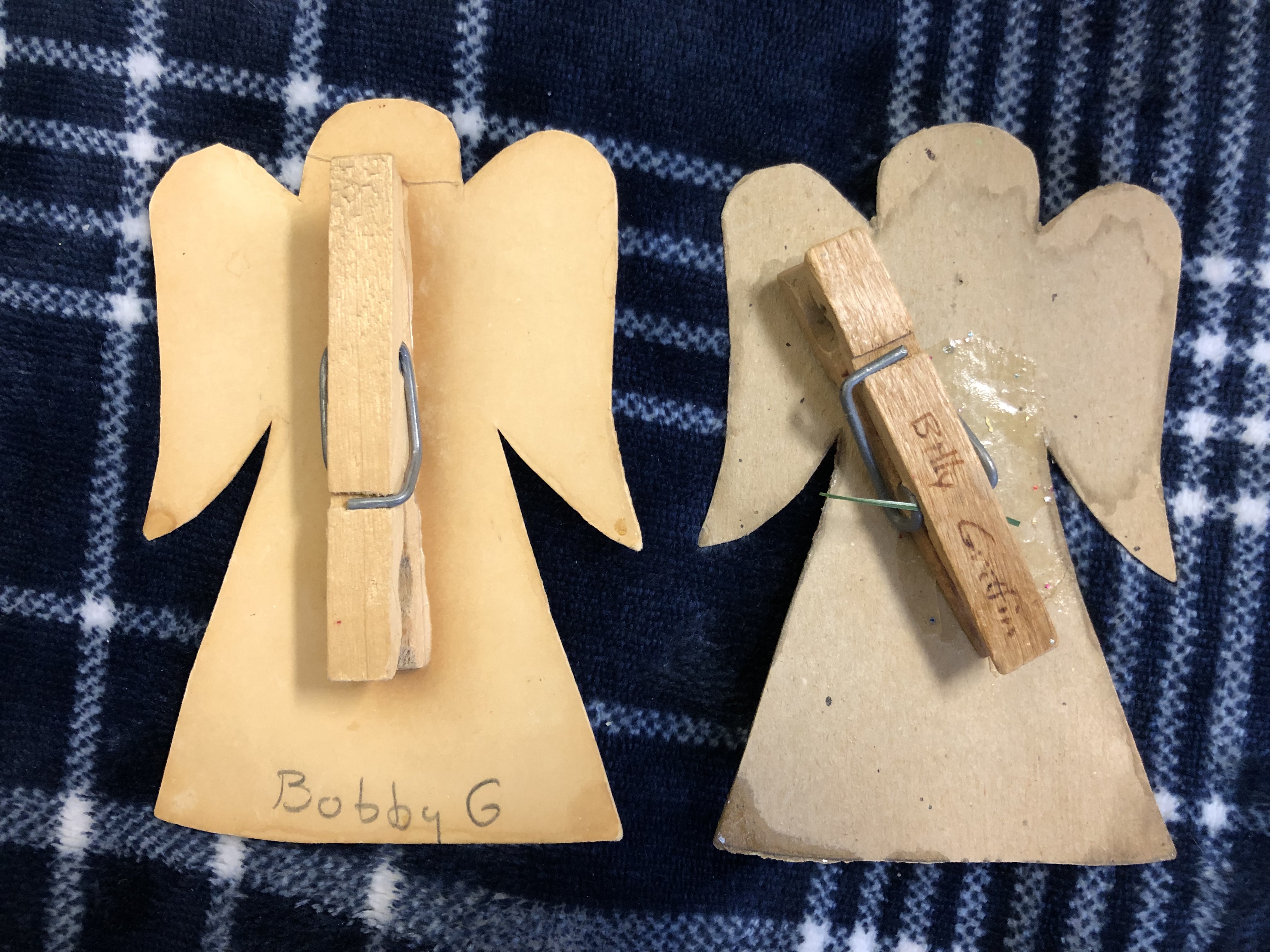
Dad barely commented to see most of the ornaments; their stories are beyond him now. Loss and diminishment is the story I was prepared to bring home with me. But in the bottom of the box I found two angel silhouettes cut from cardboard, hand decorated with glitter. Dad chuckled when I turned them over to show their clothes pin hangers and names in pencil, “Bobby G.” on one and the other “Billy.” As I was leaving, Dad gazing rapt at the handsome tree, he turned and said, “Thank you for bringing this to me.” Loss, diminishment, preservation, memory. Joy?
.
❀
.
Betty Adcock (b. 1938) was inducted into the North Carolina Literary Hall of Fame in 2014. She has taught and served as writer-in-residence in the state for many decades. Among her numerous awards and publications, this comment by Mary Oliver stands out: Adcock “writes poems that are as upright as houses, and as flighty as clouds. She never postures. The poems … are beautiful, meaningful, and very real.” (for The Difficult Wheel, 1995)
.
Intervale and Betty Adcock’s other books are available from LSU PRESS.
.
Additional poetry by Betty Adcock at Verse and Image —
.
.
❀ ❀ ❀ ❀ ❀
.
Thank you for visiting VERSE and IMAGE:
. . . . . every Friday I present one or two poems I’ve read this week that particularly speak to me;
. . . . . every Saturday I present one or two poems submitted by YOU, my readers.
.
If you would like to offer a poem for consideration, either by a favorite author or your own work, please view these GUIDELINES for Saturday Readers Share:
.
.
Also note: after January 1, 2026 I will no longer be sending separate weekly email reminders.
If you would like to receive an email each time a post appears, please SUBSCRIBE to VERSE and IMAGE using the button on the Home Page.
.
If you have a hard time finding the SUBSCRIBE button on this WordPress site, you can send me your email address and I will add you to the subscriber list. Send your request to
.
COMMENTS@GRIFFINPOETRY.COM
.
Thanks again for joining the conversation.
.
– Bill
.
.

 V E R S E and I M A G E
[…] About/Submit […]