Feeds:
Posts
Comments

Posts Tagged ‘main street rag’

Every workday I’m out the door with a travel mug just as the sun pokes through the pines on Johnson Ridge across the valley. One solace – I leave by the back door, through the screened porch, embraced by the centenary beech before I get in my car. If there’s a little light it’s a herald of goldfinches; if full dark a doe might spook. The ‘possum might still be rooting in the compost. All just outside my porch.

This morning March snow is sifting through the screen and puddling on the planks. Office closed (at least until noon). While coffee perks I shove the screened door open against a drift of heavy white and toss a couple of handfuls of seed to the ground feeders. I huddle against the house until the birds return (they’d only flown twenty feet into the hickory branches). Hello, my friends. On the porch I’m only ten feet from the phone, the bills, the desk-high tasks undone, and three miles away I can hear traffic on I-77 unslowed by a little precipitation, but here is sanctuary.

*      *      *      *      *
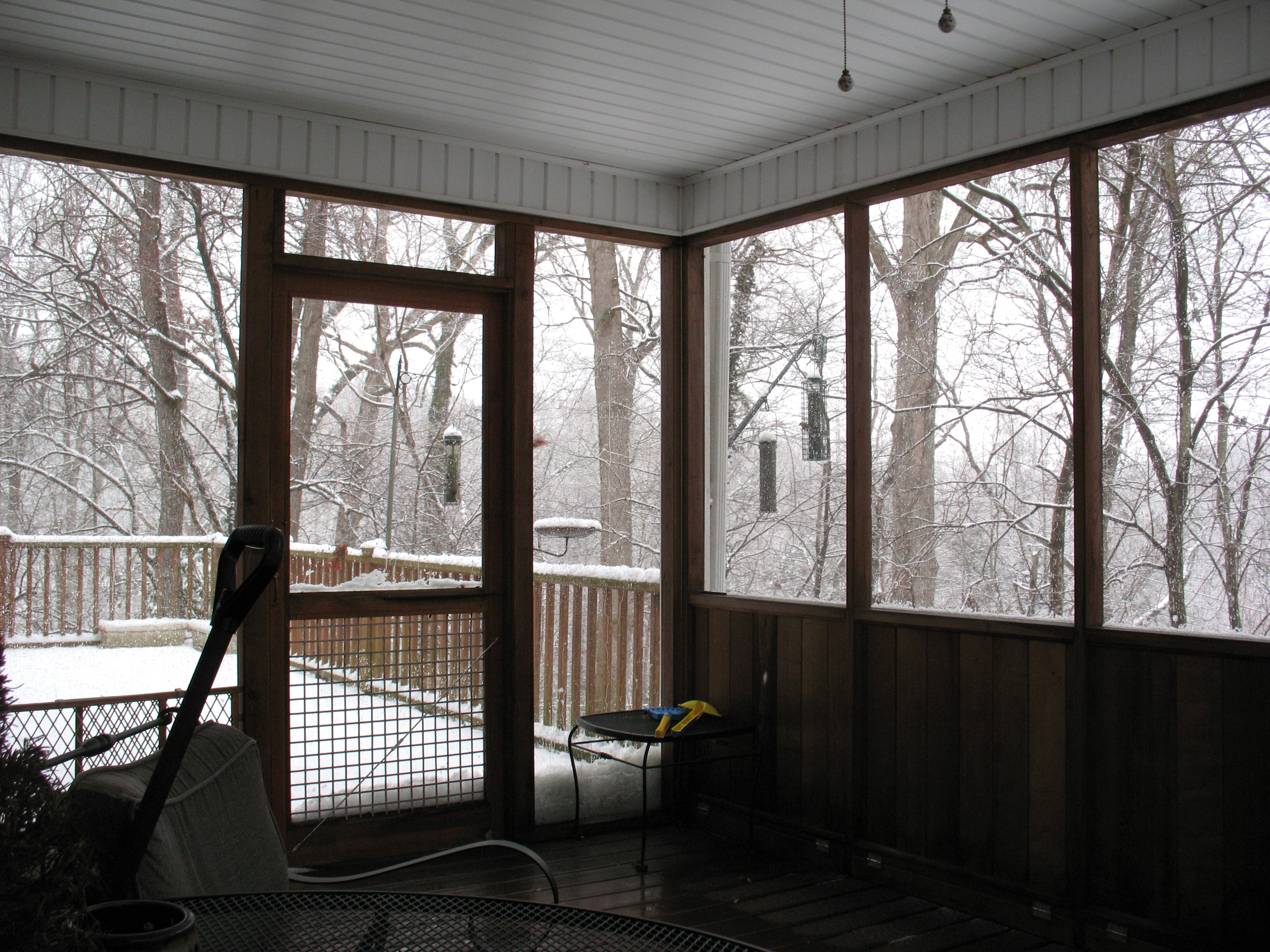
Porch_01

How many porches have acquired personality in your memory? Grandmother’s in Hamlet: the swing hanging from heavy chains, for Bob and me a pirate ship, a jet plane. Nana’s in Morehead: the smell of Bogue Sound, the chaise lounge one of us would sleep on when the July nights were too hot; our own first porch, the red rental house in Durham on Green Street, a family portrait with toddler Josh and Margaret just beginning to smile, all of us smiling.

With such an archetype it must have been easy for Maureen Sherbondy to elicit the poems, essays, short fiction that she has compiled into Voices from the Porch (Favorite Gathering Places). It is an anthology broad as a coastline or a rural avenue, but also deep in the secret heart of people gathered and torn. It’s a tangled story of memories and feelings that won’t allow themselves to be laid aside. It is voices that have whispered and will continue to whisper to each of us.

Voices Cover 01

Judith Behar’s poem Evening opens the collection. Like opening a door onto a space of sanctuary, and revelation.

*      *      *      *      *

Evening

Dusk rises from the pond,
misty and green, then gray;
a bullfrog croaks his song
up to the darkening porch
where three women drink wine by candlelight,
the humid air like saris on their skin.
They idly talk of gardening and plans
for summer travel. Work falls away,
lines soften, then disappear
in shadow. A slivered moon
hangs in a cloudless sky.
They clear the dishes, carry their glasses in –
their day ended, the guests depart.
Creatures of the night
swarm in the grass.

*      *      *      *      *

Judith Behar lives in Greensboro and is the volunteer publicity director for Writers Group of the Triad. She has taught English at Guilford College and practiced law in Greensboro for 30 years. Her poems and short stories appear in a number of publications, including contest winners in Pinesong, published by the NC Poetry Society.

*      *      *      *      *

One more reason to consider sitting down in the porch swing and reading this anthology: my short story Overflowing about Jimmy, Nella, and Monty in Surry County and the danger of love.
IMG_7952

*      *      *      *      *

Read Full Post »

Forty years ago when I was a sophomore in college I messed up.  I failed a friend.  While I was getting out of bed on dark Ohio mornings to head down to the chemistry lab, I let my roommate Mike sleep through all his classes.  While I was wearing out a carrell in the libe, I left him in the frat house getting stoned again.  When his assigned stack of Hermann Hesse lay untouched on the desk, I picked them up one by one and read them all without ever trying to engage him in discussion.  And when his German Lit. prof called me in to ask, “What’s going on with Mike?  Can’t you help?” my reply still humiliates me forty years later.  “I am not my brother’s keeper.”

Mike flunked out and I’ve never heard from him since.  What was wrong with me that I didn’t at least once try to kick his ass into gear?  A twenty-year old’s lack of empathy?  I’d define that kind of spiritual void not as lack of caring but as something far worse — lack of imagination.  I couldn’t see myself in his place.  If I was congenitally and utterly self-motivated and compulsive, why couldn’t anyone else become just like me if they wanted to?  And I confess to something even more base and perverse.  Maybe I wanted him to fail.  His failure affirmed my success.  For one guy to win another has to lose; when one falls another rises.  Damned selfish and mean-spirited, that.  Anyone who’d known such about me would surely have found me pretty hard to love.

I’m sorry, Mike.  I hope you got your act together and have found your heart’s desire.  Sorry I didn’t give you a leg up when you needed it.  I thought of you when I read Hard to Love by Scott Douglass.

.     .     .     .     .

Characters like Mike and about a hundred other equally earthbound human creatures populate the poems of Scott’s new full-length collection.  Gesticulating poets whose words are air.  A guy with a big head.  New mimes.  Those Ryan boys.  Some are hapless, some redeemed, and a few get skewered.  (Caveat:  you might not want to read this book if you’re a cryptofascist airhead zombie.)  Yes, they’re hard to love, but here’s the secret Scott doesn’t want you to know: he pretty much loves them anyway.

Read every poem.  You and I live in those lines.  We can’t escape what they reveal within us: impatience, ignorance, jealousy, self-righteousness, all the follies we’ve got shuffled in our hearts like a deck of cards — what’ll be next?  deal it! — every one of those things that have “caught me leaning too hard / into dangerous curves.”  You’ve got me this time, Officer.  I’ll pay the ticket.

.     .     .     .     .

Blenheim Tea #1

Bobby McMullen Died Last Night

Or the night before,
or last week,
or maybe it was years ago
when his wife left him
or his only son succumbed
to leukemia

A lifetime of reasons
to cuddle a bottle of Jim Beam.

We could forecast the workday
by the way he walked through the door:

quiet and sullen meant hungover,
hungover meant irritable, outright mean,
loud and talkative meant still drunk,
hangover to follow at eleven.

Even drunk he was a better
finisher than most, and after
some lunchtime refueling, he
was good for the rest of the day.

But it caught up with him.

First he totaled his car,
then the state revoked his license,
liver failing, emphysema and
tuberculosis choking him —
two years ago he retired.

Paper said they found him
face-down in his double-wide.
He’d been dead awhile.
But he went the way he wanted,
the way we always knew he would.

from Hard to Love by M. Scott Douglass

.     .     .     .     .

Blenheim - Tea #2

M. Scott Douglass is the editor of the quarterly journal Main Street Rag and the notorious czar of Main Street Rag Publishing Company.  Don’t get me started.  Hard to Love was released during an ice storm on February 19, 2012.

Scott has done more to promote poetry at the grass roots, both in NC and around the US, than a dozen MFA programs.  Stephen E. Smith calls him “a poet in the spirit of Charles Bukowski — but better, more controlled.”  I consider it an honor and a privilege to have had him kick my ass.  Told you not to get me started.

Sample other poetry by M. Scott Douglass:

Auditioning for Heaven
Balancing on Two Wheels
Steel Womb Revisited

.     .     .     .     .

IMG_0768

Read Full Post »

. . . to look a lot like . . . just another Christmas book or movie, another Christmas song or poem.  Is there anything you can write or say or perform for Christmas that hasn’t already been done, and better, sometime in the past 2000 years? There can’t be a more evocative metaphor for the arrival of the Messiah than “dancing day,” and yet we continue to compose new musical settings.  The Nativity has been retold in every possible medium, from clay-mation to post-modern irony (though perhaps not yet in RealD).  And yet . . .

. . . every year we search the shelves for the next perfect Christmas book for our grandson.  Now that Linda’s Mom (nickname, Conan the Librarian) is no longer able to go book shopping for the entire family, Linda and I are mailing copies of our favorites to the newest nephew.  And when I saw Sally Buckner’s latest collection on the Main Street Rag website, Nineteen Visions of Christmas, I had to have it.

As an educator and writer and proponent of poetry, Sally Buckner’s name is known to everyone active in the North Carolina poetry scene.  But in private discourse Sally has blessed her family and friends every year with an annual Christmas poem.  This book presents many of those poems to the public for the first time.  It’s a diverse blend with something for the child and the adult, something contemplative, something exultant, something to make you grin.  I’m fond of The Morn After Christmas – I challenge anyone to recite a line in anapestic tetrameter without conjuring Clement Moore.  I choked up reading The Ballad of the Innkeeper’s Wife; I could see it being adapted for the stage.  As could The North Wind Catches Christmas.

But my favorite of the series is one that’s clearly very personal to Sally, and through its distinctives and details it evokes in the reader something much larger.  How many seemingly minor memories of our own past Christmases have we forgotten?  How many stories have we wrapped in tissue and left boxed in the attic?  Entering the world of one of Sally Buckner’s childhood Christmases, I find images flooding my mind.  Day after tomorrow, when we gather around the tree, I’ll try not to forget – the best gift is to share what binds us together in love.

.     .     .     .     .

CEDAR
Sally Buckner

Always cedar.
Fir trees didn’t grow in Iredell County,
and George never considered pine or hemlock,
which suited me fine: I loved the scent of cedar
spicing the entire house from the very minute
those feathery branches ruffled through the door
until right after Christmas, when we flung
its carcass, picked as clean as chicken bones
outside where it could dry till fit for firewood.

In early years, he’d combine his search
for a tree with a hunting trip, return grinning,
tree on one shoulder, rabbits on the other.
Later, when whatever disease the doctors
couldn’t find a name for drew the muscles
in his legs so tight he could barely walk –
lurched like a drunken sailor – he would drive
far out in the country, scanning the winter roadside
till he found a likely candidate, straight and full,
which he could manage to clamber to, cane
clasped in one hand, ax in the other.

Never paid or asked permission.  Lord, why would he?
We were all tree-poor those days, wouldn’t miss a cedar
more than a dandelion.  Nobody thought
of using tillable land for Christmas trees.
When Hoover was still making promises,
who would have laid down a cherished dollar
for something to toss away after just a week?

When George got home, he’d nail two boards in an X
for the tree’s support.  I’d swath them with a blanket.  The
girls would help him string the lights, then wind
cellophane garlands through the greenery.
Meanwhile I’d whip Lux flakes to a frothy lather;
dried in the branches, if you’d squint your eyes,
you’d swear that it was snow.  Altogether,
it was some kind of pretty.

Eighteen years now, he’s been gone.  At first,
my boy still at home, I’d buy a tree –
resenting every dollar – fix it up
the best I could all by myself.  Then later,
hoisting trees got to be beyond me.
I purchased one advertised as “everlasting,”
needles, branches, trunk – all aluminum.
Don’t use lights, just big red satin balls.
The children, When they come, don’t complain.
The grandchildren exclaim, “Red and silver”
Look at it shine!”
And it lasts year after year –
not half the trouble of a woodland tree.

But I still miss the scent of cedar.

.     .     .     .     .

IMG_6585_edit01

Sally Buckner, former journalist and English professor, is the author of two additional poetry collections: Strawberry Harvest and Collateral Damage.  She also edited the anthology Word and Witness: 100 Years of North Carolina Poetry, which is an essential volume of your poetry collection; if you don’t own a copy, contact me and I’ll let you know how to order one!  Sally resides in Cary, NC.

Nineteen Visions of Christmas (copyright 2011): the new poetry chapbook by Sally Buckner is available from Main Street Rag Publishing.

.     .     .     .     .

IN A DARK SEASON
Sally Buckner

Though forg has shrouded sky and hill,
I dare to dream this Christmastime
that you may tread a steady trail
with hands to hold you as you climb.

May candles fling their bravest flame
against the claim of bleakest night,
and great bells sound their silver chime
to sing the presence of the light.

.     .     .     .     .

IMG_9310_edit01

Read Full Post »

« Newer Posts