SUBMISSIONS CALENDAR
Latest Update January 17, 2026
.
My friend Scott Owens asks this question: What is it that poets want?
The answer: To Write! To write and write until fire fills the room and our words burn themselves into the page. Or at least to come back to what we wrote yesterday and say, well, that’s not so bad.
Some poets, not all but some, also want to be read. Some of us would like our poems to be read by someone other than our mother, our friend, our teacher. So we send our poems to editors.
I share this Submission Calender in hopes it will make the process a little easier. It will not convince you that your poem is okay or hold your hand when rejection arrives, it probably won’t ease the process of saying goodbye as your poem speeds into the ether, but it will help you put your poems in editor’s hands.
.
And a confession: I like editors. Most of them are also writing poetry and trying to get published – we are all in this together. Most editors are engaged and enthusiastic and really optimistic that the next poem they read is going to knock their socks off. And every once in a while one of them will communicate that enthusiasm to you, if you keep sending them your best writing.
.
Treat editors as your friends. Read their guidelines. Even better, read their publications. Send them poems they are apt to like, in the format they like, on the schedule they like. That’s where this POETRY SUBMISSIONS CALENDAR comes in.
.
⇓⇓⇓ CLICK HERE ⇓⇓⇓
.
.
Here’s how I use the CALENDAR:
.
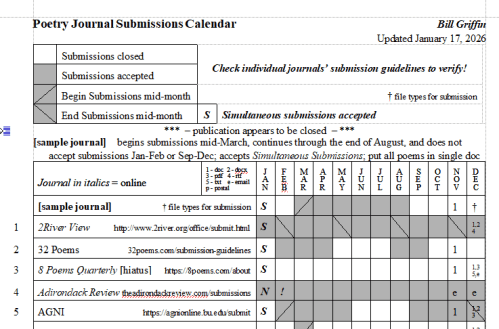
It’s arranged by month – look down the column to see what journals and sources are open for submissions right now!
.
.
Each row includes the web address – be sure to check before you submit, because requirements and schedules are always changing!
.
The row also includes other information such as:
Is this an online publication only?
Should your submission include all poems in a single document?
What file formats do they accept?
.
There are more instructions on the table itself. Feel free to print it out. The table currently (20 Jan 2025) contains 332 listings, including journals on hold or defunct (to save you from wild goose chases). At the end are some random references I’ve collected, a table of winners and losers on promptness of reply, and a few journals accepting art & photography.
.
I would really appreciate it if you notify me of any errors or suggested changes! If you have journals you’d like me to add to the table please do send me the particulars! I will try to post an updated table once or twice a year and whenever I have made significant additions and corrections to the table.
.
Finally, here’s a happy little story. I had received a standard rejection notice after a standard waiting period, but something about the personal nature of the rejection message prompted me to send a follow up email. I dared to ask if any of my poems came near the mark, and this was the editor’s reply:
.
You certainly meet the mark, Bill. That is, you’re a fine writer. As are most of Innisfree‘s submitters. Who knows what causes a poem to leap out and insist on its acceptance to the reader. That happens about 2 percent of the time. I look forward to seeing more of your work in the future. [Greg McBride, editor, Innisfree Poetry Journal, December 2023]
.
May your own poems leap out and insist upon their acceptance to the friendly neighborhood editor who is reading them. And even if they don’t, well, that was at least one reader!
.
If you find this useful, if you can suggest more journals to include, or if you discover errors please send me a comment, correction or suggestions at:
.
comments@griffinpoetry.com
.
BILL GRIFFIN / ELKIN, NORTH CAROLINA / USA
.
❦ ❦ ❦
.
Oh, and here’s the origin story: In 2015 I posted the prototype of this table as I was developing a tool to keep track of when and where to submit poems for publication. As the second of a two-part muse on why oh why we place ourselves at the mercy of all powerful editors, here’s the original post with description, but make sure you’re using the link at the top of this page for the most up-to-date version:
.
.

 V E R S E and I M A G E
[…] About/Submit […]