
Golden Ragwort, Packera aurea
.
[poems by Charles Simic, Sylvia Plath, Katharine Spadaro,
Rosanna Warren – selected and shared by
Sharon Sharp, Kitsey Burns, Brad Strahan, Bill Griffin]
❦
photographs in today’s post are from the banks of Dutchman Creek,
Elkin NC, within a 2 meter diameter circle, taken on April 16, 2025
❦
Stone
.
Go inside a stone.
That would be my way.
Let somebody else become a dove
Or gnash with a tiger’s tooth.
I am happy to be a stone.
.
From the outside the stone is a riddle:
No one knows how to answer it.
Yet within, it must be cool and quiet
Even though a cow steps on it full weight,
Even though a child throws it in a river;
The stone sinks, slow, unperturbed
To the river bottom
Where the fishes come to knock on it
And listen.
.
I have seen sparks fly out
When two stones are rubbed,
So perhaps it is not dark inside after all:
Perhaps there is a moon shining
From somewhere, as though behind a hill-
Just enough light to make out
The strange writings, the star-charts
On the inner walls.
.
Charles Simic
from Selected Poems 1963-1983, George Braziller, New York; © 1990
.
Charles Simic’s Stone delights me because I’ve been a rockhound since childhood. This poem celebrates the mysterious, silent presence I’m aware of when holding stones, turning them in my hands, and wondering about the part of Earth’s – and even the cosmos’s – history each one represents. I keep stones as reminders of my own history, and clear scenes from various places emerge anew as I cradle these inanimate yet vibrant objects tying me to the natural world. I take Stone as an invitation to savor what is interior, silent, often overlooked, and unique in all aspects of nature.
.
I keep a wrinkled, often-read copy of Stone posted near some of my collected treasures, including the tektite that inspired my own poem, which follows. – Sharon Sharp
.
❦
.
Tektite
.
From my necklace chain dangles a shiny,
pocked, black-glass exclamation point,
minus the dot, full of chemical clues
about celestial origins and a likely
ancient collision: a comet or an
asteroid smashing into Earth.
Upon impact, melted shards
catapulted back into the
outer atmosphere, then
descended, cooling.
The hard rain that
pelted hundreds
of miles still
mesmerizes
dreamers.
.
Sharon A. Sharp
from Pinesong, North Carolina Poetry Society; © 2018
.
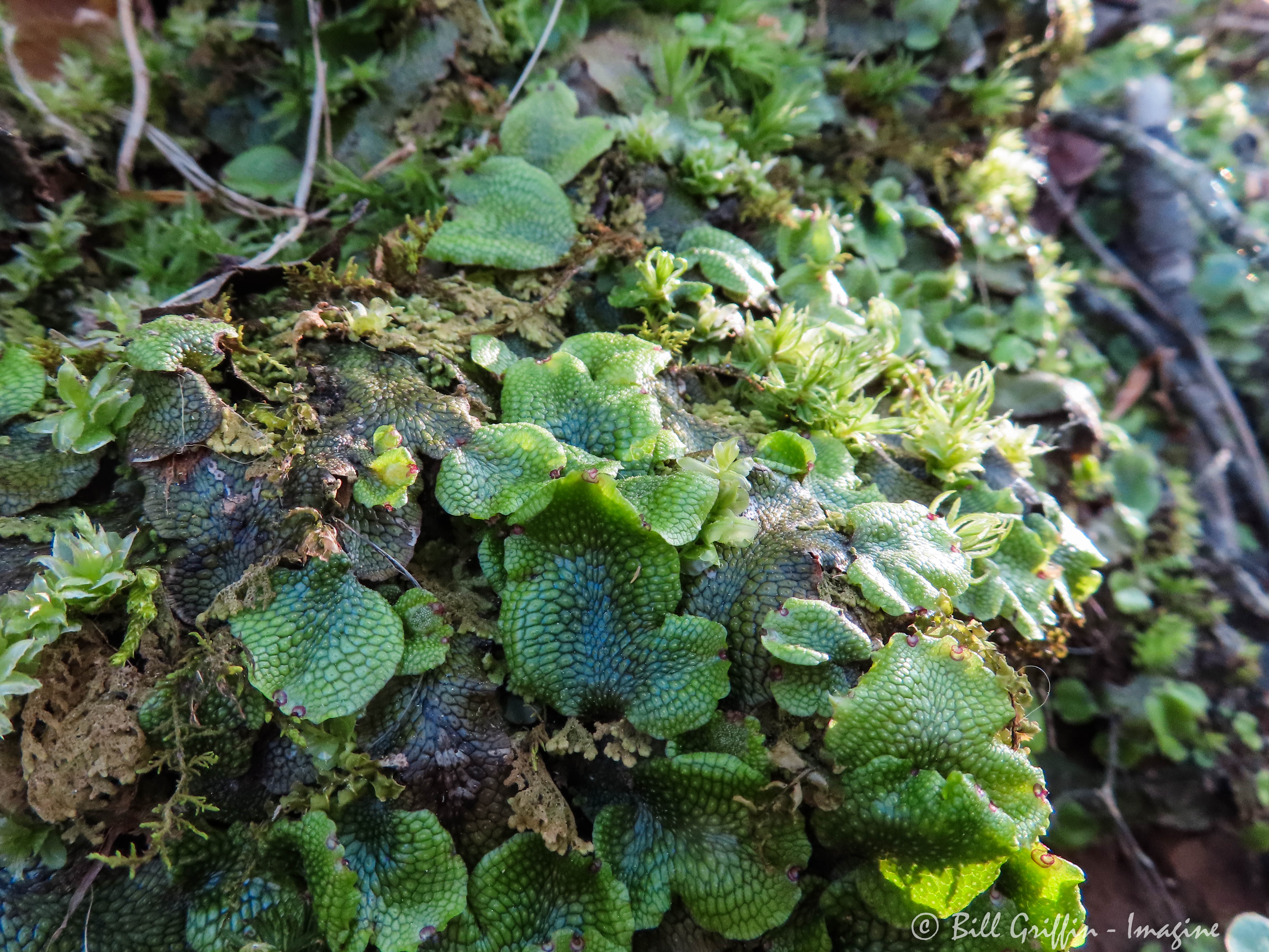
Snakewort (Liverwort), Conocephalum salebrosum
.
❦ ❦ ❦
.
The Beekeeper’s Daughter
.
A garden of mouthings. Purple, scarlet-speckled, black
The great corollas dilate, peeling back their silks.
Their musk encroaches, circle after circle,
A well of scents almost too dense to breathe in.
Hieratical in your frock coat, maestro of the bees,
You move among the many-breasted hives,
.
My heart under your foot, sister of a stone.
.
Trumpet-throats open to the beaks of birds.
The Golden Rain Tree drips its powders down.
In these little boudoirs streaked with orange and red
The anthers nod their heads, potent as kings
To father dynasties. The air is rich.
Here is a queenship no mother can contest—
.
A fruit that’s death to taste: dark flesh, dark parings.
.
In burrows narrow as a finger, solitary bees
Keep house among the grasses. Kneeling down
I set my eye to a hole-mouth and meet an eye
Round, green, disconsolate as a tear.
Father, bridegroom, in this Easter egg
Under the coronal of sugar roses
.
The queen bee marries the winter of your year.
.
Sylvia Plath
from The Kenyon Review, Autumn 1960 • Vol. XXII No. 4
.
I sat down this morning to read some Sylvia Plath poetry. I read The Bell Jar for the first time a few years ago, while at my Dad’s deathbed. You would think it would have been a poor choice for that time in my life, but truly I loved the book, so beautifully written. So my Earth Day selection from Plath is The Beekeeper’s Daughter. Bees are the ultimate example of community working together for good. This piece is very sensual and dark, in a way too. For me it is a reminder that light and darkness, life and death are an irrevocable part of the human experience. While we may be in a time of darkness and existential dread about the future of our earth, it is imperative now more than ever, that we seek community to sustain us.
.
Thank you, Bill, for these lovely poems you send each week. It brightens my week immensely when I am able to take the time to read them. – Kitsey Burns
.
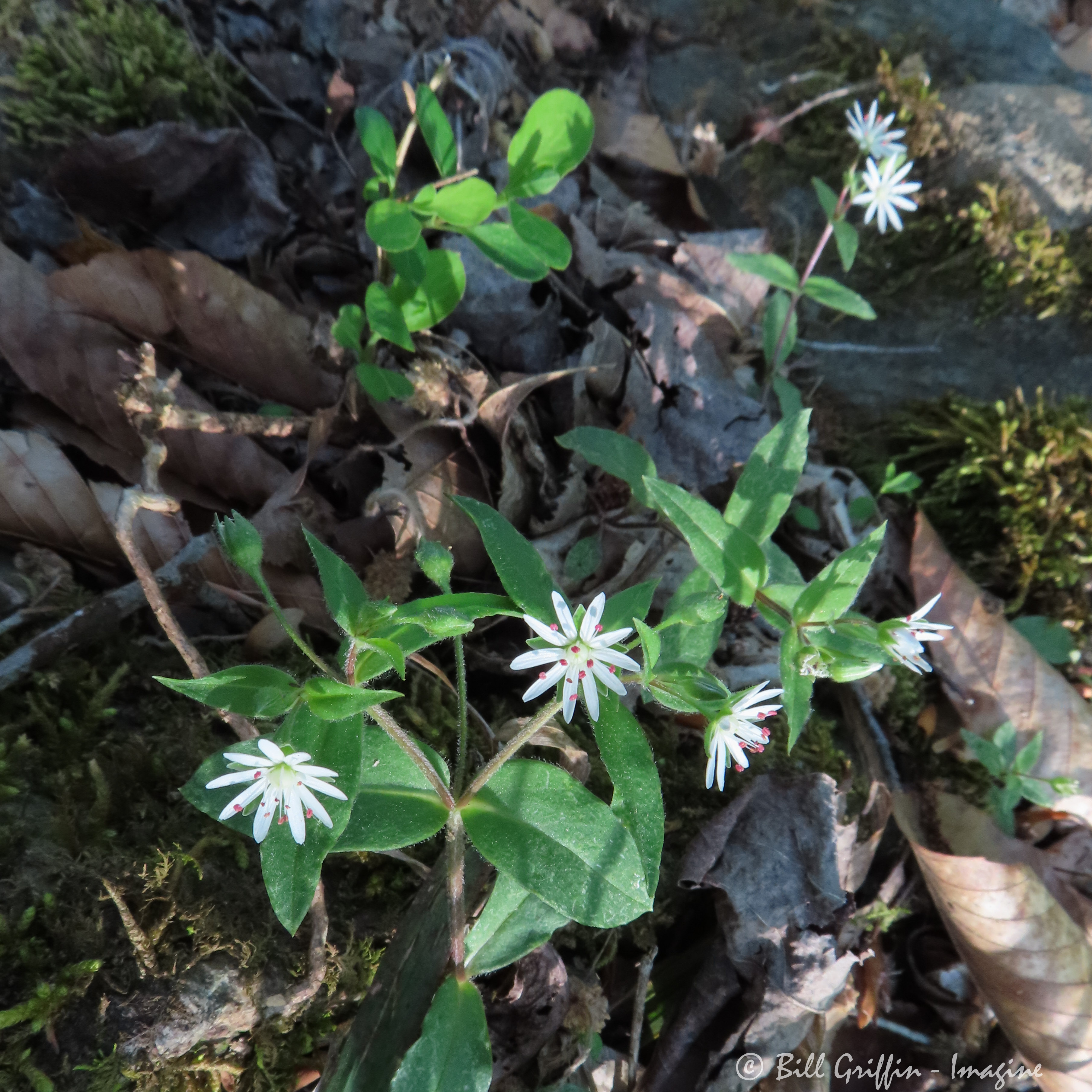
Star Chickweed, Stellaria pubera
.
❦ ❦ ❦
.
The Day of the Funeral
.
Are you ready? they say, preparing to go. The search
how to say, how to feel, becomes a groping for jackets,
a finding of shoes. I look for a place to tie up my hair
and there is the cabinet, forever there.
Its mirrored backing can barely be seen
behind gold-speckled teacups, presents child-made,
crystal marching away to the past. Kneeling on carpet
I join in this scene and serious features
echo and float amongst
gilt generations of gently washed china.
An accordion of hands is fixing my hair.
Has anyone ever been ready?
.
Katherine Spadaro
from Visions International, Vol. 109
.
I often think of how much we have buried or pushed nature aside but she is there waiting and will sooner or later reclaim it all from us, our brief, brief dominion.
.
For earth day I thought of the subtext of this little poem from the past (mine). – Bradley Strahan
.
❦
.
Ghosts
.
In a lost corner of childhood
where marshland sleeps
beneath concrete,
the tide of evening
still climbs the forest wall.
.
Across the pond,
now drained and lawned,
the path looks westward
through the red receding flood of day.
.
There June is always a memory of redwings
singing with a chorus of frogs,
and in dank basements ghost cattails grow
through the temporary habitations of man.
.
Bradley Strahan
.
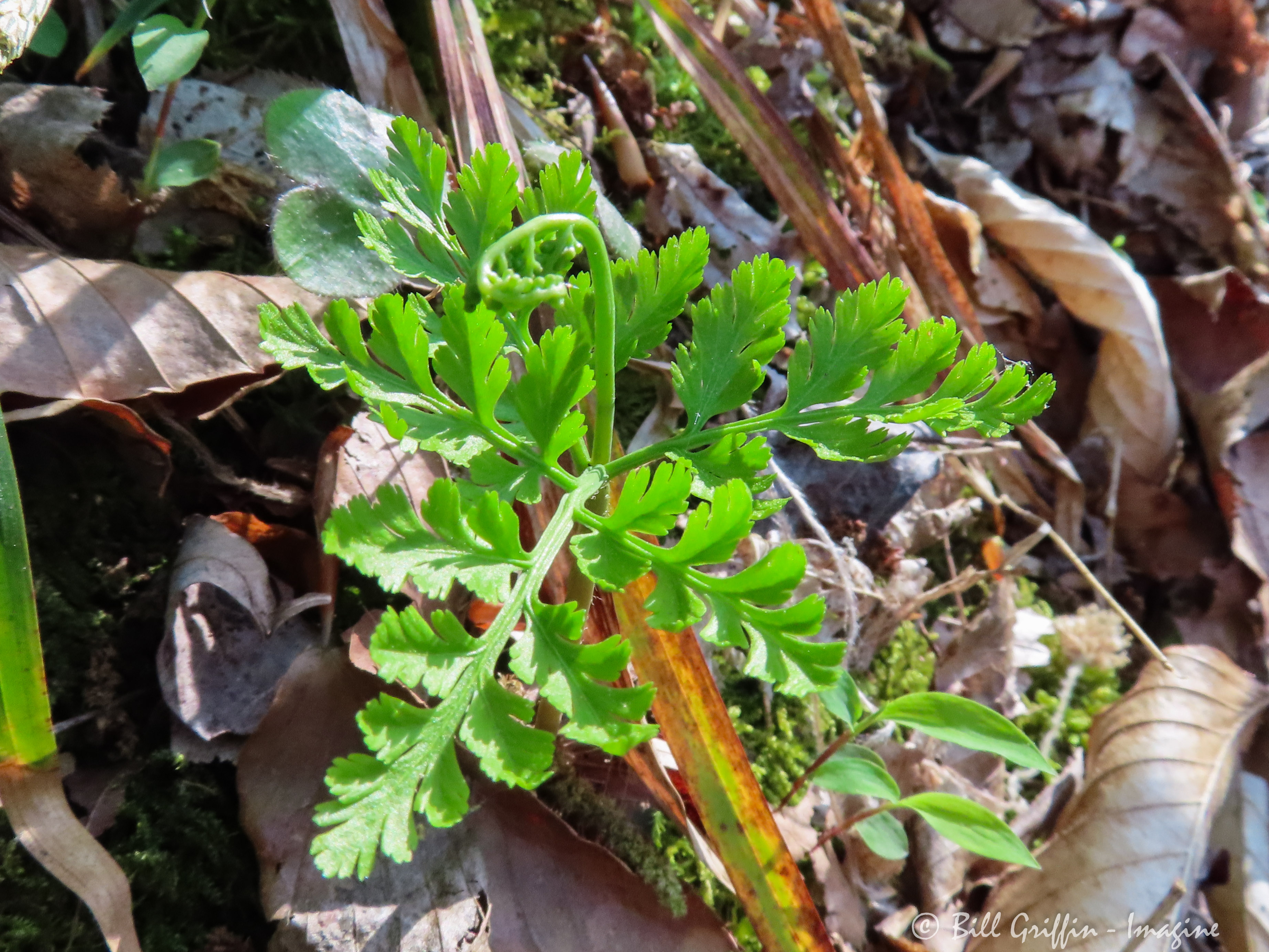
Rattlesnake Fern, Botrypus virginianus
.
❦ ❦ ❦
.
The Cormorant
for Eunice
.
Up through the buttercup meadow the children lead
their father. Behind them, gloom
of spruce and fir, thicket through which they pried
into the golden ruckus of the field, toward home:
.
this rented house where I wait for their return
and believe the scene eternal. They have been out
studying the economy of the sea. The trudged to earn
sand-dollars, crab claws, whelk shells, the huge debt
.
repaid in smithereens along the shore:
ocean, old blowhard, wheezing in the give
and take, gulls grieving the shattered store.
It is your death I can’t believe,
.
last night, inland, away from us, beyond
these drawling compensations for the moon.
If there’s an exchange for you, some kind of bond,
it’s past negotiation. You died alone.
.
Across my desk wash memories of ways
I’ve tried to hold you: that poem of years ago
starring you in your mater dolorosa phase;
or my Sunday picnic sketch in which the show
.
is stolen by your poised, patrician foot
above whose nakedness the party floats.
No one can hold you now. The point is moot.
I see you standing, marshalling your boats
.
of gravy, chutney, cranberry, at your vast
harboring Thanksgiving table, fork held aloft
while you survey the victualling of your coast.
We children surged around you, and you laughed.
.
Downstairs the screen door slams, and slams me back
into the present, which you do not share.
Our children tumble in, they shake the pack
of sea-treasures out on table, floor, and chair.
.
But now we tune our clamor to your quiet.
The deacon spruces keep the darkest note
though hawkweed tease us with it saffron riot.
There are some wrecks from which no loose planks float,
.
nothing the sea gives back. I walked alone
on the beach this morning, watching a cormorant
skid, thudding, into water. It dove down
into that shuddering darkness where we can’t
.
breathe. Impossibly long. Nothing to see.
Nothing but troughs and swells
over and over hollowing out the sea.
And, beyond the cove, the channel bells.
.
Rosanna Warren
from Poems for a Small Planet: Contemporary American Nature Poetry, Middlebury College Press, University Press of New England; A Breadloaf Anthology © 1993.
.
In the Afterword to Small Planet, Robert Pack writes, “When the primary models for beauty and creativeness no longer are grounded in nature, we will already have evolved into another kind of species. . . . Without the sense of beauty that derives from an awareness of others, from the realization that we are merely creatures in an evolving world that we share with other creatures, a prior world on which our fabricated cultural world depends, the capacity for taking delight in our surroundings will wither away. Even before the planet becomes inhospitable to the human species, we will have died in spirit.”
.
One thing we inevitably share with every other creature is our mortality. Turning our backs and refusing to see death, or chasing promises to extend our lives at all costs, are simply among the many ways that we also choose to ignore and overlook life. Lichen stone and bee, ghost cattail and cormorant, I will sit down at your wake and invite you to mine. Until that day, let us live together. – Bill Griffin
.

Sensitive Fern, Onoclea sensibilis
.
❦ ❦ ❦
.

.
.


 V E R S E and I M A G E
Leave a comment