Feeds:
Posts
Comments

Archive for April, 2011

In January 2010 the neurosurgeon diagnosed Linda’s Dad with glioblastoma multiforme (the most aggressive malignant brain tumor). The cruelest cut was that the first thing the cancer robbed Dad of was the evenings spent scratching physics equations on yellow legal pads – he was reworking relativity from the fundamentals on up, correcting the errors he’d discovered Einstein had made.

Park French was the most intelligent person I’ve ever met, and the most curious. He knew something about everything and everything about a whole lot of things. There was no particle of creation that was not a subject for his discovery and delight. And his greatest delight was sharing that knowledge. I would feel just brilliant when I sat beside him and he explained electromagnetism and the derivation of Maxwell’s equations. Park died on February 16, 2011.

Last fall I spent a Saturday hiking from Basin Creek up the Flat Rock Ridge Trail to the Blue Ridge Parkway. All the way I was thinking about Dad French and all the things he would have been teaching me along the climb. Here in our neck of the woods is a tree with distinctive buttery autumn foliage, seen commonly along the spine of the Southern Appalachians but not often elsewhere: Fraser Magnolia, first described by William Bartram in 1775 but named by John Fraser, a British collector of botanicals. I picked up a leaf to press for Dad. I had it with me when I read this poem at his memorial service:
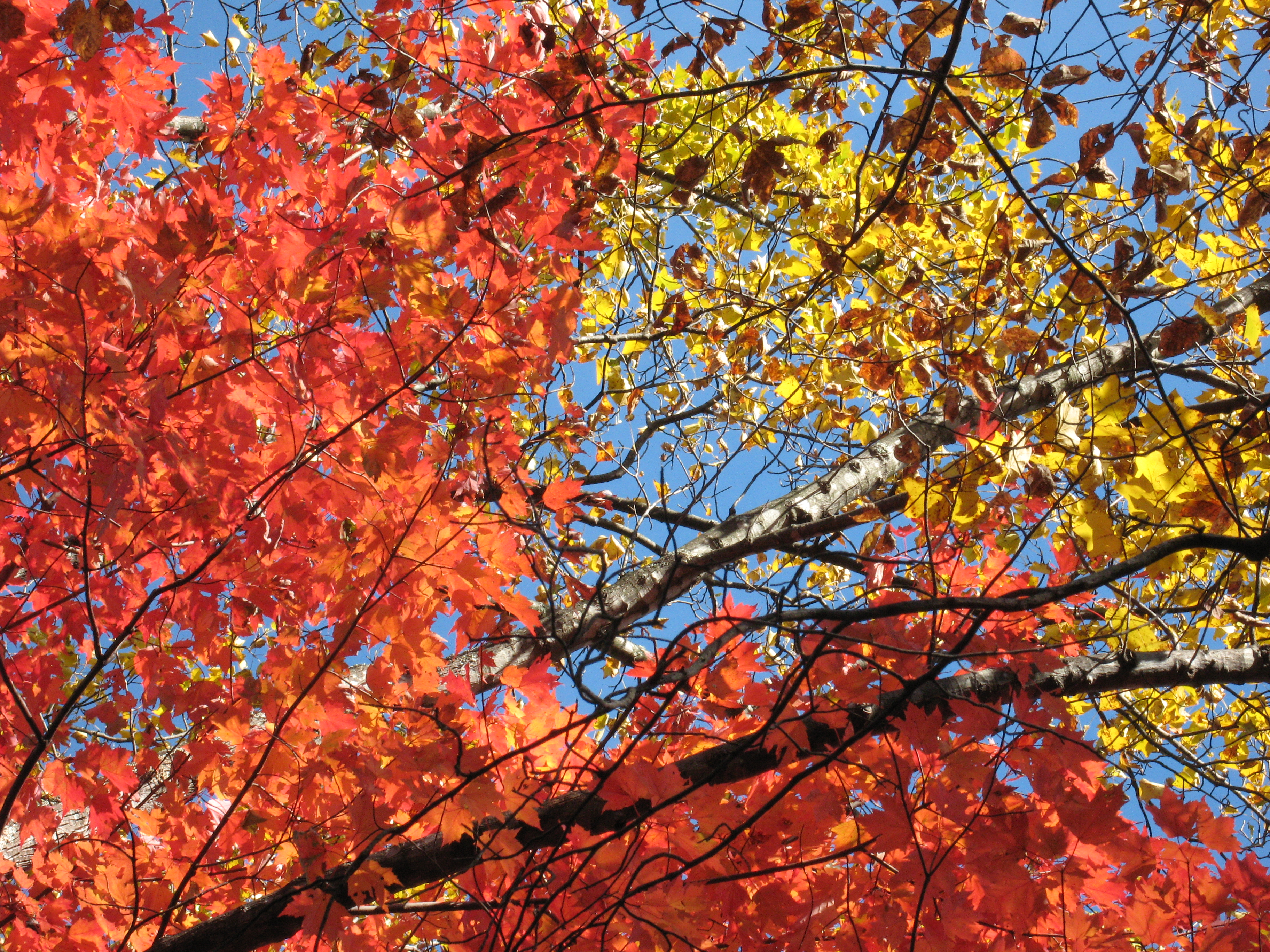
Flat Rock Ridge Trail


With the Separate Leaves

The trail up Flat Rock Ridge this morning
       is ankle deep, the brittle season
of chestnut oak, cracked manuscript of maple.
Every scrape and scuffle calls out – I know
       you are listening.

Every long breath recalls the first time
you walked me through mountains
       to Kelly’s Pines, up the Allegheny steprock,
a raven’s perch and runes
you scratched there:
gandalf was here
In your company wonder
and revelation, ancient mutterings
       of dark forest, the language
of night deep as memory, stars
in our pockets.

For us you were all window,
all door; was there anything
       you couldn’t teach us?
Heat disentangling its waves
into particles, everything connected,
       every thing distinct. Listen,
they are speaking to us, the planets,
the separate leaves.

And you know we are listening.
We never wanted to learn
       this language of loss, dim path
grown narrow, but this morning the trail
crests above Basin Cove before
       it descends, and here at my feet
is something rare: I will save
an offering for you – let’s discover
       its oblate identity, trace
twin lobes at the pedicle, name it
Fraser Magnolia,

name it listening, seeing,
       name it revelation . . .
              wonder.
 

[the title is from the final line of the poem Hymn by A.R. Ammons: “and if I find you I must stay here with the separate leaves”]


Read Full Post »

Picture a slender somewhat grave man approaching the lectern. Matter-of-fact. Even slightly reticent. With only the briefest introduction he begins to read, and now you’re suddenly jolted by verse that is tart as some strong organic acid. Or wickedly funny. Or so tender, so full of love, you want to beg this person to be your friend, too.

And sometimes all three of those in the same poem!

I have admired Dave Manning’s poetry for a decade, but the images that seethe up through his lines have been simmering from California in the ‘60’s all the way to Cary, NC yesterday. Sarcasm that is never cruel. Sweetness never treacle. And always lurking a page or two away that divine wickedness.

Two of my favorite are collected in his book-length The Flower Sermon. In almost every poem a mystery hovers at the edges. The lines between waking and dreams, between chemistry&physics and the spirit realm, between existence and the everafter, all these lines are blurred and merging.  From the poem Mysteries:

How can light so absolute be gone –
no lesson to learn, no explanation?
Only a wall where a door
once opened. A mystery

like death
or where fire goes
when it goes out.

A poem like a Zen koan, more question than answer. The act of discovery comes after I’ve finished the last line; its silence reverberates, its hushed clamor.

And the last two stanzas of Mallards in Winter, which cries to be read when spring is still a thing hoped for but mostly unseen:

Their peace is so profound I cannot
disturb them. Their house is icebound,
but its attic is the sky. In the tearing storm

I invite them to take refuge in my dreams.
At the canvas edge, where the seasons
change, they escape into springtime.

So many of Dave’s poems intimate that where there seems to be no escape – from ice, from winter, from death – the mystery of hope abides.

Crested Dwarf Iris

Here are the complete poems:

Mysteries
you are the music
While the music lasts.  —  T.S.Eliot

I light candles to the way
you eyes would find me
from the far choir loft
and you would smile,

to the day
we brought the smell
of Liquidamber leaves indoors
with us, the first two stair steps
wet with the May rain; on a wall
a painting I had never seen —
geese rising from a marsh at dawn —
street sounds with tones,
the green-bue of late afternoon.

How can light so absolute be gone –
no lesson to learn, no explanation?
Only a wall where a door
once opened. A mystery

like death
or where fire goes
when it goes out.


Mallards in Winter

With the leaves down, I see them
paddle the creek-length, green heads
against the lighted flow.

They drift downstream in silence,
as if in a painting on a silk screen,
toward Lake of the Winds.

Their wakes show them to be real.
I watch them bob and disappear,
then emerge from the banks into the winter’s

silvering light. They let the current
take them, soundless, through
the shadowed channel’s mystery.

Their peace is so profound I cannot
disturb them. Their house is icebound,
but its attic is the sky. In the tearing storm

I invite them to take refuge in my dreams.
At the canvas edge, where the seasons
change, they escape into springtime.

[from The Flower Sermon, Main Street Rag Publishing, (c) 2007 David T. Manning]


Links to other poems by David T. Manning:

Dave Manning Sampler in WestEndPoets Newsletter
www.Westendpoetsweekend.com/pdf/WestEndPoetsNewsletterjanuaryFebruary2011.pdf
www.Westendpoetsweekend.com/pdf/WestEndPoetsNewsletterMarchApril2011.pdf

At the Spring, in Rattle
http://rattle.com/blog/2009/05/at-the-spring-by-david-t-manning

Mirella, in PoetrySpark
http://Poetryspark.sparkcon.com/poems/manning/mirella.html

Read Full Post »

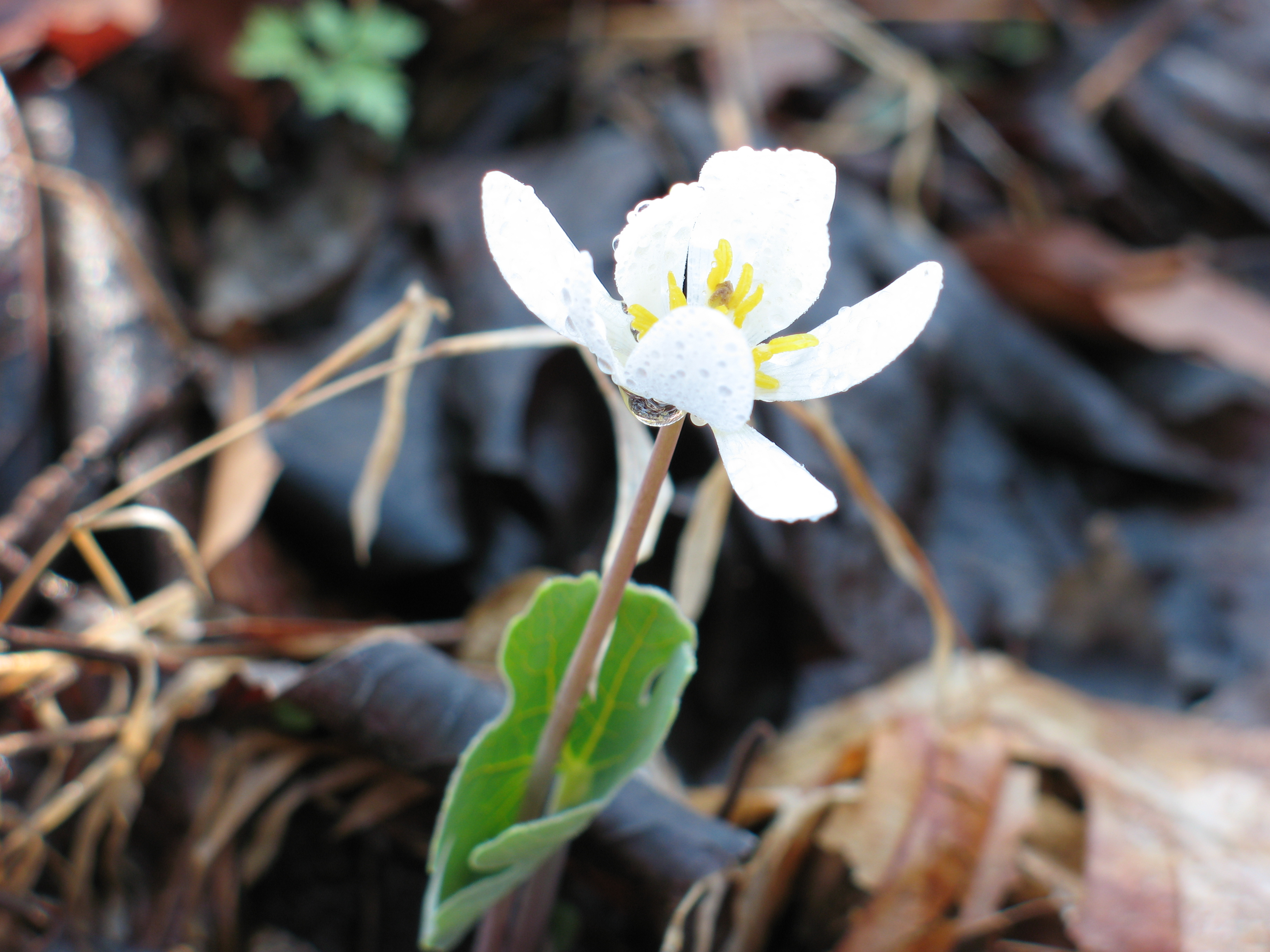
Today the bloodroot is blooming along Brookwood Drive in Elkin – its leaf an unfolding hand, its 10-point star of petals. Every Spring I wonder if I will find it again, or will it be overcome by the the choke of invasives. Every Spring it rises. Tenacious, faithful, humble, generous, this April it gives the gift of itself to the earth making new.

Just once I watched a naturalist dig one up (from an extensive spread). He sliced into the rhizome like a nubby finger; one then another drop of thick red-orange life juice bled onto his palm. One small plant, all metaphor.

Bloodroot

Watch mid-April for the liver-lobed leaves,
a week later the flower that rises from duff,
a star, lace bonnet, last memory of snow;

this patch of blossoms grows smaller each spring
overtaken by honeysuckle and poison ivy –
I wonder how long it can go on blooming.

Each year our lives grow smaller as well,
overgrown by everything we thought made us strong,
thatch of vines spelled should and shall

too dense to admit the April sun.
How long until we stop imagining spring,
’til indifference sucks us dry as winter?

I want to free this flower, lift from strictures
to spread its rhizomes across a dozen wild places
wider than I can begin to discover,

but won’t my touch break its delicate stem?
Fear is the red-orange drop that oozes
out from the heart that hesitates.

Help me to feel the truth of roots
thrust like blood into earth’s desire;
make me believe dead branches bud, then

take my fingers where warmth begins –
this webwork of birth has grown so light
raising it will require two hands.

[first appearance in Changing Woman, Main Street Rag Publishing, 2006; also published in in HeartLodge Vol. 3, 2007]

Read Full Post »

« Newer Posts