Feeds:
Posts
Comments

Posts Tagged ‘Joseph Bathanti’

For one brief moment each place is its center. The sky parts, darkness rends, the sun touches that place then moves on, but the place retains the sureness of its center.

We are wakened at 2:00 a.m. by trumpets and tubas playing hymns. They have stopped outside our window on Marshall St., played two verse, then moved on. I peek through the blinds while downstairs my Mom goes out onto the front porch in her nightie to thank them. From other parts of the old town, faint and distant, Linda and I can hear the band’s counterparts. Our alarm is set for 4:30. We whisper in the darkness. For a moment we are the center.

By 5:30 we have gathered with hundreds of others in the darkness outside Home Moravian Church in Salem Square. Robins sing continuously. There’s a scolding chickadee in the fresh-leaved poplar, its silhouette barely discernible in the pre-dawn. The old church clock strikes the hour. The liturgy commences. The congregants respond: This we truly believe. A brass choir leads the hymns and we listen for the echo.

Now we have processed from the Square to God’s Acre, brass harmonies behind to encourage, bands at all corners of the broad fields to call us along. As we gather among the unadorned white gravestones, “the democracy of death,” each with fresh flowers, the players gradually converge into one orchestra at the center. Three hundred strong. The liturgy concludes with a sweeping final anthem. The sky parts. Darkness is rent. Here is the sun, and the center.

The Lord is risen indeed.

.     .     .     .     .

IMG_1959

It’s hard to count how many times Joseph Bathanti has visited Elkin, NC to bring us poems. He read at the library here in March to prepare us all for Poetry Month, and as he always begins when he stands up after the introduction, he said, “It’s great to be back here at the center of the universe.”

Thank you, Joseph. We always feel like you mean it. And after we’ve listened to your poetry we do discover ourselves at the center.

.     .     .     .     .

Joseph’s poem EASTER is from his book Anson County. It was originally published in 1989 but has been re-released in 2013 by Press 53 in Winston-Salem. When we returned from this morning’s Easter sunrise service in Old Salem, and after a nap, I sat on the porch in the sun and leaned back with Anson County. “I know there’s an Easter poem in here.” I was not disappointed. I never am.

. . . . .

EASTER

They stand like shades
against the skyline:
in resurrection suits
and second-day dresses;
waiting to be gathered and burned
by the first fires of dawn
they have come to believe
will perfect their two-days-planted fruit.
Now like the rush of souls
it leaps across the sky
shredding fog with cerise flames
sudden as tongues.
And there can be no denial
of this white light
that carves fields rife
with wheat and corn,
sculpts holy men behind plows,
draws the harrow and martingale –
nor the flash and raiment of seeds
above the red river mouth.
Behold.

.     .     .     .     .

from Anson County, Joseph Bathanti, Press 53, Winston-Salem NC, copyright 2103.

Originally published in 1989 by William & Simpson, and again in 2005 by Parkway Publishers.

.     .     .     .     .

IMG_0880

Read Full Post »

Each of us needs a friend who challenges us a little.  Someone who expects more from us than we expect from ourselves.  Who wiggles something interesting in our peripheral vision, something we may not have thought about in years, and just knows we will turn and reach for it.

I have a friend like that who wiggled poetry where I just couldn’t quite ignore it.  About twenty years ago Anne Gulley called: “Bill, the Friends of the Library is sponsoring a poetry series, and I think you should come.”  “The last poem I read was Walt Whitman in college.  Well, I think I did try to write Linda a poem for our twentieth anniversary.”  “There, you see.”

When I took German in high school our teacher, Herr Watt, spent as much time narrating all the Wagnerian operas for us as he did on pronunciation and declension.  He insisted, “This is important!  It’s part of your allgemeine Bildung*.”  Maybe it was curiosity, maybe I recognized the need to beef up my allgemeine Bildung, maybe it was a sheepish feeling of being undereducated, but I went to the series: six Sunday evenings reading contemporary poets I’d never heard of like A.R.Ammons and Sharon Olds.  Holy Zeitgeist, this was writing as fresh as today’s Washington Post and a couple of orders of magnitude more compelling.  My brain fizzed.  Thanks, Anne!  And the very best part was the instructor.

Joseph Bathanti drove down from the mountains for each of those Sunday sessions. So calm, so coaxing, another friend who just naturally expects more from you than you even expect from yourself, he held out a handful of seeds to the squirrels of our curiosity with confidence that we’d come.  When we read Ammons’s Hymn I shuddered to discover language that melds lyricism and physics, imagination and biology, the particular with the cosmic.  I had to discover more of this stuff.  I’m still discovering.  Thanks, Joseph!

IMG_4244

.     .     .     .     .

Last month Leighanne at the Foothills Arts Council called to see if I’d like read some poems at an event she was planning.  Music by “Not Your Usual . . . ,” wine by Grassy Creek, eight readers, she titled the evening BEAT!  If there are going to be beatniks, you can’t neglect Allen Ginsburg, so I decided to read America, but I also wanted to introduce folks who don’t know his work to our newest NC Poet Laureate – Joseph Bathanti.  I re-read Joseph’s newest collection, Restoring Sacred Art, and finally chose to read Your Leaving.

What grabs me about this poem (besides the razor sharp dead center descriptions) is the complexity of the characters, artfully revealed in just a few lines.  There’s the father laughing drunk the night before his daughter’s wedding, then next day standing stoic in his “mourning suit.”  Marie, giggling in a muumuu with her bridesmaids, is transformed, “perfect in all the ways a bride desires to be.”  Mother, one moment stern and organizing, the next moment lost “on the edge of her bed, still in her house dress.”  And of course there’s the little brother, angry at the cousins and the loss of his bed, but struggling with a greater loss as he begins his “apprenticeship as an only child.”  Ambivalence, conflict, longing, revelation – reading these lines is to walk into a new household and become part of the family.

.     .     .     .     .

Your Leaving
for Marie

The night before you married,
Pap’s godsons from Detroit
got him drunk and I had to help
wrangle him upstairs, so mad

I threatened to punch them.
Married men, cement finishers
with mortar grey hands who spoke
broken English with Michigan accents,

they wore Bermuda shorts, undershirts,
black socks and tennis loafers.
My outrage made them laugh.
A father marrying off his only daughter,

his best girl, after all, is entitled
on the eve of the wedding
to drink as much as he wants.
Pap laughed too,

but he felt sorry for me.  Like them,
he figured I was still innocent.
We laid him in my bed.
Mother wouldn’t sleep with him,

“stupid drunk
the night before his daughter’s wedding.”
She blinked the porch light off and on
to signal you in from kissing

your fiancé in his red MG,
the first Protestant
to marry into the family.
No wonder Pap got drunk;

it was you last night home.
Your bridesmaids slept over,
cosmetic kits and high, spun hair,
spit-curls scotch-taped to their cheeks,

rustling aqua gowns lounging
from the mantel on cloth hangars.
the six of you stayed up all night in muumuus,
laughing and eating popcorn.

Downtown, the groom and his ushers cheered
the stripers at the Edison Hotel.
I had nowhere to sleep,
so I crawled into your empty bed, and began

my apprenticeship as an only child.
The next day, Pap got up
and donned his mourning suit.
The girls descended the porch steps

in single file, heads bowed
over nosegays as the photographer
stilled each for posterity.
And you, only twenty, behind them,

without hesitation, disguised
in wedding dress and veil, perfect
in all the ways a bride desires to be,
the repeated click of the camera

documenting those first irrevocable seconds
of your leaving once and for all,
while upstairs Mother san on the edge
of her bed, still in a house dress.

© 2010 by Joseph Bathanti, Star Cloud Press, Scottsdale AZ

.     .     .     .     .

A couple of years after that Friends of the Library series Anne called again.  “We’ve arranged a Saturday morning poetry writing workshop at the Arts Council.  I really want you to meet Frank Levering.  And Bill is going to be there.”  A whole new story – estrangement, reconciliation, inspiration, new friendships.  Anne, you can’t quit challenging me!

While I was trying not to step in the bear scat on Albert Mountain two weeks ago, the Foothills Arts Council held opening night for Anne’s show Mythology–eyes, which will be up through most of November.  Her oils, from almost pocket-size to wall filling, are for me a little like that Ammons poem.  Rooted in closely observed and rendered beasts, landscapes, they branch and soar into surreal planes that challenge me to see, to think, to discover.  Thanks, Anne!  My allgemeine Bildung continues to accrue.

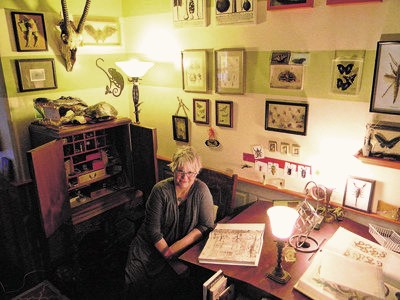
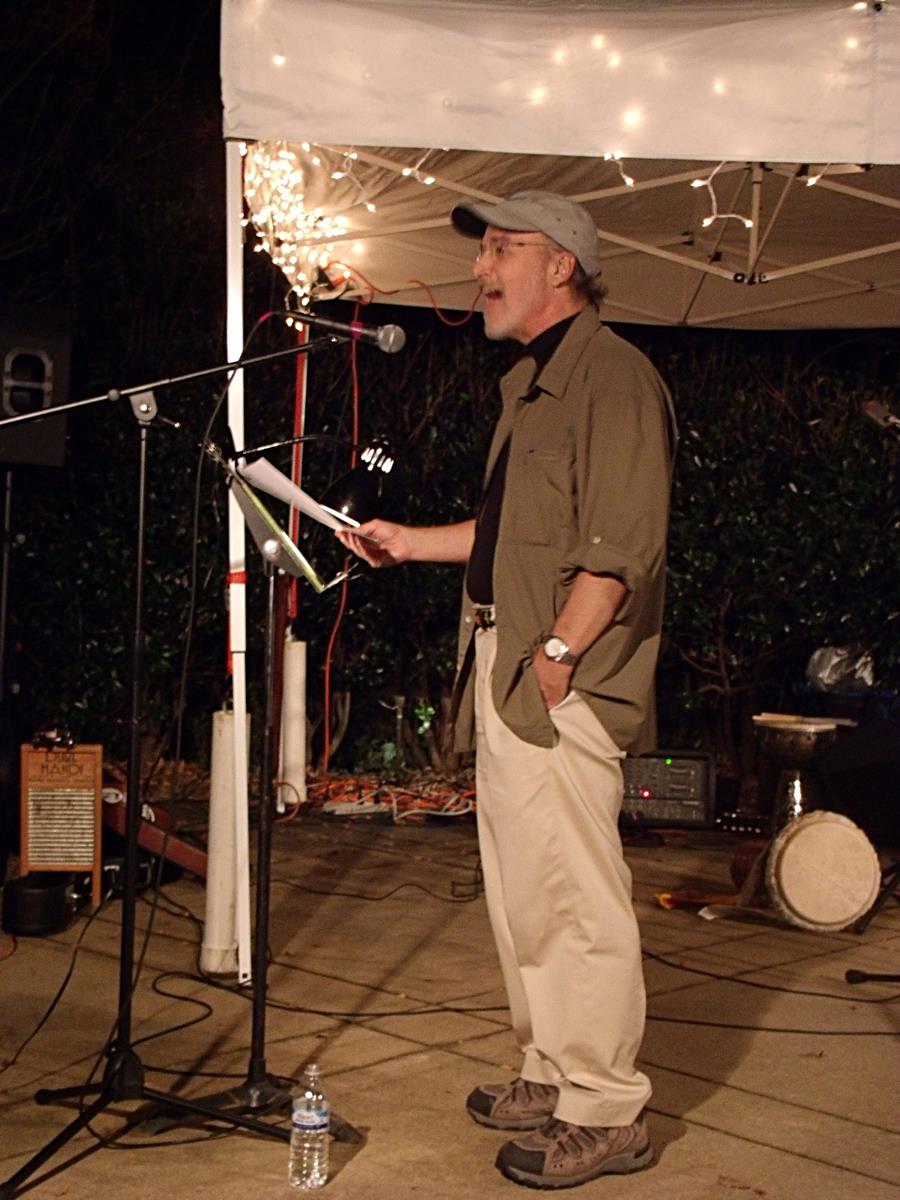
Here’s a photo of Anne cloistered in her Cabinet of Curiosity, and me reading Your Leaving at the FAC.

5W7E_Obscura_2

.     .     .     .     .

334773_504673889552553_984935058_o

.     .     .     .     .

*   Allgemeine Bildung = general culture, or education – Google the phrase for 17 megahits.

.     .     .     .     .

IMG_1827

Read Full Post »

« Newer Posts