Feeds:
Posts
Comments

It’s Beginning . . .

. . . to look a lot like . . . just another Christmas book or movie, another Christmas song or poem.  Is there anything you can write or say or perform for Christmas that hasn’t already been done, and better, sometime in the past 2000 years? There can’t be a more evocative metaphor for the arrival of the Messiah than “dancing day,” and yet we continue to compose new musical settings.  The Nativity has been retold in every possible medium, from clay-mation to post-modern irony (though perhaps not yet in RealD).  And yet . . .

. . . every year we search the shelves for the next perfect Christmas book for our grandson.  Now that Linda’s Mom (nickname, Conan the Librarian) is no longer able to go book shopping for the entire family, Linda and I are mailing copies of our favorites to the newest nephew.  And when I saw Sally Buckner’s latest collection on the Main Street Rag website, Nineteen Visions of Christmas, I had to have it.

As an educator and writer and proponent of poetry, Sally Buckner’s name is known to everyone active in the North Carolina poetry scene.  But in private discourse Sally has blessed her family and friends every year with an annual Christmas poem.  This book presents many of those poems to the public for the first time.  It’s a diverse blend with something for the child and the adult, something contemplative, something exultant, something to make you grin.  I’m fond of The Morn After Christmas – I challenge anyone to recite a line in anapestic tetrameter without conjuring Clement Moore.  I choked up reading The Ballad of the Innkeeper’s Wife; I could see it being adapted for the stage.  As could The North Wind Catches Christmas.

But my favorite of the series is one that’s clearly very personal to Sally, and through its distinctives and details it evokes in the reader something much larger.  How many seemingly minor memories of our own past Christmases have we forgotten?  How many stories have we wrapped in tissue and left boxed in the attic?  Entering the world of one of Sally Buckner’s childhood Christmases, I find images flooding my mind.  Day after tomorrow, when we gather around the tree, I’ll try not to forget – the best gift is to share what binds us together in love.

.     .     .     .     .

CEDAR
Sally Buckner

Always cedar.
Fir trees didn’t grow in Iredell County,
and George never considered pine or hemlock,
which suited me fine: I loved the scent of cedar
spicing the entire house from the very minute
those feathery branches ruffled through the door
until right after Christmas, when we flung
its carcass, picked as clean as chicken bones
outside where it could dry till fit for firewood.

In early years, he’d combine his search
for a tree with a hunting trip, return grinning,
tree on one shoulder, rabbits on the other.
Later, when whatever disease the doctors
couldn’t find a name for drew the muscles
in his legs so tight he could barely walk –
lurched like a drunken sailor – he would drive
far out in the country, scanning the winter roadside
till he found a likely candidate, straight and full,
which he could manage to clamber to, cane
clasped in one hand, ax in the other.

Never paid or asked permission.  Lord, why would he?
We were all tree-poor those days, wouldn’t miss a cedar
more than a dandelion.  Nobody thought
of using tillable land for Christmas trees.
When Hoover was still making promises,
who would have laid down a cherished dollar
for something to toss away after just a week?

When George got home, he’d nail two boards in an X
for the tree’s support.  I’d swath them with a blanket.  The
girls would help him string the lights, then wind
cellophane garlands through the greenery.
Meanwhile I’d whip Lux flakes to a frothy lather;
dried in the branches, if you’d squint your eyes,
you’d swear that it was snow.  Altogether,
it was some kind of pretty.

Eighteen years now, he’s been gone.  At first,
my boy still at home, I’d buy a tree –
resenting every dollar – fix it up
the best I could all by myself.  Then later,
hoisting trees got to be beyond me.
I purchased one advertised as “everlasting,”
needles, branches, trunk – all aluminum.
Don’t use lights, just big red satin balls.
The children, When they come, don’t complain.
The grandchildren exclaim, “Red and silver”
Look at it shine!”
And it lasts year after year –
not half the trouble of a woodland tree.

But I still miss the scent of cedar.

.     .     .     .     .

IMG_6585_edit01

Sally Buckner, former journalist and English professor, is the author of two additional poetry collections: Strawberry Harvest and Collateral Damage.  She also edited the anthology Word and Witness: 100 Years of North Carolina Poetry, which is an essential volume of your poetry collection; if you don’t own a copy, contact me and I’ll let you know how to order one!  Sally resides in Cary, NC.

Nineteen Visions of Christmas (copyright 2011): the new poetry chapbook by Sally Buckner is available from Main Street Rag Publishing.

.     .     .     .     .

IN A DARK SEASON
Sally Buckner

Though forg has shrouded sky and hill,
I dare to dream this Christmastime
that you may tread a steady trail
with hands to hold you as you climb.

May candles fling their bravest flame
against the claim of bleakest night,
and great bells sound their silver chime
to sing the presence of the light.

.     .     .     .     .

IMG_9310_edit01

Every Christmas for almost thirty years, Linda and I have sung with the Elkin Community Chorus.  This year marked the 51st annual performance of the Chorus, originally founded by Fran Greene, currently directed by David McCollum, and open to all comers . . . that is anyone who wants to commit every Thursday night to rehearsing Christmas anthems beginning way back in October.  Gets you in the spirit early!

This year’s Chorus has been a special joy for me for many reasons, but one is that David selected a piece by me for us to perform.  In 2010 my friend composer and director Mark Daniel Merritt asked me to write lyrics he could work into a Christmas suite for our semi-pro choral group Voce.  We premiered The Wanderer’s Carols last Christmas at Biltmore House, and this year on December 4th one hundred of my friends and neighbors in the Elkin Community Chorus sang the first movement, The Birds’ Carol.

.     .     .     .     .

The Wanderer’s Carols
Music by Mark Merritt Lyrics by Bill Griffin
[copyright 2010]
Movement 1
The Birds’ Carol

“Morning!  Morning!” trills the lark,
“The Babe brings gold to the sky!
A song of light now showers the earth,
And we shall know God this day.
.    Now is the dawn of our new life,
.    And we shall know God this day.”

“This coat I wear,” caws the rook,
“So black, so heavy, so grim.
Only One knows the way to make it bright –
The Child who reclaims us from sin.
.    He lifts our burden upon himself,
.    The Child who reclaims us from sin.”

“Come rest with me,” coos the dove,
“In this humble stable take ease.
Kings and shepherds together embrace
The Prince who unites us in peace.
.    You make us one in all the earth,
.    O Prince who unites us in peace!”

“I . . . Thou, I . . . Thou,” vow the geese
From dark earth to heaven above –
“May we join with Thee in a world made new;
May we fly forever in love.
.    Give us wings of Your perfect light,
.    And we’ll fly forever in love.”

.     .     .     .     .

IMG_9285

I’d like to share some thoughts about the background of these lyrics:

The Lark   –   Joy

In England the Sky Lark is known for its towering display flight, greeting the morning with loops and aerobatics, all the while filling the sky with its exuberant warble.  A fitting welcome for Christmas and the newborn Babe!

Our own North Carolina Meadowlark also sings a welcome to light returning to the earth   –   its melody seems to chant the words, “Spring of the year!”

.     .     .     .     .

The Rook   –   Hope

Every one of us encounters darkness during our lives; there is no one that does not shoulder some burden.  The Rook proclaims hope in the coming of the Child who will take our burden upon Himself.  The One who can bring light into our darkness.

The English Rook is first cousin to our American Crow, both of them highly sociable and intelligent creatures.  If you’re smart, you know you must look beyond yourself for the hope of salvation.

.     .     .     .     .

The Dove   –   Peace

The Dove has symbolized God’s promises since ancient times   –   picture the bird clasping an olive branch as it returns to Noah and the wanderers.  Today there is no more universal image of peace than the Dove.  In this verse, the Dove affirms that the peace of this Prince is promised to all people of whatever station in life, exalted or lowly, king or shepherd.  If we are to be united in all the earth, it will only be through Christ’s peace.

The Rock Dove is native to England’s cliffs and coasts, but after being imported to the new world it has become ubiquitous wherever there is human habitation   –   we call it a “pigeon.”  From the eaves of an abandoned building, doesn’t the sound of that cooing evoke peacefulness and home?

.     .     .     .     .

The Geese   –   Love

Next time you hear a pair of Canada Geese flying overhead honking back and forth (the male perhaps slightly lower pitched than the female), imagine that they are not only calling to each other but also to their Creator   –   “I, Thou . . . I, Thou.”

For me these Geese are a powerful symbol of love.  They mate for life and may live twenty to thirty years in the wild.  They constantly watch out for each other.  They protect their goslings most ferociously.  And when I hear their call through the trees at dusk, it reminds me that the love of our Creator surrounds us and lifts us up.

.     .     .     .     .

IMG_2548

If you would like to listen to the choral group Voce performing The Wanderer’s Carols (with harp accompaniment and boy soprano), please follow these links:

THE WANDERER’S CAROLS

1 – The Birds’ Carol

2 – Beside the Manger

3 – The Wanderer’s Prayer

.     .     .     .     .

This is the book I had to write so that I could move on to higher literary endeavors.   David Treadway Manning

I came to Malaprop’s Books and Café expecting to be cracked up.  Which is to say, I came to listen to Dave read from his latest book, Yodeling Fungus.  After the introductory statement above, I knew I would not be disappointed.

I’ve been listening to David Manning read his poetry all across NC for the past ten years, nature poetry, love poetry, spiritual visions, politics, and I am always captivated by his ability to imagine fresh images.  He speaks truth from the heart.  And then . . . every once in a while he’ll startle me with a poem that is so sly, acerbic and right on downright damn funny I’ll just about strangle.  He confesses that these are the result of a genetic misfire from his muse, Guzman:

“Guzman de Pietro is a benevolent demon inhabiting the Manning bloodline for generations as a genetic hitchhiker, imparted into the genome to each its hosts humility and the restorative virtues of Merlot and bathtub naval strategy.  A form of male duende, Guzman erupts from time to time in newspapers and poems in outrageous and occasionally embarrassing public behavior.”

.     .     .     .     .

IMG_0250

Starry Campion

Terminal Issues

Far from faculty teas, and leather elbow-patches,
out in the blue-collar, bare-knuckle world,
out in the cliché-ridden, six-pack world,

the little magazines flash in and out like
virtual particles in the plenteous void.  Some
catch and flicker into light to illumine

the pages of Poet’s Market for a year
or two.  Names like Manna, Pegasus go up
like bottle-rockets then fall for next week’s

recycle.  Somehow Lyn Lifshin strides
their galaxies as if on stepping stones
before they vanish, the tiny journals,

home-grown in someone’s sewing room.
Coastal Plains, Wellspring, Potato Eyes –
I’ve had a poem in the final issue

of each one.  I have sent my coup-de-grace
like poisoned arrows into their vitals.
Amelia took my killer limerick then died

(with editor Fred) before the fatal fetal poem
could be born.  And Knuckle Merchant greeted
my aggression open-armed then shuddered,

limp into rain-soaked tabloid rags.  Now,
I send out poems, with a warning
like a black box label on a drug.

Enclosed are five new poems.
Thanks for you consideration.
The side effect is death.

.     .     .     .

What I should Have Said to the Young Poet Who Asked, “What Is the Typical Age of Your Reading Group Members?”

It’s don’t ask, don’t tell
when we wheel in our IVs
& orderlies.  Just come with some poems.
At noon we bring our lunches,

community oxygen & an extra tank
or two.  You won’t feel out of place
after we lay a few lines of Thanatopsis
on you with our cool blue hands.

Come visit – you’ll fit right in –
like six by three.  We keep out too much
sun, so you can ease back on one
of our satiny pillows & enjoy.

They keep the black van running
outside & Brown-Wynne on speed-dial.
Yesterday a youngster with progeria
came & caught up real fast.  Don’t worry,

before you know it you’ll be
one of us.  Your hands will clammy up
real fine – knobbly veins and all – and
those cheeks of baby fat will croc-o-dile.

.     .     .     .     .

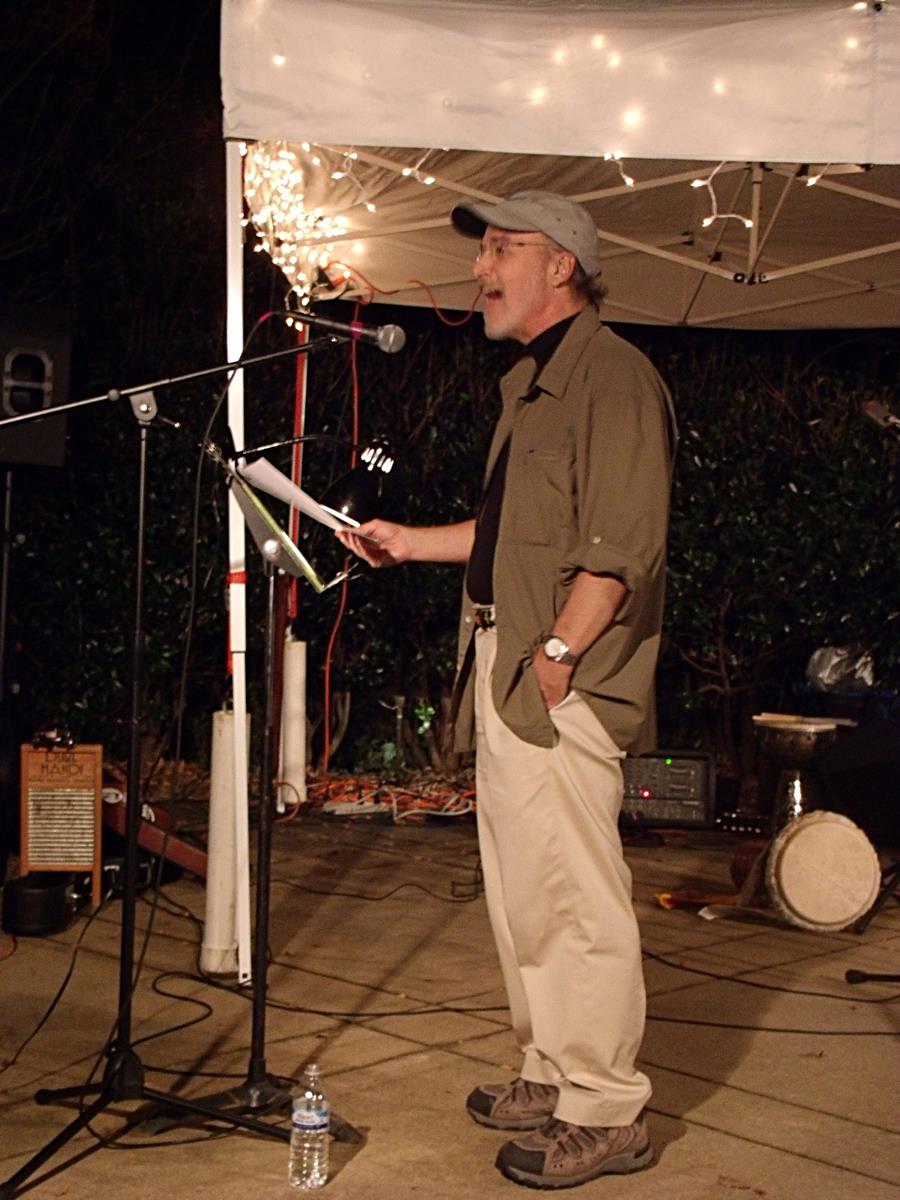
Dave, Worthy Evans and I read as the “Poetrio” at Malaprop’s Books and Café on July 3, 2011.

Yodeling Fungus, Old Mountain Press

Other books by David Manning:
The Flower Sermon
The Ice Carver

Previous GriffinPoetry post Featuring Dave Manning

IMG_1827